How a Pallet Jack Works
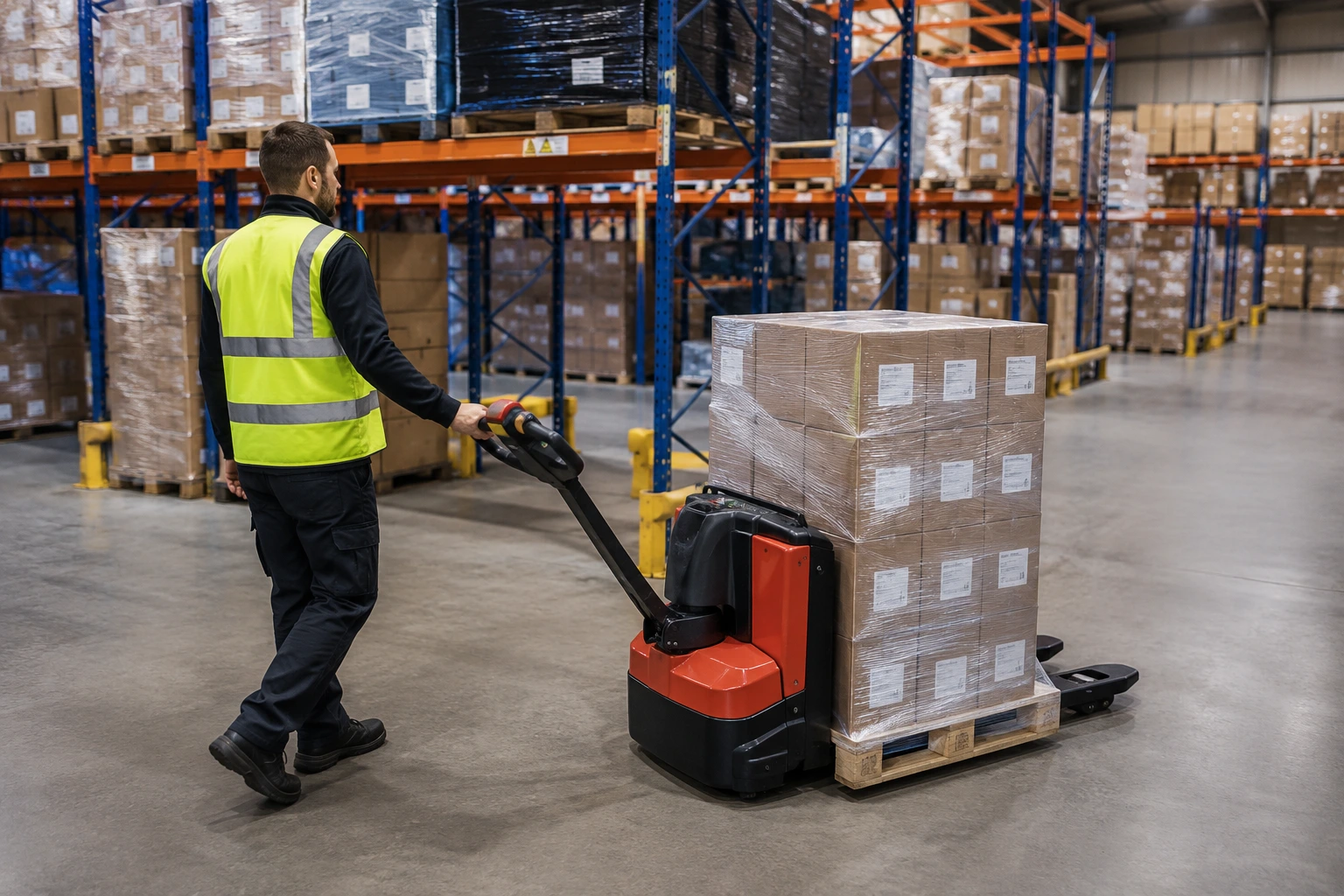
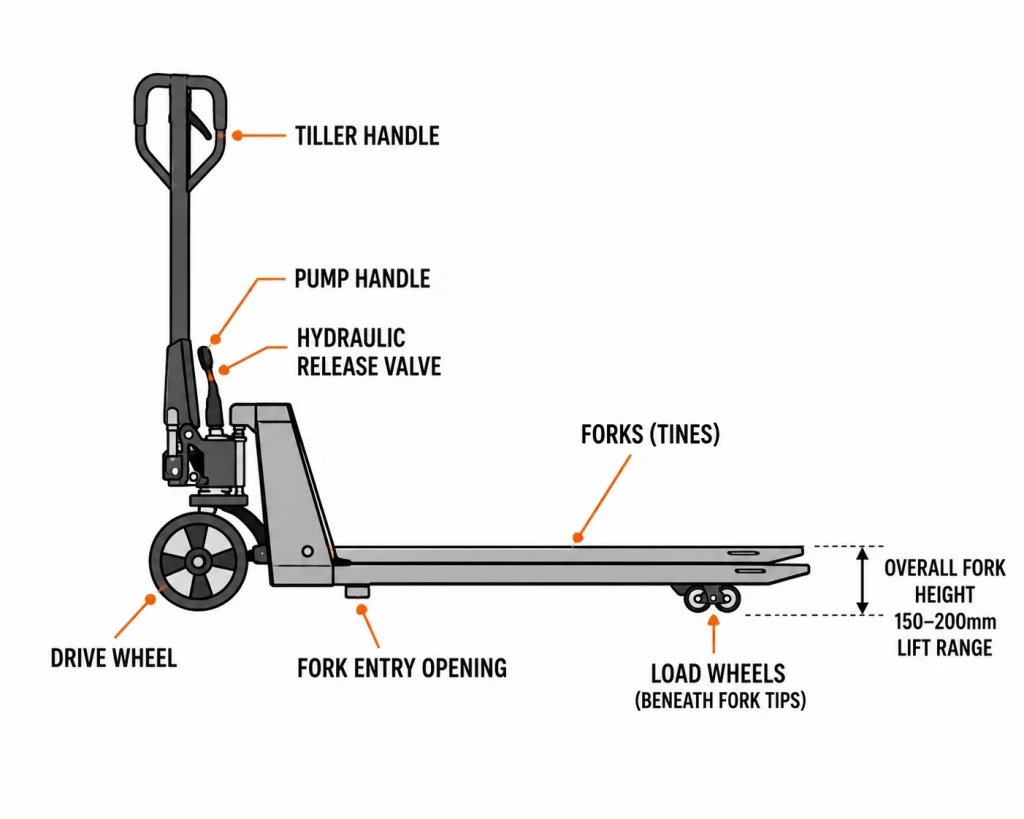 All pallet jacks operate on the same fundamental principle: a pair of forks, horizontal tines that extend from the body of the machine, are inserted into the openings of a standard pallet, and a hydraulic lifting mechanism raises the forks just enough to lift the pallet clear of the floor. The load is then carried on the forks, supported by the machine’s wheels, and moved to the destination.
The hydraulic lifting mechanism is actuated either manually, by pumping a handle up and down, or electrically, by a motor-driven hydraulic pump. The forks raise only a short distance on a standard pallet jack, typically 150 to 200 mm, just enough to clear the floor and allow the load to be moved. This limited lift height distinguishes the pallet jack from a pallet stacker, which raises loads to significant heights for stacking on racking.
The machine steers through the single drive wheel or set of drive wheels at the handle end, with the fork tips supported on small load wheels beneath the fork ends. The operator pushes, pulls, or rides the machine depending on the type, controlling direction through the handle or a tiller arm.
Standard pallet dimensions, 1,200 mm × 1,000 mm for the European standard pallet (EUR pallet) and 1,219 mm × 1,016 mm for the standard CHEP pallet, are designed to accept pallet jack forks. The fork width and length of any pallet jack must be confirmed as compatible with the pallets in use before deployment.
All pallet jacks operate on the same fundamental principle: a pair of forks, horizontal tines that extend from the body of the machine, are inserted into the openings of a standard pallet, and a hydraulic lifting mechanism raises the forks just enough to lift the pallet clear of the floor. The load is then carried on the forks, supported by the machine’s wheels, and moved to the destination.
The hydraulic lifting mechanism is actuated either manually, by pumping a handle up and down, or electrically, by a motor-driven hydraulic pump. The forks raise only a short distance on a standard pallet jack, typically 150 to 200 mm, just enough to clear the floor and allow the load to be moved. This limited lift height distinguishes the pallet jack from a pallet stacker, which raises loads to significant heights for stacking on racking.
The machine steers through the single drive wheel or set of drive wheels at the handle end, with the fork tips supported on small load wheels beneath the fork ends. The operator pushes, pulls, or rides the machine depending on the type, controlling direction through the handle or a tiller arm.
Standard pallet dimensions, 1,200 mm × 1,000 mm for the European standard pallet (EUR pallet) and 1,219 mm × 1,016 mm for the standard CHEP pallet, are designed to accept pallet jack forks. The fork width and length of any pallet jack must be confirmed as compatible with the pallets in use before deployment.
Also read : Aerial Lift vs Boom Lift: Differences and How to Choose
Types of Pallet Jacks
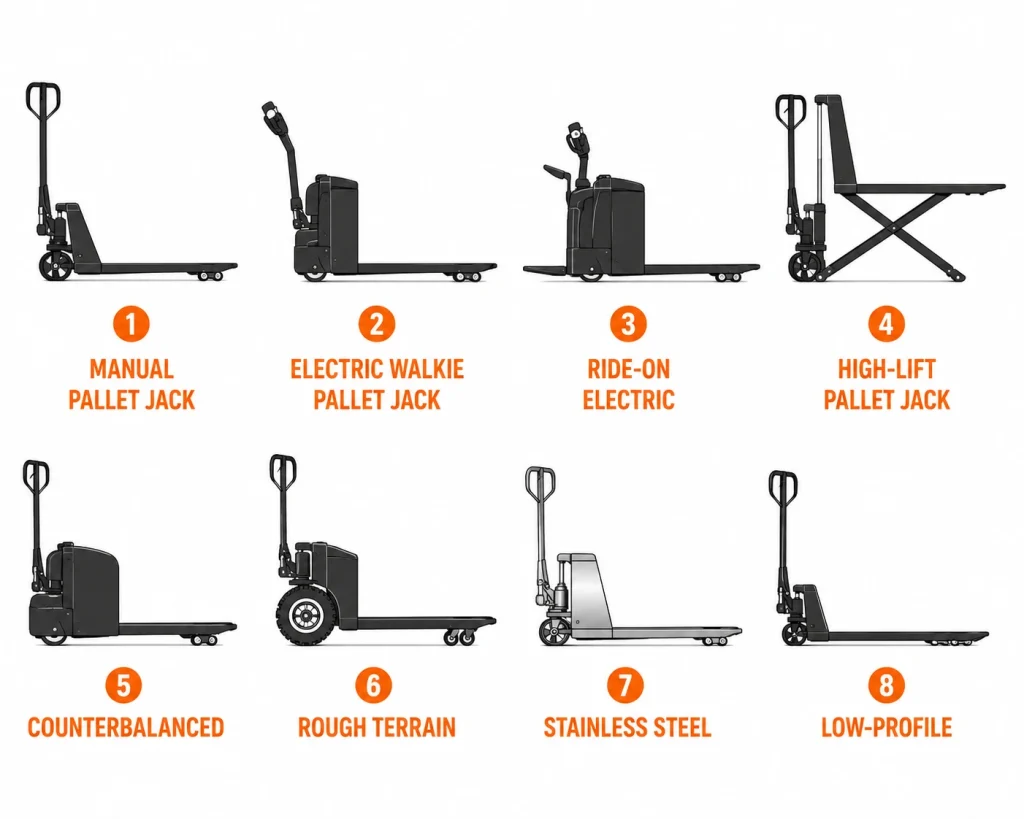 The pallet jack family includes a range of configurations, each designed to address specific load weight requirements, travel distances, height requirements, and operating environments.
-
-
Manual Pallet Jack
-
The manual pallet jack, also called a hand pallet truck or hand pump pallet jack, is the most basic and most widely used pallet handling tool in warehouses, retail stockrooms, and distribution operations. The operator pumps the handle to build hydraulic pressure that raises the forks, pushes or pulls the loaded machine to the destination, and releases the hydraulic pressure to lower the forks and deposit the load.
Manual pallet jacks are available in load capacities from 1,000 kg to 5,000 kg, with the 2,500 kg capacity unit being the most common standard specification. Their simplicity, no battery, no motor, no charging requirement, makes them highly reliable, low-maintenance, and economical to purchase and operate.
The limitation of the manual pallet jack is operator effort. Moving a 2,500 kg load across a smooth warehouse floor is manageable for a fit operator over short distances. Over longer distances, on gradients, or across uneven surfaces, the manual pallet jack becomes physically demanding and slow. For operations involving frequent movements over distances greater than approximately 20 to 30 metres, an electric model becomes more productive and less physically taxing.
Manual pallet jacks require a smooth, level, hard floor surface. Attempting to use a standard manual pallet jack on rough, uneven, or soft ground is both inefficient and hazardous, the small load wheels and the limited ground clearance of standard models make them unsuitable for anything other than smooth indoor or hardstanding surfaces.
-
-
Electric Pallet Jack
-
The electric pallet jack, also called a powered pallet truck or walkie pallet jack, replaces the manual pump handle with an electric motor driving a hydraulic pump for lifting, and an electric traction motor driving the main wheel for propulsion. The operator walks behind the machine, steering through a tiller arm, and controls speed and direction with thumb controls or a butterfly throttle on the handle.
Electric pallet jacks eliminate the physical effort of moving heavy loads over longer distances. They are suited to distribution centres, large warehouses, and manufacturing facilities where loads must be moved repeatedly over distances of 30 metres or more throughout a shift. The operator’s productivity, loads moved per hour, is significantly higher on an electric pallet jack than on a manual unit for the same load weights and distances.
Battery management is the primary operational consideration for electric pallet jacks. Most units use sealed lead-acid or lithium-ion batteries with a working life of one to three shifts per charge depending on the battery capacity and the intensity of use. The correct charging procedure, completing full charge cycles on lead-acid units, using the opportunity charging capability of lithium-ion units, is essential for maintaining battery life and operational availability. The principles of electric vehicle battery management apply directly to powered pallet jacks in the same way they apply to electric aerial work platforms, as covered in the guide to scissor lift battery charging and electric equipment power management.
Electric pallet jacks are available in load capacities from 1,500 kg to 8,000 kg, with most standard warehouse units rated at 2,000 to 3,000 kg. They require a smooth, firm floor surface, their larger drive wheel provides better traction than manual models, but they are not suited to rough terrain or outdoor use on unpaved surfaces without specialist configuration.
-
-
Ride-On Electric Pallet Jack
-
The ride-on electric pallet jack, also called a rider pallet truck or electric pallet rider, extends the electric pallet jack concept by adding a platform or seat at the rear of the machine on which the operator stands or sits while driving. This allows the operator to travel with the load at speeds of up to 12 to 14 kilometres per hour, covering much greater distances per shift than a walkie operator can achieve on foot.
Ride-on pallet jacks are the standard choice for large distribution warehouses and logistics facilities where loads must be moved across distances of 50 metres or more, long warehouse aisles, cross-dock operations, and inter-area transfers where a walkie operator would spend a significant proportion of their shift walking rather than handling loads.
The ride-on configuration requires a greater safety awareness from the operator than a walkie unit. The higher travel speed and the operator’s elevated and stationary position on the platform change the dynamics of pedestrian interaction and aisle navigation. Speed limits, pedestrian exclusion zones, and traffic management in shared-use areas must be enforced consistently for ride-on pallet jack operations.
Load capacities for ride-on units typically range from 2,000 to 6,000 kg. The machines are larger than walkie units and require wider aisles for safe operation, minimum aisle width requirements must be confirmed against the machine’s turning radius specification before deployment in an existing facility.
-
-
High-Lift Pallet Jack
-
The high-lift pallet jack, also called a scissor lift pallet jack or high-lift truck, raises the forks to heights significantly greater than a standard pallet jack, typically between 800 mm and 1,500 mm above floor level. This enables the operator to transfer loads to and from work benches, conveyor infeed heights, and low-level racking positions without the need for a separate lifting device.
High-lift pallet jacks are widely used in manufacturing assembly lines, order picking operations, and any application where loads must be transferred between floor level and a working height. They bridge the gap between a standard pallet jack, which only lifts the pallet clear of the floor, and a full pallet stacker, which raises loads to racking heights.
The load capacity of high-lift models is typically lower than standard pallet jacks at equivalent purchase price, reflecting the additional structural demands of the scissor lift mechanism. Most high-lift units are rated at 1,000 to 2,000 kg at maximum lift height, with capacity reducing as lift height increases, the same structural principle that governs the capacity reduction with increasing boom angle on aerial work platforms and cranes.
-
-
Counterbalanced Pallet Jack
-
The counterbalanced pallet jack carries a counterweight at the rear of the machine, behind the drive wheel, that balances the load weight on the forks without the need for outrigger legs. This allows the machine to pick up a pallet from a position flush against a wall, from inside a container, or in any situation where the space behind and beside the forks is too restricted for outrigger stabilisers.
Standard pallet jacks use stabilising outrigger legs that run alongside the forks and extend beyond the fork tips, these legs support the loaded forks and prevent the machine from tipping forward under load. The outrigger legs limit where the machine can go: they cannot enter a fully loaded container, they cannot reach a pallet positioned in a corner, and they add to the machine’s overall width.
The counterbalanced pallet jack eliminates these constraints at the cost of greater machine weight and a larger turning radius, the counterweight adds to the machine’s overall length and mass. For container unloading, tight corner access, and loading dock operations where standard outrigger models cannot reach, the counterbalanced design is the practical solution.
-
-
Rough Terrain Pallet Jack
-
The rough terrain pallet jack is designed for outdoor or semi-outdoor use on unpaved, uneven, or soft ground, the conditions found on construction sites, agricultural operations, timber yards, and outdoor storage areas where standard smooth-floor pallet jacks cannot operate.
Rough terrain models feature large-diameter pneumatic or solid rubber tyres that provide the ground clearance, traction, and load distribution needed for soft and uneven surfaces. The fork tips are supported on larger, more robust load rollers than standard models, and the hydraulic system is typically more powerful to handle the increased resistance of moving across unpaved ground.
Rough terrain pallet jacks are available in manual and electric configurations, with load capacities typically from 1,500 to 3,000 kg. Their outdoor capability complements the broader range of rough terrain plant used on construction and civil engineering sites, the same sites where rough terrain cranes, rough terrain boom lifts, and heavy earthmoving equipment operate on the same unpaved ground conditions, as discussed in the guide to rough terrain cranes and their application on difficult site terrain.
Also read : Types of Excavators: A Complete Guide for Every Job
-
-
Stainless Steel Pallet Jack
-
The stainless steel pallet jack is a specialist variant designed for use in environments where hygiene, corrosion resistance, and ease of cleaning are paramount, food processing facilities, pharmaceutical manufacturing, beverage production, and medical supply operations. The forks, frame, and all external components are fabricated from stainless steel rather than painted carbon steel.
Standard pallet jacks in painted carbon steel corrode rapidly in wet, humid, or chemically aggressive environments. They harbour bacteria in surface corrosion and paint chips, creating contamination risks that regulatory standards for food and pharmaceutical production do not permit. The stainless steel pallet jack resolves these issues entirely, at a higher purchase cost that reflects the material and fabrication requirements.
Stainless steel models are available in both manual and electric configurations and in standard load capacities. Their application is specialist but important, in facilities where product contamination risk is a regulatory compliance issue, a stainless steel pallet jack is not a premium option but a mandatory specification.
-
-
Low-Profile Pallet Jack
-
The low-profile pallet jack is designed for use with non-standard pallets, specifically with low-entry pallets, plastic pallets with low deck clearance, or display pallets used in retail environments where the pallet and load are moved directly onto the shop floor and the pallet is not removed from beneath the display.
Standard pallet jacks have a minimum entry height requirement, the forks must be able to enter the pallet opening with sufficient clearance for the load wheels beneath the fork tips. Low-profile pallets have smaller openings than standard EUR or CHEP pallets, and standard pallet jack load wheels are too large to enter them. The low-profile pallet jack uses smaller-diameter load wheels and a lower fork profile that clears the reduced entry height of these pallets.
Low-profile pallet jacks are the standard specification for retail distribution operations, supermarket replenishment, and any supply chain that uses display pallets as part of the store merchandising system.
Choosing the Right Pallet Jack Type
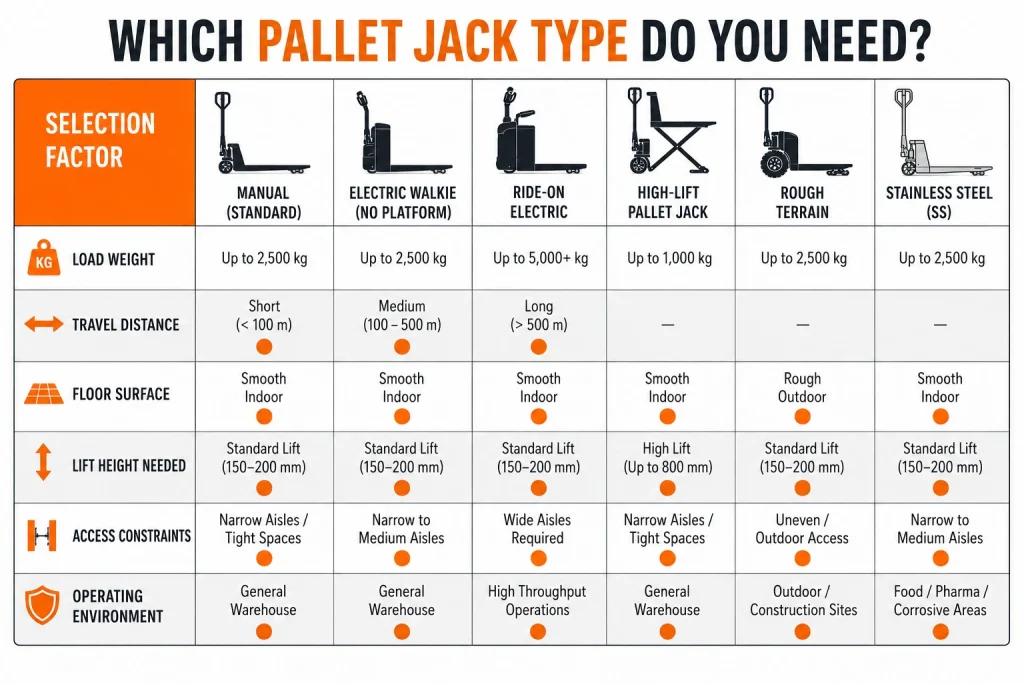 Selecting the correct pallet jack type for any application requires matching the machine’s key parameters to the operational requirements:
-
- Load weight
The pallet jack’s rated capacity must exceed the maximum loaded pallet weight that will be handled. Overloading a pallet jack, placing a load on the forks that exceeds the rated capacity, damages the hydraulic system, deforms the forks, and creates a tipping hazard. Rated capacity figures are at standard fork height, check the capacity reduction at maximum height for high-lift models.
-
- Travel distance
For short, infrequent movements over distances up to 20 to 30 metres, a manual pallet jack is sufficient. For frequent movements over longer distances, an electric walkie or ride-on model is more productive and less physically demanding. The travel distance per shift is the primary variable that determines whether manual or electric power is justified.
-
- Floor surface
Standard manual and electric pallet jacks require smooth, hard, level floor surfaces. For outdoor use or on rough ground, a rough terrain model with pneumatic or heavy-duty solid tyres is required. Deploying a standard pallet jack on an outdoor construction site or in an unpaved storage yard will damage the machine and create a handling hazard.
-
- Lift height required
If loads must be transferred to a working height above standard pallet jack lift range, a high-lift model or a pallet stacker is required. Confirm the required transfer height against the machine’s maximum lift specification before selection.
-
- Access constraints
In tight spaces, narrow aisles, or container loading and unloading, the machine’s turning radius and overall width must be confirmed against the available space. For corner access and container work, a counterbalanced model eliminates the outrigger leg constraint.
-
- Operating environment
Food, pharmaceutical, and wet environments require stainless steel construction. Retail distribution with display pallets requires low-profile models. Confirming the operating environment specification before purchase or rental prevents the need to replace equipment after deployment.
These selection principles are directly parallel to those applied to other categories of materials handling and lifting equipment, the systematic matching of machine capability to task requirements that governs the selection of every type of plant on an active site. The same approach is applied to crane selection, aerial work platform selection, and earthmoving plant selection, as set out in guidance on construction site planning and heavy plant selection for materials handling operations.Safety Requirements for Pallet Jack Operations
Pallet jack operations carry safety obligations that apply regardless of the machine type in use:-
- Operator training
All pallet jack operators must be trained in the safe operation of the specific machine type. Electric and ride-on pallet jacks require more comprehensive training than manual units, the higher speeds, the battery systems, and the pedestrian interaction risks of powered units require specific competency. Operator training requirements for powered industrial trucks, including electric pallet jacks, are consistent with the broader equipment operator competency requirements discussed in the practical guide to heavy equipment safety on construction and industrial sites.
-
- Pre-use inspection
Every pallet jack must be inspected before the start of each operating shift. The inspection covers fork condition, hydraulic system integrity, wheel and tyre condition, battery charge level on electric units, and the operation of all controls. A defective pallet jack must not be used until the defect is rectified.
-
- Load capacity compliance
The load on the forks must not exceed the machine’s rated capacity at the relevant fork height. Load capacity placards must be displayed on the machine and must be legible. Operating an overloaded pallet jack is a safety violation regardless of how short the travel distance.
-
- Pedestrian segregation
Pallet jacks, particularly ride-on electric models operating at speed, present a serious collision risk to pedestrians in shared-use areas. Pedestrian and vehicle traffic routes must be separated where possible, and speed limits for powered pallet jacks in shared areas must be established and enforced.
-
- Ramp and gradient limits
Every pallet jack has a rated maximum gradient for loaded travel. Descending a ramp with a loaded pallet jack exceeding the rated gradient risks loss of control, runaway, and overturn. Gradient limits must be confirmed and communicated to operators before any ramp or slope operation.
Also read : What Size Generator Do I Need? A Practical Sizing Guide
The Right Pallet Jack for Every Operation
The pallet jack is one of the most versatile and widely deployed materials handling tools across warehousing, logistics, manufacturing, and construction. Its apparent simplicity conceals a genuine breadth of types, each optimised for a specific combination of load, distance, environment, and access constraint, and the selection between them has a direct impact on operator productivity, operational efficiency, and handling safety. RR Machinery provides a comprehensive range of materials handling and construction equipment for rental and sale, including forklifts, pallet jacks, boom lifts, scissor lifts, and supporting plant, all maintained to full operational standard and available with guidance from experienced equipment specialists. Explore our full range of construction and materials handling equipment solutions, or contact our team for practical advice and a clear quotation matched to your load requirements, operating environment, and site conditions.