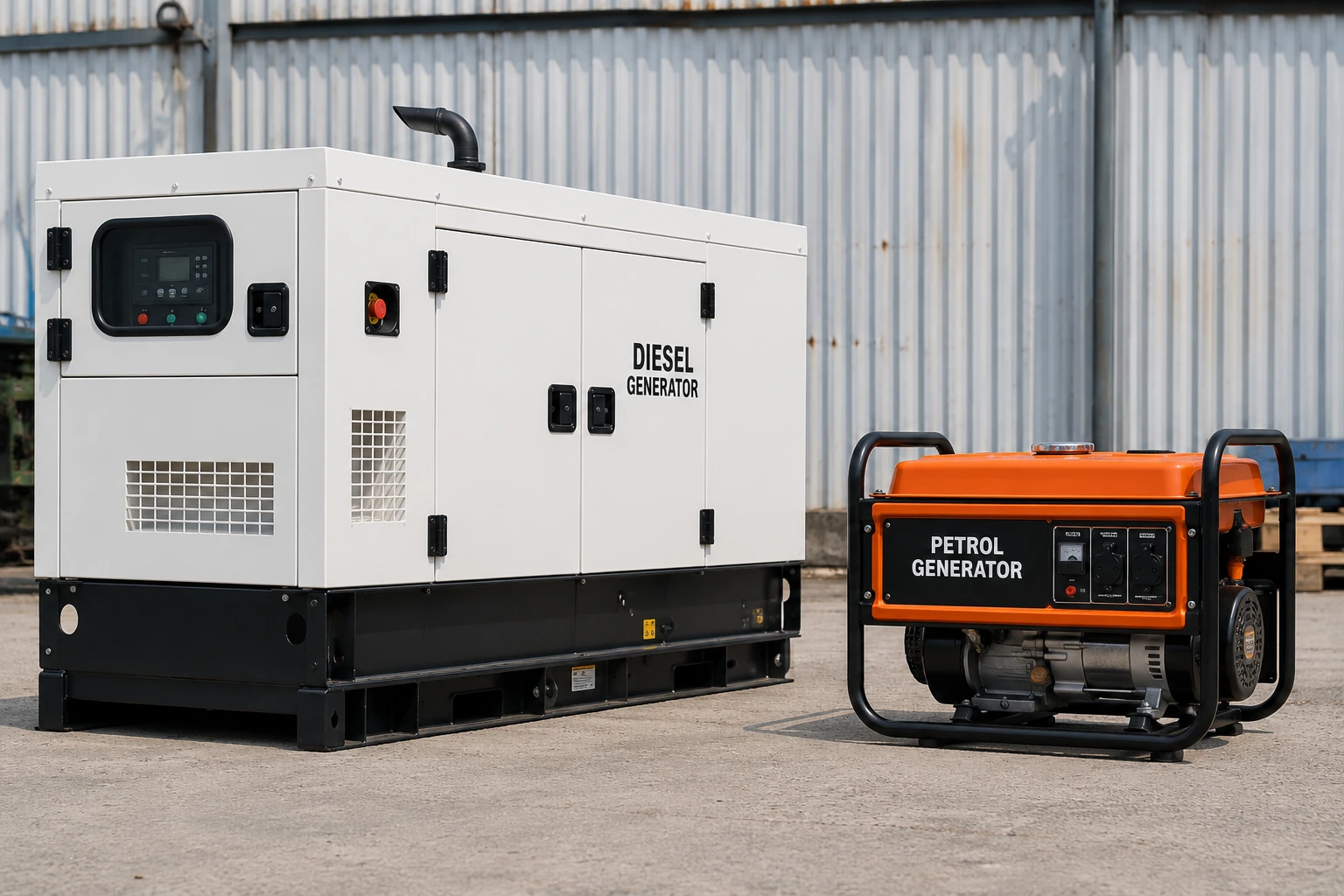
Two fuel types dominate the portable and site generator market: diesel and petrol. Both convert fuel into electrical energy through an internal combustion engine. Both are available in a wide range of sizes from compact portable units to large site power solutions. And both will power the same electrical loads, lights, power tools, pumps, and site equipment, when connected and running.
But diesel and petrol generators are not interchangeable. The differences between them, in fuel cost, engine durability, runtime, noise output, startup behaviour, emissions, maintenance requirements, and total cost of ownership, are significant enough that choosing the wrong fuel type for an application creates ongoing operational problems that no amount of adjustment will resolve. A petrol generator specified for a task that requires sustained high-load operation will wear out faster and cost more to fuel than a diesel unit would have. A diesel unit specified for an application requiring occasional short-duration use in a low-ventilation space creates a hazard that a petrol generator would not.
Understanding the differences between diesel and petrol generators, precisely and in operational terms, is the foundation of making the right fuel type choice for any construction site, industrial application, event, rental fleet, or standby power requirement.
How Each Engine Type Works
Both diesel and petrol generators use a four-stroke internal combustion engine to drive an alternator, the rotating component that generates electrical output. The engine burns fuel in a cylinder, the expanding combustion gases push a piston, and the piston’s reciprocating motion is converted to rotary motion that drives the alternator shaft. The alternator then converts this mechanical rotation into alternating current (AC) electrical output.
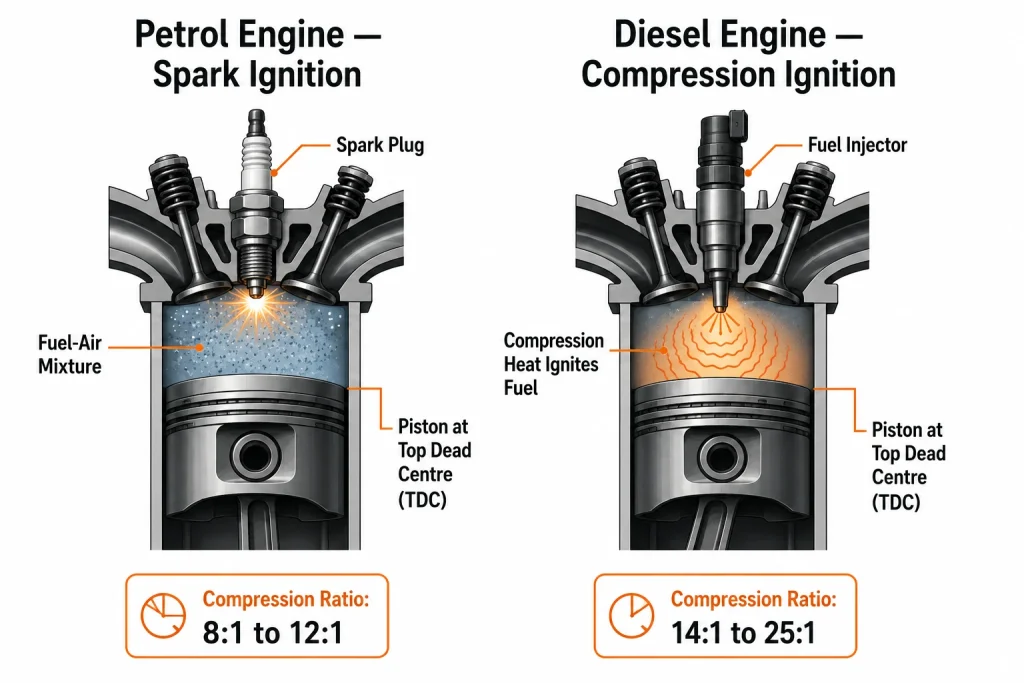
The fundamental difference between the two engine types is how the fuel-air mixture is ignited.
A petrol engine uses a spark ignition system. Petrol is mixed with air in the carburettor or injected directly into the cylinder, and the compressed mixture is ignited by a spark plug at the precise moment of maximum compression. The spark plug is the critical component, without a functioning spark plug at the right ignition timing, the engine will not fire.
A diesel engine uses compression ignition. Diesel fuel is injected directly into the cylinder, where the air has already been compressed to a ratio high enough, typically 14:1 to 25:1, compared to 8:1 to 12:1 for petrol, that the heat of compression alone ignites the fuel. There is no spark plug. The diesel engine’s higher compression ratio is both the source of its greater fuel efficiency and the reason it requires a more robust engine block and a heavier overall construction than an equivalent petrol engine.
This mechanical difference, spark ignition vs compression ignition, underlies almost every practical difference between the two generator types in terms of durability, fuel efficiency, maintenance requirements, and operating characteristics.
Also read : Aerial Lift vs Boom Lift: Differences and How to Choose
Diesel vs Petrol Generator: A Direct Comparison
Fuel Cost and Efficiency
Diesel fuel has higher energy density than petrol, more energy per litre, and diesel engines extract that energy more efficiently due to their higher compression ratio. The result is that a diesel generator produces more electricity per litre of fuel consumed than a petrol generator of equivalent power output.
For applications where the generator runs for extended periods, eight hours per day or more on a construction site, or continuously for standby power, this fuel efficiency difference has a significant impact on operating cost. A diesel generator consuming 0.25 litres per kWh and running at 75 kVA for ten hours uses considerably less fuel per day than a petrol generator at the same output consuming 0.35 to 0.40 litres per kWh.
In most markets, diesel fuel is also priced lower per litre than petrol, amplifying the fuel cost advantage of diesel for sustained operation. The combination of lower fuel consumption per kWh and lower fuel price per litre means that diesel generators have a significantly lower running cost per hour than petrol equivalents at equivalent power outputs.
For applications where the generator runs infrequently, standby power that operates only during mains failures, an occasional weekend event, or a short-duration task, the fuel cost difference is less decisive because the total fuel consumed is small regardless of which type is used.
Engine Durability and Service Life
Diesel engines are built to higher mechanical tolerances and with heavier components than petrol engines. The higher compression ratio requires a stronger engine block, heavier pistons, and more robust fuel injection components. This heavier construction translates directly to longer service life, a well-maintained diesel generator engine typically achieves 15,000 to 30,000 hours before a major overhaul is required, compared to 6,000 to 10,000 hours for an equivalent petrol engine under similar operating conditions.
For generator applications where the machine will run continuously for thousands of hours per year, prime power on a construction site, a remote industrial facility, a mining operation, this durability difference is a major factor in the total cost of ownership calculation. The higher purchase price of a diesel generator is offset over a longer service life against a lower fuel cost and less frequent major maintenance.
For applications where the generator will be used infrequently and stored for extended periods between uses, an emergency standby unit that may run for only a few hours per year, the diesel engine’s durability advantage is less relevant, because total hours are low regardless of the engine’s rated service life.
Starting Behaviour
Petrol generators start easily across a wide range of ambient temperatures. The spark ignition system fires reliably in cold conditions, and petrol engines warm up quickly from cold start. This ease of starting makes petrol generators practical for applications where the generator must be started quickly after periods of storage, or where ambient temperatures vary significantly.
Diesel generators are more demanding at cold start. The compression ignition system depends on the heat of compression to ignite the fuel, in cold ambient conditions, the air in the cylinder may not reach the ignition temperature despite full compression, preventing the engine from firing. Most diesel generators mitigate this through glow plugs, electrical heating elements that pre-heat the combustion chamber before cranking, and through engine block heaters on units intended for cold climate operation.
In tropical and equatorial climates, including Singapore and the wider Southeast Asian region where RR Machinery operates, cold start is not a practical constraint. Ambient temperatures are consistently high enough that diesel generators start reliably without cold-start aids. In cooler climates, cold-start capability must be confirmed before specifying a diesel generator for outdoor or unheated environments.
Battery condition is also more critical for diesel generator starting than for petrol. The higher compression ratio of a diesel engine means a greater cranking force is required, and a weak or partially discharged starting battery will fail to crank the engine at sufficient speed for compression ignition. Battery maintenance is therefore a more important element of diesel generator upkeep than it is for petrol.
Noise Output
Diesel generators are louder than petrol generators of equivalent power output. The higher compression ratio, the injection system, and the heavier mechanical components all contribute to a higher noise signature. A standard open diesel generator produces noise levels of 95 to 105 dB(A) at one metre, a level that requires hearing protection for personnel working nearby and that is unacceptable in most residential or noise-sensitive environments without acoustic enclosure.
Petrol generators, particularly inverter-type petrol generators, are significantly quieter. A petrol inverter generator may produce as little as 55 to 65 dB(A) at seven metres, making it suitable for use in noise-sensitive locations where a diesel generator would require a heavy-duty acoustic canopy to meet the same noise limit.
For noise-sensitive applications, residential construction, events in urban or residential settings, indoor use in occupied buildings, the lower noise output of petrol generators, particularly inverter petrol models, is a significant operational advantage.
Both diesel and petrol generators are available in acoustic canopy enclosures that substantially reduce noise output. A canopy-enclosed diesel generator can achieve noise levels of 65 to 75 dB(A) at seven metres, which is acceptable in most site and event environments. The correct noise specification for any application must be confirmed against the applicable regulatory or contractual noise limit before equipment is selected.
Standard noise measurement for generators follows the ISO 8528 standard for reciprocating internal combustion engine driven generating sets, the internationally recognised benchmark for generator noise and performance rating. Generator noise management is one element of the broader site environment and noise control planning that forms part of construction site planning and the management of site services and environmental constraints.
Emissions and Indoor Use
Neither diesel nor petrol generators should be operated in enclosed spaces without exhaust extraction, both produce carbon monoxide, a colourless, odourless gas that is rapidly fatal at elevated concentrations. However, diesel combustion produces significantly more particulate matter, soot, and nitrogen oxides than petrol combustion, making diesel generators less suitable for operation near occupied areas or in environments where air quality is a concern.
Petrol generators, and particularly LPG and inverter generators, produce cleaner exhaust and are sometimes used in semi-enclosed environments with adequate natural ventilation, though this must be assessed on a case-by-case basis against the actual ventilation rate and the generator’s emission output. A diesel generator in the same semi-enclosed environment would produce unacceptably high particulate and nitrogen oxide concentrations at the same ventilation rate.
For genuinely indoor applications where no exhaust extraction is available, neither diesel nor petrol is the correct fuel type, a battery-electric power supply, a fuel cell, or an LPG generator with carbon monoxide monitoring and automatic shut-off may be the appropriate solution, depending on the load requirements.
Maintenance Requirements
Diesel generators require less frequent scheduled maintenance than petrol generators at equivalent operating hours. Diesel engine oil change intervals are typically longer, spark plugs do not exist and therefore do not require replacement, and the fuel injection system is more robust than a carburettor under sustained operation.
However, diesel generator maintenance tasks that do arise, injector servicing, fuel system bleeding, turbocharger inspection on turbocharged models, require more specialist tools and knowledge than the equivalent petrol generator maintenance tasks. For remote site applications where specialist maintenance access is limited, this can be a relevant operational consideration.
Both generator types require regular air filter inspection and replacement, coolant level checks, battery maintenance, and alternator inspection at the intervals specified in the manufacturer’s service schedule. Deferring scheduled maintenance on either type accelerates wear and increases the risk of in-service failure. The principles of regular pre-use inspection and scheduled maintenance that apply to generators are consistent with those that apply to all categories of construction plant and access equipment, as covered in guidance on lifting equipment safety and equipment inspection requirements for construction operations.
Purchase and Rental Cost
Diesel generators carry a higher purchase and rental price than petrol generators of equivalent power output. The heavier construction, the more complex fuel injection system, and the longer service life of diesel generators are reflected in their cost.
For short-duration, low-power applications where the generator will be used occasionally and the running cost is not a dominant factor, a petrol generator’s lower upfront cost makes it the more economical choice. For sustained, high-load applications where the generator runs for many hours per day, the diesel generator’s lower fuel cost and longer service life make it more economical over any period beyond a few months of operation, despite the higher initial cost.
Also read : Bulldozer vs Excavator: Differences and When to Use Each
When to Choose a Diesel Generator
The diesel generator is the right choice when:
- The generator will run for extended periods under sustained load
Construction sites, industrial operations, mining sites, and remote facilities where the generator is the primary power source for eight or more hours per day, prime power applications, are the natural domain of the diesel generator. Its fuel efficiency, durability, and long service life are decisive advantages when total operating hours are high.
- Power output above 10 to 15 kVA is required
Petrol generators are not widely available above approximately 10 to 15 kVA as single units. For applications requiring more power, diesel is the only practical option in the standard generator market.
- The application requires a rental or standby unit for a construction site
The vast majority of construction site generators, from 20 kVA site units to large prime power installations, are diesel. Rental availability, service infrastructure, and fuel logistics are all better developed around diesel for construction site applications. Understanding how to correctly specify a construction site generator, including duty rating, fuel consumption calculation, and load assessment, is covered in the practical guide to generator sizing for construction and industrial applications.
- Long-term total cost of ownership matters more than initial cost
For any application where the generator will be in sustained use for more than six to twelve months, the diesel generator’s lower fuel cost per kWh and longer service life make it more economical in total cost terms than a petrol equivalent, despite its higher purchase price.
When to Choose a Petrol Generator
The petrol generator is the right choice when:
- The power requirement is modest and the duty cycle is light
For powering a small number of tools on a small site, lighting a temporary welfare facility, or providing backup power for a short-duration event, a petrol generator in the 3 to 10 kVA range is adequate and more economical in initial cost than an equivalent diesel unit.
- Portability and ease of transport are priorities
Petrol generators are lighter and more compact than diesel equivalents at the same power output. For applications where the generator must be carried by hand, remote access locations, rooftop work, confined access sites, the weight advantage of a petrol unit may be decisive.
- Noise is a critical constraint and power requirements are low
Petrol inverter generators are the quietest generators available for outputs up to approximately 7 kVA, making them suited to noise-sensitive environments, residential maintenance, occupied buildings, events in quiet locations, where a diesel generator’s noise output would be unacceptable even with a canopy enclosure. The selection of the right generator type for noise-sensitive applications is one of the factors covered in the complete guide to how to choose a generator for any application.
- The generator will be started infrequently after periods of storage
Petrol engines start more reliably than diesel after storage, particularly in variable temperature environments, making petrol a more practical choice for emergency standby units that may sit unused for months between operations.
Diesel vs Petrol Generator: Summary Comparison
| Factor | Diesel | Petrol |
| Fuel efficiency | Higher, more kWh per litre | Lower |
| Engine service life | 15,000–30,000 hours | 6,000–10,000 hours |
| Available power range | 6 kVA to multi-MW | Typically up to 10–15 kVA |
| Noise output | Higher, needs canopy for sensitive sites | Lower, inverter models very quiet |
| Cold start | More demanding | Easier |
| Purchase cost | Higher | Lower |
| Running cost (sustained use) | Lower | Higher |
| Indoor/semi-enclosed use | Not suitable without extraction | Better ventilation tolerance |
| Maintenance complexity | Higher, specialist tasks | Lower |
| Best application | Prime power, sustained load, large sites | Portable, light duty, noise-sensitive |
Also read : Types of Excavators: A Complete Guide for Every Job
The Right Fuel Type for the Right Job
Diesel and petrol generators are not interchangeable, they are optimised for different operational profiles, and the correct choice is determined by a clear assessment of the power requirement, the duty cycle, the operating environment, the noise constraints, and the total cost of ownership over the intended period of use.
For sustained, high-load prime power applications on construction sites and industrial operations, diesel is almost always the correct choice. For portable, light-duty, noise-sensitive, or infrequent-use applications, petrol, and particularly petrol inverter generators, is frequently the more practical and economical option.
RR Machinery provides a comprehensive range of power generators for rental and sale, diesel prime power units, standby generators, and silent canopy models across a wide kVA range, all maintained to full operational standard and supported by experienced power specialists. Explore our full range of power generator options for construction, industrial, and standby applications, or contact our team for practical advice and a clear quotation matched to your power requirements, duty cycle, and site conditions.