A forklift that is not maintained is not simply an unreliable machine, it is a hazardous one. Hydraulic systems that degrade without attention lose the ability to hold a raised load safely. Brakes that are not inspected and adjusted wear to the point of inadequate stopping distance. Tyres that are not checked for damage can fail under load at speed, causing the machine to become unstable. Mast chains that are not lubricated and inspected for wear can fail catastrophically while a load is elevated.
These are not remote possibilities. They are predictable, documented failure modes that occur when maintenance is treated as optional or deferred. They are also entirely preventable, through a maintenance programme that is systematic, documented, and consistently applied.
Whether you operate a single electric forklift in a small warehouse or manage a mixed fleet of diesel and LPG machines across multiple facilities, the same principle applies: planned maintenance costs a fraction of unplanned repair. Downtime from a scheduled service is manageable. Downtime from a breakdown, an incident, or a regulatory non-compliance is not.
This guide provides a comprehensive forklift maintenance checklist, from the daily pre-operation inspection every operator must complete before starting a shift, through to the scheduled service intervals that sustain the machine’s mechanical integrity over years of operation. It covers every major system: hydraulics, brakes, tyres, mast and chains, electrical and battery, engine (where applicable), and the safety devices that protect the operator and those around the machine.
Why Forklift Maintenance Is Both a Safety and Legal Obligation
Forklift maintenance is not merely good operational practice, in most jurisdictions it is a legal requirement. Workplace health and safety legislation imposes specific obligations on employers to ensure that all work equipment, including forklifts, is maintained in a safe condition, inspected at appropriate intervals, and operated only when fit for purpose.
These obligations typically include:
Pre-use inspection: The operator must inspect the forklift before each shift and must not use a machine that is defective or presents a safety hazard. This inspection must cover all safety-critical systems.
Periodic thorough examination: A qualified inspector must examine the forklift at defined intervals, typically every twelve months for a standard counterbalance forklift in normal use, or every six months for lifting attachments, and issue a report confirming the machine’s fitness for continued use.
Defect reporting and rectification: Any defect identified during inspection must be recorded and rectified before the machine is returned to use. Operating a forklift with a known defect is a serious regulatory breach and a significant liability exposure.
Maintenance records: Records of all inspections, services, defects, and corrective actions must be maintained and made available to the relevant authority on request.
Understanding these obligations is the starting point for building a compliant maintenance programme. The safety principles that underpin forklift maintenance, structured inspection, documented records, prompt corrective action, are the same principles that apply across all lifting and material handling equipment safety management.
Also read : Scissor Lift Maintenance: Essential Checks, Service Intervals, and Best Practices
The Forklift Maintenance Checklist: An Overview
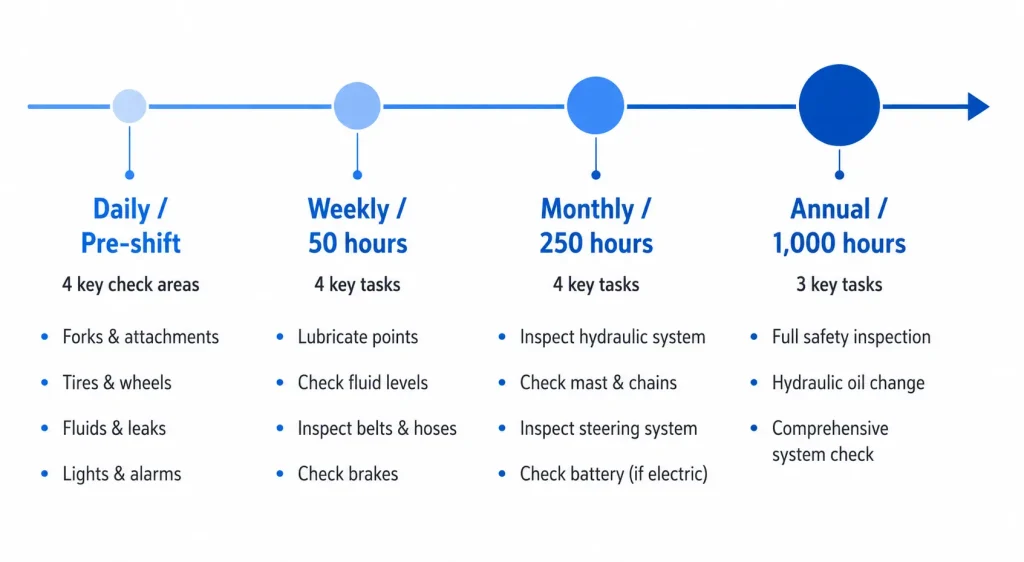
A comprehensive forklift maintenance programme operates at four levels:
Daily pre-operation inspection, conducted by the operator before each shift. Takes five to fifteen minutes. The first and most frequent line of defence against developing faults.
Weekly or 50-hour check, a more thorough inspection of consumable items and adjustable systems, conducted weekly or after every 50 hours of operation, whichever comes first.
Monthly or 250-hour service, a structured service conducted by a qualified technician, covering all items in the daily and weekly checks plus additional system-level inspection and adjustment tasks.
Annual or 1,000-hour service, the most comprehensive scheduled maintenance event, covering all systems in detail and including the thorough examination required by most regulatory frameworks.
Daily Pre-Operation Inspection Checklist
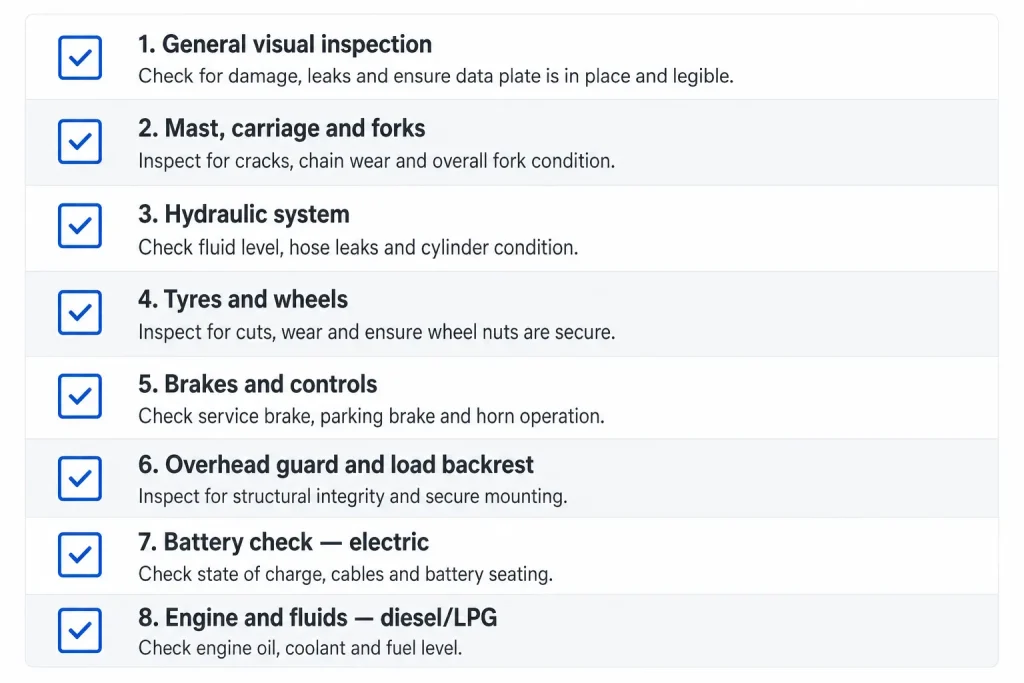
The daily pre-operation inspection is the operator’s responsibility. It must be completed before the forklift is started or moved, not after the first job of the day. The inspection results must be recorded, either on a paper or digital inspection form, and any defects must be reported to the supervisor before the machine is used.
General visual inspection
- Walk around the machine and inspect for visible damage, dents, cracks, bent components, missing fasteners, fluid leaks on the floor beneath the machine
- Check that all access panels, engine covers, and battery compartment covers are secure
- Confirm that the data plate (showing rated capacity and mast configuration) is present, legible, and matches the actual configuration of the machine
Mast, carriage, and forks
- Inspect the mast channels for visible damage, cracks, or deformation, any bending or cracking of the mast structural members means the machine must not be used
- Check the mast chains for visible wear, link deformation, corrosion, or missing links, chains that are stretched, worn, or damaged must be replaced
- Lubricate the mast chains if dry (chain oil or the manufacturer’s specified lubricant)
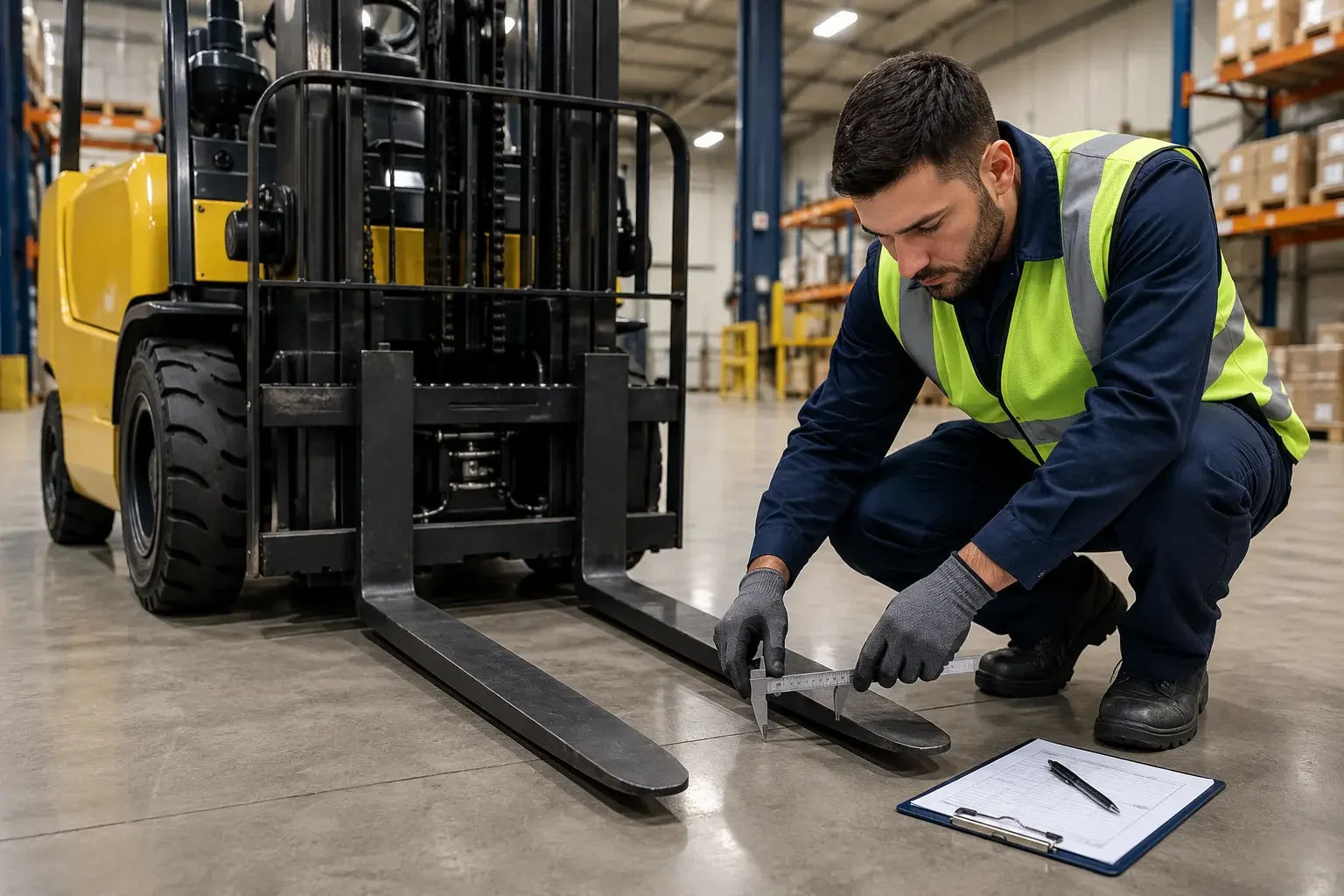
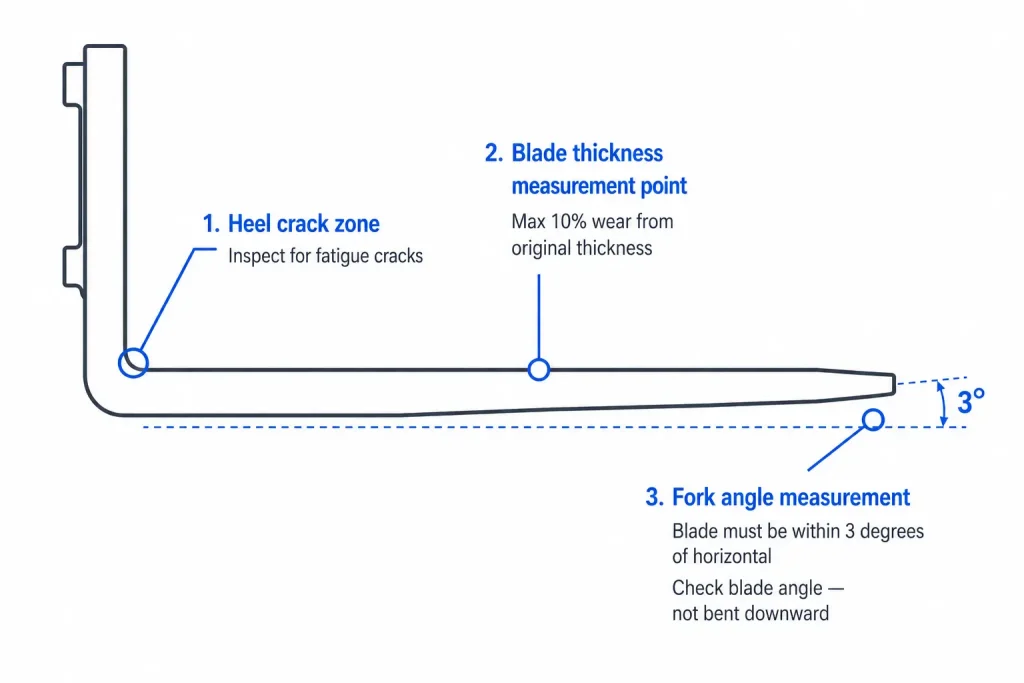
- Inspect the fork tines for cracks, particularly at the heel (the inner bend of the fork where the vertical blade meets the horizontal blade), which is the highest-stress point and the most common location for fatigue cracking
- Check that both forks are the same length and that fork blade wear at the heel does not exceed 10% of the original blade thickness
- Confirm that the fork locking pins or hooks are in place and secure, preventing the forks from sliding off the carriage
- Operate the forks through one full raise-and-lower cycle and observe for smooth, even operation, absence of juddering, and correct tilt function
Hydraulic system
- Check the hydraulic fluid level in the reservoir, top up if below the minimum mark, and investigate the cause of any unexplained fluid loss
- Inspect all visible hydraulic hoses, cylinders, and fittings for leaks, any wetness or staining around cylinder rods, hose connections, or control valves must be investigated
- Observe the lift cylinder rods for scoring or damage, a scored cylinder rod will damage the seal and cause leakage
Tyres and wheels
- Inspect all tyres (cushion or pneumatic) for cuts, chunks missing, flat spots, or wear beyond the manufacturer’s specified wear indicator
- Check that all wheel nuts are present and appear tight, loose wheel nuts may indicate the need for torque checking
- For pneumatic tyres, check tyre pressure if a gauge is available on site
Brakes and controls
- Test the service brake, approach a marked stopping point at low speed and confirm that braking distance is within the expected range
- Test the parking brake, engage the parking brake on a slight incline (where safe to do so) and confirm the machine does not roll
- Test all hydraulic control levers (lift, lower, tilt, sideshift) and confirm they return to neutral correctly when released
- Test the horn, reverse alarm, and any flashing warning lights
- Confirm that the seat belt is present, undamaged, and latches correctly
Overhead guard and load backrest
- Inspect the overhead guard for visible damage, missing fasteners, or deformation, the overhead guard must be structurally intact to provide protection against falling objects
- Check that the load backrest extension is securely mounted on the carriage and is not bent or damaged
Battery check (electric forklifts)
- Check the battery state of charge and confirm it is sufficient to complete the planned shift
- Inspect the battery for visible damage, electrolyte leakage, or damaged cables
- Confirm that the battery is correctly seated and locked in position
Engine and fluids check (diesel and LPG forklifts)
- Check engine oil level, top up if below the minimum mark
- Check coolant level in the overflow reservoir
- Check LPG cylinder pressure gauge or diesel fuel level, confirm sufficient fuel for the planned shift
- Check for any warning lights on the instrument panel
- Listen for unusual noises during start-up, knocking, misfiring, or excessive exhaust smoke should be investigated
Weekly or 50-Hour Checklist
The weekly check covers items that require more frequent attention than the monthly service but do not need daily inspection. It should be conducted by a competent person, typically a trained maintenance technician or a senior operator with appropriate maintenance training.
- Mast chain tension: Check chain tension against the manufacturer’s specification. Uneven tension between the two chains causes uneven loading and accelerates wear. Adjust as required.
- Carriage side rollers: Check for wear and correct clearance between the rollers and the mast channel. Excessive clearance causes the carriage to rock, reducing load stability and accuracy of placement.
- All grease points: Lubricate all greased pivot points, mast tilt cylinders, steer axle pivot, carriage pivot pins. Inadequate lubrication at these points causes rapid wear and corrosion.
- Battery electrolyte level (lead-acid batteries): Check cell water level and top up with distilled water after charging. Never use tap water.
- Air filter condition (engine forklifts): Check and clean or replace the air filter element if dusty or blocked.
- LPG hose and connection inspection: Check LPG fuel hose for cracking, brittleness, or damage at connections. A cracked LPG hose creates a serious fire and explosion risk.
Also read : Workplace Safety Tips for Construction and Industrial Sites
Monthly or 250-Hour Service Checklist
The monthly service is the first level that should be conducted exclusively by a qualified maintenance technician, either the manufacturer’s service network or an independently qualified forklift technician.
Hydraulic system
- Sample hydraulic fluid and assess condition, colour, clarity, water content, and contamination level. Replace fluid if condition indicates degradation
- Replace hydraulic filter if due per the manufacturer’s schedule
- Inspect all hydraulic cylinder seals for weeping or active leakage, cylinders that are losing fluid internally will allow the platform to drift downward when stationary under load
- Check hydraulic pump output pressure and compare against specification
Braking system
- Measure brake pad or brake disc wear and compare against manufacturer’s wear limits
- Check brake fluid level and condition
- Adjust brake mechanism if stopping distance testing indicates excessive travel
Mast and chains (detailed inspection)
- Measure chain elongation using a chain wear gauge, chains that have elongated beyond the manufacturer’s limit (typically 3% elongation) must be replaced
- Inspect chain anchor pins and retaining clips
- Inspect all mast cross members, rollers, and slide pads for wear
Electrical system
- Inspect all visible wiring for damaged insulation, loose connections, and signs of heat damage
- Check all fuses and circuit breakers
- Test all safety interlocks, the operator presence system (seat switch), the parking brake interlock, and any load weight indicators fitted
Steering system
- Check steering play, excessive free movement of the steering wheel before the steer wheels respond indicates wear in the steering linkage or cylinder
- Check steer axle pivot for wear and lubrication
Battery management (electric forklifts)
- Conduct a capacity test, compare actual battery capacity under load against rated capacity. Batteries that have fallen below 80% of rated capacity should be flagged for replacement planning
- Clean battery terminals and check for corrosion
- Inspect battery cables for damage or heat discolouration
Annual or 1,000-Hour Service Checklist
The annual service is the most comprehensive scheduled maintenance event and should be conducted by the manufacturer’s authorised service network. It includes all items from the daily, weekly, and monthly checks, plus:
- Full hydraulic system overhaul: Replace all hydraulic filters, change hydraulic fluid, inspect and pressure-test all circuits, assess cylinder internal condition
- Engine overhaul inspection (diesel/LPG): Check compression, valve clearances, fuel system condition, cooling system integrity
- Mast chains: Replace if elongation or wear is at or near the limit, chain replacement is significantly cheaper than a mast or carriage repair caused by chain failure
- Fork inspection: Formal measurement of fork blade thickness at the heel, fork blade angle, and fork length differential, any fork outside the permitted tolerances must be replaced, not repaired by welding
- Thorough examination: The annual service should coincide with the thorough examination required by regulation, the examiner should have access to the full service history and current condition assessment
Record-Keeping for Forklift Maintenance
A maintenance programme without records is not a programme, it is a series of informal activities that cannot be demonstrated to a regulator, cannot be used to identify patterns of recurring failure, and cannot support an insurance claim or legal defence in the event of an incident.
Records to maintain for each forklift:
- Daily pre-operation inspection forms, signed by the operator, retained for the minimum period required by local regulations (typically three years)
- All scheduled service records, date, operating hours, tasks performed, parts replaced, technician identity
- Defect records, nature of defect, date identified, corrective action taken, date resolved
- Thorough examination reports, issued by the qualified examiner, retained for the life of the machine
- Fork inspection records, formal measurement results and any replacement history
Good record-keeping also enables proactive fleet management, identifying machines that are generating disproportionate repair costs, tracking component life expectancy, and planning replacement cycles before failure forces an unplanned decision. This same discipline of using maintenance data to drive operational decisions applies across all maintained equipment, from forklifts to scissor lifts and other aerial work platforms in a managed fleet.
Understanding the full range of forklift components, what each part does and why it is safety-critical, provides the technical foundation for understanding why each maintenance task matters. A detailed guide on the key components of a forklift and how they work together provides this context in practical terms.
For technical reference on forklift inspection standards, maintenance requirements, and international best practice for industrial truck maintenance programmes, engineering resources on industrial forklift safety and maintenance standards provide useful background on how maintenance obligations are defined and implemented across different regulatory frameworks.
Also read : How to Choose a Forklift: A Complete Buyer’s Guide
Build a Maintenance Programme That Protects Your Forklift and Your People
A forklift maintenance checklist is only as valuable as the discipline with which it is used. Completed honestly, acted on promptly, and maintained as a genuine record of machine condition, it is one of the most effective tools for preventing the equipment failures, operational disruptions, and safety incidents that follow from neglected maintenance.
Every item on this checklist exists because a failure of that component or system has, somewhere and at some time, caused an injury, a fatality, or a catastrophic machine failure. The checklist does not make maintenance complicated, it makes the consequences of skipping maintenance explicit.
RR Machinery provides professional servicing and maintenance for all forklifts and material handling equipment, including scheduled service, breakdown repair, and compliance inspection by factory-certified technicians. We also offer a comprehensive range of forklifts for sale and rental, all maintained to operational standard and ready for deployment. Explore our full range of forklift solutions and professional servicing or contact our team for a service enquiry or equipment quotation tailored to your requirements.