Air compressors are among the most widely used pieces of equipment in construction, manufacturing, automotive, oil and gas, and industrial maintenance operations. Yet despite their prevalence, the differences between the main types of air compressors, how they work, what they are suited for, and what distinguishes one from another, are frequently misunderstood. Selecting the wrong compressor type for an application leads to inadequate pressure or flow, premature wear, excessive energy consumption, and in some cases, operational shutdowns at critical moments.
Understanding air compressor types matters at every level of decision-making, from the site supervisor choosing a portable compressor for pneumatic tools, to the facility engineer specifying a fixed industrial compressor for a continuous-duty production line. The right type, correctly sized and properly maintained, is a reliable workhorse. The wrong type, regardless of how well it is specified in other respects, creates ongoing operational problems.
This guide covers all the main types of air compressors in widespread use, explaining how each works, what applications it is best suited for, and what to consider when making a selection. It also covers the key performance parameters, pressure, flow rate, duty cycle, and power source, that apply across all compressor types and must be understood before any meaningful comparison can be made.
How Air Compressors Work: The Core Principle
All air compressors operate on the same fundamental principle: mechanical energy, from an electric motor or internal combustion engine, is used to reduce the volume of a quantity of air, increasing its pressure. The pressurised air is stored in a receiver tank and delivered to the connected tool or system through a regulator and hose.
The differences between compressor types lie in the mechanical mechanism used to achieve this compression, whether through reciprocating pistons, rotating screws, rotating vanes, or other means, and in the resulting performance characteristics: how much pressure can be achieved, how consistently, how efficiently, and how quietly.
Before selecting a compressor type, several key parameters must be established:
- Pressure (bar or PSI)
The maximum pressure the compressor can deliver. Most pneumatic tools operate at 6–8 bar (90–120 PSI). Industrial processes may require significantly higher pressures.
- Flow rate (CFM or l/min)
The volume of air the compressor can deliver per unit of time. This must match or exceed the combined air consumption of all tools and systems being powered simultaneously.
- Duty cycle
The percentage of time the compressor can run at full load without overheating or damaging components. A 50% duty cycle means the compressor should run for no more than 30 minutes in every hour.
- Power source
Electric (single-phase or three-phase), diesel, or petrol. Diesel and petrol compressors offer portability for sites without grid power. Electric compressors are quieter and lower-maintenance for fixed installations.
With these parameters understood, the choice of compressor type becomes much more tractable.
Also read : Parts of a Forklift and Their Functions Explained
Main Types of Air Compressors
Reciprocating (Piston) Compressors
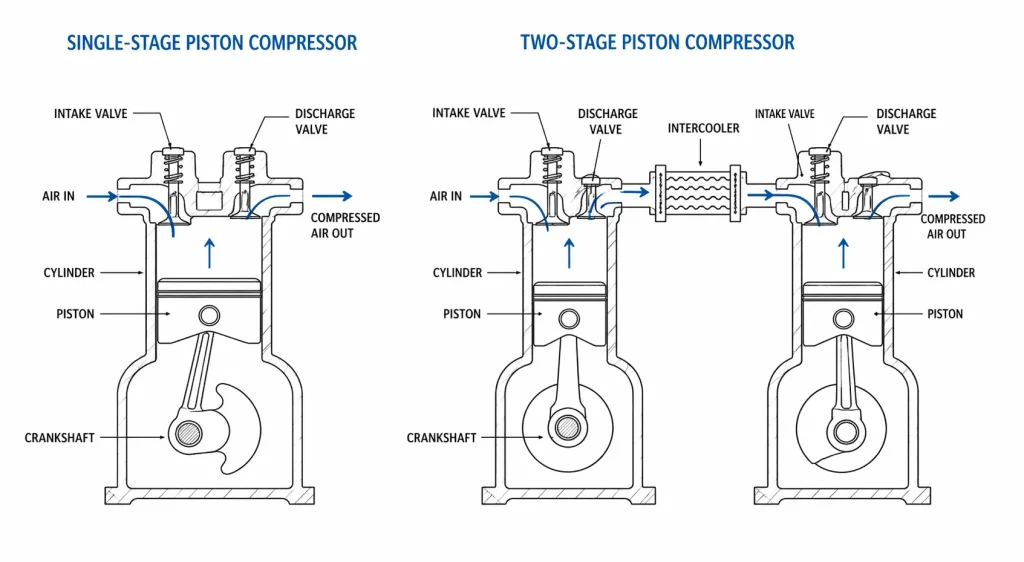
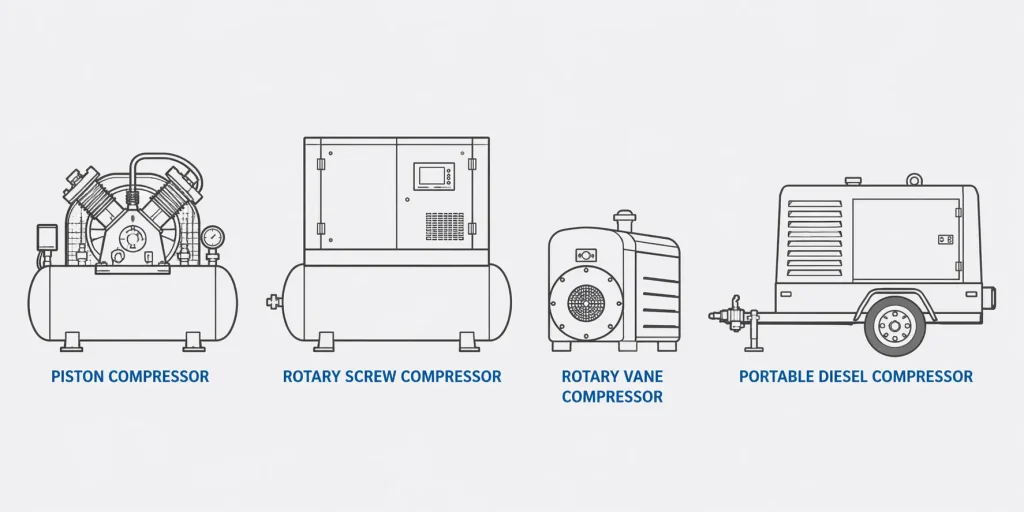
Reciprocating compressors, commonly called piston compressors, are the most widely recognised type, and the standard choice for workshops, light industrial use, and intermittent construction site applications. They work by drawing air into a cylinder and compressing it using a reciprocating piston driven by a crankshaft, in a process directly analogous to a car engine’s compression stroke.
Single-stage piston compressors compress air in a single stroke to the delivery pressure. They are suitable for pressures up to approximately 8–10 bar and are the standard choice for general workshop and light construction use.
Two-stage piston compressors compress air in two successive stages, a low-pressure cylinder compresses the air first, then passes it through an intercooler to a high-pressure cylinder for final compression. This two-stage process achieves higher pressures (up to 15–25 bar) more efficiently than a single stage and produces less heat, extending component life under sustained use.
Key characteristics:
- Simple, well-understood technology with widely available spare parts
- Best suited for intermittent use, duty cycles are typically 50–75%
- Relatively loud in operation compared to rotary screw compressors
- Oil-lubricated models require regular oil changes; oil-free models are available for applications where air purity is critical (food processing, medical, spray painting)
- Wide range of sizes from small portable units to large workshop compressors
Best suited for: General construction, workshop pneumatic tools, tyre inflation, small-scale spray painting, intermittent industrial applications.
Not suited for: Continuous-duty applications where a 100% duty cycle is required, or high-volume industrial processes where rotary screw compressors are more appropriate.
Rotary Screw Compressors
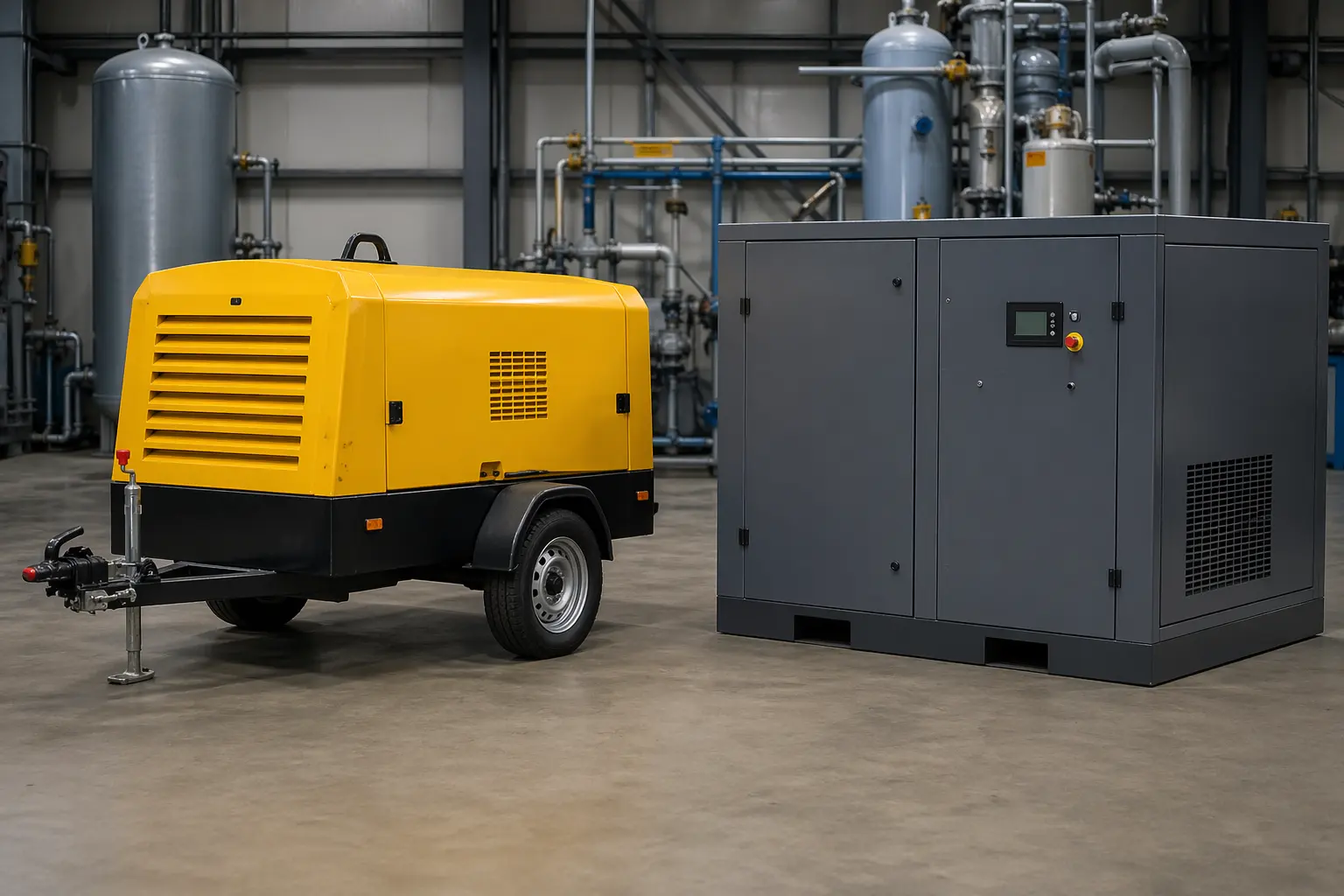
Rotary screw compressors are the dominant choice for industrial, commercial, and heavy construction applications requiring a reliable supply of compressed air over extended periods. They work through two counter-rotating helical screw rotors that mesh together, trapping air between them and progressively compressing it as the air moves along the length of the rotors.
Unlike piston compressors, rotary screw compressors are designed for 100% duty cycle, continuous operation with no rest periods. This makes them the correct choice wherever compressed air is needed without interruption: production lines, large construction sites, industrial facilities, and any application where a piston compressor’s intermittent duty cycle would be a limiting factor.
Key characteristics:
- Continuous duty, rated for 100% utilisation without overheating
- Significantly quieter than piston compressors of equivalent output
- Consistent air delivery with minimal pressure pulsation
- Higher initial cost than equivalent piston compressors, offset by lower maintenance requirements and longer service life in continuous-duty applications
- Available in oil-injected and oil-free configurations
- Variable speed drive (VSD) models adjust motor speed to match air demand, significantly reducing energy consumption in applications with variable load
Best suited for: Manufacturing and production facilities, large construction sites, industrial maintenance, compressed air systems requiring continuous supply, applications requiring consistent pressure without pulsation (precision spraying, automated machinery).
Not suited for: Intermittent light-duty applications where the capital cost of a rotary screw compressor cannot be justified over a simpler piston unit.
The rotary screw compressor’s role in construction is directly parallel to the role of prime power generators in providing continuous site power, both are pieces of equipment where continuous duty rating is the critical selection parameter, as explored in detail in practical guides covering standby and prime rated equipment for construction operations.
Rotary Vane Compressors
Rotary vane compressors use a rotor mounted eccentrically within a cylindrical housing, with spring-loaded vanes that slide in and out of slots in the rotor. As the rotor turns, the vanes maintain contact with the housing wall, creating chambers of varying volume that compress the air progressively.
Rotary vane compressors occupy a niche between piston and screw compressors, they are quieter than piston compressors and simpler than rotary screw units, with fewer moving parts than either. They are well-suited for moderate-duty applications requiring quiet operation, such as dental surgeries, laboratories, and light industrial environments.
Key characteristics:
- Quieter and smoother than piston compressors
- Simpler construction than rotary screw compressors
- Moderate duty cycle, typically 75–100% depending on the model
- Less common than piston or screw compressors, with a narrower range of sizes and configurations available
Best suited for: Medical and dental equipment, laboratory air supply, light industrial processes, quiet workshop environments.
Centrifugal (Turbo) Compressors
Centrifugal compressors use a high-speed rotating impeller to accelerate air radially outward, converting kinetic energy into pressure through a diffuser. Unlike positive displacement compressors (piston, screw, vane), centrifugal compressors are dynamic machines, their performance characteristics vary with flow rate, and they are inherently oil-free.
Centrifugal compressors are designed for very high flow rates and are used in large-scale industrial applications, chemical plants, petrochemical refineries, steel mills, large HVAC systems, and pneumatic conveying. They are not relevant to general construction or workshop use.
Key characteristics:
- Very high flow rates, suited for large industrial applications
- Inherently oil-free air delivery
- Continuous duty at very high capacities
- High capital cost, only economical at large scale
- Sensitive to operating conditions, performance varies with inlet temperature and pressure
Best suited for: Large-scale industrial processes, petrochemical plants, large HVAC and refrigeration systems, pneumatic conveying of bulk materials.
Also read : Types of Excavator Buckets and Their Uses Explained
Portable Diesel Compressors
While not a compressor type defined by its compression mechanism, portable diesel compressors deserve specific treatment because they represent a distinct and critical category for construction and civil engineering applications. They combine a diesel engine with a rotary screw or piston compression mechanism in a towable or skid-mounted package that requires no external power supply.
Portable diesel compressors are the standard choice for road construction, pipeline work, tunnelling, underground construction, mining, and any site where grid power is unavailable or impractical. They power pneumatic rock drills, jackhammers, road breakers, sandblasters, and spray equipment in environments where electric compressors cannot operate.
Key characteristics:
- Fully self-contained, no external power required
- Towable or skid-mounted for site mobility
- Available in a wide range of outputs from small contractor units to large high-pressure units for specialist applications
- Require regular fuelling and more maintenance than electric equivalents
- Louder than electric compressors, relevant for urban site noise management
- Available in high-pressure configurations for sandblasting, rock drilling, and specialist industrial applications
Best suited for: Construction sites without grid power, road and infrastructure projects, mining and quarrying, tunnelling, offshore and remote site operations, any application where portability is the primary requirement.
The parallels with portable generator selection are direct, just as diesel generators are specified as prime or standby rated based on expected duty cycle, diesel compressors must be matched to the expected daily operating hours and workload of the application. Understanding how generators and temporary power equipment are selected and sized for construction sites provides useful context for approaching diesel compressor selection with the same rigour.
Oil-Free vs Oil-Lubricated Compressors
Across all compressor types, a critical secondary classification is whether the compressor is oil-lubricated or oil-free. This distinction affects air quality, maintenance requirements, and application suitability.
Oil-lubricated compressors use oil to lubricate the compression mechanism. A small amount of oil carry-over into the compressed air is normal, downstream filtration (coalescing filters, oil-water separators) is used to reduce oil content to acceptable levels for most general applications. Oil-lubricated compressors are lower cost and generally longer-lived under heavy use.
Oil-free compressors use alternative materials (PTFE coatings, water injection, or non-contact rotor geometry) to eliminate oil from the compression chamber entirely. The compressed air is inherently free of oil contamination without the need for downstream filtration. Oil-free compressors are required for food and beverage processing, pharmaceutical manufacturing, medical air supply, electronics manufacturing, and precision spray finishing, any application where oil contamination in the air supply is unacceptable.
Oil-free compressors typically cost more than equivalent oil-lubricated units and may require more careful maintenance to preserve the integrity of the oil-free compression elements.
Key Factors When Choosing an Air Compressor
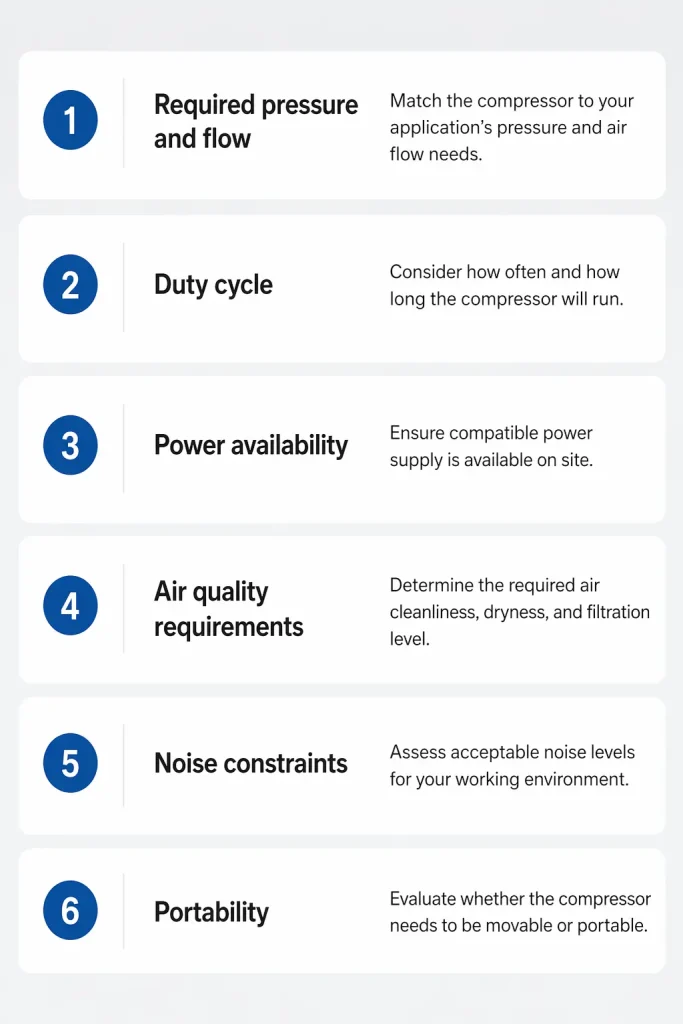
Selecting the right air compressor involves evaluating several factors simultaneously:
Required pressure and flow
Establish the maximum pressure and combined flow rate of all connected tools and systems. Size the compressor to meet peak demand with a margin of at least 20–25%.
Duty cycle requirements
Intermittent use favours piston compressors. Continuous or near-continuous use requires rotary screw or centrifugal compressors rated for 100% duty.
Power availability
Fixed site with grid power favours electric compressors for lower operating costs and quieter operation. Remote or mobile applications require diesel or petrol.
Air quality requirements
Oil-sensitive applications require oil-free compressors or comprehensive downstream filtration on oil-lubricated units.
Noise constraints
Urban sites or enclosed facilities may impose noise limits that favour rotary screw or vane compressors over piston units.
Portability
Fixed facility installations favour stationary compressors. Site and field work typically requires portable or towable units.
These same principles of matching equipment rating and type to the specific demands of the application apply equally across all categories of construction and industrial equipment, from selecting the right type of lifting equipment for a specific lifting task to specifying the correct compressor for a construction site’s pneumatic tool requirements.
For technical reference on air compressor engineering principles, performance standards, and international classifications, resources on compressed air systems and industrial compressor technology provide useful background on how performance parameters are defined and measured across different compressor types.
Also read : Construction Equipment Names: A Complete Reference Guide
Get Reliable Compressed Air Solutions for Your Operation
Understanding the different types of air compressors, from reciprocating piston units for general workshop use to continuous-duty rotary screw compressors for industrial applications and portable diesel units for remote construction sites, gives operators, site managers, and facility engineers a clear basis for specifying the right equipment the first time.
A well-chosen compressor, correctly sized and properly maintained, delivers reliable compressed air throughout its service life. A poorly specified compressor creates ongoing operational friction, insufficient pressure, inadequate flow, unplanned downtime, and maintenance costs that accumulate faster than anticipated.
RR Machinery offers a comprehensive range of construction and industrial equipment for sale and rental across Singapore, including power generators, mobile scaffolding, boom lifts, scissor lifts, and forklifts, all professionally maintained and supported by experienced technicians. Explore our full range of heavy machinery and site equipment solutions or contact our team for practical advice and a clear quotation tailored to your project requirements.