
Switching to an electric forklift is only half the decision, the battery powering it matters just as much, and the three main technologies available today, lead-acid, lithium-ion, and fuel cell, differ substantially in cost, charging behaviour, maintenance demands, and total lifespan. Choosing the wrong battery type for a given operation can mean unnecessary downtime for a business running multiple shifts, or unnecessary upfront cost for one that only needs a single shift of runtime a day.
This guide compares each forklift battery type in detail, how it works, what it costs to own and maintain, and which operating pattern it actually suits, so the decision can be made based on genuine operational fit rather than simply choosing whatever the forklift came fitted with.
Lead-Acid Batteries
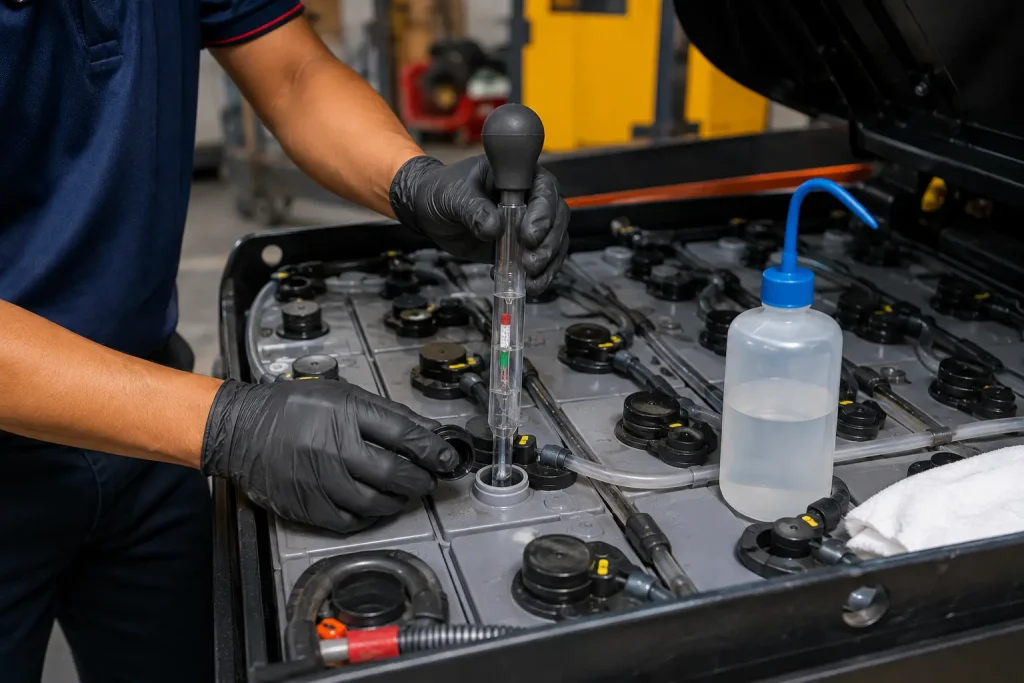
Lead-acid batteries remain the most widely used forklift battery type globally, a mature, well-understood technology that has powered electric forklifts since well before lithium-ion became commercially viable for this application.
How Lead-Acid Batteries Work
A lead-acid forklift battery generates current through a chemical reaction between lead plates and a sulfuric acid electrolyte solution, a technology that has remained fundamentally unchanged in principle for over a century even as manufacturing quality and design have improved considerably. Multiple cells are connected together within the battery casing to reach the voltage a specific forklift model requires.
Maintenance Requirements
Lead-acid batteries require regular watering to maintain the electrolyte level above the lead plates, since the charging process gradually consumes water through electrolysis, and allowing plates to become exposed accelerates permanent damage to the battery. Equalisation charging, a periodic extended charge cycle that corrects any imbalance between individual cells, is also a routine part of lead-acid battery upkeep, typically required on a weekly basis for batteries in regular use.
This maintenance burden is a genuine ongoing operational cost, both in the labour required and in the risk of accelerated battery degradation if watering and equalisation are neglected, a connection worth considering alongside the broader forklift maintenance routines covered below.
Lifespan, Cost, and Charging Behaviour
Lead-acid batteries typically last around 1,500 charge cycles before capacity degrades to the point of replacement, translating to roughly five years of service under typical single-shift use, though this varies considerably based on how well maintenance is followed. They also require a full charge and cool-down cycle rather than supporting the brief opportunity charging that newer battery chemistries handle well, meaning a battery swap is often necessary for operations running more than one shift on the same forklift.
Lead-acid remains the lowest upfront cost option among the three battery types, which continues to make it the default choice for single-shift operations where the maintenance routine and full-charge cycle are not a significant operational constraint.
Also read: Forklift Maintenance Tips for Safe and Efficient Operation
Lithium-Ion Batteries

Lithium-ion batteries have moved from a premium, niche option to an increasingly mainstream choice for electric forklifts, driven by falling costs and genuine operational advantages that address several of lead-acid’s practical limitations.
How Lithium-Ion Batteries Differ
Lithium-ion batteries use a fundamentally different chemistry, lithium ions moving between electrodes rather than the lead-and-acid reaction lead-acid batteries rely on, resulting in higher energy density, meaning more usable energy stored in a similarly sized or smaller battery pack. This chemistry also does not produce the gassing or water loss lead-acid batteries experience during charging, eliminating the watering and equalisation maintenance routine entirely.
Opportunity Charging and Multi-Shift Operations
Lithium-ion batteries support opportunity charging, short top-up charges during breaks or between tasks, without the damage a partial charge cycle would cause a lead-acid battery over time. This capability allows a single lithium-ion battery to sustain multi-shift operation without a battery swap, a meaningful operational advantage for businesses running continuous or near-continuous forklift use, an advantage covered from a broader operational perspective below.
Lifespan and Total Cost of Ownership
Lithium-ion batteries typically deliver two to three times the cycle life of an equivalent lead-acid battery, often exceeding 3,000 charge cycles, translating to considerably longer service life before replacement is needed. While the upfront cost of a lithium-ion battery remains higher than a comparable lead-acid unit, this longer lifespan, combined with eliminated maintenance labour and reduced total downtime from battery swaps, frequently produces a lower total cost of ownership over the battery’s full working life for businesses with sufficiently high utilisation to justify the higher initial investment.
Also read: Benefits of Electric Forklifts: Why Warehouses Are Switching
Fuel Cell (Hydrogen) Batteries
A smaller but growing category of electric forklifts uses hydrogen fuel cells rather than a conventional rechargeable battery, generating electricity on demand through a chemical reaction between hydrogen and oxygen rather than storing charge directly.
Fuel cell forklifts refuel in minutes rather than charging over hours, closely matching the refuelling speed of a diesel or LPG forklift while retaining the zero local emissions of electric power. This makes fuel cell technology particularly attractive for very high-utilisation, multi-shift operations where even lithium-ion’s opportunity charging cannot keep pace with continuous demand, though the upfront infrastructure cost of a hydrogen refuelling station remains a significant barrier that limits fuel cell adoption to a smaller number of large-scale, high-throughput operations for now.
Comparing the Three Battery Types
| Factor | Lead-Acid | Lithium-Ion | Fuel Cell |
| Upfront cost | Lowest | Higher | Highest (including infrastructure) |
| Maintenance | Regular watering and equalisation | Minimal | Minimal |
| Charging pattern | Full charge and cool-down only | Opportunity charging supported | Refuels in minutes |
| Typical cycle life | ~1,500 cycles | ~3,000+ cycles | Not applicable (refuelled, not cycled) |
| Best suited to | Single-shift operations | Multi-shift operations | Very high-utilisation, continuous operations |
Choosing the Right Battery Type for Your Operation
The right battery type depends less on general preference and more on two specific operational factors: how many shifts the forklift actually runs across a day, and how much labour and cost the business is prepared to absorb for ongoing maintenance.
Matching Battery Type to Shift Pattern
Single-shift operations with a predictable overnight charging window are well served by lead-acid batteries, since the full charge cycle fits naturally into unused hours and the lower upfront cost is not offset by any need for opportunity charging. Multi-shift or continuous operations, by contrast, gain a genuine operational advantage from lithium-ion’s opportunity charging, avoiding the battery swaps and dedicated swap-room infrastructure that sustaining a lead-acid fleet across multiple shifts would otherwise require.
Weighing Total Cost Against Utilisation
Businesses with low to moderate forklift utilisation often find lead-acid’s lower upfront cost difficult to beat, since the battery is unlikely to be cycled enough over its life for lithium-ion’s efficiency and longevity advantages to fully offset the higher initial investment. High-utilisation operations see the opposite pattern, where lithium-ion’s longer lifespan and eliminated maintenance labour compound significantly over years of heavy use, a calculation worth running explicitly for any business specifying a new forklift fleet, covered alongside broader equipment decisions below.
Also read: How to Choose a Forklift: A Complete Buyer’s Guide
Battery Charging Safety Considerations
Lead-acid battery charging releases hydrogen gas as a by-product, an explosion risk if allowed to accumulate in a poorly ventilated charging area, which is why dedicated battery charging rooms require proper ventilation and a strict no-open-flame policy regardless of how routine the charging process feels. Lithium-ion batteries carry a different risk profile, thermal runaway in a damaged or defective cell, which is why damaged battery packs should never be charged and should be handled according to the manufacturer’s specific safety guidance.
Singapore’s Ministry of Manpower publishes detailed Workplace Safety and Health guidance covering battery charging area requirements and electrical safety standards relevant to forklift battery maintenance and charging infrastructure. Further general technical background on how these battery chemistries function is available through Wikipedia’s overview of lithium-ion batteries.
Powering Your Fleet the Right Way
Lead-acid remains the practical, low-cost choice for single-shift operations, lithium-ion increasingly justifies its higher upfront cost for multi-shift and heavy-use fleets, and fuel cell technology serves a smaller niche of very high-throughput operations willing to invest in dedicated refuelling infrastructure. Matching battery type to actual shift pattern and utilisation, rather than defaulting to whatever came with the forklift, is what determines whether a fleet’s power source becomes a genuine operational advantage or a recurring source of downtime.
RR Machinery Pte Ltd offers a diverse selection of forklifts across multiple power sources and battery configurations suited to every operation. Contact us today for expert advice on the right battery type for your fleet.