Bridge design is the process of planning a structure that safely carries people, vehicles, or trains across an obstacle such as a river, road, railway, or valley. A good design balances several goals at once: the bridge must be strong and stable under every load it will face, last for many decades with reasonable maintenance, suit the site and the way it will be built, stay within budget, and fit well into its surroundings.
Behind every bridge, whether a short footbridge or a long highway viaduct, is a chain of decisions made long before construction begins. This guide explains what bridge design involves, the forces a bridge must resist, how engineers choose its structural form and materials, the role of foundations, the main stages of the design process, and how construction and long term maintenance shape the design from the start.
What Bridge Design Involves
Bridge design brings together several engineering disciplines. Structural engineers work out how the bridge carries its loads, geotechnical engineers study the ground that supports it, and hydraulic engineers assess rivers and flood flows where the bridge crosses water. Transport planners define the traffic the bridge must carry, and architects or landscape designers often shape its appearance, especially in towns and cities.
All of this work is guided by a design life, the period over which the bridge is expected to perform safely with normal maintenance, which for major bridges is typically measured in many decades. Further general background on bridges and their history is available through Wikipedia’s overview of bridges.
The Forces a Bridge Must Carry
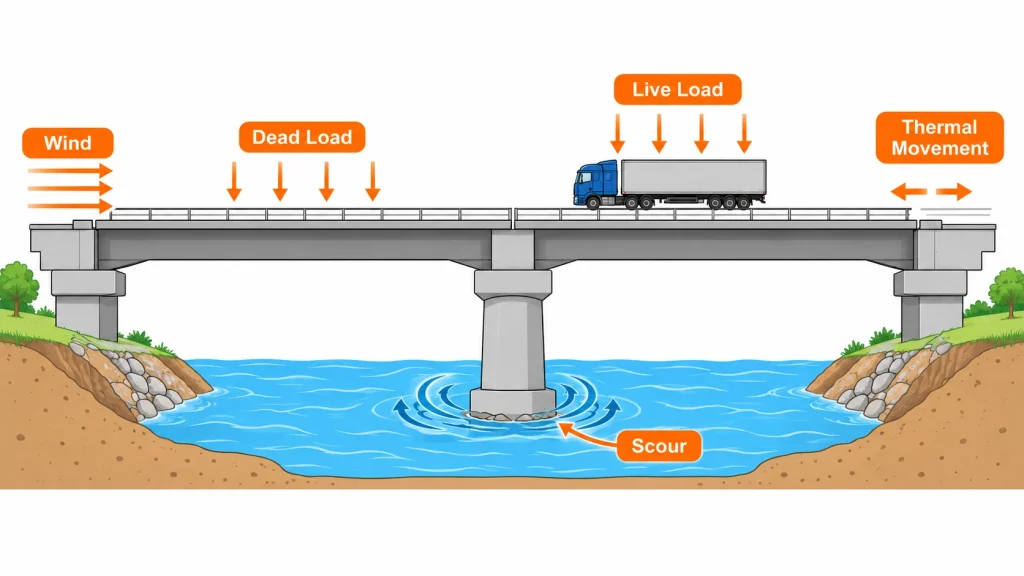
At its core, bridge design is about loads, the forces acting on the structure, and making sure every part of the bridge can resist them with a safe margin. The main categories include:
Dead load. The permanent weight of the bridge itself, including the deck, beams, surfacing, parapets, and services. On large bridges, the self weight is often the largest single load the structure carries.
Live load. The moving loads from traffic, such as cars, heavy trucks, trains, and pedestrians. Designers consider not only the weight of these loads but also how they are positioned to produce the worst effects on each part of the bridge.
Environmental loads. Wind, temperature changes, and, in some regions, earthquakes. Temperature changes cause the deck to expand and contract, which is why bridges need expansion joints and bearings that allow movement. Long, slender bridges can also be sensitive to wind induced vibration.
Water and ground effects. Where a bridge crosses water, flowing water pushes against piers and can wash away soil around foundations, a process known as scour. Settlement of the ground beneath supports must also be considered.
Dynamic and fatigue effects. Moving traffic causes vibration and repeated loading. Over millions of cycles, repeated stress can cause fatigue cracking, especially in steel details, so connections and joints are designed carefully to resist it.
Every load ultimately produces tension, compression, bending, or shear in the bridge’s members, and the way a structure handles these forces is what distinguishes one bridge form from another.
Choosing the Structural Form
One of the earliest and most important design decisions is the structural form of the bridge. The choice depends mainly on the span, the distance the bridge must cross between supports, along with the site conditions, the clearance needed beneath the bridge, the loads it must carry, and the budget.
Short spans are often crossed most economically by simple beam bridges, while longer spans may call for arches, trusses, or cable supported forms that carry loads more efficiently over greater distances. Site constraints matter just as much. A deep valley may suit an arch, a busy waterway may require a long clear span with few piers, and a crowded urban site may favour forms that can be built quickly with minimal disruption. How each form carries its loads, and where each one is typically used, is explained in detail below.
Also read: Types of Bridges and How They Work in Construction
Materials and Why They Are Chosen
The materials used in a bridge affect its strength, weight, durability, cost, and appearance, and they are closely linked to the structural form.
Reinforced concrete is durable, fire resistant, and well suited to slabs, piers, and shorter spans. It is often cast on site using formwork, and the systems used to shape it are covered in our guide to concrete formwork types. Prestressed concrete uses tensioned steel tendons to put the concrete into compression, allowing longer and slimmer spans, and is widely used in precast beams and segmental bridges.
Steel is strong in both tension and compression and relatively light for its strength, which makes it suitable for long spans, trusses, and cable supported bridges. It needs protection against corrosion through coatings or weathering steel. Composite construction, with a concrete deck acting together with steel girders, combines the advantages of both materials and is common on highway bridges. Timber and fibre reinforced polymers are also used, mainly for footbridges and lighter structures.
Foundations and the Substructure
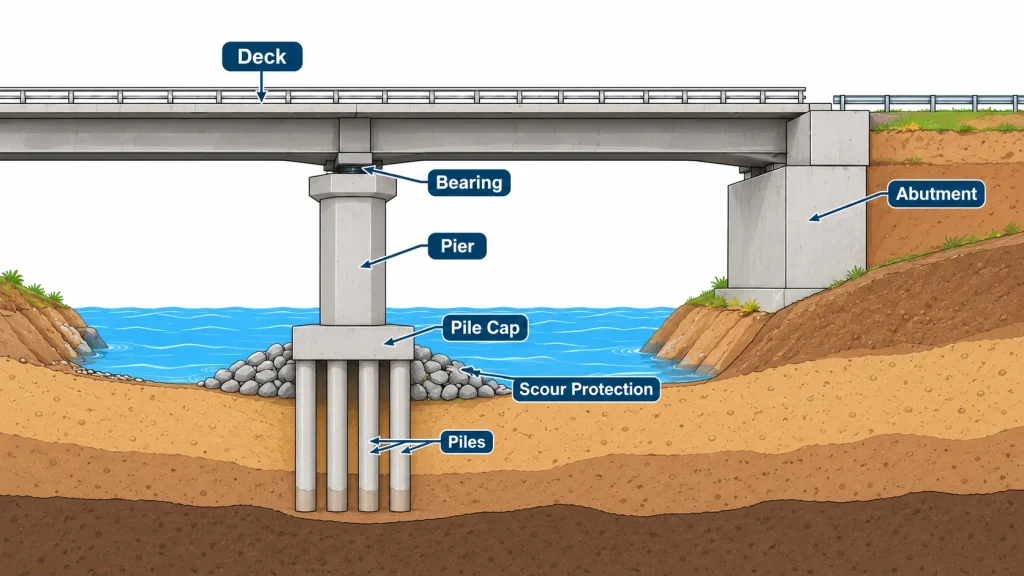
A bridge is only as sound as the ground it stands on. The part of the bridge below the deck, known as the substructure, includes the abutments at each end, the piers in between, and the foundations beneath them. Bearings sit between the deck and the substructure, transferring loads while allowing the deck to move with temperature changes.
The choice of foundation depends on the ground conditions revealed by site investigation. Where firm ground is close to the surface, shallow footings may be enough, while soft ground, deep water, or heavy loads usually call for pile foundations that carry loads down to stronger layers. Foundations in rivers must also be protected against scour. The wider range of options, from shallow footings to deep foundations, is covered in our overview of foundation types used in construction.
The Bridge Design Process
Bridge design usually moves through a series of stages, each adding detail and confidence:
- Define the requirements. Establish what the bridge must carry, the span and clearances needed, the design life, and any constraints on cost, appearance, and the construction programme.
- Investigate the site. Survey the topography, investigate the ground with boreholes and testing, study water flows where relevant, and identify existing services, structures, and access routes.
- Develop concept options. Compare several structural forms and materials against the requirements, considering cost, buildability, durability, and appearance.
- Carry out preliminary design. Size the main elements of the preferred option, check that it works, and prepare cost estimates and drawings for review.
- Complete the detailed design. Analyse the structure under all load cases, design every member and connection, and produce full construction drawings and specifications, following the design codes adopted by the relevant authority, such as the Eurocodes used in many countries.
- Obtain reviews and approvals. Independent checks and approvals from the owner and authorities confirm that the design is safe and complies with regulations.
- Support construction. Designers review construction methods, temporary works, and site changes, and respond to issues found during construction.
Throughout this process, designers repeatedly test the design against practical questions: can it be built safely, can it be inspected and maintained, and will it still perform well decades from now?
Designing With Construction in Mind
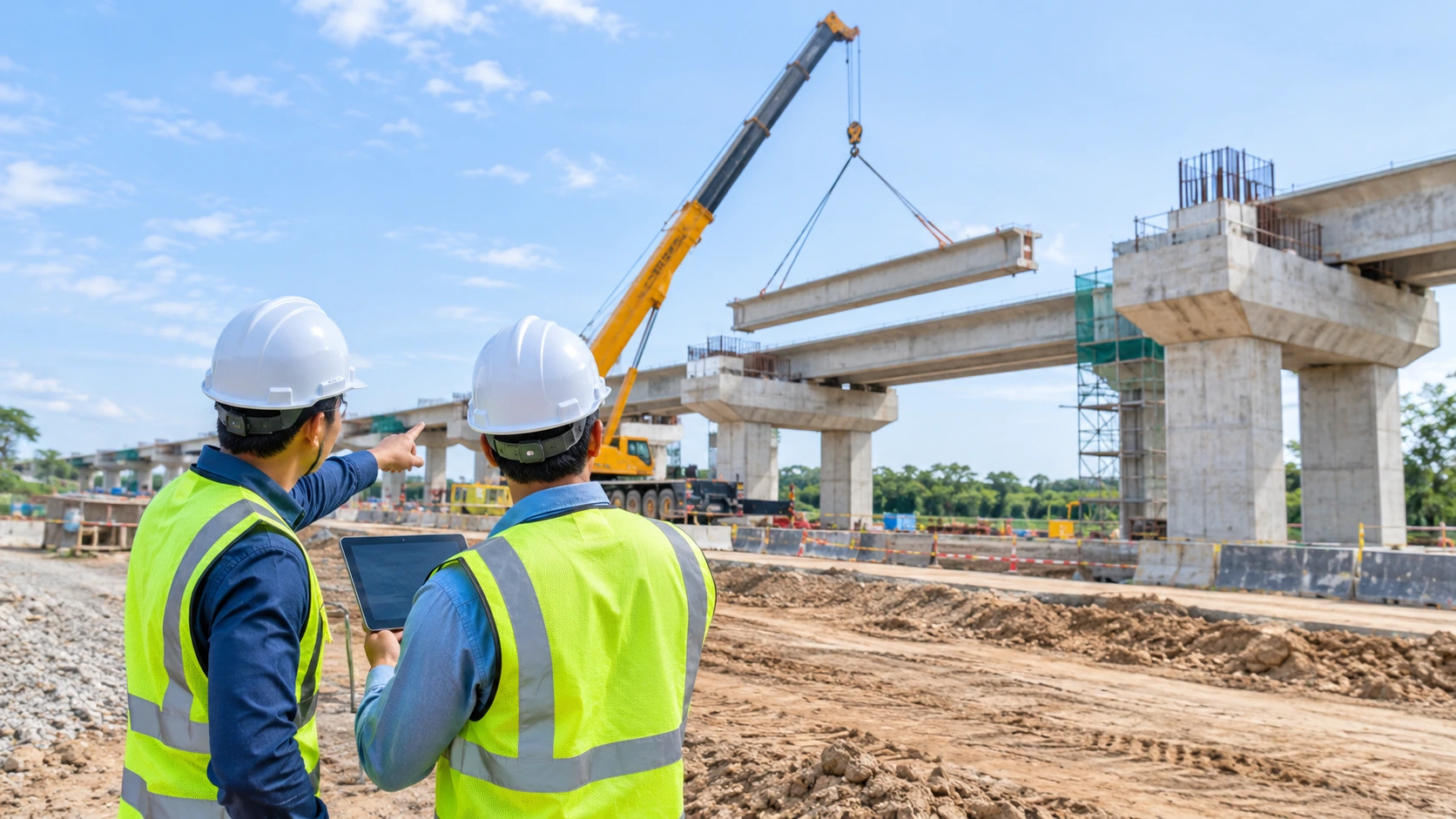
A design that looks good on paper can be expensive or dangerous to build if construction is not considered early. The erection method shapes many design decisions, from the size and weight of precast beams to the sequence in which spans are completed and the temporary supports needed along the way.
Large components often need heavy lifting, so crane access, outrigger positions, and lifting zones are planned into the design, and the different machines available for this work are described in our guide to types of cranes. Earthworks, paving, and compaction for the approach roads draw on another group of machines, set out in the guide below.
Also read: Road Construction Equipment List: Every Machine Explained
Designing for Durability, Inspection, and Maintenance
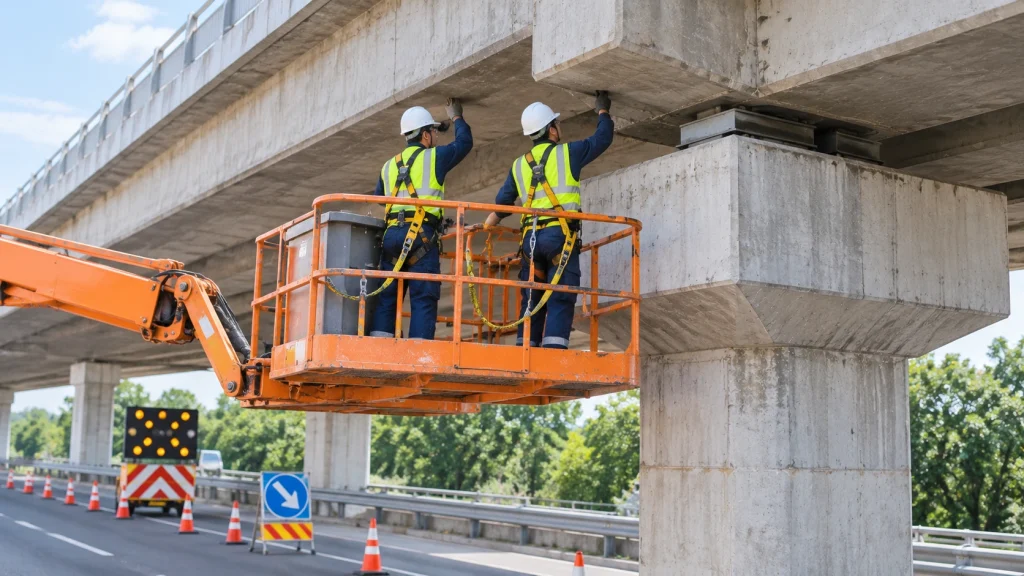
The best bridges are designed to be looked after. Durability starts with the right materials, adequate concrete cover over reinforcement, good drainage that keeps water away from joints and bearings, and protective coatings on steel. Details that trap water or debris are among the most common causes of long term deterioration.
Regular inspection is essential throughout a bridge’s life. Engineers check for cracking, corrosion, spalling concrete, worn bearings and joints, and scour around foundations. Designers make this easier by planning safe access to bearings, joints, and the underside of the deck, which on many bridges is reached using boom lifts, under bridge inspection units, or scaffolding, depending on the height and what lies beneath. The access machines most often used for this work are compared below.
Also read: Types of Boom Lifts: Which One Does Your Job Need?
Safety During Construction and Inspection
Bridge work combines several high risk activities, including work at height, work over water or traffic, heavy lifting, and deep excavation for foundations. Safe working requires careful planning of access, edge protection, fall arrest systems, exclusion zones beneath elevated work, and traffic management where the bridge crosses or carries live roads.
Inspection and maintenance work brings similar risks, often with the added challenge of working next to traffic that cannot be fully stopped. Singapore’s Ministry of Manpower publishes detailed Workplace Safety and Health guidance covering work at height and the safe use of access equipment, which provides a useful reference for planning this type of work.
Access Equipment for Bridge Construction and Inspection
Choosing the right access equipment for bridge work starts with a clear picture of the task. When you contact the team, it helps to describe the height and outreach needed, what lies beneath the work area, such as water, roads, or uneven ground, the space available to position the machine, and how long the work is expected to take. With these details, a suitable machine can be recommended from the start.
RR Machinery Pte Ltd offers an extensive range of boom lifts for construction, inspection, and maintenance work at height, backed by factory certified technicians and full servicing support. Contact us today for expert advice on the right machine and a quote tailored to your project.