Few machines cover as many jobs as the backhoe loader. With a loader bucket at the front and a digging arm at the back, a single machine can dig a trench, backfill it, load the spoil onto a truck, and drive to the next job, which is why it has long been a favourite for utility work, roadworks, and smaller construction sites.
This guide explains what a backhoe loader is, the parts it is built from, how each end works, the attachments that extend its use, where it fits best, how it compares with other machines, and what safe operation involves.
What a Backhoe Loader Is
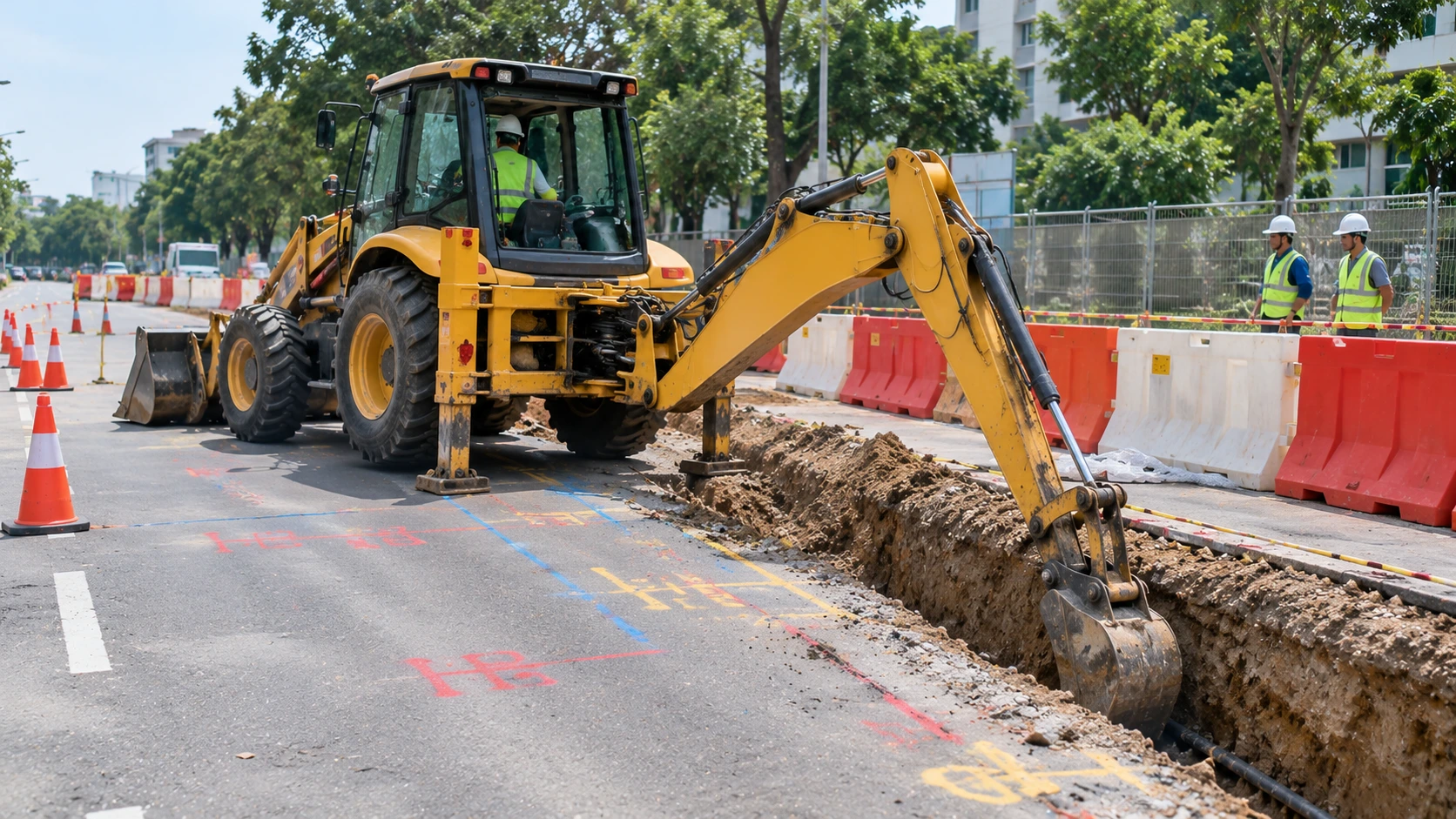
A backhoe loader is a wheeled machine built on a tractor style chassis, with a loader bucket mounted on arms at the front and a backhoe, a jointed digging arm with a bucket, mounted at the rear. The operator sits in a central cab with a seat that turns to face either end, so the same person can switch between loading and digging without leaving the machine.
Because it combines two machines in one and travels on rubber tyres, a backhoe loader can move between work areas quickly, including short distances on public roads where permitted, and handle a sequence of tasks that would otherwise need both a loader and an excavator. Further general background on the machine’s design and history is available through Wikipedia’s overview of backhoe loaders.
Backhoe loaders sit within the wider family of earthmoving machinery, alongside excavators, dozers, and dedicated loaders, which is described in Earth Moving Equipment: Types, Uses, and Applications.
Main Parts of a Backhoe Loader
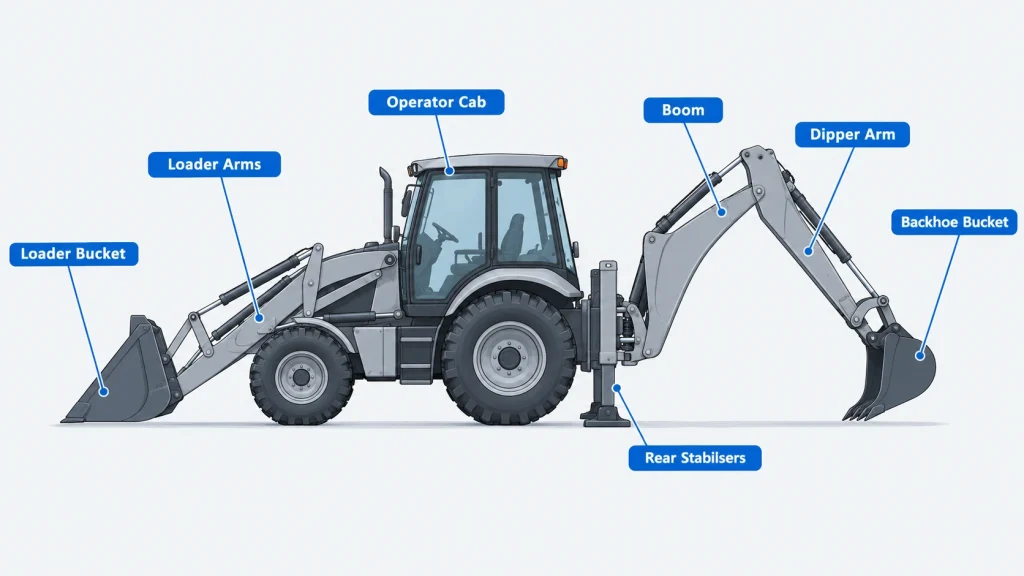
A backhoe loader is made up of a few major assemblies, each with a clear role:
- Tractor unit. The chassis, engine, drive system, and wheels that carry the machine and power everything else. Many machines use four wheel drive for better traction on site.
- Loader assembly. The front lift arms and bucket, used for scooping, carrying, levelling, and loading material.
- Backhoe assembly. The rear boom, dipper arm, and bucket, used for digging trenches and holes below ground level.
- Stabilisers. Legs at the rear that are lowered before digging to lift the weight off the rear tyres and keep the machine steady.
- Operator cab. Contains two sets of controls, one for driving and the loader and one for the backhoe, with a seat that swivels between them.
- Hydraulic system. Pumps, valves, and cylinders that power the loader arms, the backhoe, the stabilisers, and many attachments.
Two design features vary between machines. Some backhoes are mounted on a frame that lets them slide sideways across the rear of the machine, known as side shift, which allows digging close to walls and fences, while others are centre mounted and pivot from a fixed point. Some machines also offer an extendable dipper arm, which adds reach and digging depth for jobs that need a little more than a standard arm can give.
How a Backhoe Loader Works
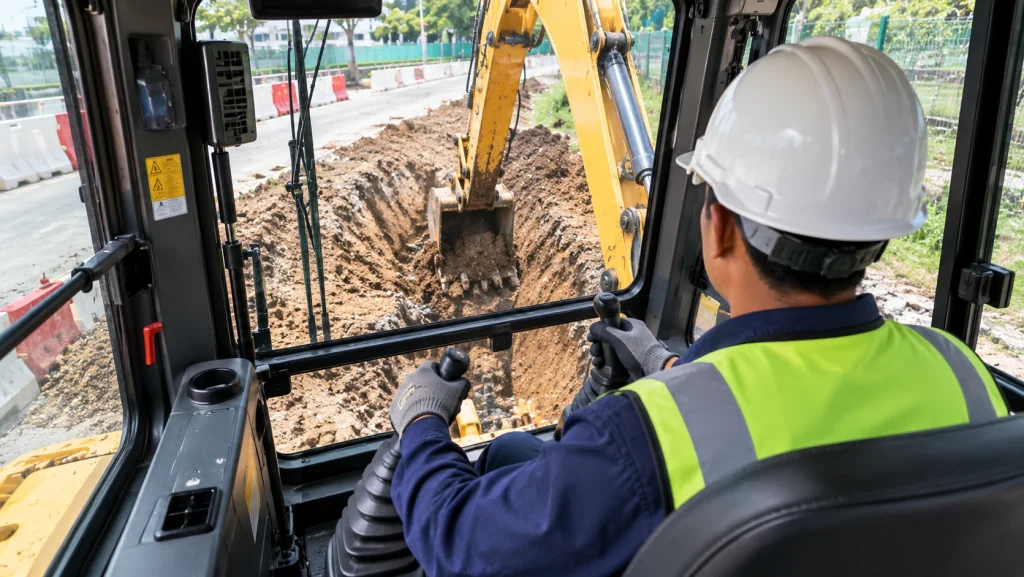
Using a backhoe loader means working two different machines from one seat. The loader end handles material above ground, while the backhoe end digs below it, and the operator moves between the two as the job requires.
Each end has its own technique and its own stability requirements, which is why operators need to understand both rather than treating the machine as a loader with a digging arm attached.
Working the Loader End
With the operator facing forward, the machine drives like a tractor and the front bucket is raised, lowered, and tilted with the loader controls. The loader end is used to scoop loose material, carry it short distances, spread and level it, backfill trenches, and load trucks, much like a dedicated wheel loader on a smaller scale.
Because the machine’s weight sits behind the front bucket, loads should be carried low when travelling, and the bucket should not be raised high while moving across uneven ground. The way dedicated loaders handle these tasks at a larger scale is explained in Front End Loader: How It Works and When to Use One.
Working the Backhoe End
To dig, the operator parks the machine, lowers the stabilisers, and usually lowers the front bucket to the ground as well, so the machine is firmly braced at both ends. The seat is then turned to face the rear, and the backhoe is controlled with levers or joysticks that move the boom, the dipper arm, the bucket, and the swing.
The backhoe digs by pulling the bucket toward the machine, which makes it well suited to trenches and holes. Unlike a full excavator, the backhoe swings through a limited arc rather than a full circle, so the machine needs to be positioned so that both the digging area and the place where the spoil will be dumped fall within that arc.
Switching Between the Two
Much of the backhoe loader’s value comes from how easily it switches between digging and loading. A typical sequence might involve digging a trench with the backhoe, turning the seat to use the loader for moving pipe bedding material, and then backfilling and levelling the trench with the front bucket once the work is done.
Before switching or moving the machine, the operator should raise the stabilisers fully, stow the backhoe in its travel position, and check that the area around the machine is clear. Skipping these steps is a common cause of damage and near misses.
Attachments That Extend Its Use
A backhoe loader becomes even more versatile with the right attachments, many of which connect through a quick coupler at either end. Common options include:
- Backhoe buckets of different widths for trenching and general digging
- Multipurpose loader buckets that can scoop, grab, doze, and level
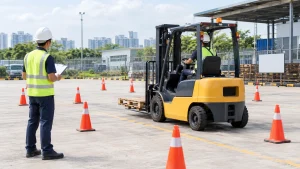
- Pallet forks on the loader arms for moving materials
- Hydraulic breakers on the backhoe for breaking concrete and rock
- Augers for drilling holes for posts and light foundations
- Grading and ditching buckets for shaping slopes and drainage channels
Matching the bucket or tool to the material and the task makes a large difference to productivity and wear on the machine. The main bucket types and their uses are explained below.
Also read: Types of Excavator Buckets and Their Uses Explained
Where Backhoe Loaders Are Used
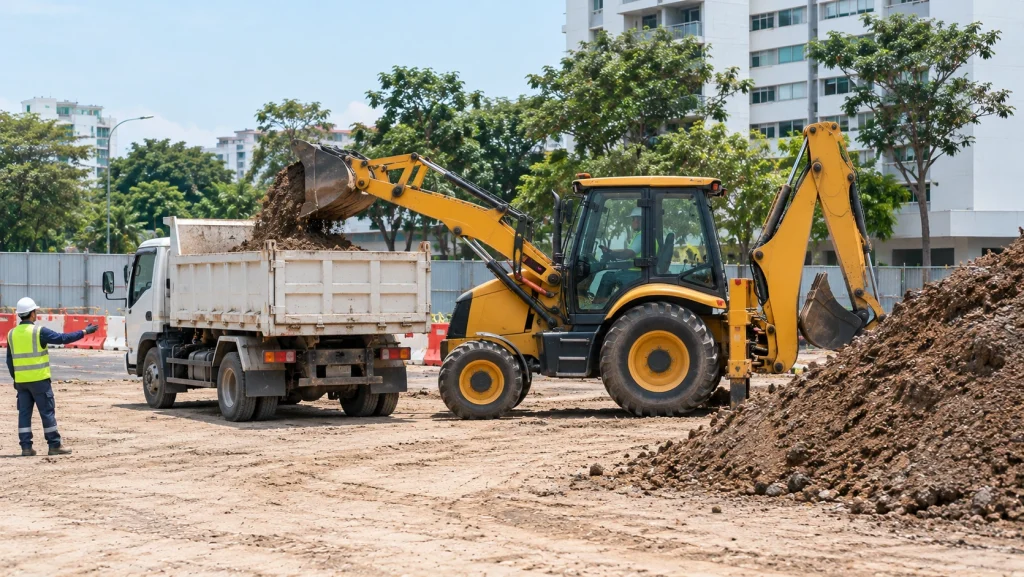
Backhoe loaders are most useful on jobs that combine digging, loading, and short moves between work areas. Typical applications include trenching for water pipes, drains, and cables, roadworks and pavement repairs, small foundations and footings, landscaping and garden works, loading trucks with spoil or aggregate, light demolition and clearance, and general site cleanup.
They are also common during the early stages of a project, where small excavations, levelling, and material handling all happen at once, which is part of the groundwork covered in What Is Site Preparation in Construction? Steps and Process. On sites where space is limited and the work is varied, one backhoe loader can often replace two separate machines.
Strengths and Limits of a Backhoe Loader
The backhoe loader’s main strengths are versatility, mobility, and convenience. It handles both digging and loading, travels quickly between work areas on its tyres, and can move between nearby sites without a separate transport vehicle where road rules allow, which suits contractors who work at several locations in a day.
Its limits are just as clear. A backhoe does not dig as deep, reach as far, or work as quickly as a dedicated excavator of a similar weight, and its limited swing means more repositioning. The loader end has less capacity than a full size wheel loader, and the machine’s tyres and higher centre of gravity make it less suited to very soft ground or steep slopes than a tracked machine. For large volumes of digging or loading, specialised machines usually work out faster and more economical.
Backhoe Loader Compared With Other Machines
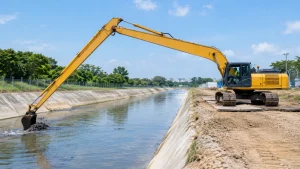
Choosing between a backhoe loader and another machine usually comes down to how much of each task the job involves. A full excavator is the better choice for deep digging, long trenches, and heavy earthworks, while a backhoe loader wins on smaller, mixed jobs where mobility and loading matter as much as digging.
For tight sites, a mini excavator can dig in spaces a backhoe loader cannot reach, though it cannot load trucks or carry material in the same way, and the range of excavator options is covered in Types of Excavators for Construction and Earthmoving. A dedicated wheel loader moves loose material faster and in greater volumes, but cannot dig below ground level. A detailed comparison of the backhoe and the excavator, including how to choose between them, is available below.
Also read: Backhoe vs Excavator: Differences, Uses & How to Choose
Operating a Backhoe Loader Safely
A backhoe loader combines the hazards of a loader and an excavator, so safe operation needs attention at both ends. Before digging, the stabilisers should be fully lowered on firm ground, and underground services such as cables and pipes should be located and marked. Before driving, the backhoe should be stowed, the stabilisers raised, and the loader bucket carried low.
People should be kept clear of the full swing area of the backhoe and the working area of the loader, since visibility is limited behind and around the machine. Operators should be trained for the specific machine, should wear a seatbelt when driving, and should never allow passengers on the machine. Singapore’s Ministry of Manpower publishes detailed Workplace Safety and Health guidance covering earthworks and machinery safety on local worksites, and the wider principles for working around heavy plant are covered below.
Is a Backhoe Loader the Right Machine for Your Job?
A few questions help decide whether a backhoe loader is the best fit:
- Does the job involve both digging and loading, rather than mostly one or the other?
- Is the digging depth and reach needed within what a backhoe can handle comfortably?
- Will the machine need to move between work areas or nearby sites during the job?
- Is the ground firm enough for a wheeled machine, with space to set the stabilisers?
- Is the volume of material modest enough that dedicated machines would not be clearly faster?
If most answers point toward a mixed, mobile job of moderate size, a backhoe loader is likely the right choice. If the work is mostly heavy digging or high volume loading, a dedicated excavator or loader will usually do it better.
Equipment Support for Earthworks in Singapore
Choosing the right machine for an earthworks job starts with a clear picture of the work. When you contact the team, it helps to describe the type of digging and loading involved, the depth and size of any excavation, the ground conditions and access route, and how long you expect to need the equipment. With these details, the right machine can be recommended from the start rather than adjusted after delivery.
RR Machinery Pte Ltd supports Singapore’s construction and industrial sectors with reliable heavy machinery solutions tailored to your specific site conditions. Browse our complete heavy machinery services or contact our team today for practical advice on the right equipment for your project.