There is no real material difference between drywall and Sheetrock. Drywall is the general name for panels made of gypsum pressed between two sheets of heavy paper, used to build interior walls and ceilings. Sheetrock is a brand name for one company’s drywall, made by USG Corporation, which became so well known that many people use it as a generic word for any gypsum board, in the same way people say Hoover for a vacuum cleaner.
The confusion matters because the name on a drawing, quote, or purchase order affects what is actually delivered to site. This guide explains what drywall and Sheetrock each mean, how they compare, the other names used around the world, the main types of board and their sizes, what really matters when choosing a board, and how board is handled and installed on a construction site.
What Is Drywall?
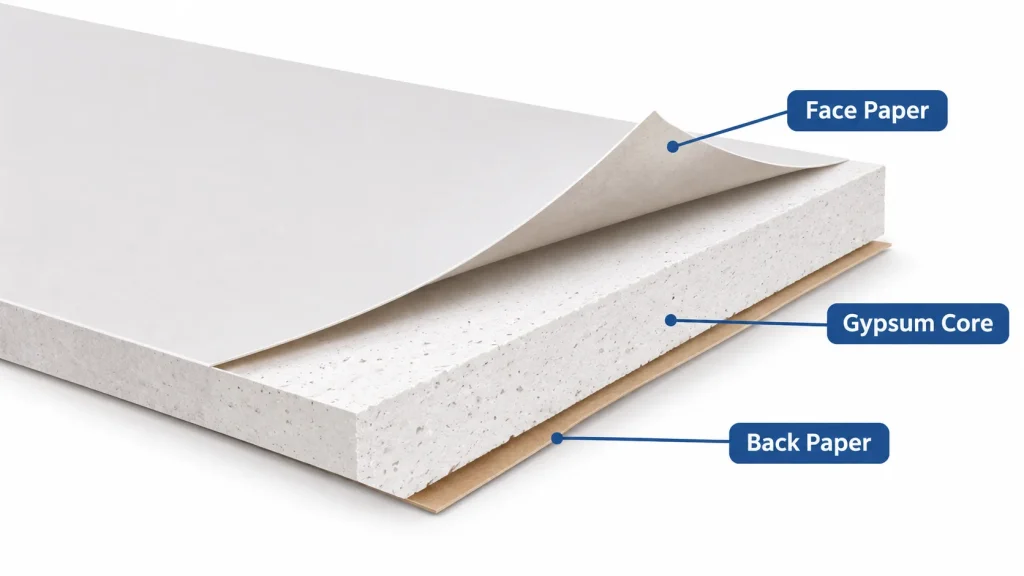
Drywall is a building panel with a core of gypsum, a soft mineral made of calcium sulphate, sandwiched between two layers of paper or, on some specialist boards, glass fibre mats. The panels are screwed or nailed to timber or light gauge steel framing to form walls, partitions, and ceilings, then the joints are taped and covered with jointing compound to create a smooth surface ready for paint. Further background on the material and its history is available in Wikipedia’s article on drywall.
The name comes from the way it is installed. Traditional plaster walls are built up with wet coats of plaster that must cure for days, while drywall arrives as dry, ready made sheets that can be fixed and finished much faster. That speed, along with low cost and good fire resistance, is why drywall replaced wet plaster as the standard interior wall finish in many countries.
How Drywall Works
Gypsum naturally contains chemically bound water. In a fire, that water is slowly released as steam, which keeps the temperature on the far side of the board low for a period of time. This is why gypsum board plays such a central role in fire rated walls and ceilings in offices, shops, hotels, and apartments.
The paper facing gives the board its strength in bending and provides a surface for paint or wallpaper. Additives in the core and special facings change the board’s behaviour, creating versions that resist moisture, mould, impact, or sound.
What Is Sheetrock?
Sheetrock is a registered trademark of USG Corporation, originally the United States Gypsum Company, which introduced the product in the early twentieth century. It was one of the first gypsum boards sold widely in the United States, and its early dominance made the brand name part of everyday construction language.
Today, the Sheetrock name covers a full range of gypsum panels, jointing compounds, and finishing products, from standard wallboard to fire rated, moisture resistant, and lightweight boards. Details of the current range are published on the USG website.
Why People Call All Drywall Sheetrock
When a brand leads a market for decades, its name often becomes shorthand for the whole product category. In much of the United States, contractors and homeowners say Sheetrock when they mean any gypsum board, whichever company actually made it.
This habit is harmless in conversation but can cause problems in specifications. If a drawing or contract names Sheetrock specifically, the project may be expected to use that brand, or a product proven to be equivalent. If the intent is simply gypsum board of a certain type and thickness, it is clearer to write that instead.
Drywall vs Sheetrock: Key Differences
Because Sheetrock is a type of drywall, the two share the same basic material, installation method, and uses. The real differences come down to naming, manufacturer, availability, and price, rather than how the boards perform.
The table below summarises how the two terms compare in practice.
| Aspect | Drywall | Sheetrock |
|---|---|---|
| What the term means | Generic name for gypsum board panels | Brand name for USG’s gypsum board |
| Manufacturer | Many manufacturers worldwide | USG Corporation |
| Core material | Gypsum between paper or glass mat facings | Gypsum between paper or glass mat facings |
| Product range | Standard, fire rated, moisture resistant, sound, impact, and more | Similar range under the Sheetrock name |
| Availability | Widely available in most markets | Strongest in North America, more limited elsewhere |
| Price | Varies by brand and type | Often similar or slightly higher than generic equivalents |
In short, every Sheetrock panel is drywall, but not every drywall panel is Sheetrock. Two boards of the same type, thickness, and rating from different reputable manufacturers will usually perform in a very similar way, provided they meet the same standards.
Other Names for Drywall Around the World
The same material goes by different names depending on the country and the industry. Knowing these names helps when reading international drawings, comparing supplier catalogues, or searching for products online.
All of the terms below describe essentially the same family of gypsum panels, sometimes with small differences in standards and sizes.
Gypsum board. The most common technical term worldwide and the one used in most specifications, standards, and supplier catalogues, including in Singapore.
Plasterboard. The usual name in the United Kingdom, Australia, New Zealand, and other Commonwealth markets.
Wallboard. A common North American term, often used interchangeably with drywall.
Gyprock and other brand names. In some countries, a leading local brand name is used generically, just as Sheetrock is in the United States.
In Singapore, gypsum board is widely used for partitions and ceilings in offices, retail units, hotels, and residential renovations, because it is quick to install, easy to modify, and supports the fire rating requirements common in commercial interiors. The Gypsum Association, a North American industry body, publishes technical guidance on gypsum board products and systems that is widely referenced internationally.
Also read: What Is Commercial Construction? Types, Stages and Roles
Types of Drywall
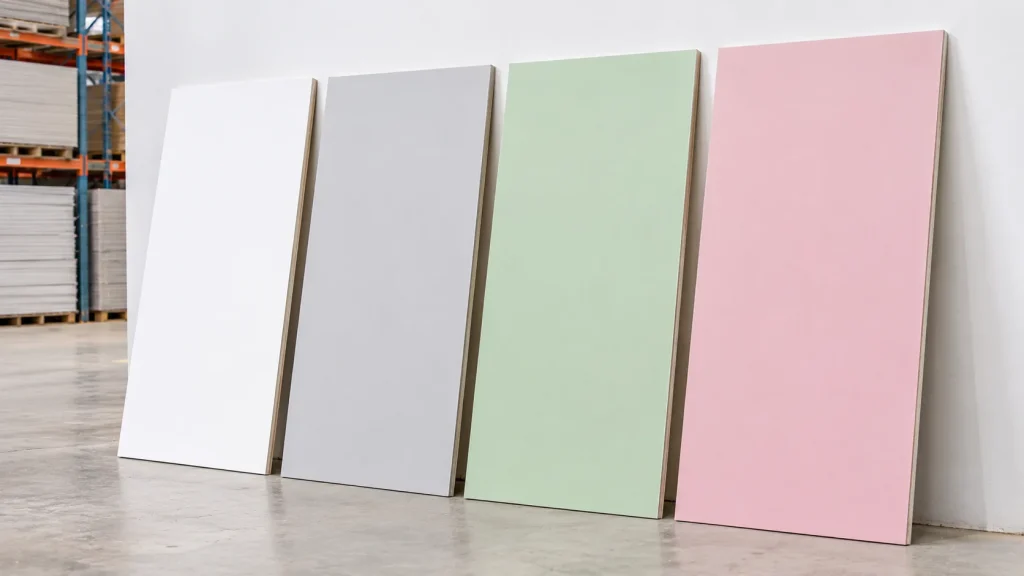
Whether a board is branded Sheetrock or made by another manufacturer, it will fall into one of several types designed for particular conditions. Choosing the right type matters far more than choosing a particular brand, because using standard board where fire, moisture, or impact protection is required can compromise the whole wall or ceiling.
Manufacturers often colour code their boards to make types easy to recognise on site, although the exact colours vary between brands and markets, so always check the printed markings.
Standard and Lightweight Board
Standard drywall is the everyday board used for most interior walls and ceilings in dry areas. It is the cheapest option and is easy to cut, fix, and finish.
Lightweight boards use a modified core to reduce weight while keeping similar strength. They are easier to carry and lift overhead, which helps installers working on ceilings and large partitions.
Fire Rated Board
Fire rated boards, often called Type X in North America, have a denser core reinforced with glass fibres so that they hold together longer in a fire. Used within a tested wall or ceiling system, they help achieve fire resistance ratings for corridors, shafts, stairwells, and separating walls between units.
A fire rating applies to the complete system, not just the board, so the framing, insulation, fixings, and joint treatment must all match the tested design.
Moisture, Mould, Sound, and Impact Resistant Board
Moisture resistant boards have water repellent additives and facings for use in bathrooms, kitchens, and other humid areas, while mould resistant boards add treatment to the core and facings. Neither is fully waterproof, so wet areas such as showers still need a proper waterproofing system or a cement based backer board.
Acoustic boards use a denser core to reduce sound transmission between rooms, and impact resistant boards add strength for busy corridors, schools, hospitals, and retail spaces where walls are likely to be knocked.
Drywall Sizes and Thicknesses
Drywall is sold in standard sheet sizes and thicknesses, which differ slightly between imperial and metric markets. Thickness affects strength, sound performance, fire resistance, and weight, while sheet size affects how many joints need finishing and how easy the boards are to handle.
The table below compares common thicknesses and their typical uses.
| Imperial thickness | Nearest metric thickness | Typical use |
|---|---|---|
| 1/4 in (6.4 mm) | 6 mm | Curved surfaces and overlaying existing walls |
| 3/8 in (9.5 mm) | 9.5 mm | Repairs, overlays, and lightweight partitions |
| 1/2 in (12.7 mm) | 12.5 mm | Standard interior walls and most ceilings |
| 5/8 in (15.9 mm) | 15 mm | Fire rated walls and ceilings, better sound control |
In North America, the standard sheet is 4 by 8 feet, with 10 and 12 foot lengths used to reduce joints on taller walls. Metric markets, including Singapore, typically use sheets 1,200 mm wide in lengths of 2,400 mm, 2,700 mm, or 3,000 mm. A single 12.5 mm board measuring 1,200 by 2,400 mm usually weighs in the region of 20 to 30 kilograms depending on its type, which is worth remembering when planning manual handling and deliveries.
Choosing a Board: What Matters More Than the Brand
For most projects, the question is not whether to use Sheetrock or drywall, but which type, thickness, and system the wall or ceiling needs. Once those are fixed, several reputable brands may be able to supply a suitable board.
Working through the points below helps avoid specifying the wrong product or paying for performance the project does not need.
Location and conditions. Dry rooms can use standard board, while humid areas need moisture resistant board and wet areas need proper waterproofing behind the finish.
Fire and acoustic requirements. Corridors, shafts, and walls between units often need tested fire rated or acoustic systems, and the whole system must follow the manufacturer’s tested design.
Durability. High traffic areas such as corridors, schools, and retail spaces benefit from impact resistant board.
Standards and approvals. Check that the board meets the relevant product standards and any local approvals for fire rated systems, rather than relying on a brand name alone.
Availability, lead time, and price. Locally stocked boards are usually easier to source, quicker to deliver, and simpler to replace if extra sheets are needed. Comparing like for like products across suppliers is a simple part of good cost management in construction.
If a specification names a brand such as Sheetrock, check whether an equivalent product is acceptable before substituting it, especially where fire or acoustic performance depends on a tested system.
Handling, Access, and Installation on Site
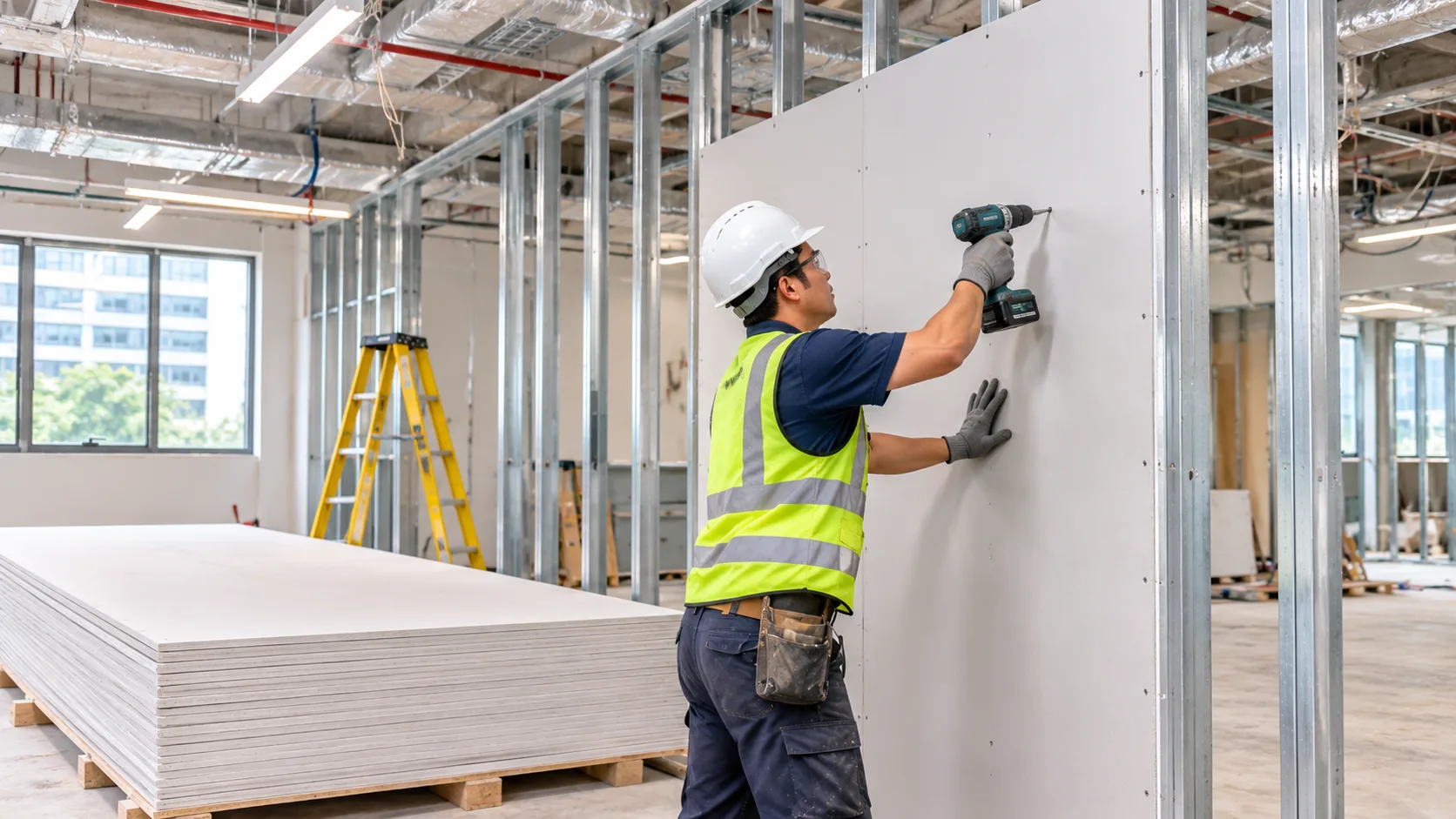
Whatever the brand, drywall is heavy, bulky, and easily damaged, so the way boards are delivered, stored, and lifted into place affects both productivity and the quality of the finished walls. On a commercial fit out, thousands of square metres of board may need to move from the delivery point to every floor of the building.
Planning deliveries, storage, and access equipment early keeps installers working instead of waiting for materials.
Delivery and Storage
Boards are usually delivered on pallets or in bundles and moved with forklifts. Long, flat loads can place their centre of gravity further out on the forks than a compact load, so operators should check the effect of forklift load center on safe capacity before lifting. On multi storey projects, boards are then moved between floors on site hoists, as explained in our guide to construction lifts and hoists.
Store boards flat on bearers, indoors or under cover, and away from wet trades. Drywall that gets wet or is stored on edge can warp, soften, or grow mould, and damaged boards often end up as waste.
Also read: Construction Site Planning: A Complete Guide
Working at Height
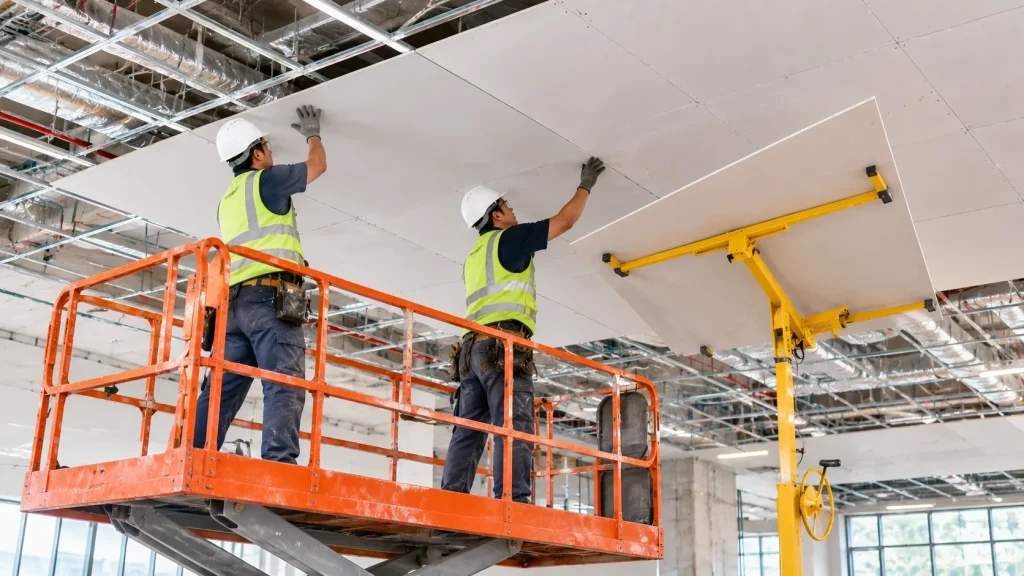
Ceilings, high partitions, and bulkheads put installers at height for much of the job. Scissor lifts and mobile scaffolding provide stable platforms for fixing boards overhead, while boom lifts suit atriums, double height spaces, and areas with obstacles below, as compared in our guide to boom lifts and scissor lifts.
Board lifters, sometimes called drywall hoists, hold ceiling sheets in position while they are fixed, reducing strain on installers. Daily checks on access equipment, clear work areas, and dust control during cutting and sanding all form part of a routine construction site safety checklist.
Also read: Classes of Forklifts and Their Uses in Material Handling
Equipment for Drywall and Fit Out Projects
Whether the drawings say drywall, gypsum board, plasterboard, or Sheetrock, the installation depends on getting boards to the right floor and giving installers safe, stable access to walls and ceilings. Planning that equipment alongside the board order keeps fit out work moving on schedule.
RR Machinery Pte Ltd provides heavy machinery rental across Singapore, including scissor lifts, boom lifts, mobile scaffolding, forklifts, and power generators, backed by servicing support. Contact us today to discuss the access and handling equipment your project needs or to request a quotation.