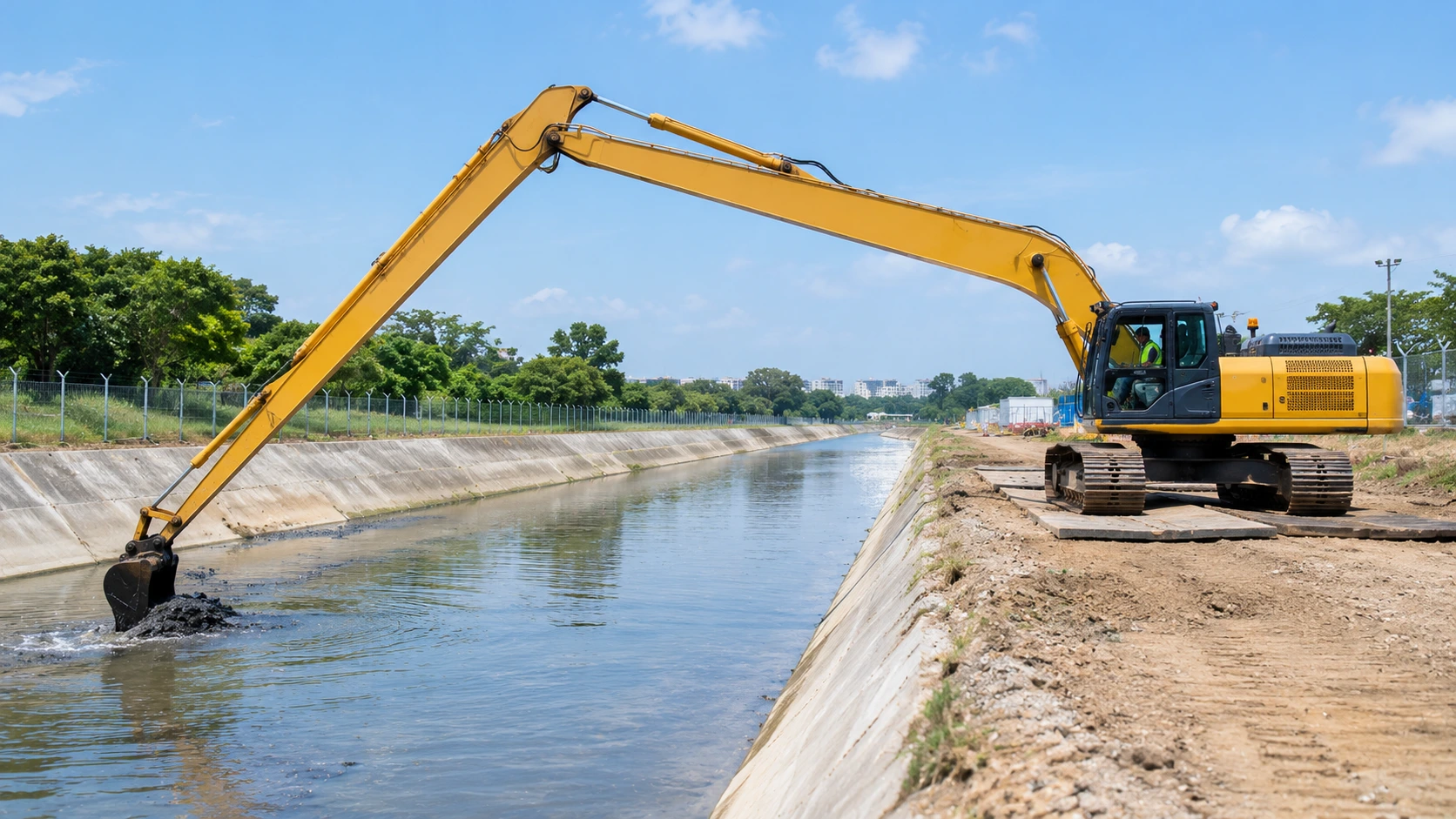
Some excavation work happens just out of reach. A drainage channel too wide to dig from one bank, a river bed that cannot be driven into, or a deep foundation pit with no room to place a machine at its edge all demand more reach than a standard excavator can offer. The long arm excavator, also called a long reach excavator, exists for exactly these situations.
This guide explains what a long arm excavator is, how the extended front end changes the way the machine works, where it earns its place, how it compares with a standard excavator, and the limits and safety points that need planning before one is brought to site.
What a Long Arm Excavator Is
A long arm excavator is a hydraulic excavator fitted with a boom and arm that are considerably longer than those of a standard machine of the same size. The base machine, including the tracks, the rotating upper structure, the cab, and the engine, is usually a familiar crawler excavator, while the extended front end gives it the ability to dig, scoop, and place material much further from where the tracks are standing.
Because the longer boom and arm put the weight of the bucket and its load further from the machine, long arm excavators are normally fitted with a smaller bucket and, on many models, additional counterweight to keep the machine balanced. The result is a machine that trades bucket size and lifting capacity for reach. Further general background on excavator design is available through Wikipedia’s overview of excavators.
The long arm excavator is one of several excavator configurations, each built for a different kind of work, from compact machines for tight sites to heavy machines for mass earthworks. A comparison of the main types is covered below.
Also read: Types of Excavators for Construction and Earthmoving
How the Long Arm Changes the Machine
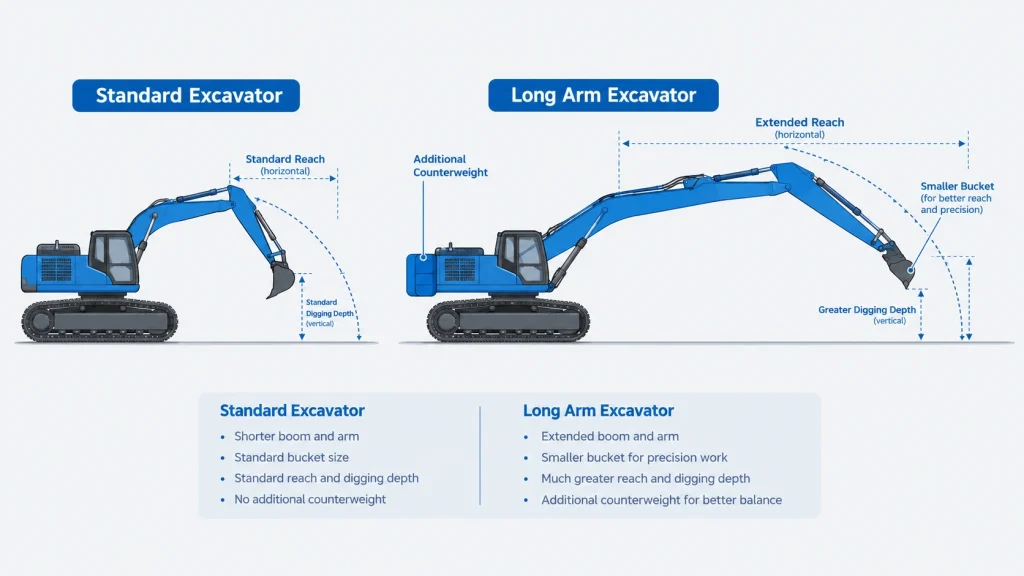
Extending the boom and arm does more than add reach. It changes how much the machine can lift, how fast it can work, how stable it is, and how it needs to be operated, and each of these changes shapes the jobs it suits.
Understanding these trade offs is what separates a well planned long reach job from one that runs slowly or puts the machine at risk. The exact figures for any model, including its reach, digging depth, and rated loads, are set by the manufacturer and shown in its specification sheet and load chart.
Reach and Digging Depth
The most obvious difference is reach. With a longer boom and arm, the bucket can travel much further horizontally from the machine and dig considerably deeper below the level of the tracks. This lets the operator work across water, over obstacles, or into the bottom of a deep excavation while the machine stays on firm ground at a safe distance from the edge.
That reach also changes how the work is planned. Fewer machine moves may be needed to cover a long channel or a wide area, and the machine can often stay on one prepared platform rather than tracking repeatedly over soft or unstable ground.
Bucket Size and Lifting Capacity
The further a load is from the machine, the more leverage it exerts, so a long arm excavator must handle smaller loads than a standard machine of the same weight. This is why these machines are fitted with smaller buckets, and why their lifting capacity at full reach is much lower than at close range.
In practice, this means each cycle moves less material, and the machine is not suited to heavy lifting. Choosing the right bucket for the material, whether a general purpose, ditching, or mud bucket, matters even more than usual, and the options available are explained below.
Also read: Types of Excavator Buckets and Their Uses Explained
Stability and Counterweight
A long front end shifts the machine’s balance forward, especially when the arm is fully extended over the side. Extra counterweight at the rear helps restore that balance, but the machine is still more sensitive to ground conditions, slopes, and the position of the load than a standard excavator.
Operators need to respect the load chart closely, keep the machine on firm and level ground, and be careful when swinging an extended arm, since the forces involved grow with every metre of reach. A long arm working near a riverbank or the edge of an excavation also places extra load on ground that may already be weak.
Where Long Arm Excavators Are Used
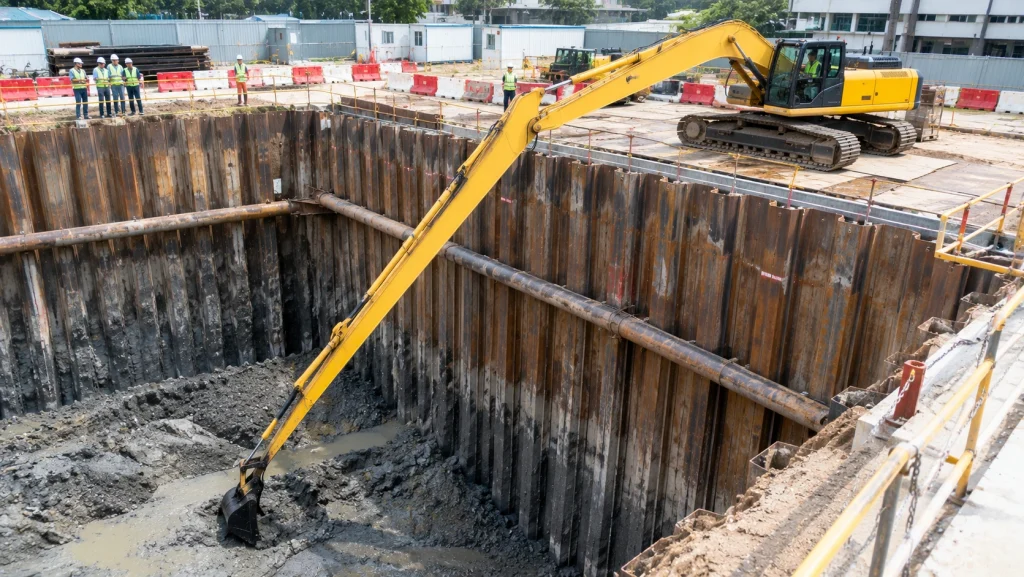
The extra reach is valuable wherever the machine cannot get close to the work, or where getting close would be unsafe. Common applications include:
- Dredging and waterway maintenance. Removing silt and debris from rivers, canals, drains, ponds, and reservoirs without the machine entering the water.
- Riverbank and shoreline work. Shaping and protecting embankments, placing rock armour, and maintaining banks from a stable position on land.
- Deep excavations. Digging deep basements, pits, and trenches where a standard arm cannot reach the bottom from the edge.
- Slope trimming and grading. Shaping embankments and cuttings from the top or the bottom of a slope.
- Ditch and channel cleaning. Clearing long drainage ditches and channels with fewer machine moves.
- Working across obstacles. Reaching over fences, structures, or protected areas that the machine cannot cross.
Deep excavations near existing structures often depend on temporary or permanent support to keep the sides stable, and the main options are covered in Types of Retaining Walls: Structures and When to Use Each. Where a long arm machine is digging for a basement or a deep foundation, the foundation design itself shapes how deep and how wide the excavation needs to be, as explained in Shallow vs Deep Foundation: Key Differences Explained.
Long Arm Excavator vs Standard Excavator
The choice between a long arm and a standard excavator usually comes down to reach versus productivity. A standard machine moves more material per cycle, works faster, lifts heavier loads, and is easier to transport, which makes it the better choice whenever it can get close enough to the work.
A long arm machine is the right choice when reach is the deciding factor. If the work is across water, at the bottom of a deep excavation, or behind an obstacle, the slower cycles and smaller bucket are a fair price for being able to do the job at all from a safe position. On many projects the two work together, with the long arm machine handling the parts of the job that are out of reach and a standard machine doing the bulk digging and loading. A wider look at how excavators fit alongside other earthmoving machines is available in Earth Moving Equipment: Types, Uses, and Applications.
Long Reach Is Not the Same as High Reach
The names sound similar, but a long reach excavator and a high reach demolition excavator are built for different jobs. A long reach machine extends its boom and arm outward and downward for digging and dredging, while a high reach demolition machine uses a tall front end designed to bring down the upper levels of buildings from the ground.
The two are not interchangeable. A long reach digging machine should not be used to pull down structures at height, because it is not designed for the loads and the falling debris involved, and demolition work at height calls for equipment and planning specific to that task.
Limits and Planning Considerations
A long arm excavator solves a reach problem, but it brings planning questions of its own. Transport is the first, since the long boom and arm can make the machine difficult to move on public roads, and some machines need part of the front end removed and carried separately. Access routes, unloading space, and assembly on site should be confirmed before delivery.
The working area also needs more room. The swing radius of an extended arm is much larger than that of a standard machine, so the space around it must be clear of people, structures, and other equipment. Overhead power lines deserve particular attention, because a long boom can reach them more easily than an operator expects. Allowing space for the machine, its swing, and safe access routes is part of the wider planning covered in Construction Site Planning: A Complete Guide.
Ground conditions matter more than usual. Working near water, at the edge of excavations, or on embankments means the ground under the tracks may be soft or close to failing, and the extra leverage of a long arm adds to that load. Timber mats, a prepared working platform, or a safe set back from the edge may be needed, and the machine should never be operated from ground that has not been assessed.
Operating a Long Arm Excavator Safely
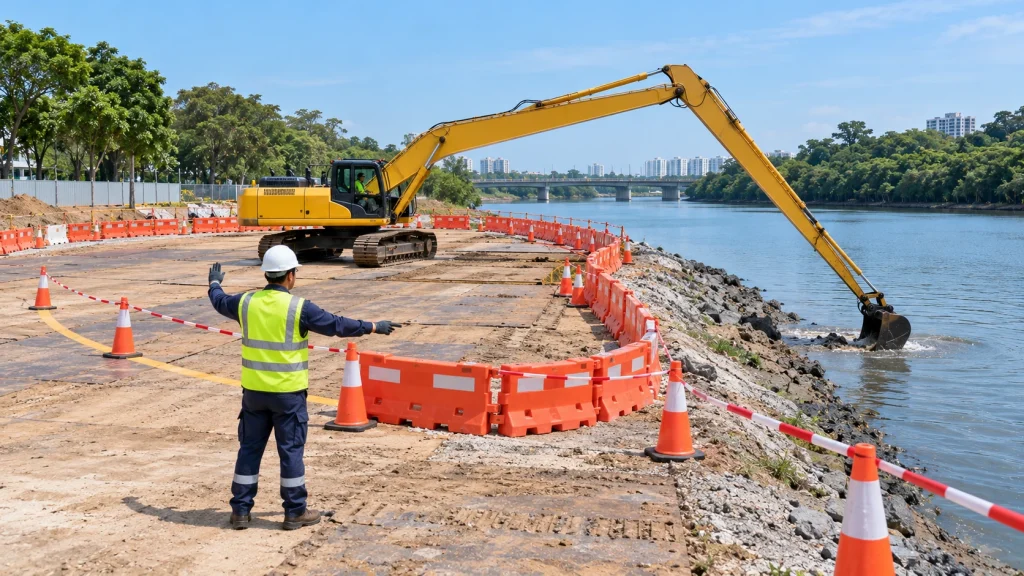
The basic controls of a long arm excavator are the same as those of a standard machine, but the extra reach changes how they need to be used. Movements should be smoother and slower, particularly when swinging or extending the arm, because a sudden movement at full reach can unsettle the machine and the load.
An exclusion zone sized to the full swing radius keeps people clear of the arm and bucket, and a banksman can help where visibility is limited, especially when working over water or the edge of an excavation. The broader principles that apply to all machinery on a worksite are covered in Heavy Equipment Safety: A Complete Site Guide, and Singapore’s Ministry of Manpower publishes detailed Workplace Safety and Health guidance covering earthworks and the safe use of machinery on local sites.
Operators should be trained and familiar with the specific machine, including its load chart and any limits on slewing or travelling with the arm extended. A practical walkthrough of excavator operation, from checks before use through to shutdown, is available below.
Also read: How to Operate an Excavator: A Step-by-Step Guide
Is a Long Arm Excavator the Right Choice?
A few questions help decide whether the extra reach is genuinely needed:
- Is the work out of reach of a standard excavator from a safe position, such as across water or at the bottom of a deep pit?
- Can the job accept slower cycles and smaller loads in exchange for that reach?
- Is there a route to bring the machine to site, and space to assemble and operate it?
- Is the ground where the machine will stand firm enough to carry the extra leverage?
- Does the task involve heavy lifting, which a long arm machine is poorly suited to?
If most answers point to reach being essential and lifting being minimal, a long arm excavator is likely the right tool. If not, a standard excavator, possibly working alongside other equipment, will usually be faster and simpler.
Equipment Support for Earthworks in Singapore
Choosing the right machine for an earthworks job starts with a clear picture of the site. When you contact the team, it helps to describe the type of work, how far the machine will need to reach, the ground conditions and access route, any water or deep excavation involved, and how long you expect the work to take. With these details, the right equipment can be recommended from the start rather than adjusted after delivery.
RR Machinery Pte Ltd supports Singapore’s construction and industrial sectors with reliable heavy machinery solutions tailored to your specific site conditions. Browse our complete heavy machinery services or contact our team today for practical advice on the right equipment for your project.