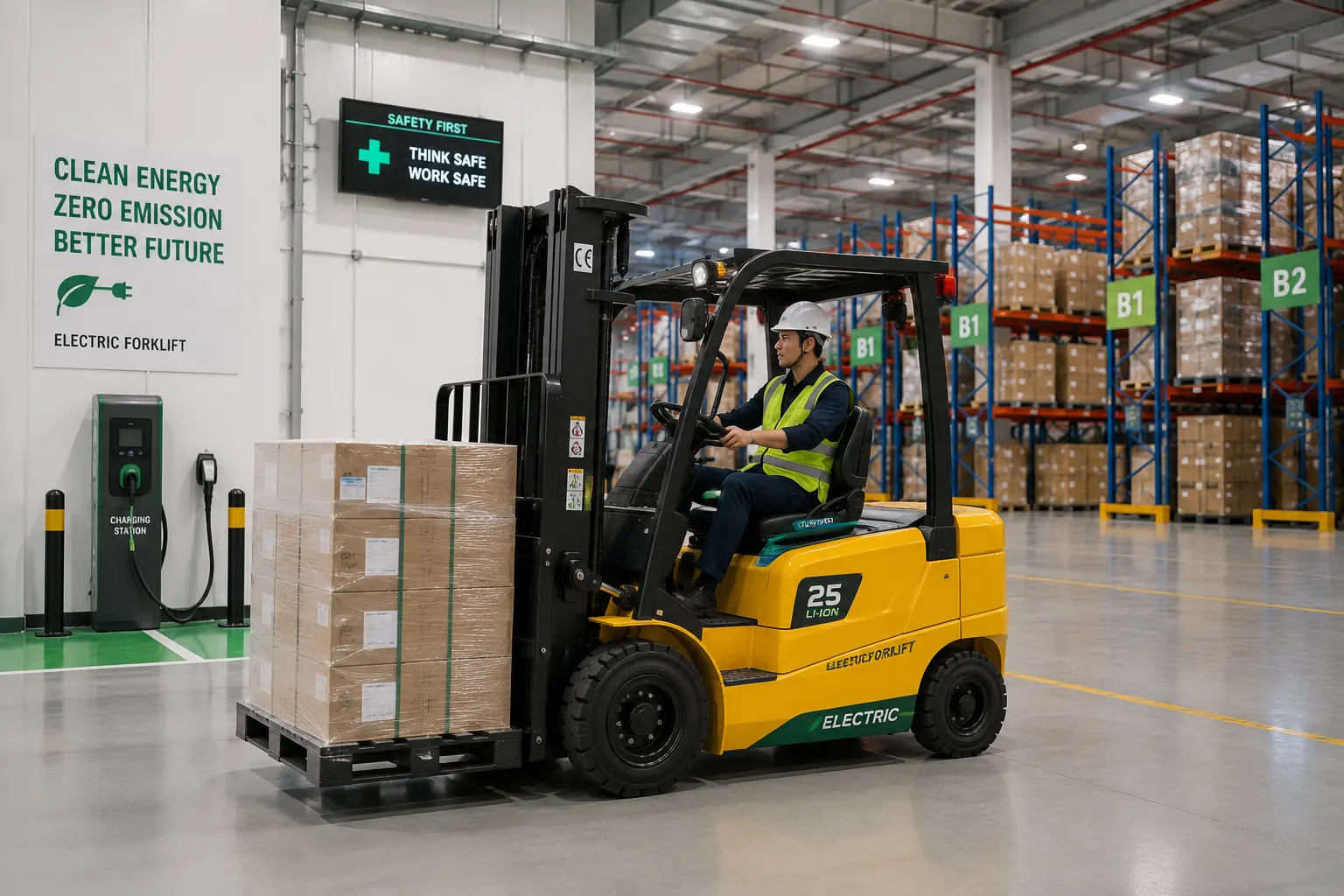
Electric forklifts have moved from a niche, indoor-only option to the default choice across a growing share of Singapore’s warehouses, retail distribution centres, and cold storage facilities. Advances in battery technology, combined with the operational and environmental advantages the machines have always offered, have made the switch increasingly straightforward for businesses that once defaulted to diesel or petrol equipment out of habit rather than necessity.
This article focuses specifically on what makes electric forklifts worth choosing, from cost and environmental benefits to the workplace comfort and battery technology improvements that have accelerated adoption in recent years. For a full side-by-side comparison against diesel equivalents, our separate comparison guide covers the trade-offs between both power sources in detail, while this guide concentrates on the specific advantages electric power brings to a warehouse operation.
Lower Operating and Running Costs
Electric forklifts consistently cost less to run per hour of operation than their diesel or petrol equivalents, a benefit that compounds significantly over a machine’s working life in a busy warehouse.
This cost advantage comes from two separate sources, the lower cost of electricity compared to fuel, and the simpler mechanical design of an electric drivetrain, which together reduce both energy cost and the ongoing servicing burden that a combustion engine requires.
Reduced Fuel and Energy Costs
Electricity costs considerably less than diesel or petrol per unit of usable energy delivered to the wheels and hydraulics, and this gap has remained consistent even as fuel prices have fluctuated in recent years. For a forklift running multiple shifts a day across a busy warehouse, this difference in energy cost adds up to a meaningful reduction in daily operating expense compared to an equivalent combustion-powered unit.
Businesses running larger fleets often see this advantage scale directly with fleet size, since the cost difference per unit multiplies across every additional electric forklift added to the operation. Understanding how electric and diesel forklifts compare more broadly across cost and capability is covered in our comparison guide below, useful for businesses weighing this benefit against other operational factors.
Lower Maintenance Requirements
Electric forklifts have significantly fewer moving parts subject to wear compared to a combustion engine, no oil changes, exhaust system, radiator, or fuel filters to maintain, which reduces both the frequency and cost of routine servicing over the machine’s working life. This simpler mechanical profile also means fewer components that can fail unexpectedly, contributing to higher uptime across a busy operation.
Maintenance still matters for electric units, particularly around battery health, motor controllers, and hydraulic systems, and following a consistent routine protects this cost advantage over time. A detailed maintenance approach that applies across both power sources, with clear guidance on what differs for electric models, is available in Forklift Maintenance Tips for Safe and Efficient Operation.
Also read: Electric vs Diesel Forklifts: Which One Should You Choose?
Zero Emissions and Cleaner Indoor Air Quality
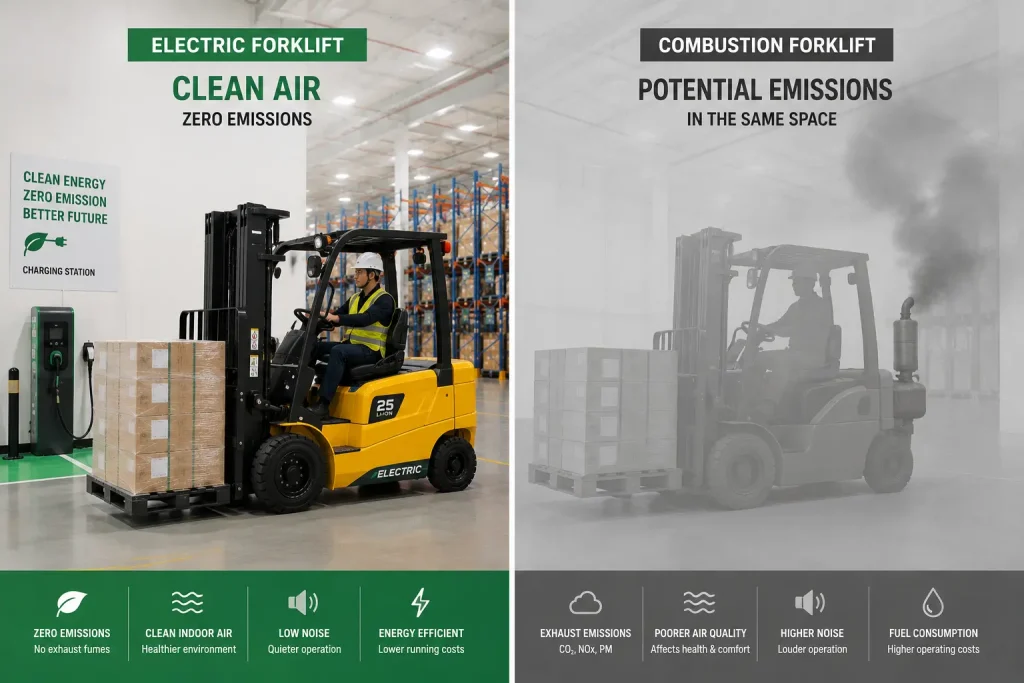
Electric forklifts produce no exhaust emissions at the point of use, a benefit that extends well beyond environmental considerations into direct, measurable improvements in workplace air quality.
This is arguably the single most consequential benefit for any operation running equipment indoors, since it removes an entire category of workplace health risk that combustion-powered alternatives cannot avoid without extensive ventilation infrastructure.
No Exhaust Emissions
Because electric forklifts draw power from a battery rather than burning fuel, they release no carbon monoxide, nitrogen oxides, or particulate matter into the surrounding air, regardless of how long or how intensively they are operated. This makes electric power the only genuinely emissions-free option among common forklift power sources, rather than simply a lower-emissions alternative.
For businesses with sustainability targets or environmental, social, and governance reporting obligations, switching a forklift fleet to electric power provides a straightforward, measurable reduction in direct operational emissions that is far simpler to document than many other efficiency initiatives.
Better Air Quality for Indoor Workers
Warehouse and distribution centre staff working in close proximity to forklifts benefit directly from the absence of exhaust fumes, particularly in enclosed spaces where ventilation is limited and combustion emissions would otherwise accumulate over a shift. This matters most in food storage, pharmaceutical warehousing, and any facility where air quality standards are subject to regulatory scrutiny.
Workplace exposure to vehicle exhaust emissions is a recognised occupational health concern, and Singapore’s Ministry of Manpower publishes detailed Workplace Safety and Health guidance covering air quality and exposure standards that apply to indoor industrial environments, standards that electric equipment helps operations meet without additional ventilation investment.
Quieter Operation and Improved Workplace Comfort
Electric forklifts run substantially quieter than combustion-powered equivalents, a benefit that affects everything from operator fatigue to broader site communication and noise compliance.
This reduction in noise is a direct consequence of the electric motor’s mechanical simplicity, without combustion, exhaust, or the associated vibration of an internal combustion engine, the entire machine simply generates less ambient noise during normal operation.
Reduced Noise for Operators and Nearby Staff
Operators spending full shifts in an electric forklift experience considerably less noise exposure than those operating diesel or petrol equivalents, reducing fatigue and making it easier to hear verbal communication, alarms, and warning signals from other equipment or personnel nearby. This is a meaningful safety benefit as well as a comfort one, since clear communication on a busy warehouse floor depends partly on ambient noise levels staying low enough for verbal warnings to be heard.
Reduced noise also benefits staff working near forklift travel paths throughout a shift, an often-overlooked advantage in busy distribution centres where forklifts operate continuously alongside pickers, packers, and other warehouse staff throughout the day.
Suitability for Noise-Sensitive Environments
Quiet operation makes electric forklifts particularly well suited to retail distribution centres, residential-adjacent facilities, and any operation running overnight or extended shifts where noise regulations or neighbouring occupants make combustion-powered equipment impractical. Facilities operating near residential zones in Singapore benefit particularly from this advantage, avoiding noise complaints that diesel equipment operating during early or late hours might otherwise generate.
Understanding how different forklift configurations, including compact and narrow-aisle electric models, fit into noise-sensitive or space-constrained facilities is covered in Reach Truck vs Forklift: Key Differences & Uses, relevant for warehouses evaluating electric equipment options beyond standard counterbalance models.
Faster Charging and Longer Battery Life
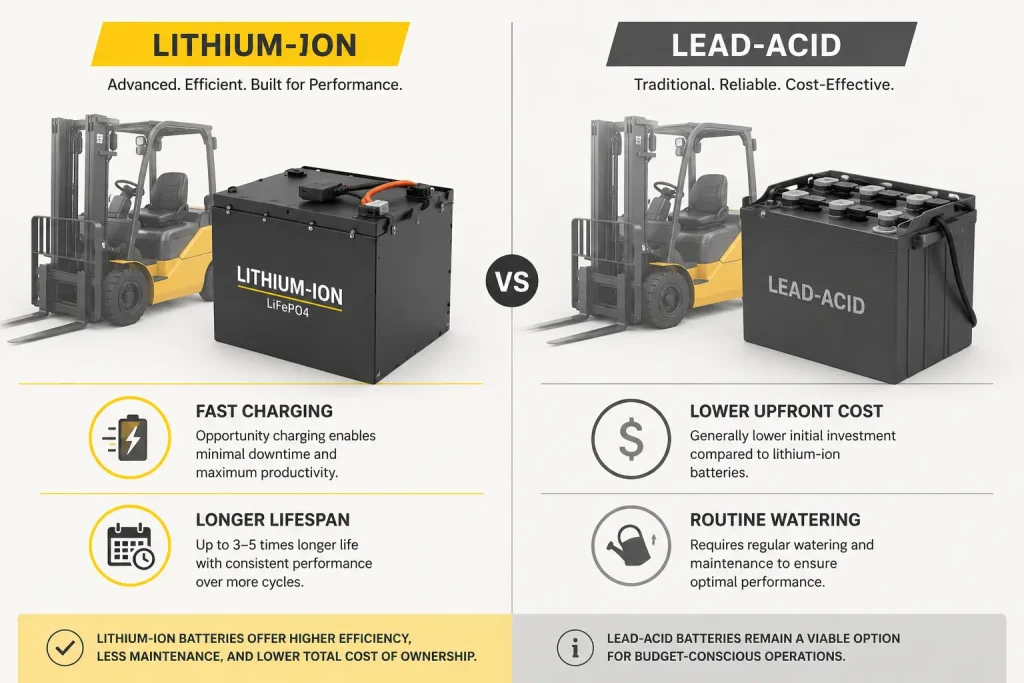
Much of the recent acceleration in electric forklift adoption comes down to genuine improvements in battery technology, which have addressed many of the practical limitations that once made electric equipment less attractive for demanding, multi-shift operations.
These improvements have narrowed the gap between electric and combustion-powered equipment considerably, removing several of the operational compromises that businesses previously had to accept in exchange for electric power’s cost and emissions benefits.
Lithium-Ion vs Traditional Lead-Acid Batteries
Lithium-ion batteries, increasingly standard in newer electric forklift models, offer meaningfully higher energy density, longer overall lifespan, and no need for the water topping and equalisation charging that traditional lead-acid batteries require as routine maintenance. Further technical background on how lithium-ion battery chemistry achieves these advantages is available through Wikipedia’s overview of lithium-ion batteries, covering the underlying technology in more depth.
Lead-acid batteries remain a viable, lower-cost option for many applications, particularly where charging infrastructure or budget constraints favour the older, well-established technology, but lithium-ion’s growing cost-competitiveness has made it an increasingly common choice even outside premium equipment tiers.
Faster Charging and Reduced Downtime
Lithium-ion batteries support fast, opportunity charging during short breaks throughout a shift, rather than requiring a single long overnight charge or a full battery swap partway through the day, significantly reducing the fleet downtime that older battery technology once made unavoidable. This capability has removed one of the most commonly cited operational objections to electric forklifts in multi-shift, high-utilisation environments.
This shift in charging flexibility has made electric forklifts viable for operations that previously assumed only diesel equipment could sustain continuous, round-the-clock use, closing much of the practical gap between the two power sources for demanding applications.
Smoother, More Precise Operation
Beyond cost, emissions, and noise, electric forklifts offer a genuinely different operating experience that many operators come to prefer once accustomed to it, built around the specific characteristics of an electric drivetrain.
This difference in feel is not simply a matter of preference, it reflects real mechanical advantages in how electric motors deliver power compared to a combustion engine and transmission.
Instant Torque and Smooth Control
Electric motors deliver full torque immediately from a standstill, without the gear changes or engine response lag inherent to a combustion drivetrain, giving operators smoother, more immediately responsive control, particularly useful for precise positioning tasks in tight racking aisles. This immediate torque delivery also makes electric forklifts easier to control at very low speeds, a genuine advantage in confined warehouse environments.
The consistency of this power delivery, unaffected by engine RPM or gear selection, gives operators a more predictable machine to work with over an entire shift, which many warehouses report translates into fewer minor collisions and smoother overall material handling.
Operator Comfort Over Long Shifts
Reduced noise and vibration, combined with smoother acceleration and braking, contribute to lower physical fatigue for operators working extended or multiple shifts on an electric forklift compared to a combustion-powered equivalent. Over a full working day, this cumulative reduction in physical strain can meaningfully affect operator alertness and, by extension, overall site safety.
Understanding how different forklift types, including counterbalance and reach truck configurations, are engineered around operator ergonomics is covered in our guide below, useful background for businesses selecting a specific electric configuration for their operation.
Also read: Counterbalance Forklift: How It Works and When to Use It
Where Electric Forklifts Deliver the Most Value
While electric forklifts offer meaningful benefits across most applications, certain environments and business types see these advantages compound into particularly strong value, making electric power the clear default choice rather than simply one reasonable option among several.
Recognising these high-value use cases helps businesses prioritise where to invest in electric equipment first, particularly when transitioning a mixed fleet gradually rather than switching every machine at once.
Indoor Warehouses and Retail Distribution
Enclosed warehouses and retail distribution centres benefit most directly from electric power’s zero-emissions operation, since these environments have limited ventilation and often run continuous shifts where exhaust accumulation would otherwise become a genuine health concern. The quieter operation also suits these settings particularly well, given the close proximity between forklifts and picking or packing staff throughout a shift.
Businesses operating primarily on smooth, level warehouse floors are also well positioned to capture electric power’s lower running cost advantage, since these conditions play to an electric drivetrain’s strengths without requiring the higher torque that rough or uneven terrain typically demands.
Food, Pharmaceutical, and Cold Storage Facilities
Facilities handling food, pharmaceuticals, or other regulated goods benefit significantly from electric power’s absence of combustion byproducts, which removes any risk of exhaust contamination affecting stored products or triggering regulatory non-compliance. Cold storage facilities in particular favour electric equipment, since combustion engines generally perform less efficiently in low-temperature environments compared to electric drivetrains.
Businesses in these sectors evaluating which specific forklift configuration best suits their facility and regulatory requirements can find a structured decision framework below, which covers electric-specific considerations alongside broader selection criteria.
Also read: How to Choose a Forklift: A Complete Buyer’s Guide
Make the Switch to Electric
The case for electric forklifts has strengthened considerably as battery technology has advanced, closing many of the practical gaps that once limited their use to light-duty indoor applications alone. Lower running costs, zero emissions, quieter operation, and improved operator comfort together make electric power an increasingly compelling default choice across a growing range of warehouse and distribution operations.
RR Machinery Pte Ltd offers a diverse selection of electric, diesel, and gasoline forklifts suited to every application and budget. Contact us today for expert advice on whether electric power is the right fit for your operations.