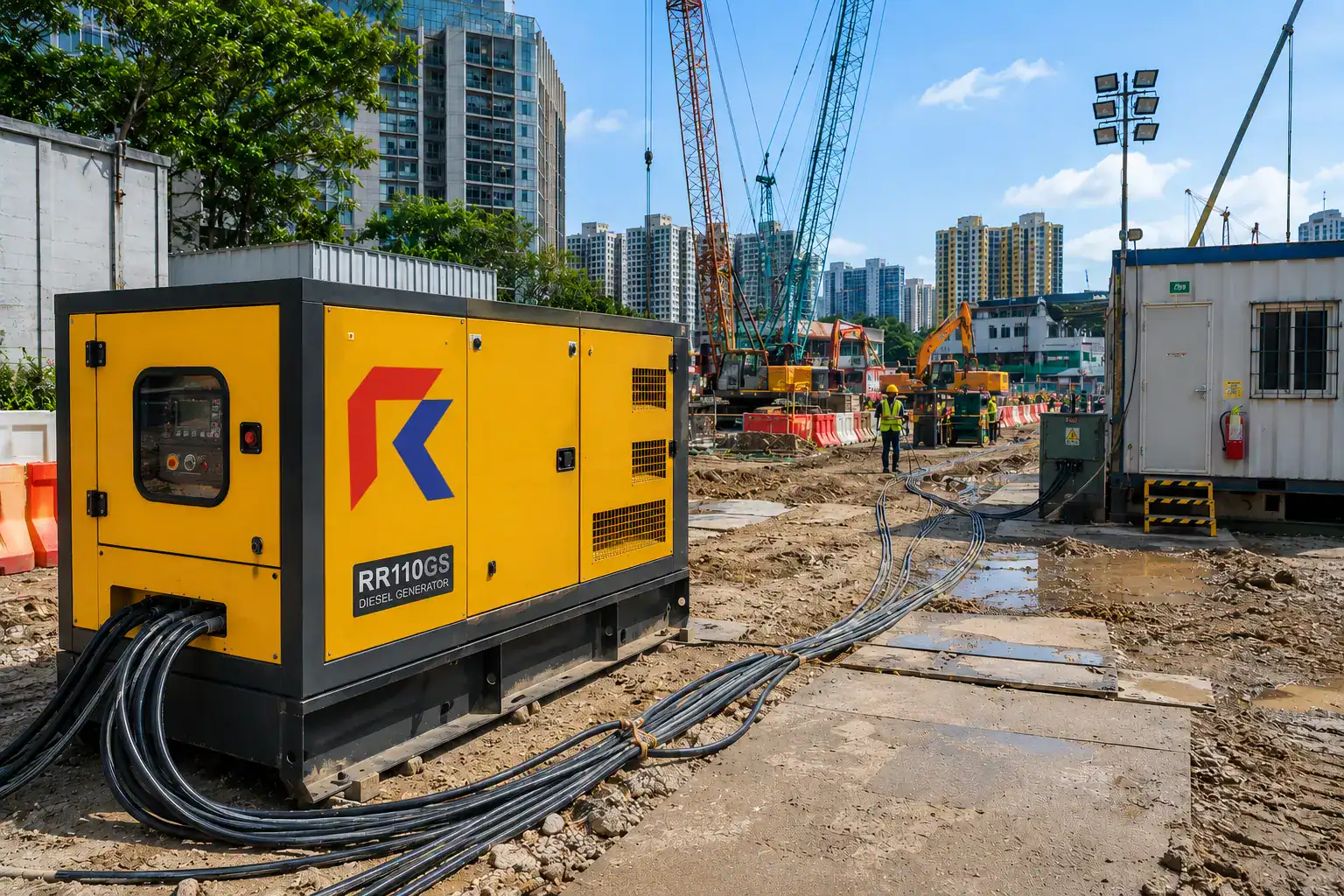
A construction site without reliable power quickly grinds to a halt, tools stop running, lighting disappears, and site offices lose the ability to function at all. Unlike a home or office backup system that sits idle most of the time, a construction site generator is often the primary source of power from the very first day of a project, powering everything from heavy equipment to portable lighting towers.
Choosing the right generator for this environment involves far more than picking a unit with a large enough number on the specification sheet. This guide walks through the practical factors, power type, fuel, sizing, runtime, and maintenance, that determine whether a generator will actually keep a construction site running smoothly from groundbreaking to handover.
Why Construction Sites Need a Dedicated Generator
Most construction sites have no permanent grid connection in their early phases, and even where one eventually exists, it is rarely available until well into the project, making an on-site generator the only practical source of power from day one.
This makes the generator one of the most operationally critical pieces of equipment on any site, since nearly every other trade and activity depends on it functioning reliably, directly or indirectly. Understanding exactly what a site generator needs to power helps clarify why sizing and reliability matter so much more here than in a typical backup power application.
Powering Tools and Machinery
Power tools, welding equipment, compressors, and small machinery all draw power directly from the site generator, and many of these tools, particularly those with electric motors, require a brief surge of starting current well above their steady running load. A generator undersized for this starting current can stall or trip under load even if its continuous rating looks sufficient on paper for the tools’ running wattage alone.
Larger equipment such as concrete mixers, pumps, and hoists add further demand, often running simultaneously with smaller tools during peak site activity. Understanding the complete mechanism behind how a generator actually converts fuel into usable electrical power is covered in How Does a Generator Get Power? The Science Explained, useful background for understanding why load and starting current matter so much to reliable operation.
Powering Site Facilities and Lighting
Beyond tools and machinery, a construction site generator also needs to support site offices, welfare facilities, security lighting, and task lighting for early morning or after-dark work, loads that are often overlooked when sizing a generator around equipment alone. These facility loads tend to run continuously throughout a shift rather than intermittently like power tools, adding a steady baseline demand on top of the more variable equipment load.
Security lighting and CCTV systems in particular often need to run overnight when the rest of the site is inactive, which is why many sites use a smaller standby unit for overnight security loads separately from the larger generator powering daytime construction activity. Getting this split right avoids running an oversized generator inefficiently overnight just to power a handful of lights and cameras.
Standby vs Prime Power for Construction Sites
One of the first decisions in specifying a construction site generator is whether it needs to run as a prime power source or simply as standby backup for an existing supply.
This distinction affects far more than terminology, it directly shapes how the generator is rated, how it should be maintained, and how much runtime it needs to sustain reliably without excessive wear.
When a Site Needs Prime Power
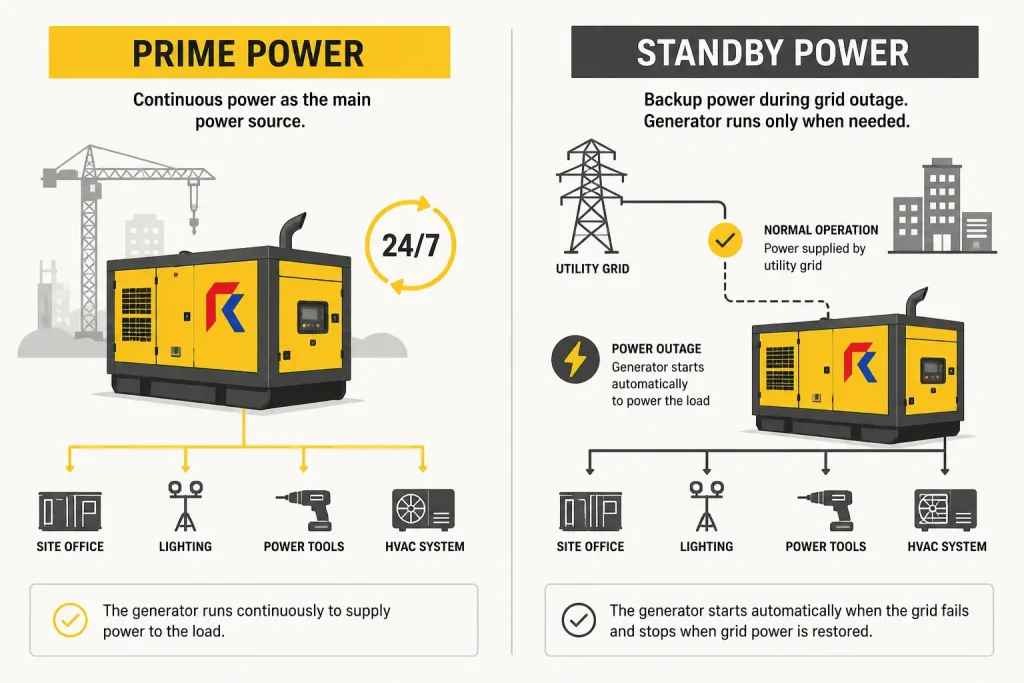
Prime power generators are designed to run as the primary and, in many cases, continuous source of electricity on a site, typically for extended periods across multiple shifts with variable loads throughout the day. Sites without any grid connection at all, or where grid connection will not be available until much later in the project, almost always require a generator rated for prime power use from the outset.
Prime-rated generators are built with this continuous duty cycle in mind, using components engineered for sustained operation rather than occasional short bursts, which is an important distinction when comparing specification sheets between different units marketed for site use.
When a Site Needs Standby Power
Standby power generators, by contrast, are intended to activate only when a primary power source, typically a grid connection, fails or is unavailable, running for shorter, less frequent periods rather than continuously throughout a shift. Sites that already have a grid connection but need backup coverage for outages, or that need power specifically for after-hours security and monitoring, are better served by a standby-rated unit.
Using a standby-rated generator for prime power duty, or vice versa, can lead to premature wear or an oversized, inefficient setup, which is why understanding this distinction clearly before specifying equipment matters considerably. A detailed comparison of how these two ratings differ in practice is covered in Standby vs Prime Generator: Key Differences Explained.
Also read: Standby vs Prime Generator: Key Differences Explained
Choosing the Right Fuel Type for a Construction Site
Fuel type affects a generator’s runtime, refuelling logistics, and total operating cost over the life of a construction project, making it one of the more consequential specification decisions for site power.
Most construction sites in Singapore rely on diesel power for the bulk of their electricity needs, though the right choice still depends on the site’s specific scale, duration, and access to fuel supply logistics.
Diesel Generators on Construction Sites
Diesel generators remain the standard choice for construction sites due to diesel fuel’s higher energy density, the engine’s ability to sustain heavy continuous loads, and the widespread availability of diesel refuelling logistics across most project locations. Diesel units also tend to have longer service intervals under heavy use compared to smaller petrol alternatives, an important factor for a generator expected to run for months or years across a project’s duration.
The trade-off is a higher upfront cost and heavier unit weight compared to petrol alternatives, though for any site running as prime power across an extended project timeline, this is almost always outweighed by diesel’s lower running cost per unit of energy delivered and its ability to sustain heavier loads reliably.
Petrol and Alternative Fuel Options
Petrol generators are more commonly used for smaller, short-duration site needs, such as powering a handful of tools on a small residential renovation or a brief standby application, where the lighter unit weight and lower upfront cost outweigh diesel’s efficiency advantage at scale. Natural gas generators are increasingly used where a site has access to a gas supply and prioritises lower emissions and quieter operation over diesel’s raw power density.
A detailed comparison of how diesel and petrol generators perform against each other across cost, runtime, and site suitability is available in Diesel vs Petrol Generator: Which One Should You Choose?, useful reading before finalising a fuel type for a specific project.
Also read: Diesel vs Petrol Generator: Which One Should You Choose?
Sizing a Generator for Construction Site Loads
An undersized generator on a construction site causes constant tripping, tool damage, and project delays, while an oversized unit wastes fuel and increases cost without providing any real benefit, making accurate sizing one of the most important steps in specifying site power.
Sizing correctly requires looking beyond the site’s average expected load to the actual peak demand that could occur when multiple tools and facilities draw power simultaneously.
Calculating Total Site Load
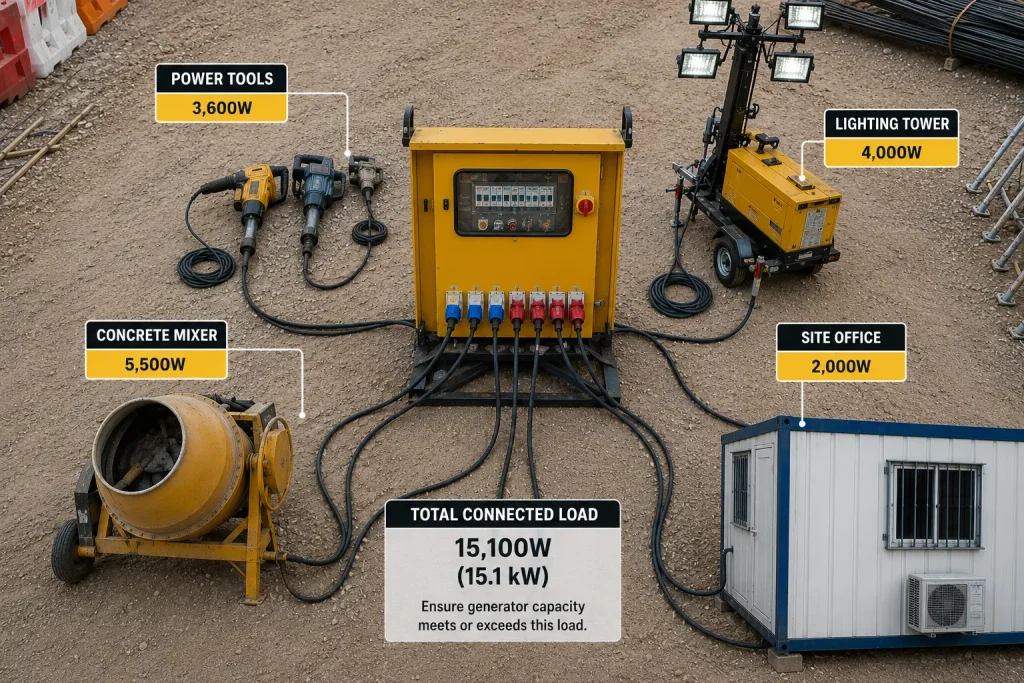
Sizing begins with listing every piece of equipment, tool, and facility expected to draw power from the generator, along with each item’s running wattage, then summing these figures to establish a baseline total load for the site. This baseline should reflect a realistic worst-case scenario, accounting for the busiest period of the project when the most equipment is likely to be running concurrently, rather than an average or typical moment.
A detailed, step-by-step method for carrying out this calculation accurately is available in How to Calculate Generator Load: A Step-by-Step Guide, which applies directly to construction site load planning as much as it does to any other generator application.
Accounting for Starting Current and Future Growth
Beyond steady running load, many tools and machines draw a significant surge of starting current, sometimes several times their running wattage, for a brief moment when first switched on, and a generator must be sized to handle this peak surge rather than just the combined running wattage of all connected equipment. Failing to account for this is one of the most common reasons a generator that looks adequately sized on paper still trips repeatedly on-site.
Construction sites also tend to grow in power demand as a project progresses, adding trades, equipment, and facilities as work advances, so sizing with some margin above the current known load helps avoid needing to upgrade equipment mid-project. A broader framework for approaching generator sizing decisions across different project types is set out in What Size Generator Do I Need? A Practical Sizing Guide.
Fuel Efficiency and Runtime on Site
Fuel efficiency and sustained runtime directly affect both the operating cost of a construction site generator and how frequently the site team needs to manage refuelling logistics.
Since a site generator is often expected to run for extended hours across weeks or months, even small differences in fuel efficiency compound into meaningful cost differences over the life of a project.
Managing Fuel Consumption
Fuel consumption depends on both the generator’s load level relative to its rated capacity and how consistently that load is applied, since running a generator well below its rated capacity for extended periods is often less fuel-efficient than running it closer to an optimal load band. Reducing unnecessary idle running time and switching off equipment not actively in use both meaningfully reduce total fuel consumption across a project.
Broader fuel efficiency practices that apply across heavy equipment generally, not just generators, are covered in Fuel Saving Tips for Heavy Equipment Operations, many of which apply directly to how a site generator is operated day to day.
Planning for Extended or Continuous Runtime
Construction sites often need a generator to run for extended, sometimes continuous, periods across a shift or even across several days for certain applications, which requires understanding the manufacturer’s recommended maximum continuous run time and any scheduled cooldown periods needed to protect the engine. Fuel tank capacity and refuelling logistics need to be planned around this runtime requirement, particularly for remote sites where frequent refuelling deliveries are impractical.
A detailed answer to exactly how long different generator types and sizes can sustain operation without stopping is available in How Long Can a Generator Run Without Stopping, useful for planning fuel logistics around a specific project’s expected runtime demands.
Keeping a Site Generator Running Reliably
A construction site generator is subjected to harsher operating conditions, dust, vibration, temperature extremes, and near-continuous use, than most other generator applications, making a consistent maintenance routine essential to reliable operation.
Unplanned generator downtime on an active construction site does not just inconvenience a single task, it can halt an entire day’s progress across multiple trades simultaneously, making preventive maintenance considerably more valuable here than in less critical applications.
Routine Maintenance on Site
Fuel and air filters need more frequent inspection on a dusty construction site than in a cleaner environment, since airborne dust and debris accelerate filter clogging and can affect combustion efficiency if left unaddressed. Engine oil, coolant levels, and battery condition should also be checked on a regular schedule reflecting the generator’s actual hours of use rather than a fixed calendar interval alone.
A complete, practical maintenance routine covering every component a site generator depends on is set out in Generator Maintenance Checklist: A Complete Site Guide, a useful reference for site supervisors managing equipment upkeep across a live project.
Site Safety Considerations
Generators on construction sites need to be positioned with adequate ventilation, protected from weather and site traffic, and connected through properly rated cabling and distribution boards to avoid electrical hazards across the site. Refuelling procedures should also follow strict safety practice, since a generator running near flammable materials or in a confined site area introduces fire risk that needs to be actively managed rather than assumed away.
Singapore’s Ministry of Manpower publishes detailed Workplace Safety and Health guidance covering electrical and equipment safety standards that apply to generator use and site power distribution on construction projects.
Also read: Generator Maintenance Checklist: A Complete Site Guide
Power Your Site With Confidence
Choosing the right generator for a construction site comes down to matching power type, fuel, size, and maintenance planning to the site’s actual operating conditions, rather than defaulting to whatever unit happens to be readily available. Getting this right from the outset keeps a project running smoothly from groundbreaking through to handover. Further technical background on generator design and classification is available through Wikipedia’s overview of electric generators, covering the broader engineering principles behind the equipment used across construction and industrial power applications.
RR Machinery Pte Ltd offers a wide selection of power generators, from compact 30 kVA units to heavy-duty 1000+ kVA industrial systems, professionally maintained and tested before every delivery. Contact us today to find the right generator for your construction site’s power needs.