Access at height is a fundamental requirement across construction, maintenance, installation, and facilities management. Choosing the right elevated work platform for any task, one that fits the site, the working height, the load requirement, and the operating environment, is a decision that directly affects both productivity and safety. Among the available options, the scissor lift occupies a clearly defined and widely applicable niche: it provides a stable, spacious, vertically elevating work platform that is simple to operate, economical to run, and practical across a wide range of indoor and outdoor applications.
Despite its widespread use, the scissor lift is frequently confused with boom lifts, cherry pickers, and other aerial work platform types, partly because the term “aerial lift” is applied broadly to all of them, and partly because the scissor lift’s appearance varies significantly between models. Understanding precisely what a scissor lift is, how it works, what types are available, when it is the right choice, and what safety requirements apply is practical knowledge for site managers, facilities teams, and anyone responsible for specifying or managing working-at-height equipment.
What Is a Scissor Lift?
A scissor lift is a type of aerial work platform (AWP) or mobile elevating work platform (MEWP) in which a flat working platform is raised and lowered vertically by a scissoring mechanism, a set of linked, folding supports arranged in a crisscross pattern beneath the platform. When the scissoring mechanism is compressed horizontally by hydraulic cylinders, the linked arms extend vertically, raising the platform above the machine’s base. When the hydraulic pressure is released, the mechanism compresses and the platform descends.
The scissor lift’s defining characteristic, and the feature that most clearly distinguishes it from boom lifts and cherry pickers, is that the platform rises and descends in a straight vertical line directly above the machine’s base. The platform cannot be extended horizontally beyond the machine’s footprint. This vertical-only movement means the scissor lift can position a worker directly above its ground position with exceptional stability, but cannot reach around corners, over obstacles, or into spaces offset from the machine’s position.
This distinction, vertical travel only versus horizontal outreach capability, is the most operationally significant difference between scissor lifts and boom-type aerial work platforms. Understanding when vertical-only access is sufficient and when horizontal outreach is required is the foundation of correct aerial work platform selection. The full comparison of scissor lifts against boom lifts and other aerial work platform types is covered in the guide to aerial lift vs boom lift differences and how to choose the right type.
Also read : How to Build Scaffolding: A Step-by-Step Site Guide
How Does a Scissor Lift Work?
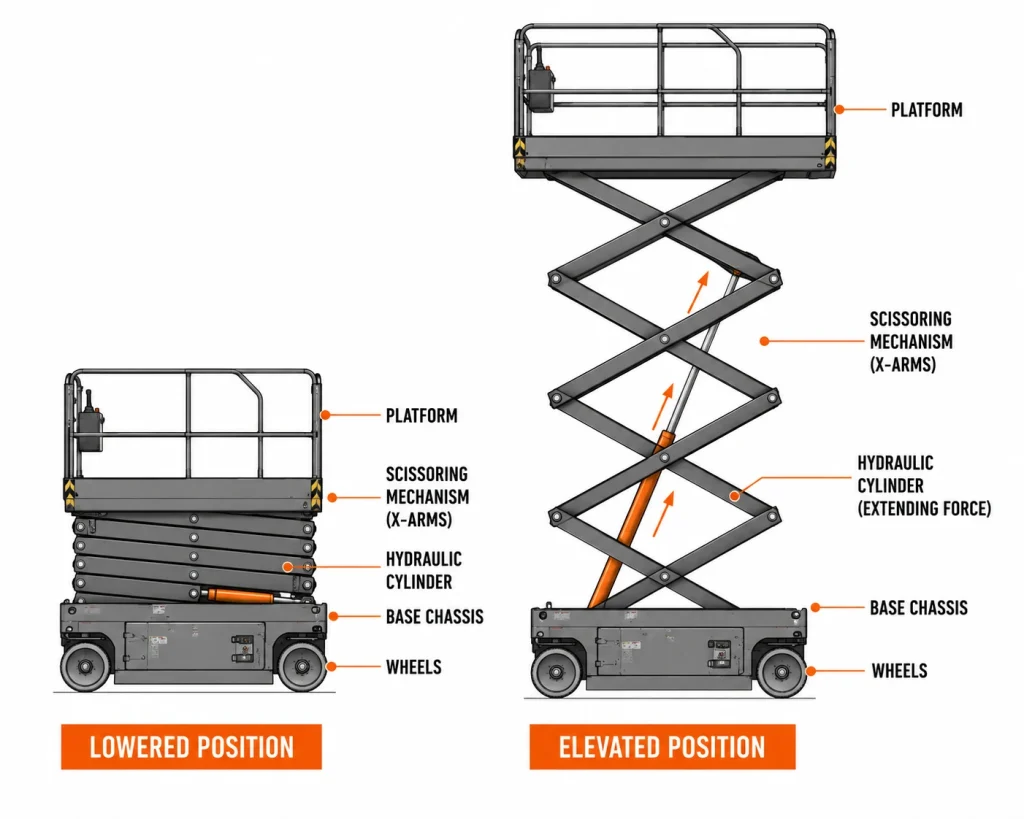
The scissoring mechanism beneath the platform consists of multiple pairs of crossed arms, each pair pinned at its centre in an X configuration. The bottom of the lowest X is pinned to the machine’s base chassis; the top of the highest X supports the platform. When hydraulic cylinders push the bottom ends of the lowest X arms toward each other, the crossed configuration forces the arms upward, compressing the horizontal width and expanding the vertical height of each X, and therefore of the full stack of X arms beneath the platform.
The number of X pairs in the stack, called lifts or stages, determines the platform’s maximum height. A single-lift scissor has one pair of crossed arms and achieves modest platform heights. A four-lift or five-lift scissor has multiple stacked pairs and achieves working heights of 12 metres or more. The more stages, the taller the potential height, but also the greater the mechanical complexity and the greater the machine’s stacked height when fully lowered.
The hydraulic system that drives the scissoring mechanism is powered either by an electric motor driving a hydraulic pump, on electric scissor lifts, or by a diesel or dual-fuel engine. The operator controls platform height from a control panel fitted to the platform guardrail, raising and lowering the platform using proportional controls that allow precise positioning at any height within the machine’s range.
The platform itself is typically a rectangular steel deck with folding or swing-out extension decks that can increase the platform area when the machine is stationary. Guardrails on all four sides, with a hinged access gate, provide the fall prevention system. An anchor point inside the platform allows operators to attach a fall arrest lanyard when required.
Key Components of a Scissor Lift
- Scissoring mechanism
The linked crossed-arm assembly beneath the platform. The structural core of the machine, must be inspected for cracks, deformation, pin wear, and hydraulic cylinder condition at every pre-use inspection.
- Platform
The working deck, typically fabricated from steel with anti-slip surface treatment. Available with fixed and extending sections. Platform load capacity, the maximum combined weight of people, tools, and materials, is marked on the machine and must not be exceeded.
- Hydraulic system
The pump, cylinders, hoses, and control valves that actuate the scissoring mechanism. Hydraulic leaks, at hose connections, cylinder seals, and valve bodies, must be identified and rectified before the machine is operated.
- Drive system
Electric scissor lifts use battery-powered electric traction motors. Diesel or rough terrain models use an engine-driven mechanical drive system. The drive system determines the machine’s travel speed, gradient capability, and ground traction.
- Battery (electric models)
The energy storage system that powers both the traction drive and the hydraulic lift system. Battery condition directly determines the machine’s available runtime per charge and its ability to complete a full working shift. The correct charging procedure, completing full charge cycles, maintaining electrolyte levels on flooded lead-acid batteries, using opportunity charging appropriately on lithium-ion units, is covered in full in the complete guide to how to charge a scissor lift and manage its battery.
- Tyres
Solid rubber, foam-filled, or pneumatic, depending on the model and application. Non-marking solid tyres are standard on indoor electric models. Pneumatic tyres are fitted to rough terrain models for outdoor and uneven surface use.
- Tilt alarm and outrigger system
Most scissor lifts are fitted with a tilt alarm that sounds if the machine is on a slope exceeding its rated gradient. Some larger models are fitted with outrigger stabilisers that extend the stability footprint for operation at maximum height.
- Control systems
Platform controls and ground-level override controls. Both must be tested at every pre-use inspection. The ground-level override allows the platform to be lowered in an emergency if the platform operator is unable to operate the controls.
Also read : Boom Lift vs Scissor Lift: Which One Should You Choose?
Types of Scissor Lifts
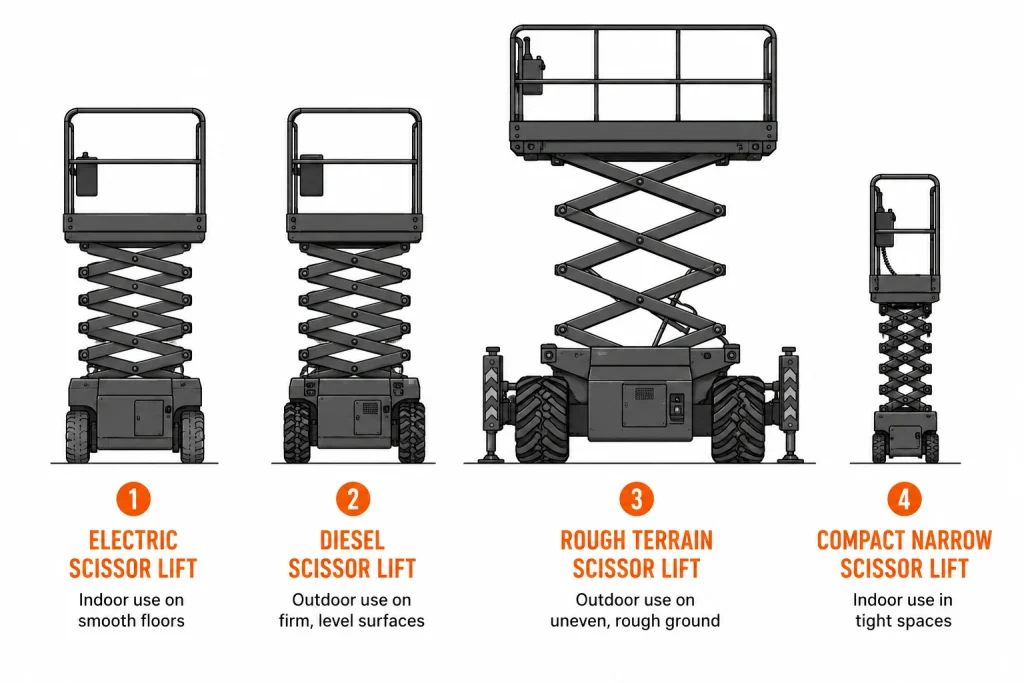
Scissor lifts are available in several configurations, each suited to a different operating environment, working height range, and ground condition.
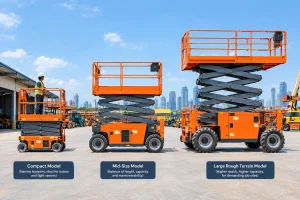
The main categories are electric scissor lifts, the standard choice for indoor and smooth-surface work due to their zero emissions and quiet operation; diesel scissor lifts, used outdoors where battery runtime would otherwise be a constraint; rough terrain scissor lifts, built with larger tyres, four-wheel drive, and outrigger stabilisers for unpaved or sloped ground; and compact narrow scissor lifts, designed for single-operator use in confined spaces such as doorways and tight aisles.
Each type suits a different combination of environment, ground condition, and access constraint, and choosing correctly has a direct effect on both productivity and safety. For a full breakdown of every scissor lift type, including working height ranges, platform capacities, and typical applications for each, see our complete guide: 6 Types of Scissor Lifts for Construction and Industry.
Also read : 6 Types of Scissor Lifts for Construction and Industry
When to Use a Scissor Lift
The scissor lift is the right working-at-height solution when the following conditions apply:
- The work is directly above the machine’s ground position
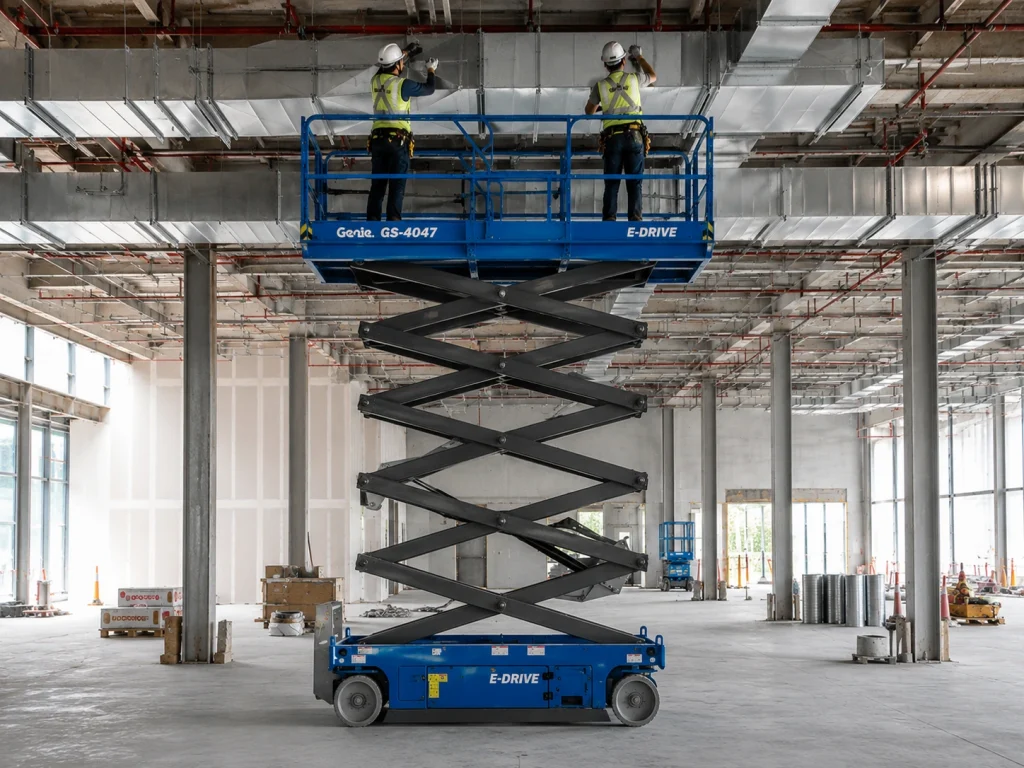
Ceiling maintenance, overhead lighting installation, ductwork and pipework installation, fire suppression system work, ceiling tiling, and any task performed directly above the machine’s footprint, these are the natural applications for a scissor lift. If the work is offset from the machine’s position, requiring horizontal reach beyond the footprint, a boom lift is required.
- Multiple operators or a wide working area is needed
Scissor lift platforms are significantly wider than boom lift baskets, and most models accommodate two operators simultaneously with space for tools and materials. For tasks where two trades must work alongside each other at height, or where a wide area of ceiling or overhead structure must be accessed from a single platform position, the scissor lift’s platform dimensions make it more appropriate than a single-basket boom lift.
- Indoor or semi-indoor environment with air quality requirements
Electric scissor lifts produce no exhaust emissions and operate quietly, they are the standard choice for warehouses, occupied buildings, food production facilities, hospitals, and any environment where diesel exhaust is not permissible.
- Working height is within the scissor lift range
For working heights up to approximately 14 to 18 metres, a scissor lift is typically more economical and more stable than an equivalent boom lift. For working heights exceeding this range, or where the access geometry requires horizontal outreach, a boom lift or cherry picker is required.
- The floor surface is firm and level
Standard electric scissor lifts require a smooth, hard, level surface. For rough or outdoor surfaces, a rough terrain model is required. Understanding when scissor lifts, boom lifts, and cherry pickers are each the right choice, based on height, outreach, environment, and ground conditions, is covered in the practical guide to what a cherry picker is and when to use one versus other aerial work platforms.
Scissor Lift vs Boom Lift
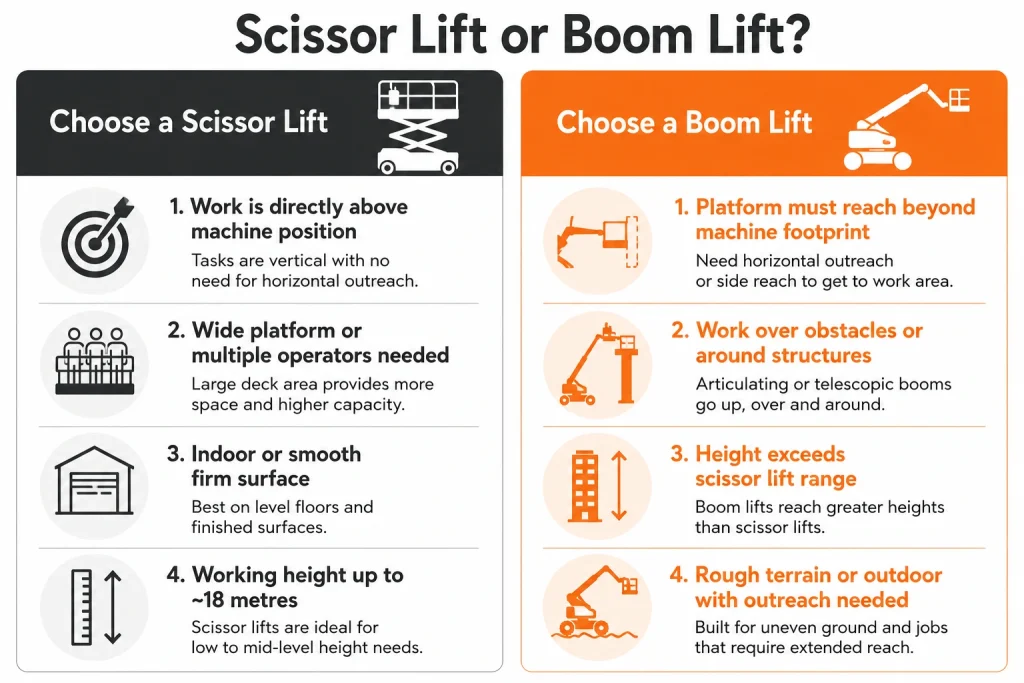
The most common specification decision involving scissor lifts is the choice between a scissor lift and a boom lift for a given access task. The decision is straightforward when the access geometry is clear:
Choose a scissor lift when the work is directly above the machine’s ground position, the platform must accommodate multiple operators or wide material loads, the working height is within the scissor lift range, and the environment is indoors or on a smooth firm surface.
Choose a boom lift when the platform must reach horizontally beyond the machine’s footprint, the work requires reaching over an obstacle or around a structure, the working height exceeds the scissor lift’s range, or the site requires rough terrain capability in a single machine that combines outreach and rough terrain mobility.
For a detailed operational comparison of boom lifts and scissor lifts, including how each type fits into the broader aerial work platform family and the decision process for selecting between them, Boom Lift vs Scissor Lift: Which One Should You Choose? covers every relevant dimension.
Safety Requirements for Scissor Lift Operations
Scissor lift operations carry specific safety obligations that apply regardless of the model type or the working height involved.
- Pre-use inspection
Every scissor lift must be inspected before each shift by a competent person. The inspection covers the scissoring mechanism for cracks and deformation, the platform structure and guardrails, the hydraulic system for leaks, the tyres or tracks for condition, the battery charge level on electric models, and the operation of all controls including the ground-level override and the tilt alarm. Any defect must be reported and rectified before the machine is used.
- Operator certification
Scissor lift operators must hold a current IPAF PAL card certification at the relevant machine category, 3a for scissor lifts, or an equivalent nationally recognised working-at-height certification. Certification must be in date and appropriate for the specific machine. An operator certified for a boom lift is not automatically certified for a scissor lift and vice versa.
- Ground and surface assessment
The surface beneath the scissor lift must be assessed for bearing capacity, levelness, and stability before the machine is positioned and the platform elevated. On internal floors, the structural floor capacity must be confirmed against the machine’s wheel loads. On external or unpaved surfaces, only rough terrain models rated for those conditions should be deployed. The consistent approach to ground and surface assessment for all elevated work platforms is set out in guidance on lifting equipment safety and surface assessment for aerial work platform operations.
- Platform load compliance
The combined weight of all operators, tools, and materials on the platform must not exceed the machine’s rated platform capacity. Platform capacity is marked on the machine and must be confirmed before each use. Overloading the platform is a safety violation and a leading cause of structural and hydraulic overload incidents.
- Gradient limits
Every scissor lift has a rated maximum gradient for both travel and lifting. The tilt alarm provides a warning when the gradient approaches the operational limit, but the machine must not be elevated on a gradient that exceeds the manufacturer’s rated lifting limit, even if the tilt alarm has not yet activated.
- Exclusion zones
A ground-level exclusion zone appropriate to the working area must be maintained beneath the elevated platform, preventing pedestrians and site traffic from entering the area where falling objects could cause injury. This requirement is consistent across all aerial work platform types and is part of the broader site safety framework for working-at-height operations, as covered in the practical guide to heavy equipment safety on construction and industrial sites.
Also read : 5 Benefits of Using a Scissor Lift for Construction Work
The Right Platform for the Right Task
The scissor lift is one of the most productive and cost-effective aerial work platforms available for direct overhead access on firm surfaces. Its wide platform, stable vertical travel, and simple operation make it the default choice for a wide range of construction, maintenance, and installation tasks where the work is above the machine’s position and where the environment permits its use.
Understanding what it can and cannot do, and when a boom lift, a cherry picker, or a mobile scaffold tower is the more appropriate choice, is the key to deploying it correctly. The scissor lift excels in its category: stable, spacious, economical overhead access. Outside that category, another platform type will serve the task better.
RR Machinery provides a comprehensive range of scissor lifts and aerial work platforms for rental and sale, including electric and rough terrain models across a wide working height range, all maintained to full operational standard and available with guidance from experienced equipment specialists. Explore our full range of scissor lift and aerial work platform options, or contact our team for practical advice and a clear quotation matched to your working height, site conditions, and access requirements.hiw does