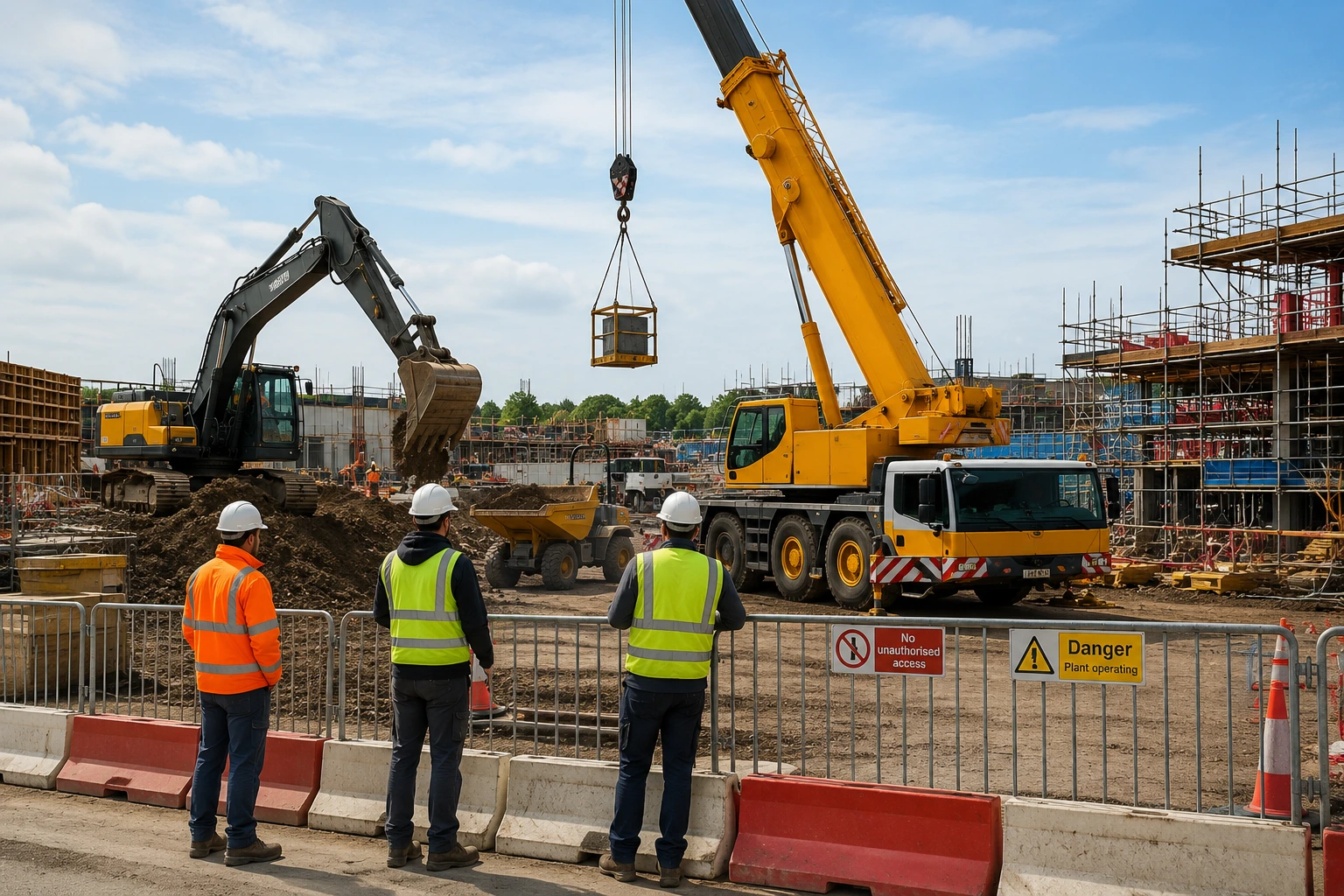
Heavy equipment is the most significant source of fatal and serious injuries on construction sites worldwide. Excavators, bulldozers, cranes, mobile elevated work platforms, and the full range of earthmoving and lifting plant all operate at energy levels that leave no margin for error. A crane load that exceeds the rated capacity, an excavator operating without a confirmed exclusion zone, a boom lift deployed on ground that cannot sustain its wheel loads, each of these conditions can kill or cause life-changing injuries in a fraction of a second, without warning, and with consequences that no amount of subsequent investigation or remediation can reverse.
Heavy equipment safety is not a compliance exercise. It is not a set of paperwork requirements imposed by regulators on unwilling site teams. It is the operational discipline, the systematic application of specific practices before, during, and after every equipment operation, that keeps experienced plant operators, ground workers, and site visitors alive and uninjured in an environment where the forces and energies at work are not inherently forgiving.
This guide sets out the core heavy equipment safety requirements that apply across all categories of construction plant: the pre-use inspection and pre-operation planning requirements, the competency and certification requirements for operators and supervisors, the site management controls that govern how equipment interacts with other plant and with pedestrians, the ground and environmental assessment requirements, and the specific safety considerations that apply to the major plant categories used on construction and civil engineering sites.
Why Heavy Equipment Incidents Happen
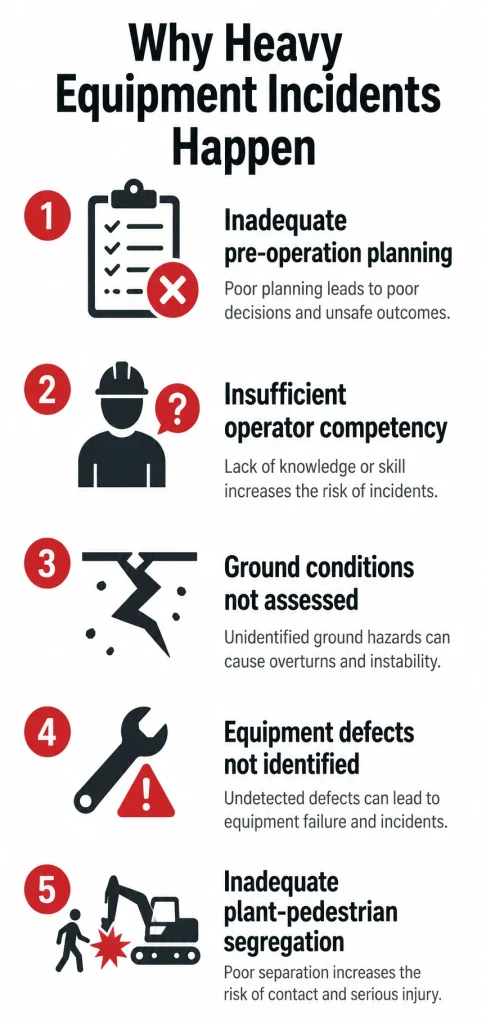
Understanding the common causes of heavy equipment incidents is the starting point for preventing them. Incident investigation data from construction and mining regulators across multiple jurisdictions consistently identifies the same categories of causal factor:
- Inadequate pre-operation planning
Incidents frequently occur because the lift plan, the exclusion zone, the ground assessment, or the equipment selection was not completed before the operation began. Decisions made under time pressure, without adequate information, create conditions that skilled operators cannot compensate for.
- Operator error and insufficient competency
Operating heavy equipment requires specific training, certification, and ongoing competency maintenance. Operating a machine type for which the operator is not certified, operating a machine in conditions beyond their experience level, or operating a machine while fatigued or distracted are consistent factors in heavy equipment incidents.
- Ground and environmental conditions not assessed
Equipment deployed on ground that cannot sustain the loads imposed by its tyres, tracks, or outriggers will settle, tip, or slide. Overhead hazards, power lines, structural elements, that have not been identified and controlled before operations begin are a consistent cause of contact incidents.
- Equipment defects not identified before use
Pre-use inspection exists because equipment develops defects in service, hydraulic leaks, brake faults, tyre damage, structural cracks, that must be identified and rectified before the machine is operated. Operating defective equipment is a choice, made by whoever allows the machine to be used without completing a pre-use inspection.
- Inadequate segregation of plant and pedestrians
The most common mechanism of fatal heavy equipment incidents on construction sites is contact between a moving machine and a pedestrian, typically in a blind spot, during a reversing manoeuvre, or in an area where pedestrian and plant access routes have not been separated. Segregation failures are planning failures, not operator failures.
Also read : Types of Graders: How Each Works and When to Use One
Pre-Use Inspection: The Non-Negotiable First Step
No heavy equipment should be operated without a pre-use inspection completed by a competent person before each working period. The pre-use inspection is the mechanism by which defects that have developed since the last inspection, or since delivery if the machine is new to site, are identified before they create a hazard during operation.
The pre-use inspection must be specific to the machine type. For an excavator, it covers the condition of the tracks or tyres, the hydraulic system, the boom and bucket pins, the cab controls, and the slewing ring. For a mobile crane, it covers the wire rope or chain condition, the hook and safety latch, the outrigger condition, the load indicator, and the boom structural condition. For a boom lift or scissor lift, it covers the platform structure, the guardrails, the emergency lower system, the tyres or tracks, and the stability indicators.
The inspection must be recorded, a signed pre-use checklist that identifies the machine, the date, the inspector, and the findings. Any defect identified during inspection must be reported and the machine must not be operated until the defect is rectified and a new inspection confirms the machine is in a safe condition.
Pre-use inspection is the first control in the safety chain for every category of lifting and access equipment. The inspection requirements that apply to cranes, aerial work platforms, and lifting equipment are set out in detail in guidance on lifting equipment safety and pre-use inspection requirements for construction plant.
Operator Competency and Certification
Every operator of heavy equipment must hold a current certification appropriate to the machine type and category they are operating. This is not a recommendation, in most jurisdictions it is a legal requirement, and in all jurisdictions it is a fundamental safety requirement that cannot be waived by site pressure, crew shortages, or convenience.
Certification requirements vary by machine category. Crane operators require certification specific to the crane type, mobile crane, tower crane, crawler crane, and in many jurisdictions must hold a licensed operator certificate issued by a national authority. Excavator and bulldozer operators require plant operator certification at the relevant machine size category. Boom lift and scissor lift operators require IPAF PAL card certification at the relevant machine category. Scaffolding erectors and supervisors require scaffolding certification appropriate to the scaffold type.
Certification does not expire once issued, it requires periodic renewal and, for some categories, evidence of ongoing operational experience. An operator whose certification has lapsed is not a certified operator, regardless of their experience level or the number of years they have operated the machine.
Beyond formal certification, operators must be competent for the specific conditions of the operation they are asked to perform. A certified crane operator who has not previously operated in a confined urban site, near overhead power lines, or in high wind conditions is not automatically competent for those conditions. Competency is task-specific and environment-specific, not just machine-specific.
The responsibility for confirming operator competency lies with the employer and the principal contractor, not with the operator. An operator should not be placed in a situation where their competency is insufficient for the task, and site management must actively confirm certification and experience before assigning any operator to a heavy equipment task.
Ground Assessment and Bearing Capacity
Ground failure beneath heavy equipment is one of the most dangerous and most preventable causes of plant overturn and structural failure. When the ground beneath an excavator track, a crane outrigger, or a scaffold base plate cannot sustain the load imposed on it, the machine sinks, tilts, and in severe cases tips, with catastrophic consequences for anyone in the overturn path and for the operator in the cab.
Ground assessment must be carried out before any heavy equipment is positioned for operation. The assessment must establish:
- The ground type and condition
Made ground, disturbed ground, recently filled areas, and ground softened by rainfall or groundwater all have significantly lower bearing capacity than undisturbed natural ground of the same soil type. The presence of buried voids, service trenches, old foundations, cellars, beneath the apparent ground surface can cause sudden and catastrophic ground collapse under equipment loads.
- The bearing capacity required
The load imposed on the ground beneath each support point, each track, each outrigger pad, each wheel or base plate, must be calculated and compared to the ground’s assessed bearing capacity. For cranes, this calculation is part of the lift plan. For excavators and other plant, it should be part of the site establishment and plant positioning plan.
- The mitigation measures required
Where the ground bearing capacity is insufficient for the equipment loads, mitigation measures, timber mats, steel plates, engineered ground improvement, must be specified and installed before the equipment is positioned. Proceeding without mitigation on ground of insufficient capacity is not a risk to be accepted, it is a condition to be resolved.
This ground assessment requirement applies consistently across all categories of heavy equipment, from rough terrain cranes operating on unpaved construction sites to mobile scaffold towers positioned on soft or uncertain indoor floors.
Exclusion Zones and Pedestrian Segregation
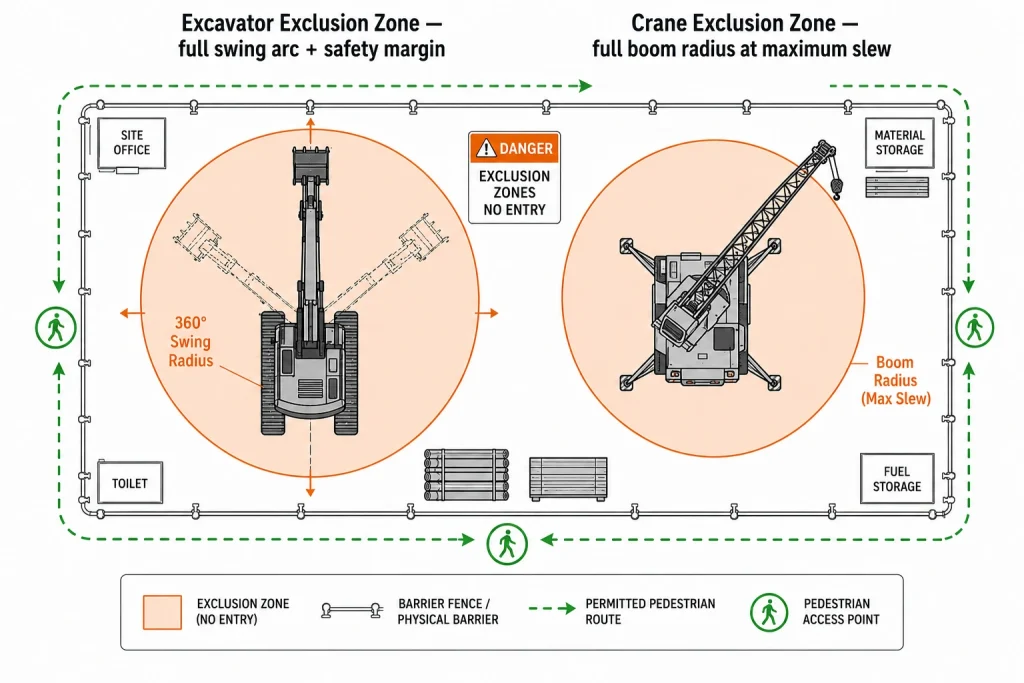
The most reliable protection against contact incidents between heavy equipment and pedestrians is physical separation, keeping pedestrians out of the areas where plant operates, and keeping plant out of the areas where pedestrians move. Exclusion zones are the mechanism for achieving this separation.
An exclusion zone is a defined area around operating plant from which all unauthorised personnel are excluded during equipment operation. The zone must be:
- Sized appropriately for the operation
A crane slewing through 360 degrees requires an exclusion zone that encompasses the full radius of the boom plus the load radius. An excavator requires a zone that encompasses its full swing arc plus a safety margin. A reversing articulated dump truck requires a zone behind the vehicle that accounts for its turning path. The zone must be sized for the worst-case machine movement during the operation, not the average movement.
- Physically demarcated
Exclusion zones must be marked with physical barriers, temporary fencing, barrier tape supported on pins, or permanent hoarding, that prevent inadvertent entry. Verbal instruction alone is not an adequate exclusion zone control.
- Enforced
A demarcated exclusion zone that is not enforced provides a false sense of security. Access to the exclusion zone must be actively managed, by a banksman, a traffic marshal, or a physical lock-out of the access points, throughout the operation.
For operations where plant and pedestrians must share the same space, delivery areas, access points, welfare facility entrances, a formal traffic management plan must be developed and implemented. The traffic management plan identifies the routes for plant and for pedestrians separately, the crossing points where they interact and the controls at those crossing points, the speed limits for plant, and the signage and physical controls that enforce the plan on the ground. Construction site traffic management and the coordination of plant and pedestrian movement across an active site is a core element of construction site planning and the management of heavy plant operations.
Also read : Bulldozer vs Excavator: Differences and When to Use Each
Overhead and Underground Hazard Management
Two categories of environmental hazard present consistent risks to heavy equipment operations that are not always visible or obvious during site establishment: overhead power lines and underground services.
Overhead Power Lines
Contact between plant and overhead power lines is consistently one of the leading causes of fatal incidents in construction and civil engineering. The hazard is not limited to direct contact, electrical arcing can occur at distances of several metres from a live conductor, and the current that flows through an earthed machine following contact is sufficient to kill anyone touching the machine or the ground in the immediate vicinity.
Every plant operation in proximity to overhead power lines requires:
A confirmed safe clearance distance, typically a minimum of three metres from the nearest live conductor for standard distribution voltage lines, and greater distances for higher voltage transmission lines. Safe clearance distances must be confirmed with the network operator, not estimated from site. The HSE guidance on avoiding danger from overhead power lines sets out the safe clearance distances and the control measures required for plant operating near live conductors.
Physical prevention measures, goal posts, height restrictors, and proximity warning devices, that prevent plant from entering the safe clearance distance zone. Relying on operator judgement alone to maintain clearance is not an adequate control.
A written permit or safe system of work that identifies the hazard, the clearance distances, and the physical controls in place before any plant operates near the line.
Underground Services
Excavation near underground services, gas pipes, electricity cables, water mains, telecommunications cables, without confirming service locations and implementing safe digging procedures is a consistent cause of service strikes, explosions, fires, and electrocution incidents.
Before any excavation begins, service records must be obtained from all relevant network operators, a cable and pipe avoidance tool (CAT and Genny) survey must be conducted, and the results must be used to establish exclusion zones around confirmed service locations within which mechanical excavation is not permitted. Hand digging, or suction excavation using a vacuum excavator, must be used within these exclusion zones to expose services safely before mechanical excavation resumes.
Load Management and Rated Capacity Compliance
Every piece of lifting and access equipment has a rated capacity, the maximum load it can safely carry, that must not be exceeded under any operating condition. Exceeding the rated capacity of a crane, an excavator during lifting operations, a boom lift platform, or a scaffold creates structural and stability conditions that the machine’s design does not account for, with consequences that can include structural failure, overturn, or progressive collapse.
Rated capacity varies with operating configuration, for cranes, with boom length, radius, and counterweight configuration; for boom lifts, with boom angle and extension; for scaffolds, with bay width and height. The rated capacity at any given configuration must be confirmed from the machine’s load chart or the scaffold design before the operation is conducted.
Load charts must be read correctly and applied to the actual operating configuration, not to the best-case configuration in the chart. Applying a capacity figure from a different boom length, a different radius, or a different outrigger configuration than the one actually in use is one of the most consistent causes of crane and lifting equipment overloads. The principles of correct load chart application are set out in the guide to reading a crane load chart for safe lifting operations.
Equipment-Specific Safety Considerations
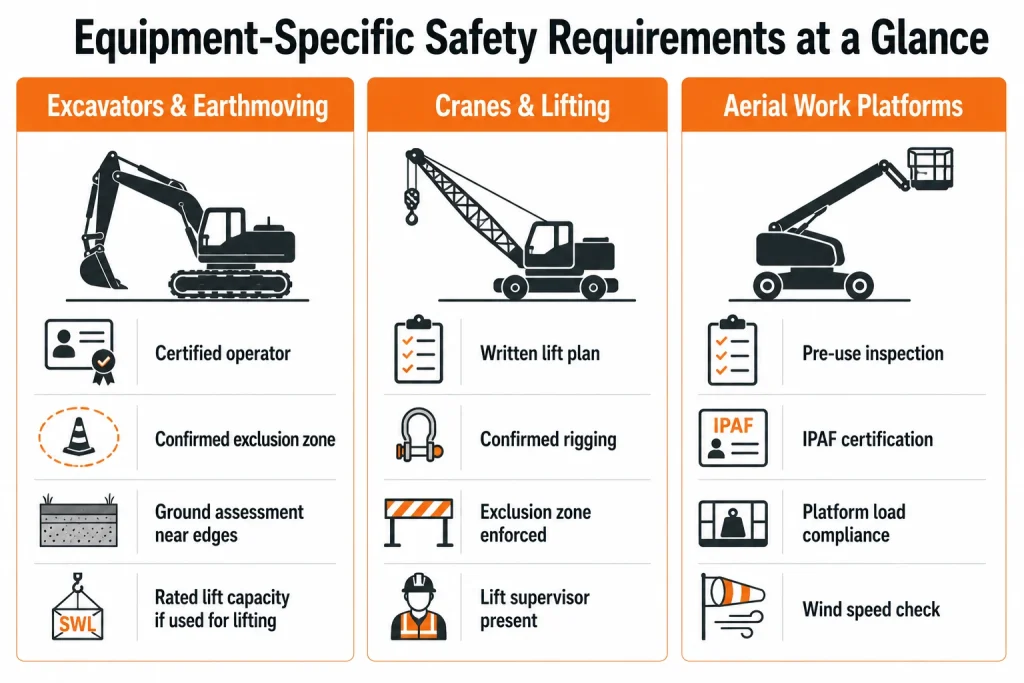
Excavators and Earthmoving Plant
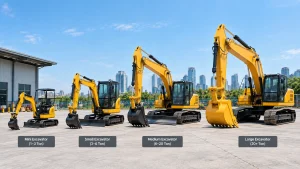
Excavators, bulldozers, and motor graders share a common set of safety requirements beyond the general plant safety principles above. All must be operated only by certified plant operators. All require confirmed exclusion zones during operation. All require ground assessment before positioning, particularly when operating near excavation edges, embankments, or recently disturbed ground.
Excavators used for lifting, a common practice on construction sites where a dedicated crane is not available, must be operated within the machine’s rated lifting capacity at the relevant radius. Exceeding the excavator’s rated lift capacity during lifting operations is structurally dangerous and represents an uncontrolled lifting operation. The selection of the right machine for lifting tasks, and the operational differences between excavators and dedicated cranes, is directly relevant to the equipment selection guidance on types of excavators and their applications on construction sites.
Cranes and Lifting Equipment
Crane operations carry some of the highest safety stakes of any construction site activity. Every crane lift must be planned, with a lift plan that specifies the crane configuration, the load weight and dimensions, the lift radius, the exclusion zone, and the communication arrangements between the operator, the rigger, and the signaller.
No lift may proceed without a confirmed ground assessment at the crane position, confirmed rigging of the load, a confirmed exclusion zone, and a confirmed communication protocol. The lift supervisor, a competent person separate from the crane operator, is responsible for confirming each of these conditions before giving the signal to lift.
Aerial Work Platforms
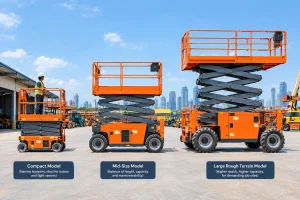
Boom lifts, scissor lifts, cherry pickers, and mobile scaffold towers all require pre-use inspection, operator certification, ground assessment, and platform load compliance before each use. The specific safety requirements for aerial work platforms, including the harness requirements for boom lift baskets, the height-to-base ratio requirements for mobile scaffold towers, and the wind speed limits for all elevated platform types, apply in addition to the general heavy equipment safety requirements above.
The full working-at-height safety framework that applies to aerial work platforms, from pre-use inspection through to emergency procedures, is directly connected to the requirements applicable to all construction site plant covered in this guide.
Building a Safety Culture Around Heavy Equipment
Rules, procedures, and inspection requirements are necessary conditions for heavy equipment safety, but they are not sufficient on their own. Sites where heavy equipment incidents are genuinely rare are sites where the safety culture, the shared norms, expectations, and behaviours of everyone from the site manager to the newest labourer, treats equipment safety as a non-negotiable operational standard rather than a bureaucratic burden.
Building that culture requires visible leadership commitment, site managers who conduct pre-start meetings, who stop operations when conditions change, and who treat near-miss reporting as valuable intelligence rather than inconvenient paperwork. It requires genuine competency development, operators who understand not just how to operate a machine but why the safety requirements exist and what happens when they are not followed. And it requires a site environment where raising a safety concern, about ground conditions, about a defective machine, about an exclusion zone that is not being maintained, is encouraged and acted upon rather than dismissed.
Heavy equipment safety is ultimately an organisational commitment, renewed every day on every site where plant operates alongside people.
Also read : What Size Generator Do I Need? A Practical Sizing Guide
Operate with Confidence, Work with the Right Equipment
Safe heavy equipment operations begin with correct equipment selection, the right machine for the task, in the right condition, operated by the right people. RR Machinery provides a comprehensive range of construction and lifting equipment for rental and sale, including excavators, mobile cranes, boom lifts, scissor lifts, mobile scaffolding, and power generators, all maintained to full operational standard and supported by experienced technical specialists.
Explore our full range of construction and heavy equipment solutions, or contact our team for practical advice on equipment selection, site safety planning, and a clear quotation matched to your project requirements and site conditions.