
Forklifts are among the most heavily used machines in warehouses, factories, ports, and construction sites, but they are also involved in a disproportionately high share of workplace injuries relative to how many workers actually operate them day to day. Most forklift incidents are not the result of unpredictable mechanical failure, they stem from a small, well-documented set of unsafe practices repeated across shifts until an incident eventually occurs.
This guide brings together the core safety tips every forklift operator, supervisor, and pedestrian working nearby should understand, along with the reasoning behind each one. Understanding why a practice matters, rather than simply following it as a rule, is what makes safe behaviour stick even during a busy, time-pressured shift.
Why Forklift Safety Matters
A forklift combines significant load-carrying capability with limited operator visibility and a comparatively high centre of gravity when carrying a raised or heavy load, a combination that makes it inherently less forgiving of operator error than most other warehouse equipment.
Understanding the specific ways this risk manifests in practice is the first step toward preventing it, since most forklift incidents fall into a handful of recurring, well-understood categories rather than being genuinely unpredictable.
Common Forklift-Related Risks
Overloading and uneven load distribution, poor visibility during travel, driving at unsafe speeds, improper turning or braking, and operating without proper training all appear repeatedly across forklift incident records. Equipment malfunction and poor maintenance round out the list, though mechanical failure is far less common a cause than the behavioural and procedural risks above it.
Each of these risks compounds when combined with another, a slightly overloaded forklift travelling too fast around a blind corner represents a materially higher risk than either factor alone, which is why safety practices need to be followed consistently rather than selectively depending on how urgent a task feels.
Consequences of Poor Forklift Safety
Beyond the immediate risk of injury to the operator or nearby workers, forklift incidents commonly cause equipment damage, product and inventory loss, and significant operational downtime while an area is cleared, an investigation is conducted, and any damaged racking or equipment is repaired. These secondary costs frequently exceed the cost of the safety measures that would have prevented the incident in the first place.
Consistently applying forklift safety practices, paired with professional heavy equipment support and properly maintained machinery, gives operations the best combination of protection for workers and reliable day-to-day productivity.
Pre-Operation Forklift Safety Checks
Every forklift shift should begin with a structured inspection, not because a fault is expected on any given day, but because a brief check consistently applied catches the rare fault before it becomes an incident.
Skipping this step under time pressure is one of the most common ways a known, preventable issue goes unnoticed until it causes a problem mid-shift, at which point the consequences are far more disruptive than the few minutes the inspection would have taken.
What to Inspect Before Every Shift
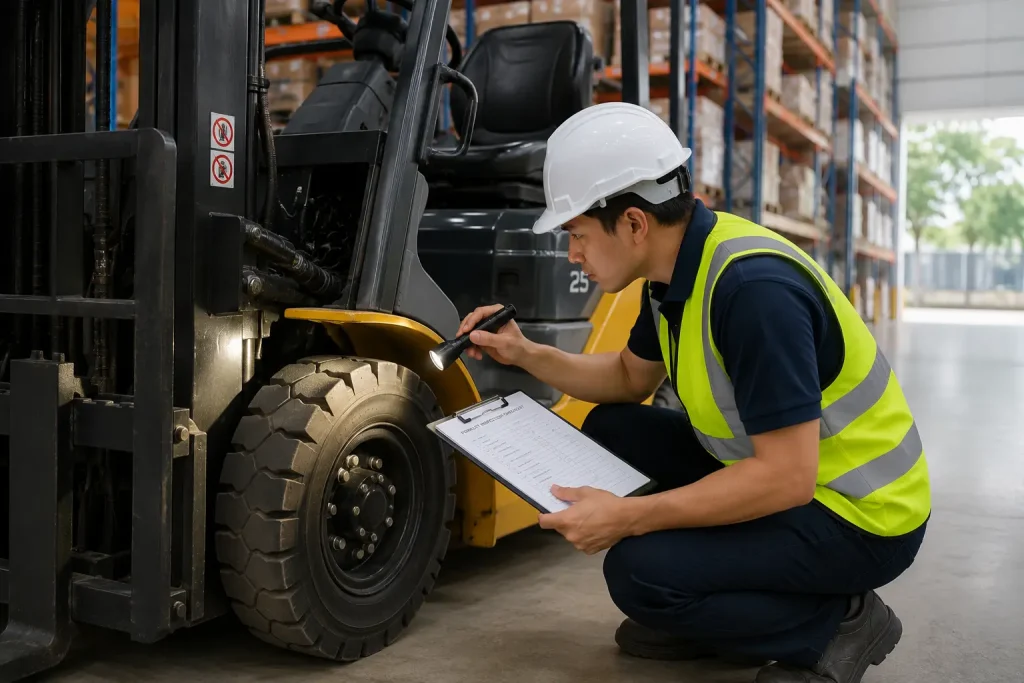
A complete pre-operation check covers the forks for cracks or damage, tyre condition and pressure, brake and steering response, hydraulic systems for leaks, and the proper function of warning lights and alarms. Battery charge or fuel level should also be confirmed before starting a shift, since running out of power or fuel mid-task in an awkward position can itself create a hazard.
Any fault identified during this check should be reported and the forklift taken out of service until resolved, rather than continuing operation with a known issue on the assumption it will not cause a problem during that particular shift.
Why Inspection Prevents Failures
Routine inspection is fundamentally about catching gradual wear before it becomes sudden failure, a slowly developing hydraulic leak or worn brake component rarely fails without warning signs that a consistent inspection routine would catch well in advance. This is part of a broader principle behind Forklift Maintenance Tips for Safe and Efficient Operation, where routine attention prevents most failures long before they become safety incidents.
Treating the pre-operation check as a fixed, non-negotiable part of every shift, rather than an optional step performed only when time allows, is what actually makes this practice effective across an entire operation rather than just on the days someone remembers to do it.
Also read: Forklift Maintenance Tips for Safe and Efficient Operation
Safe Forklift Operating Practices
Once a forklift has passed inspection, how it is actually driven and handled throughout a shift becomes the primary factor determining whether that shift passes without incident.
Most safe operating practices exist to manage the same underlying issue, the forklift’s comparatively high centre of gravity and limited visibility, from a slightly different angle depending on the specific task or environment.
Speed, Stability, and Load Balance
Driving at a speed appropriate to the environment, particularly in narrow aisles or busy shared work areas, gives an operator the reaction time needed to respond to an unexpected obstacle or pedestrian. Loads should be evenly distributed and kept within the forklift’s rated capacity, since an unbalanced or overweight load significantly increases tipping risk, particularly during turns.
Sudden movements, sharp turns, abrupt braking, or rapid acceleration, destabilise both the forklift and its load even when the load itself is properly balanced and within capacity, which is why smooth, deliberate movement matters as much as correct loading.
Visibility and Communication
When a load blocks forward vision, the correct practice is to reverse the forklift and use mirrors rather than attempting to drive forward with obstructed sight lines, even over a short distance. Using the horn and any fitted warning signals when approaching corners, intersections, or blind spots alerts nearby workers before the forklift itself becomes visible to them.
These visibility and communication practices matter most in exactly the areas where incidents cluster, corners, doorways, and intersections between forklift and pedestrian traffic, where a moment’s warning can be the difference between a near-miss and a collision.
Load Handling Safety
Improper load handling remains one of the most common root causes of forklift incidents, distinct from driving practice, and deserves its own dedicated attention beyond general operating rules.
Many load handling incidents share a common thread: a load that looked manageable was handled in a way that failed to account for how its weight or shape would behave once the forklift began moving or turning.
Rated Capacity and Load Positioning
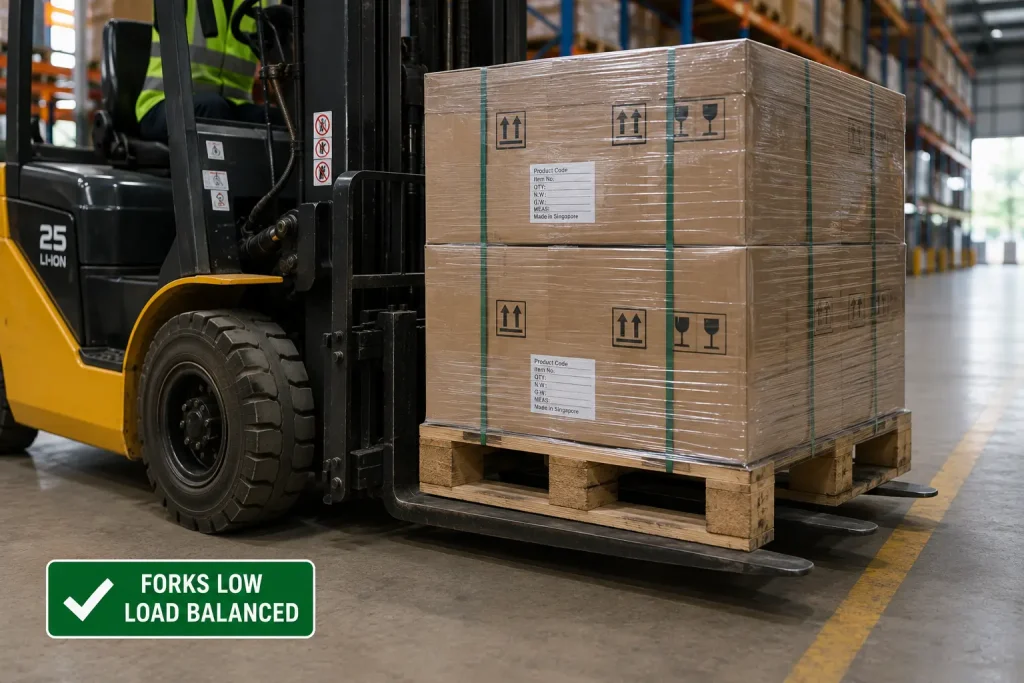
Never exceeding a forklift’s rated load capacity is a fixed, non-negotiable rule, since capacity ratings already account for the specific forklift’s stability limits, and operating beyond them removes any safety margin the manufacturer built in. Forks should be kept low while travelling, and loads tilted slightly backward, both practices that lower the load’s centre of gravity and improve stability throughout a run.
Understanding how a specific forklift’s capacity relates to its configuration and mast height is covered in more detail in Parts of a Forklift: What Each Component Does, useful background for operators working across different forklift models within the same fleet.
Handling Unstable or Awkward Loads
Loads should never be lifted or lowered while the forklift is in motion, since combining vertical load movement with horizontal travel significantly increases instability at exactly the moment control matters most. Unstable, unsecured, or improperly palletised loads should be corrected or re-secured before lifting begins rather than adjusted mid-task once the load is already elevated.
Different forklift configurations handle awkward or oversized loads differently, and understanding which type of forklift actually suits a specific load shape or environment is covered in 7 Different Types of Forklifts You Should Know, useful reading when a recurring load type does not fit comfortably within a standard configuration.
Forklift Operator Training and Conduct
Behind every safe operating practice sits a properly trained, certified operator, since even a perfectly maintained forklift cannot compensate for an operator who has not been taught how to apply these practices consistently under real working conditions.
Operator conduct rules exist specifically to address the human factors that no amount of equipment engineering can fully eliminate on its own.
Certification and Competency Requirements
Only trained and certified operators should be permitted to operate a forklift, and this certification should be specific to the class of forklift being used, since different configurations, counterbalance, reach truck, or rough terrain models, carry distinct handling characteristics. Understanding how these classes differ is covered in Classes of Forklifts and Their Uses in Material Handling, useful context for ensuring an operator’s certification actually matches the equipment they are assigned to.
Certification should be treated as an ongoing requirement rather than a one-time qualification, with refresher training scheduled periodically and immediately following any incident or near-miss involving that operator.
Operator Conduct Rules
Required personal protective equipment should be worn consistently, hands and feet kept inside the operator compartment at all times, and passengers never carried unless the specific forklift model is designed for two occupants. Operators should remain alert and free from distraction throughout a shift, since a forklift’s stability margins leave very little room for a delayed reaction to an unexpected hazard.
Well-trained, disciplined operators are consistently associated with fewer incidents and less equipment damage across an operation, making investment in proper training one of the highest-value safety measures available to any business running a forklift fleet.
Also read: Forklift Safety Checklist: A Complete Guide
Workplace Safety Around Forklifts
Forklift safety is not solely the operator’s responsibility, since every worker sharing a floor with an active forklift plays a role in preventing incidents involving pedestrians and other equipment.
Many struck-by incidents involve a pedestrian who assumed the operator had seen them, or an operator who assumed a work area was clear, underscoring why shared responsibility and clear communication matter as much as any single individual’s compliance.
Pedestrian Safety Rules
Workers should maintain a safe distance from moving forklifts at all times, never walk beneath raised forks regardless of how briefly a load appears to be stationary, and stay visible to operators rather than assuming an operator has already noticed them. Designated pedestrian walkways should be followed consistently, even when a more direct route across an active forklift path seems more convenient in the moment.
Sudden, unpredictable movement near an operating forklift is particularly dangerous, since an operator’s ability to react depends heavily on pedestrian movement remaining predictable within their expected field of view.
Site Layout and Signage
Clear signage marking forklift travel paths, pedestrian walkways, and blind corners helps reinforce safe behaviour without relying solely on individual awareness, particularly valuable in busy warehouses with high foot traffic and frequent forklift movement. Mirrors at blind corners and clearly marked crossing points further reduce the risk of a pedestrian and forklift meeting unexpectedly at a shared intersection.
Site layout decisions made during a warehouse’s design or reconfiguration should account for these safety considerations from the outset, since retrofitting proper walkways and signage into an already congested layout is far more difficult than planning for them in advance.
Forklift Maintenance and Long-Term Safety
Proper maintenance underpins every other safety practice covered in this guide, since even the most careful, well-trained operator cannot compensate for a forklift with a genuine mechanical fault.
Maintenance-related incidents are almost always preventable, distinguishing them from the more unpredictable risks inherent to any powered industrial equipment, which is precisely why a consistent maintenance routine delivers such a strong safety return.
Routine Maintenance Tasks
Regular lubrication of moving parts, inspection of hydraulic systems and hoses, tyre condition monitoring, and testing of brakes, steering, and safety alarms should all follow a fixed schedule based on the forklift’s actual hours of use rather than an informal, reactive approach. A complete, practical routine covering these tasks in detail is available in Forklift Maintenance Checklist: A Complete Guide, a useful reference for supervisors managing a fleet’s maintenance schedule.
Deferred maintenance is one of the most common underlying causes when a mechanical fault does eventually contribute to an incident, precisely because minor issues are rarely urgent enough to interrupt a busy schedule until they compound into something more serious.
The Link Between Maintenance and Safety
A forklift’s braking, steering, and hydraulic systems are all directly tied to how safely it can be operated, meaning maintenance is not a separate concern from operational safety but an integral part of it. Singapore’s Ministry of Manpower publishes detailed Workplace Safety and Health guidance covering the training, inspection, and maintenance obligations that apply to powered industrial trucks such as forklifts.
Businesses that treat maintenance as a core safety practice, not simply an operational cost, consistently see fewer incidents, lower repair costs, and longer equipment lifespan across their fleet.
Also read: Types of Aerial Work Platform and Their Common Uses
Forklift Safety at a Glance
The table below summarises the core safety areas covered in this guide and the specific practice each one centres on.
Safety Area | Core Practice |
Pre-operation checks | Inspect forks, tyres, brakes, hydraulics, and alarms before every shift |
Operating practices | Match speed to environment, reverse when vision is blocked, use horn at blind spots |
Load handling | Stay within rated capacity, keep forks low while travelling, never lift while moving |
Operator training | Only certified operators, correct PPE, no distractions |
Pedestrian safety | Maintain distance, never walk under raised forks, use marked walkways |
Maintenance | Follow a fixed schedule based on hours of use, not a reactive approach |
Get Reliable Equipment Support
Following proper forklift safety tips, from pre-operation inspection to safe driving, load handling, and consistent maintenance, is what turns a productive piece of equipment into a genuinely safe one across every shift. No single practice covered here works in isolation, they reinforce each other across operator behaviour, equipment condition, and workplace layout.
RR Machinery Pte Ltd offers a diverse selection of well-maintained forklifts suited to every application, backed by professional servicing support. Contact us today to discuss your equipment needs and get expert guidance on safe, reliable forklift operations.