Most earthmoving tasks require at least two machines working together, one to dig or load material, another to haul it away. A scraper does something genuinely different, it cuts material from the ground, carries it internally, and spreads it back out at the destination, all in a single continuous operating cycle without needing a second machine at all.
This self-contained capability makes the scraper one of the more distinctive pieces of earthmoving equipment, purpose-built for large-scale grading and bulk earthworks rather than the more common combination of an excavator loading a separate dump truck. This guide explains exactly what a scraper is, how its cutting and spreading mechanism works, the main types available, and how it compares to the more familiar excavator, loader, and dump truck combination.
What Is a Scraper?
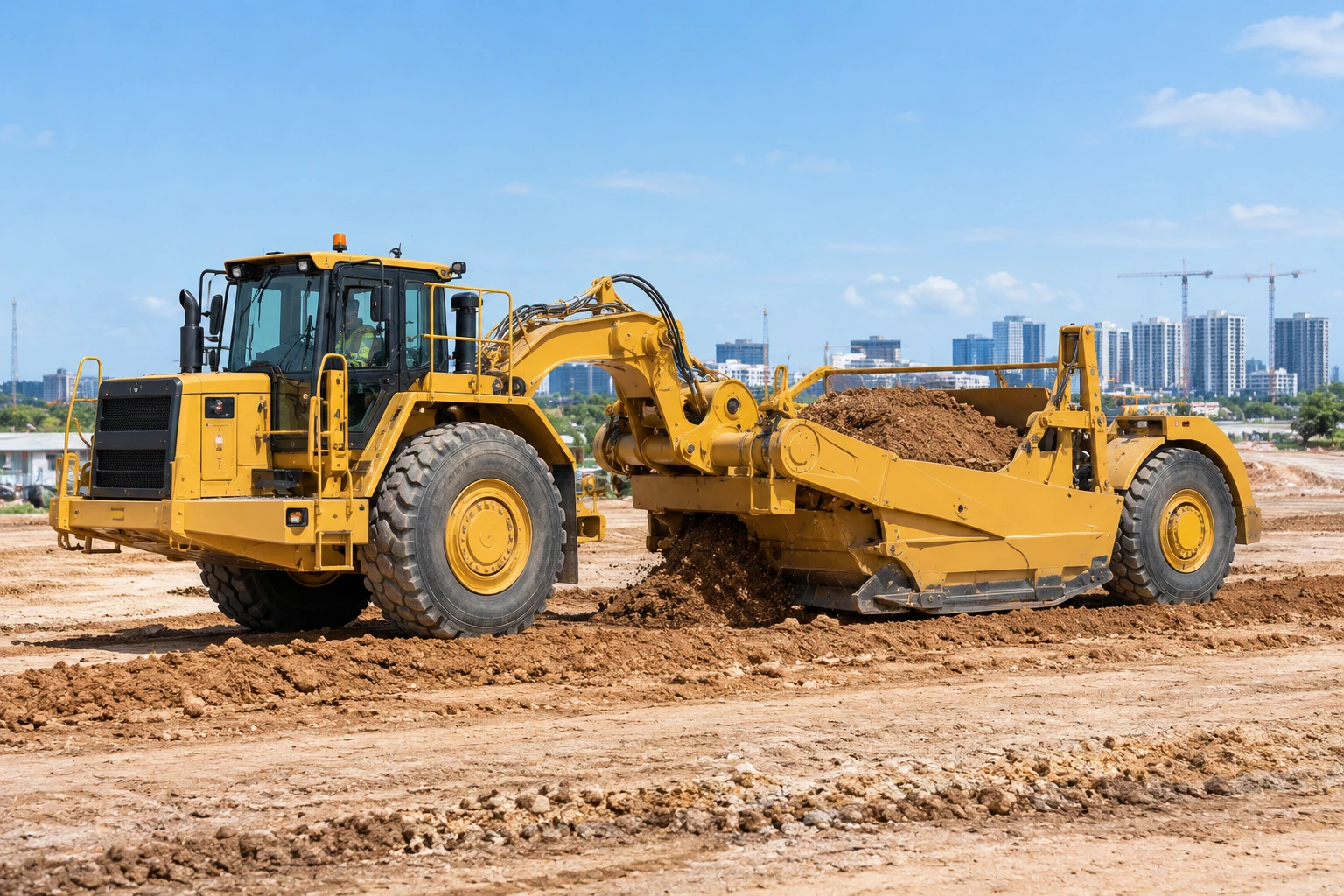
A scraper, also called a motor scraper or pan, is a piece of earthmoving equipment built around a large bowl fitted with a sharp cutting edge along its front lip, capable of cutting a thin layer of soil as it moves forward, drawing that material up into the bowl, and later ejecting it in a controlled, spread layer at a separate location.
This combination of cutting, carrying, and spreading in a single machine sets the scraper apart from most other earthmoving equipment, which typically specialises in only one part of that sequence, an excavator digs, a dump truck hauls, a grader spreads and levels. A scraper performs a version of all three functions itself, making it particularly efficient for large, open sites where material needs to be moved and levelled across significant distances without complex material handling.
How a Scraper Works
A scraper’s operating cycle follows a consistent sequence regardless of size or configuration, cutting a layer of material, transporting it, and depositing it at the destination in a controlled spread.
The Loading Cycle
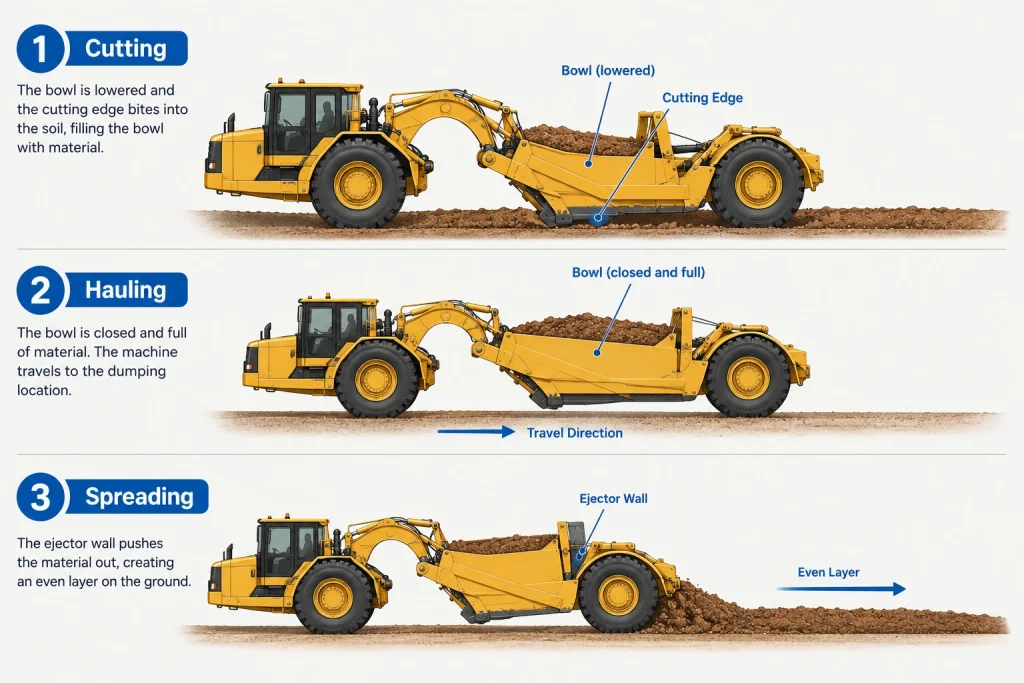
As the scraper moves forward, its bowl is lowered so the cutting edge bites into the ground, shaving off a thin, controlled layer of soil that curls up and is pushed into the bowl by the machine’s forward motion. An apron gate at the front of the bowl typically lifts during this loading phase to allow material to enter, then closes once the bowl is sufficiently full, preventing material from spilling back out during transport. Some scraper configurations use a powered elevator within the bowl to actively lift material inside, improving fill efficiency in harder or more compacted soil conditions than gravity loading alone can manage.
The Spreading and Unloading Cycle
Once loaded, the scraper travels to the placement location, where the bowl’s ejector wall moves forward, pushing material out through the open apron gate in a controlled, even layer as the machine continues moving forward. This mechanism allows a scraper to deposit material in a precisely spread layer of a specified thickness, rather than dumping it in a single pile that would then need to be spread separately by another machine.
This spreading capability is one of the scraper’s most valuable features for grading work, since it can place fill material at a consistent depth across a wide area in the same pass that delivers it, a task that would otherwise require a separate grading pass after a dump truck or loader delivered the material in piles.
Types of Scrapers
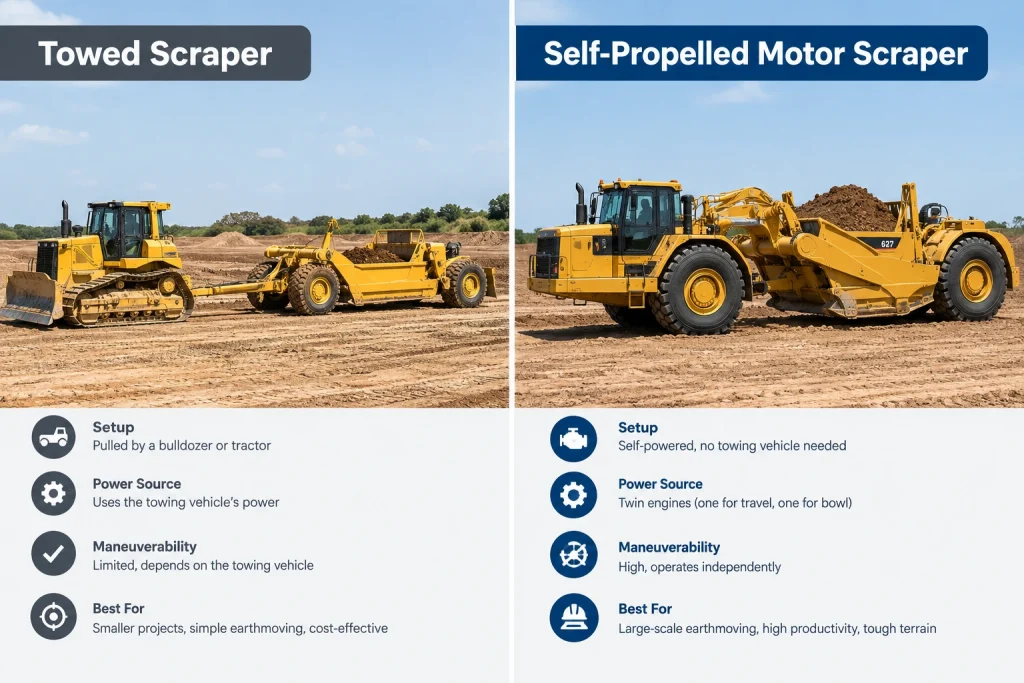
Scrapers come in two main configurations, distinguished primarily by how they are powered and moved across a site.
Towed (Pull) Scrapers
Towed scrapers have no engine of their own and are pulled behind a separate tractor or dozer, which supplies the power needed to cut and haul material. This configuration was historically the dominant scraper type and remains in use for smaller-scale or specialised applications, though it has been largely overtaken by self-propelled models for most large-scale earthworks due to the efficiency of combining power and load-carrying capability into a single unit.
Self-Propelled Motor Scrapers
Self-propelled motor scrapers integrate their own engine and drivetrain directly into the machine, eliminating the need for a separate towing vehicle and allowing considerably faster travel speeds between the cut and fill locations. Many larger motor scrapers use a twin-engine configuration, one engine driving the front axle and another powering the rear, providing the substantial traction needed to cut into firm ground while hauling a full load. This configuration has become the standard choice for large-scale earthworks, road construction, and airport or large industrial site grading, where speed and haul distance efficiency matter considerably to overall project productivity.
Also read: Earth Moving Equipment: Types, Uses, and Applications
Scraper vs Other Earthmoving Equipment
Understanding where a scraper fits relative to more commonly used earthmoving equipment clarifies exactly when its self-contained cut-and-spread capability offers a genuine advantage over more conventional equipment combinations.
Scraper vs Excavator and Dump Truck
An excavator and dump truck combination requires two separate machines working in coordination, the excavator digging and loading material, the dump truck hauling it to a separate location for unloading, a process covered in more detail in Dump Truck Types: A Complete Guide for Construction and Mining. A scraper performs the equivalent function with a single machine, cutting and hauling material without needing a second unit to receive and transport the load, an efficiency advantage that grows with haul distance and the volume of material being moved.
The trade-off is that a scraper is generally less effective than an excavator at digging deep, precise excavations or working in confined spaces, since its cutting mechanism is designed for shallow, broad cuts across open ground rather than deep, targeted digging.
Scraper vs Front End Loader
A front end loader excels at scooping and loading material that is already loose or piled, typically loading it into a separate hauling vehicle rather than transporting it any significant distance itself, a distinction covered further below. A scraper, by contrast, cuts material directly from undisturbed ground and carries it internally over distance, making it better suited to large-scale cut-and-fill grading where material needs to move a significant distance across a site rather than simply being loaded and stockpiled nearby.
Also read: Front End Loader vs Excavator: Key Differences & Uses
Common Applications
Scrapers are specified for a specific category of earthmoving work where their cut-and-spread capability offers a genuine efficiency advantage over conventional equipment combinations:
- Large-scale site grading, cutting high areas and filling low areas across expansive sites such as airports, large industrial developments, and major road projects
- Road and highway construction, shaping the subgrade profile across long, linear alignments where haul distances between cut and fill sections can be substantial
- Land development and reclamation, redistributing large volumes of material across a site to prepare it for subsequent construction phases
- Agricultural and land levelling work, where large open areas need consistent grading over significant distances
Once material has been cut, hauled, and spread by a scraper, achieving the correct density in that fill layer still requires appropriate compaction, covered in more detail below, since a scraper’s spreading function controls layer thickness but does not itself achieve the density a load-bearing fill requires.
Also read: Soil Compaction Methods: A Practical Engineering Guide
Advantages and Limitations
A scraper’s core advantage is efficiency over distance, since combining cutting, hauling, and spreading into a single continuous cycle removes the coordination overhead and idle time that comes with running separate loading and hauling equipment. This makes scrapers particularly cost-effective on large, open sites with substantial haul distances between cut and fill areas, where their speed and self-contained operation translate directly into lower cost per unit of material moved.
The same design that makes scrapers efficient over open ground limits their usefulness elsewhere, they require relatively firm, unobstructed ground to operate effectively, perform poorly in confined or heavily obstructed sites, and are not well suited to digging below general ground level the way an excavator can. Further general technical background on scraper design and history is available through Wikipedia’s overview of the earthmoving scraper.
Specifying the Right Earthmoving Equipment
A scraper’s ability to cut, haul, and spread material in a single continuous cycle makes it a genuinely efficient choice for large-scale grading and bulk earthworks, but it is far from a universal replacement for excavators, loaders, and dump trucks, each of which remains better suited to specific tasks a scraper cannot perform as effectively. Matching equipment to the actual site conditions and scale of material movement required, rather than defaulting to whichever machine is most familiar, is what determines genuine project efficiency.
RR Machinery Pte Ltd supports Singapore’s construction and industrial sectors with reliable heavy machinery solutions tailored to your specific site conditions. Browse our complete heavy machinery services or contact our team today for practical advice on the right equipment for your earthmoving project.