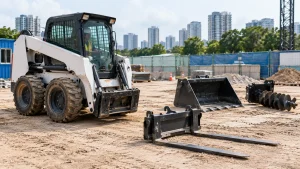
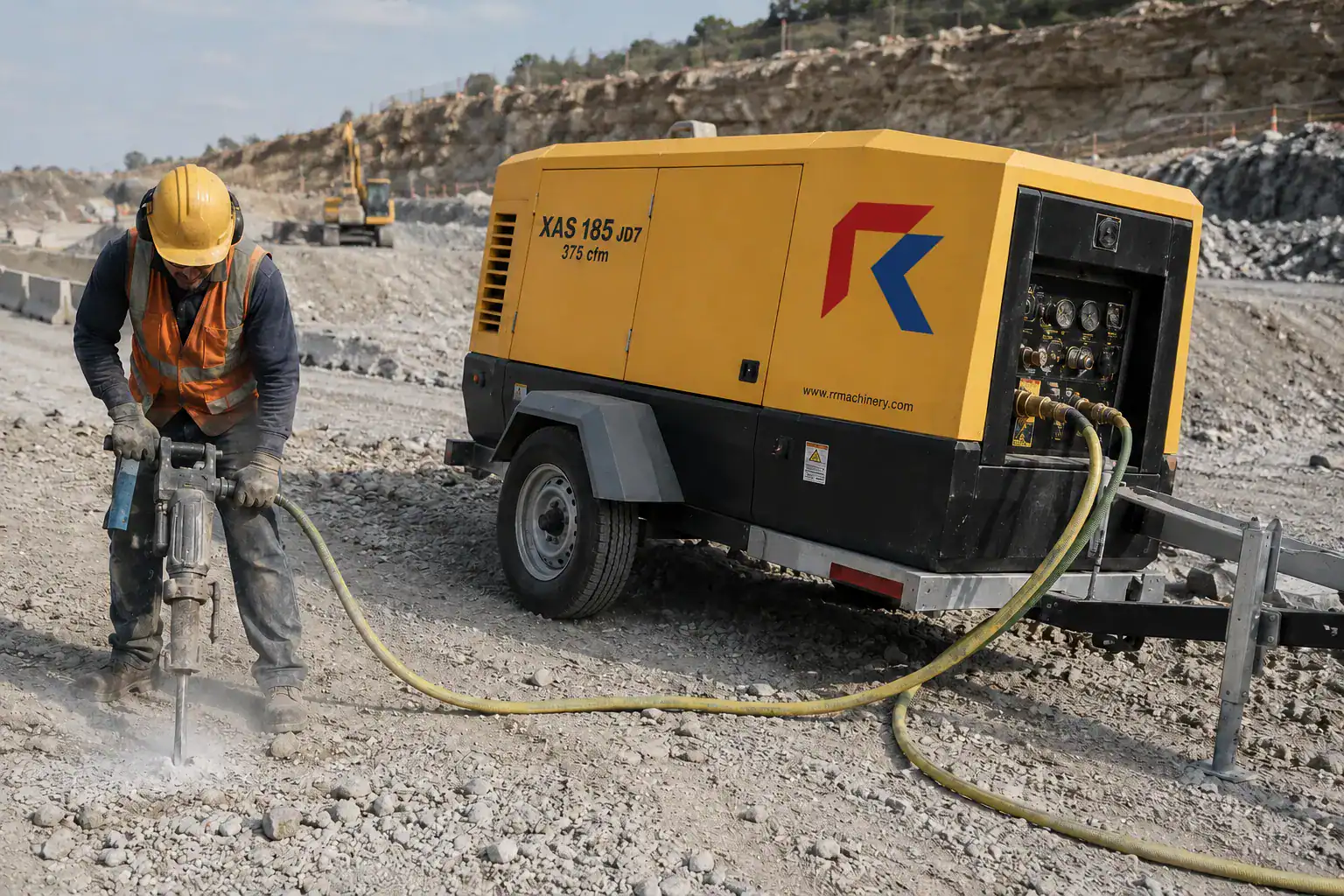
Compressed air is the invisible utility that powers a significant proportion of the tools and equipment on a construction site, in a manufacturing facility, and in a maintenance workshop. Jackhammers and rock drills break concrete and rock. Pneumatic wrenches drive fasteners on structural steel. Sandblasters prepare surfaces for coating. Spray guns apply paint and protective coatings. Pneumatic nail guns assemble formwork and timber structures. Air-powered pumps move liquids in confined spaces where electric motors are impractical.
All of these tools have one thing in common: they require a reliable, continuous supply of compressed air delivered at the right pressure and the right volume for the tool to operate correctly. The machine that provides that supply is the air compressor, and understanding how it works, what types are available, what the key specifications mean, and how to select and operate one correctly is practical knowledge for site managers, plant coordinators, and anyone responsible for tool and equipment planning on a project.
What Is an Air Compressor?
An air compressor is a machine that takes atmospheric air, at ambient pressure of approximately 1 bar absolute, and mechanically reduces its volume, raising its pressure to a level useful for powering pneumatic tools, inflating tyres, operating air-powered control systems, and performing a wide range of industrial and construction tasks.
The compressed air is stored in a receiver, a steel pressure vessel, and drawn from the receiver by connected tools and equipment. The compressor cycles on and off (or adjusts its output in variable-speed machines) to maintain the receiver pressure within the working range as air is consumed by the connected loads.
The energy stored in compressed air is substantial. A receiver containing air at 7 bar (100 psi) holds seven times the air mass that the same vessel would contain at atmospheric pressure, all of it under potential energy that is released as the air expands back to atmospheric pressure through the tool. This energy density makes compressed air a highly practical power transmission medium for tools, lighter to carry and simpler to power than an equivalent electric motor, but it also makes the compressor system a pressure vessel subject to specific safety regulations that must be respected during operation and maintenance.
Also read : Diesel vs Petrol Generator: Which One Should You Choose?
How an Air Compressor Works: The Basic Principle
All air compressors operate on the same fundamental thermodynamic principle: a mechanism reduces the volume available to a quantity of air, and the reduced volume forces the air pressure upward according to the gas laws. The work done by the compressor mechanism is converted into both increased air pressure and increased air temperature, compressed air is always hotter than the intake air, which is why compressors require cooling systems and why the air discharged from a compressor must typically be cooled and dried before use in sensitive applications.
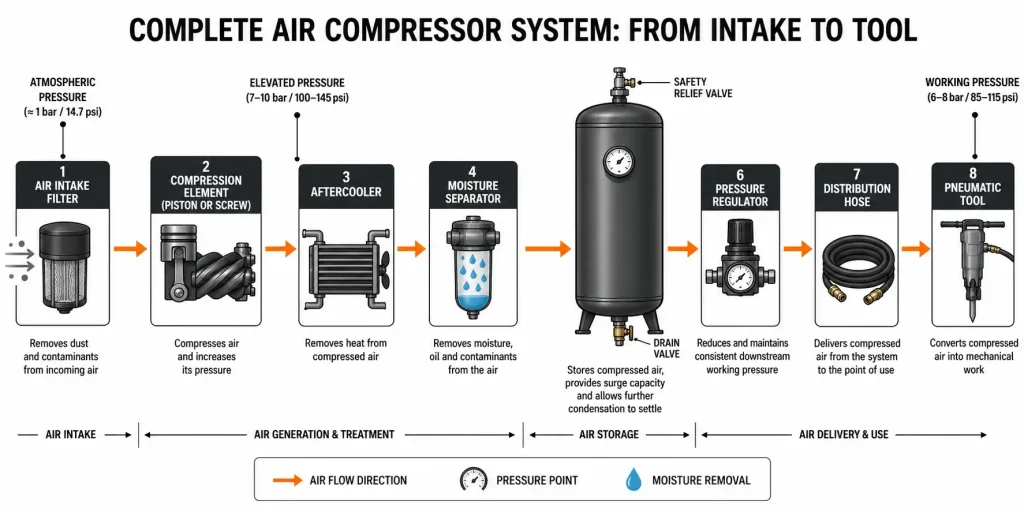
The compressed air then passes through an aftercooler, a heat exchanger that reduces the air temperature and causes moisture to condense out, through a moisture separator, and into the receiver vessel for storage and distribution. From the receiver, the air flows through a pressure regulator, distribution pipework, and flexible hoses to the connected tools and equipment.
The compressor’s output is measured in two key parameters: pressure, typically expressed in bar or psi (pounds per square inch), and flow rate, typically expressed in cubic metres per minute (m³/min) or cubic feet per minute (cfm). Both must be matched to the requirements of the connected tools. A tool that requires 6 bar and 0.5 m³/min will not operate correctly on a compressor that delivers only 5 bar or only 0.3 m³/min.
Types of Air Compressors
Air compressors are available in several configurations, each using a different mechanical principle to compress air. The choice between types is determined by the required pressure, the required flow rate, the duty cycle, the operating environment, and the cost constraints of the application.
Reciprocating (Piston) Compressor
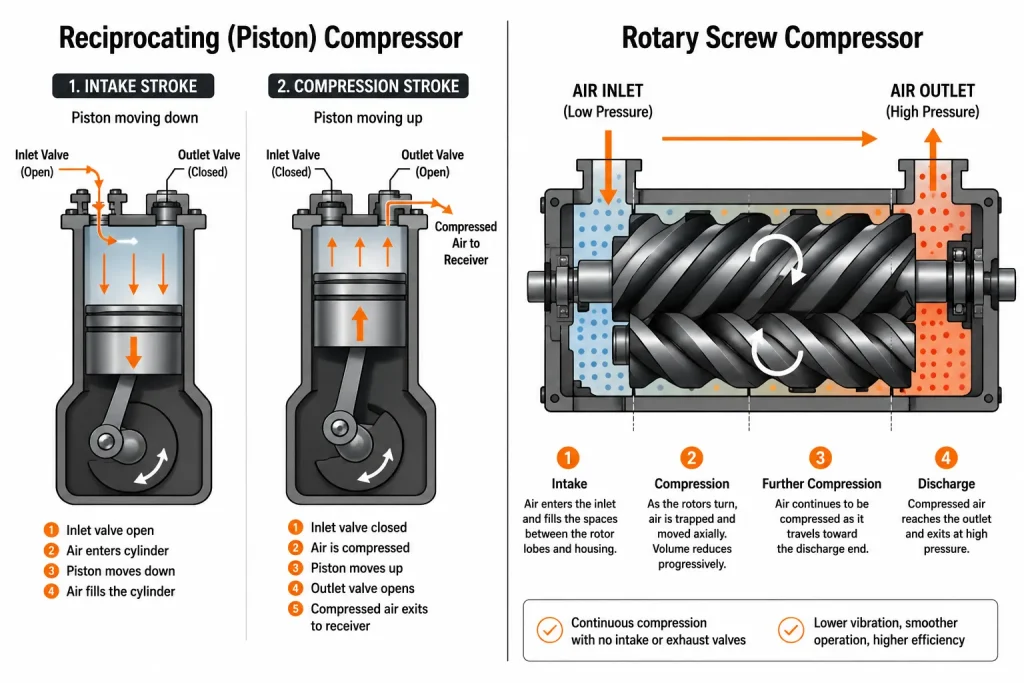
The reciprocating compressor, also called a piston compressor, is the most common type for portable and small-to-medium construction site applications. A piston driven by a crankshaft moves back and forth in a cylinder. On the intake stroke, the piston moves away from the cylinder head, creating a partial vacuum that draws air through the inlet valve. On the compression stroke, the piston moves toward the cylinder head, compressing the air against the closed inlet valve and forcing it through the outlet valve into the receiver at elevated pressure.
Single-stage reciprocating compressors compress air in one cylinder from atmospheric pressure to the delivery pressure, typically up to approximately 10 bar. Two-stage reciprocating compressors use a first-stage cylinder to compress air to an intermediate pressure, cool the partially compressed air in an intercooler, and then compress it further in a second smaller-diameter cylinder to the final delivery pressure. Two-stage compression is more efficient than single-stage for delivery pressures above approximately 8 bar, because the intercooling reduces the temperature of the air entering the second stage and therefore reduces the work required to compress it further.
Reciprocating compressors are available in both oil-lubricated and oil-free configurations. Oil-lubricated models use a small quantity of lubricating oil in the compression cylinder to reduce wear and improve sealing, acceptable for most construction and industrial applications. Oil-free models use precision-engineered piston rings and coatings to achieve lubrication-free compression, required for applications where oil contamination of the compressed air is not acceptable, such as food production, pharmaceutical manufacturing, and painting with high-quality coatings.
The primary limitation of the reciprocating compressor is its duty cycle. Most portable reciprocating compressors are designed for intermittent operation, running until the receiver is pressurised, stopping, then starting again when receiver pressure falls below the cut-in setting. Continuous 100 percent duty cycle operation overheats the valves and pistons of most reciprocating designs, reducing service life. For applications requiring continuous air delivery at high flow rates, a rotary screw compressor is more appropriate.
Rotary Screw Compressor
The rotary screw compressor uses two meshing helical rotors, a male rotor with convex lobes and a female rotor with concave flutes, to compress air. Air enters the compressor at one end of the rotor pair, is trapped in the reducing space between the meshing rotor profiles as the rotors turn, and is discharged at the other end at elevated pressure. The continuous rotation of the rotors produces a continuous, pulsation-free air delivery, unlike the reciprocating compressor, which produces pressure pulses with each piston stroke.
The rotary screw compressor is designed for continuous 100 percent duty cycle operation. The meshing rotor profiles run with close clearances but without contact, lubricated by a fine mist of oil in oil-injected models. The oil is separated from the compressed air in an oil separator after compression, collected, cooled, and recirculated, the delivered air contains only trace amounts of oil that are removed by downstream filters.
Rotary screw compressors are the standard specification for large construction sites, industrial workshops, and any application requiring a continuous high-volume air supply at consistent pressure. Large diesel-powered rotary screw compressors mounted on trailers, mobile compressors, are the standard power source for road breaking operations, rock drilling, and other high-consumption pneumatic tool applications on civil engineering and construction sites.
The performance of rotary screw compressors, and how to select the right capacity for a given tool fleet, is directly relevant to the construction site power planning process, which also involves generator load calculation for the site’s electrical loads. Both compressed air and electrical power planning follow the same systematic approach of identifying every connected load, establishing its consumption rate, and sizing the supply plant with appropriate margins, as covered in the guide to how to calculate generator load for construction sites.
Centrifugal Compressor
The centrifugal compressor uses a high-speed rotating impeller to accelerate air to high velocity, then converts that velocity into pressure in a diffuser. Unlike positive displacement compressors, piston and screw types, the centrifugal compressor is a dynamic machine that achieves compression through the kinetic energy of rapidly rotating components rather than through direct volume reduction.
Centrifugal compressors are not typically encountered on construction sites, their optimal operating range is at very high flow rates and relatively moderate pressures, and they are most commonly used in large industrial plants, pipeline compression stations, and air separation facilities. For construction and general industrial applications, the positive displacement types, piston and rotary screw, are the appropriate specification.
Portable Diesel Compressor
The portable diesel compressor, a rotary screw or piston compressor driven by a diesel engine, mounted on a two-wheel or four-wheel trailer, is the standard construction site compressed air source for outdoor and remote applications where mains electricity or a separate generator are not available or not convenient.
Diesel compressors are available from compact single-tool models producing 1.5 to 3.0 m³/min to large multi-tool units producing 20 m³/min or more, capable of powering multiple rock drills, demolition hammers, or concrete breakers simultaneously. Their self-contained diesel power source makes them independent of site electrical infrastructure, they can be towed to any location accessible by vehicle and begin producing compressed air within minutes of positioning.
For large civil engineering projects, road construction, pipeline installation, tunnelling, quarrying, the diesel portable compressor is the primary pneumatic power source, delivering compressed air to drill rigs, rock breakers, and pneumatic tamping equipment across the site. The integration of the compressed air supply into the overall site plant plan, positioning compressors to minimise hose run lengths, managing fuel delivery, and scheduling maintenance, is part of the broader construction site planning process covered in the guide to construction site planning and the management of utilities and heavy plant.
Also read : Types of Excavators: A Complete Guide for Every Job
Key Components of an Air Compressor
- Compression element
The piston-and-cylinder assembly, the rotor pair, or the impeller, whichever mechanism performs the actual compression. The condition of the compression element determines the compressor’s efficiency and output capacity.
- Prime mover
The electric motor or diesel engine that drives the compression element. On electric compressors, the motor must be sized for the starting current demand as well as the running load, the same inrush current consideration that applies to any motor load on a site generator, as discussed in the guide to generator sizing and motor starting loads for construction sites.
- Receiver vessel
The steel pressure vessel that stores compressed air between compressor cycles and buffers demand variations from connected tools. Receiver capacity, in litres, determines how long the system can supply air at the working pressure without the compressor running. Receiver vessels are subject to pressure vessel regulations and must be inspected and certified at defined intervals.
- Aftercooler
A heat exchanger that reduces the temperature of compressed air immediately after it leaves the compression element. Cooling the air causes moisture to condense, which is then removed by the moisture separator. Efficient aftercooling is essential for downstream air quality and for the longevity of air tools, which are damaged by hot, wet air.
- Air filters
The inlet air filter removes dust and particulates from the intake air before it enters the compression element, essential for preventing abrasive wear of piston rings, rotor profiles, and valve seats. The downstream air filter removes oil aerosols and fine particulates from the delivered air. Both filters must be inspected and replaced at the intervals specified in the manufacturer’s maintenance schedule.
- Safety relief valve
A pressure-activated valve that opens automatically if the receiver pressure exceeds the maximum rated pressure, typically set at 10 percent above the working pressure. The relief valve is the last line of defence against over-pressurisation of the receiver and the distribution system. It must be tested regularly and must never be blocked or bypassed.
- Pressure switch and regulator
The pressure switch controls the compressor motor, starting when receiver pressure falls below the cut-in setting and stopping when it reaches the cut-out setting. The pressure regulator at the tool connection point reduces receiver pressure to the working pressure required by the specific tool.
Air Compressor Specifications for Construction Use
Selecting the right compressor for a construction site application requires matching three key specifications to the tool fleet requirements:
- Delivery pressure (bar or psi)
Standard pneumatic construction tools, hammers, drills, impact wrenches, nail guns, typically operate at 6 to 7 bar. Sandblasting and painting applications typically require 6 to 8 bar. Rock drilling and heavy demolition tools may require 8 to 12 bar. The compressor’s rated delivery pressure must meet or exceed the highest pressure required by any connected tool.
- Free Air Delivery (FAD, m³/min or cfm)
FAD is the volume of air delivered at atmospheric pressure per minute, the true measure of the compressor’s output capability. FAD must be sufficient to supply all tools operating simultaneously at their full consumption rates, with a margin for pressure drops in the distribution system. Tool air consumption is typically stated in the manufacturer’s specification. For multiple simultaneous tools, the total FAD requirement is the sum of the individual tool consumptions with a 20 to 25 percent safety margin.
- Duty cycle
For continuous operation where multiple tools are running simultaneously for extended periods, a rotary screw compressor with a 100 percent duty cycle is required. For intermittent use with infrequent tool operation, a reciprocating compressor with an appropriate duty cycle is adequate. Mismatching duty cycle, specifying an intermittent-duty compressor for continuous use, causes overheating and premature failure.
Air Compressor Safety Requirements
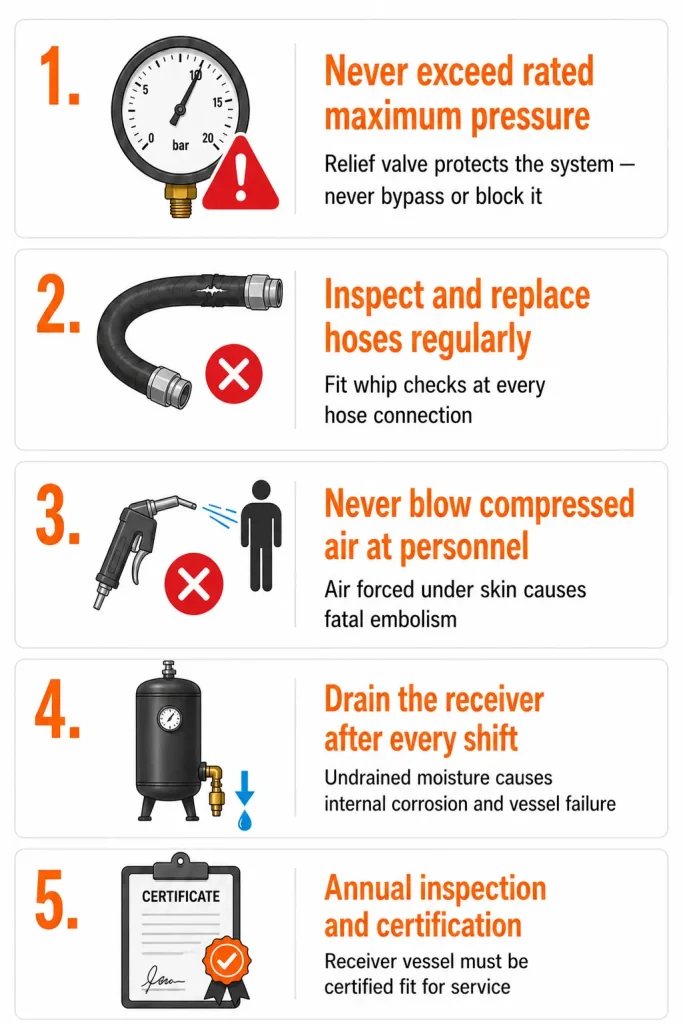
Compressed air systems are pressure vessels operating at significant stored energy levels. The safety requirements that govern their operation and maintenance are not optional and are not suspended by time pressure or operational convenience:
- Never exceed the rated maximum working pressure
The receiver and distribution system are rated for a specific maximum pressure. Exceeding this pressure, even briefly, risks catastrophic failure of the receiver vessel, hose connections, or tool. The relief valve provides automatic protection, but it must be functional and correctly set.
- Inspect and replace hoses regularly
Pneumatic hoses on construction sites are subject to mechanical damage from plant movements, kinking, abrasion, and UV degradation. A hose failure under pressure, particularly at a fitting connection, can cause a violent whipping injury. Hoses must be inspected before each shift and replaced when damaged. Whip checks, wire restraints, must be fitted at every hose-to-tool and hose-to-manifold connection.
- Never use compressed air to clean personnel
Blowing compressed air at a person, even to clean dust from clothing, can force air under the skin and into the bloodstream, causing an air embolism that is rapidly fatal. Compressed air must never be directed at any person under any circumstances.
- Drain the receiver regularly
Moisture accumulates in the receiver from condensed atmospheric humidity. Undrained moisture causes internal corrosion of the receiver vessel, the most common cause of receiver failure over time. The receiver drain valve must be opened briefly at every shutdown to release accumulated moisture.
- Annual inspection and certification
Receiver vessels must be inspected by a qualified inspector and certified as fit for continued service at the intervals specified by national pressure vessel regulations. Operating an uncertified pressure vessel is both a safety risk and a regulatory violation. The safety inspection and certification requirements for compressed air equipment are consistent with the broader equipment inspection obligations that apply to all construction plant, as set out in the guide to heavy equipment safety and equipment inspection for construction operations.
The Compressed Gas Association (CGA) publishes technical standards and safety guidelines for compressed air and gas equipment, widely referenced by manufacturers and safety regulators across international markets as the baseline for compressed air system design and operation.
Also read : Road Construction Equipment List: Every Machine Explained
The Right Compressor for Every Application
An air compressor correctly specified, matched to its tool fleet in pressure, flow rate, and duty cycle, is a highly reliable and productive component of any construction or industrial operation. Incorrectly specified, it becomes the source of productivity loss when tools underperform due to insufficient pressure or flow, and of premature equipment failure when operated beyond its rated duty cycle.
RR Machinery provides a comprehensive range of construction and industrial equipment for sale and rental, including portable diesel compressors, pneumatic tools, power generators, and supporting plant, all maintained to full operational standard and supported by experienced equipment specialists. Explore our full range of construction and industrial equipment solutions, or contact our team for practical advice on compressor selection, tool fleet planning, and a clear quotation matched to your site requirements and operating conditions.