A trench is a narrow excavation in the ground that is deeper than it is wide, dug to lay pipes, cables, foundations, or drains, or to carry water away from a site. Trenches are among the most common features of any construction project. Almost every building, road, and utility network depends on them, even though most are backfilled and hidden from view once the work is finished.
Trench work looks simple, but it is also one of the most hazardous activities on site, because the walls of an unsupported trench can collapse without warning. This guide explains what a trench is, how it differs from other excavations, the main types of trenches, how they are dug, the equipment used, the systems that protect workers inside them, and the planning that keeps trench work safe and on schedule.
What Is a Trench in Construction
In construction, a trench is a long, narrow cut in the ground made to install or reach something below the surface. The defining feature is its shape: a trench is deeper than it is wide, and it usually runs in a line, following the route of a pipe, cable, wall, or drain. General background on the term and its many uses is available in Wikipedia’s article on trenches.
Safety regulators use similar definitions. The US Occupational Safety and Health Administration, for example, describes a trench as a narrow excavation that is deeper than it is wide and no wider than about 4.5 metres at the bottom, and its trenching and excavation guidance is widely used as a reference by contractors worldwide.
Trench vs Excavation
Every trench is an excavation, but not every excavation is a trench. Excavation is the general term for any cut, cavity, or depression made by removing earth, which includes wide basement pits, open foundation areas, and bulk earthworks across a whole site.
A trench is a particular kind of excavation defined by its narrow, deep profile. This distinction matters because a narrow trench gives workers very little room to escape if a wall moves, so trench work usually calls for specific protective measures that a wide, shallow excavation may not need.
Trench vs Ditch
The words trench and ditch are often used interchangeably, but they usually describe different things. A ditch is typically a shallow, open channel left in place to carry surface water along a road, field, or site boundary.
A trench is more often temporary and deeper. It is dug to place something in the ground, such as a pipe or footing, and is then backfilled once that work is complete. Some drainage trenches stay open or are filled with gravel, which is where the two terms overlap.
Types of Trenches
Trenches are usually described in two ways: by what they are for, and by the shape of their walls. The purpose decides the trench’s route, depth, and width, while the wall shape decides how the sides are kept stable.
Understanding both helps when reading drawings, planning equipment, and preparing method statements, because a shallow cable trench and a deep sewer trench need very different approaches even though both are simply called trenches on site.
Trenches by Purpose
Utility trenches carry water pipes, sewer lines, gas pipes, power cables, and telecommunications ducts. They follow set routes and depths, often with bedding sand, warning tape, and marker boards placed above the service before backfilling.
Foundation trenches are dug along the lines of walls to hold strip footings or ground beams. They are common on low rise buildings and boundary walls, and the choice between trenches and other footing systems is explained in our guide to types of foundations.
Drainage trenches collect and carry away surface water or groundwater. They include French drains filled with gravel and a perforated pipe, as well as open drainage channels around sites and roads.
Exploratory trenches, also called trial pits or trial trenches, are dug to expose existing services or inspect soil conditions before the main works begin.
Trenches by Wall Shape
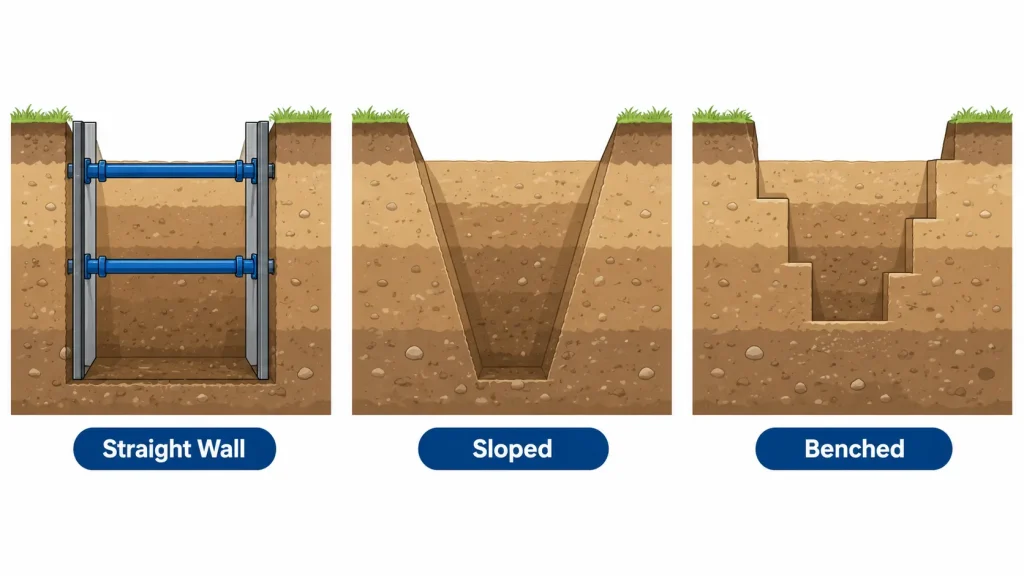
Straight wall trenches have vertical sides and take up the least space, which suits narrow urban sites. Above shallow depths, they generally need shoring or a trench shield, because vertical walls in most soils are not stable on their own.
Sloped trenches have walls cut back at an angle away from the trench, so the soil can stand without support. Benched trenches achieve the same effect with a series of steps. Both are safer for deeper work in suitable soil, but they need much more space and remove far more material, which affects cost and the room left for plant and storage on site.
How a Trench Is Dug
Digging a trench is more than removing soil along a line. A well run trench follows a clear sequence, from checking what is underground to compacting the backfill, and each step affects both safety and the quality of the finished work.
The early steps usually form part of wider site preparation, when the ground is cleared, surveyed, and made ready for the main works.
- Survey and locate existing services. Check utility records, then scan the route with cable and pipe detection equipment. Where services are close, hand dig trial holes to confirm their exact position before machines start.
- Assess the ground. Review soil type, groundwater level, and nearby structures, roads, or slopes, since these decide how deep the trench can go unsupported and which protective system is needed.
- Mark out the route. Set out the line, width, and levels with pegs and paint, and plan where spoil, materials, and machines will sit along the trench.
- Excavate. Dig with an excavator, backhoe, or trencher, checking depth and gradient as the work progresses, especially for drains and sewers that rely on a set fall.
- Install protection. Fit shoring or a trench shield, or cut the walls back to a safe slope, before anyone enters the trench, and provide ladders or ramps for access.
- Lay the pipe, cable, or footing. Prepare the bedding, place and test the service or pour the concrete, and have the work inspected before it is covered.
- Backfill and compact. Replace the soil in layers, compacting each one to avoid later settlement, then reinstate the surface.
Also read: Construction Site Planning: A Complete Guide
Equipment Used for Trenching
The right equipment depends on the trench’s depth, width, length, and ground conditions, as well as how much space there is on site. Most trench work combines a digging machine, a machine to move spoil and materials, and compaction equipment for the backfill.
Choosing well sized equipment keeps the trench to its planned width, which reduces the amount of soil to remove and replace and lowers the load on any shoring system.
Digging Machines
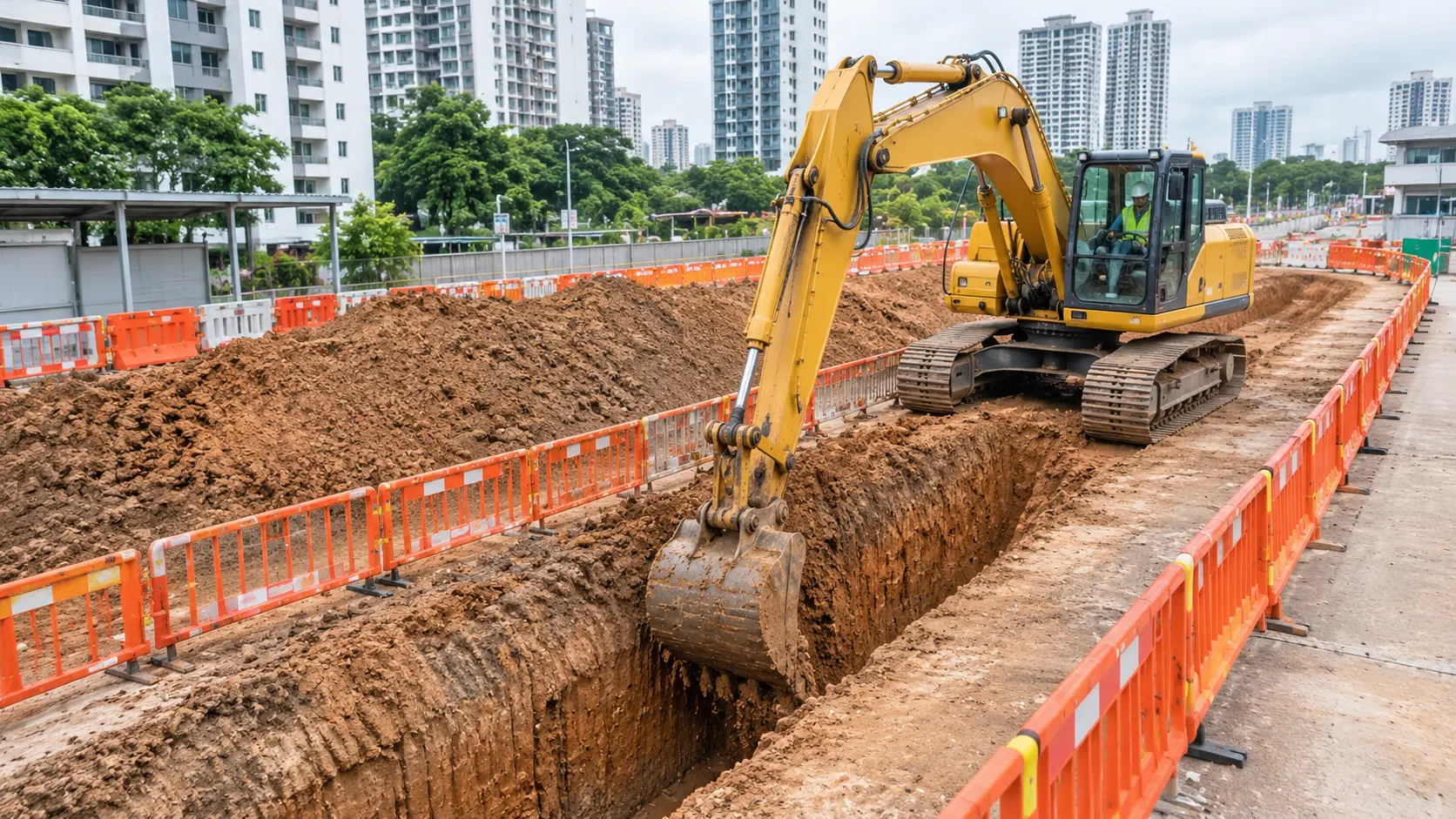
Excavators are the main trenching machines on most sites. Crawler excavators handle deep, long trenches, while mini excavators work in tight urban streets, gardens, and inside building footprints. The differences between these machines are covered in our guide to types of excavators.
Backhoe loaders combine a rear digging arm with a front loader bucket, which suits utility work that moves between short trench runs. Dedicated trenchers, either chain or wheel type, cut long, narrow trenches for cables and irrigation quickly and with very little spoil spread beside the trench.
Support and Backfill Equipment
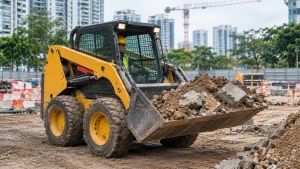
Once the trench is open, other machines keep the work moving. Dump trucks carry away surplus soil, and compact loaders move bedding sand and backfill along the trench. A skid steer loader is especially useful here, because it can backfill, spread material, and clean up in confined spaces, and it can also run its own trencher attachment for shallow cable runs.
For backfilling, plate compactors, rammers, and small rollers compact each layer of soil. Trench shields, hydraulic shores, and lifting equipment for placing pipes and trench boxes complete the typical setup.
Also read: Types of Construction Vehicles Used on Modern Worksites
Trench Protective Systems
The walls of a trench are under constant pressure from the surrounding soil, groundwater, nearby traffic, and any spoil or plant at the edge. Protective systems either remove that risk by changing the trench’s shape or resist it with a physical support, so that workers inside are not exposed to a collapse.
Which system to use depends on the depth, soil type, groundwater, available space, and how long the trench will stay open. On larger projects, the design of deep trench support is usually checked by a competent person or a temporary works engineer.
Sloping and Benching
Sloping cuts the trench walls back to an angle at which the soil can stand without support. The weaker the soil, the flatter the slope must be, so loose sand or wet ground needs a much wider trench at the top than firm clay.
Benching does the same job with a series of horizontal steps cut into the walls. Both methods avoid installing support equipment, but they need open space on either side of the trench and increase the volume of digging and backfill, so they are rarely practical on narrow urban sites.
Shoring and Shielding
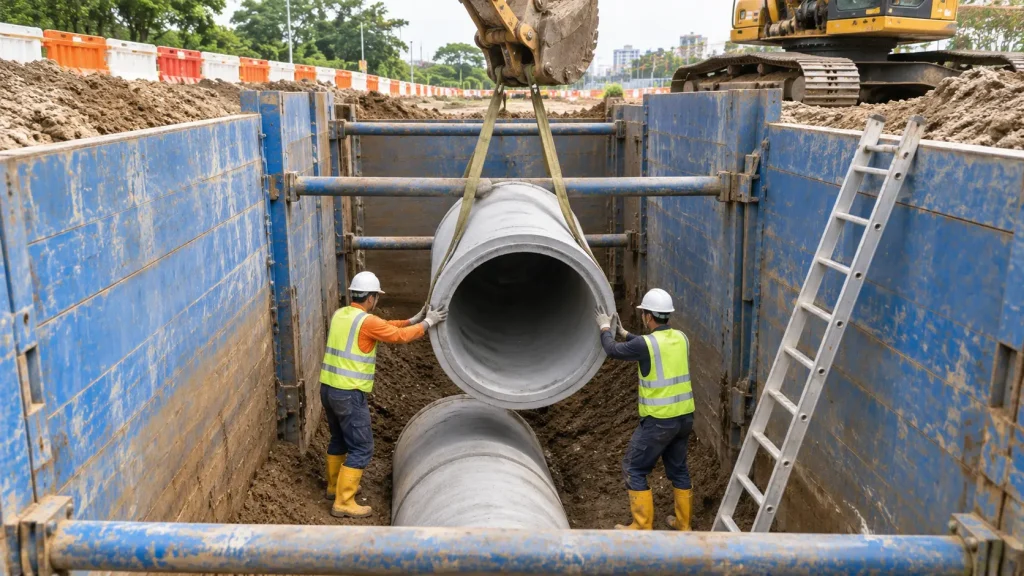
Shoring supports the trench walls directly to prevent movement. Common systems include hydraulic or screw struts with timber or aluminium panels, and sheet piles driven along both sides for deeper or wetter ground.
Shielding uses trench boxes, which are steel or aluminium frames placed inside the trench. A shield does not stop the walls from moving, but it protects workers inside it if a wall does fail. Trench boxes are quick to install and move along the trench as work progresses, which makes them popular for pipe laying.
Trench Hazards and Safety
Trench collapses are among the most serious risks in construction. A single cubic metre of soil can weigh well over a tonne, so even a shallow collapse can trap or crush a worker before anyone can react. Collapse is not the only danger, which is why trench work needs planning, supervision, and daily checks.
In Singapore, contractors manage these risks under the Workplace Safety and Health framework, and the Ministry of Manpower publishes Workplace Safety and Health guidance covering excavation and other high risk construction work. Routine inspections that support this are set out in our construction site safety checklist.
Main Hazards in Trench Work
Besides wall collapse, workers face falls into open trenches, materials or equipment falling onto people below, and strikes on buried electrical cables or gas pipes. Water can flood a trench quickly during heavy rain, and low lying trenches can collect hazardous gases or lack oxygen.
Heavy plant adds further risk. Excavators and dump trucks working too close to the edge increase the load on the walls, and moving machines create struck by hazards for people working beside the trench.
Good Practice on Site
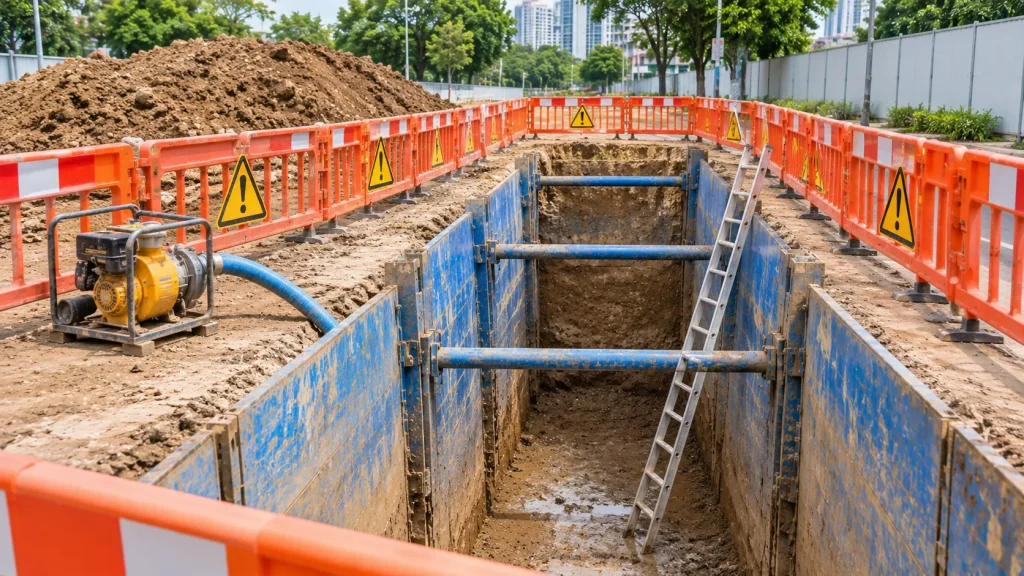
A competent person should inspect the trench and its protective system before each shift and after rain or any event that could affect stability. Spoil, materials, and plant should be kept back from the edge, and the trench should be fenced or barricaded where people or vehicles pass.
Workers inside need a safe way in and out, such as a ladder or ramp close to where they work. Pumps should be ready to control water, the air should be tested where gases could build up, and no one should ever enter an unsupported trench, even for a quick task.
Planning Trench Work: Cost and Programme Factors
Trench work often sits on the critical path, because services, drains, and footings must be in place before the next stage can start. Delays caused by unexpected services, poor ground, or flooding can quickly push back the whole programme.
Good planning reduces those surprises and keeps costs under control. The main factors to review before work begins are listed below.
Depth and width. Deeper and wider trenches mean more excavation, more spoil to remove, and more backfill to bring in and compact.
Ground and groundwater. Soft soil, rock, or a high water table can call for heavier shoring, dewatering pumps, or different digging equipment.
Existing services and access. Congested urban routes need careful detection, hand digging near services, and sometimes traffic management or night work.
Equipment and time on site. Matching machine size to the trench and planning how long each machine is needed avoids paying for idle equipment, a key part of good cost management in construction.
Protective systems. Shoring, trench boxes, and their installation time should be priced and programmed from the start, not added once digging has begun.
Equipment Support for Your Project
Trench work is only one part of a construction programme. Once services and footings are in, the project moves on to lifting materials, working at height, and powering the site, so it helps to plan the supporting equipment early.
RR Machinery Pte Ltd provides heavy machinery rental across Singapore, including boom lifts, scissor lifts, forklifts, mobile scaffolding, and power generators, backed by servicing support. Contact us today to discuss the equipment your project needs or to request a quotation.