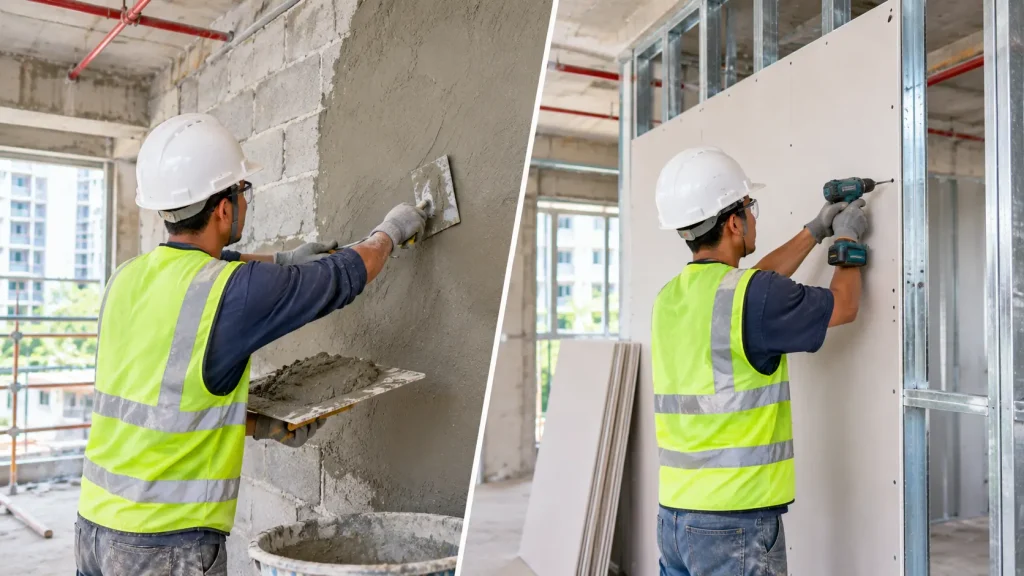
Plaster and drywall both give a building its smooth interior walls and ceilings, but they get there in very different ways. Plaster is applied wet, in coats, over a solid background such as masonry, and hardens into a dense, seamless surface. Drywall is a dry system of factory made gypsum boards fixed to a frame, with the joints taped and finished. In short, drywall is usually faster, lighter, and easier to alter, while plaster is harder, more durable, and better at resisting knocks and moisture when the right type is used.
Which one is better depends on the building, the room, the budget, and the programme. This guide explains what each material is, compares them point by point, looks at where each is typically used, and sets out practical guidance for choosing between them, along with the access and safety considerations that come with installing either one.
What Is Plaster?
Plaster is a material mixed with water and applied as a paste to walls and ceilings, where it sets into a hard surface. On most modern projects, it is applied over masonry, concrete, or another solid background, usually in one or more coats followed by a finishing coat. Further general background on the material is available through Wikipedia’s overview of plaster.
Several types are in common use. Cement sand plaster, often called render when used outside, is strong and resistant to moisture, making it a common choice on block and brick walls. Gypsum plaster sets quickly and gives a smooth finish, and is widely used for internal walls and as a thin skim coat over other surfaces. Lime plaster is softer and more breathable, and is mostly used in conservation work on older buildings. Plaster is usually applied over walls built from concrete blocks, bricks, or cast concrete.
What Is Drywall?
Drywall, also called plasterboard or gypsum board, is made of a gypsum core faced with paper or fibreglass. The boards are cut to size and screwed to a frame, usually light gauge steel studs in commercial buildings or timber in some residential work. The joints between boards are covered with tape and joint compound, sanded smooth, and then painted. Further general background is available through Wikipedia’s overview of drywall.
Drywall comes in several specialised versions. Moisture resistant boards are made for humid areas, fire rated boards have additives that slow the spread of fire, acoustic boards improve sound insulation, and impact resistant boards stand up better to knocks in busy areas. Because the system is assembled from a frame and boards, insulation and services such as cables and pipes can be run inside the cavity before the boards are closed up.
How Plaster and Drywall Compare
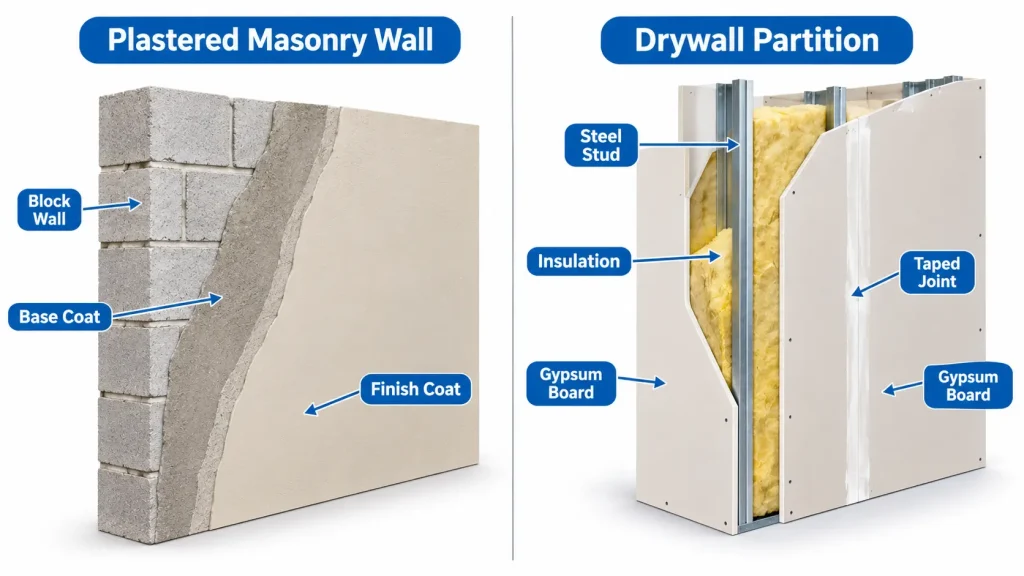
The differences between the two show up in almost every aspect of a wall’s life, from installation to long term maintenance.
Installation speed. Drywall is the faster option in most situations. Boards cover large areas quickly and need no drying time beyond the joint compound. Plaster is a wet trade, so each coat must be applied by skilled tradespeople and allowed to dry before the next stage, which can extend the programme, especially in humid conditions.
Cost. Drywall is often cheaper overall because it is quicker to install and needs less specialised labour. Plaster can cost more in labour and time, although it may save money where a solid masonry wall is needed anyway and only a finish is required. The real comparison depends on local labour rates, the wall type, and the size of the project.
Durability and impact resistance. Plaster on masonry forms a hard, dense surface that resists dents and knocks well. Standard drywall is softer and easier to damage, although impact resistant boards and double layers narrow the gap in high traffic areas such as corridors and schools.
Finish quality. Plaster gives a seamless surface with no board joints, which is valued in high quality finishes and curved walls. Drywall can achieve an excellent finish too, but poor taping or movement in the frame can leave visible joints or cracks along board edges.
Sound insulation. Solid plastered masonry walls are dense and naturally good at blocking sound. Drywall partitions can match or exceed them when designed for it, using insulation in the cavity, acoustic boards, double layers, and careful sealing, but a basic single board partition lets more sound through.
Fire resistance. Both materials are based on gypsum or cement, which do not burn easily. Fire rated drywall systems are tested as complete assemblies and widely used to separate fire compartments, while plastered masonry walls are also inherently fire resistant.
Moisture resistance. Cement sand plaster on masonry copes well with damp conditions, which is why it is common in wet areas and on external walls. Standard drywall is damaged by prolonged moisture, so wet areas need moisture resistant boards, proper waterproofing, and suitable finishes.
Repairs and alterations. Drywall is easy to cut, patch, and replace, and partitions can be removed or moved with relatively little mess. Plaster repairs need skill to blend in, and altering a plastered masonry wall means breaking out the wall itself.
Weight. Drywall partitions are much lighter than plastered masonry walls, which reduces the load on floors and structure. This can matter in tall buildings and on upper floors where loads must be kept down.
Where Plaster and Drywall Are Typically Used
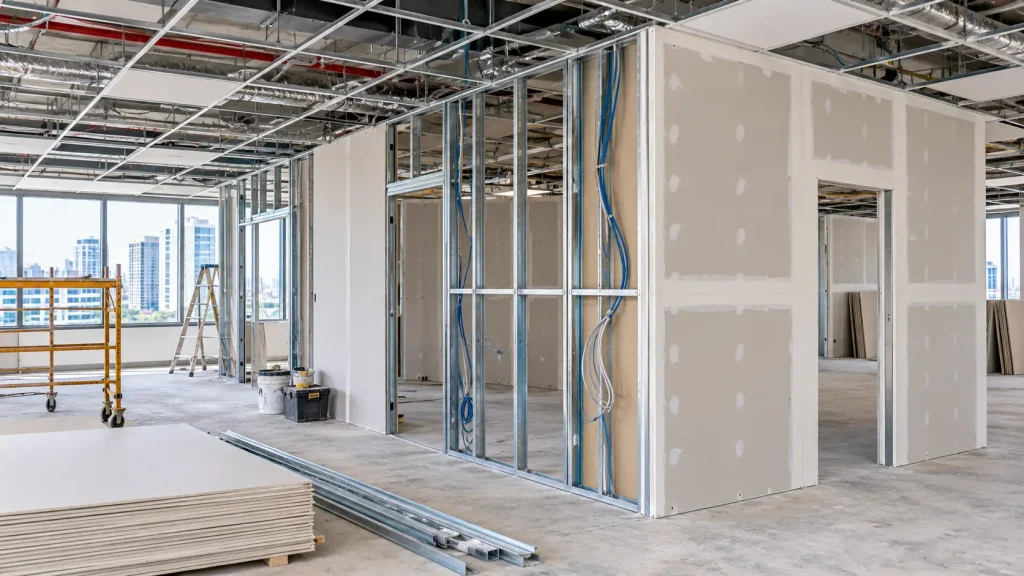
In many cities, both systems are used side by side, often in the same building. Residential blocks commonly have masonry or precast concrete walls finished with cement sand plaster or a skim coat, particularly in kitchens, bathrooms, and external walls where durability and moisture resistance matter. Offices, shops, and other commercial interiors make extensive use of drywall partitions and suspended ceiling boards, which suit frequent changes of layout and the large amount of services hidden in walls and ceilings.
The wider push toward more productive, less labour intensive construction has also encouraged the use of dry wall systems in many building types, since they reduce wet work on site and can be installed by smaller crews. Climate plays a part too. In hot and humid places such as Singapore, plaster takes longer to dry, while drywall in damp areas must be the right board type and properly protected.
Which One Should You Choose?
The right choice usually becomes clear when the use of the space is considered first.
For office and retail fit outs, drywall is usually the better fit. It is quick to install, easy to reconfigure when tenants change, and leaves room in the cavity for cables and services.
For bathrooms, kitchens, and wet areas, cement sand plaster on masonry is a robust choice, while moisture resistant drywall with proper waterproofing is a lighter alternative where the design allows it.
For high traffic areas, such as corridors, schools, and back of house spaces, plastered masonry or impact resistant drywall stands up better to daily knocks.
For homes and renovations, the existing walls often decide the answer. Repairing or matching existing plaster may be best in older buildings, while new partitions are often built faster in drywall.
For heritage buildings, lime plaster is usually preferred to respect the original construction and allow older walls to breathe.
Whatever the choice, it affects the programme and the budget well beyond the walls themselves, since faster finishes can shorten the whole fit out. These trade offs are part of wider cost management in construction, where labour, materials, and time are balanced across the project.
Many plastered walls are built from concrete blocks, a material still often called cinder block, and the difference between the two names, and the materials behind them, is explained below.
Also read: Concrete vs Cinder Blocks: What’s the Real Difference?
Installing Plaster and Drywall at Height
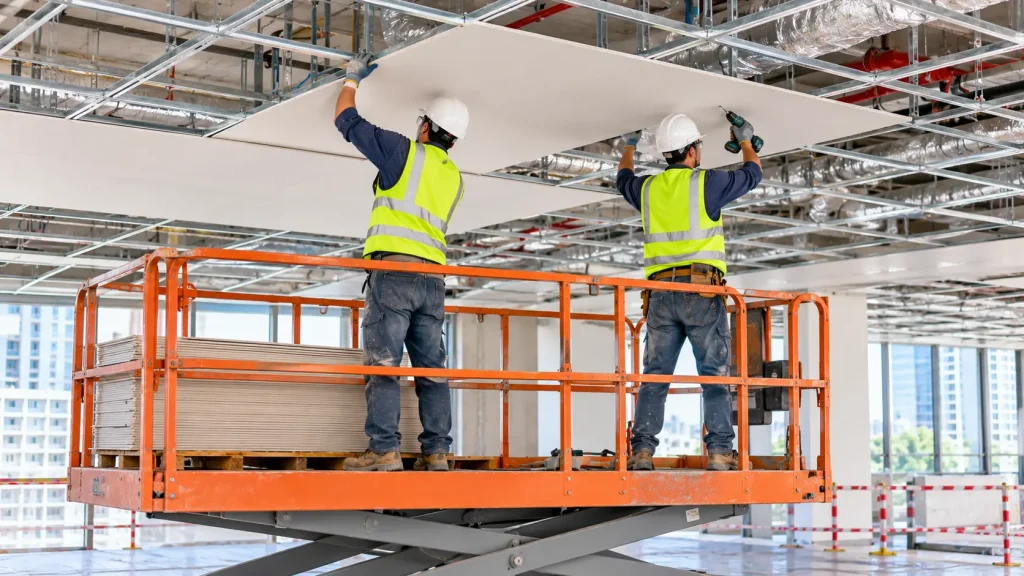
Ceilings, high walls, atriums, and stairwells all need safe access for plasterers and drywall installers. For drywall ceilings and bulkheads, a scissor lift is often the most efficient choice, since its wide, stable platform holds workers, tools, and boards together, and the main options are compared in our guide to types of scissor lifts. For plastering long walls or working around fixed obstacles, mobile scaffolding towers give a steady platform that can be moved along the wall as work progresses.
The right access depends on the height, the floor conditions, and how often the platform needs to move. Where work also involves reaching over obstacles or outside the building, a boom lift may be needed instead, and the differences between the two main powered platforms are explained below.
Also read: Boom Lift vs Scissor Lift: Which One Should You Choose?
Health and Safety Considerations
Both trades create hazards that need managing. Cutting and sanding drywall produces fine dust, and mixing and applying plaster can create dust and skin irritation, so dust control, ventilation, eye protection, gloves, and suitable respiratory protection should be used. Boards are large and awkward to handle, and plaster bags are heavy, so good manual handling practice and mechanical lifting where possible reduce the risk of strain.
Work at height brings the greatest risk on interior finishing jobs. Platforms should be stable and suitable for the task, guardrails kept in place, and floors kept clear of offcuts and trailing cables. Singapore’s Ministry of Manpower publishes detailed Workplace Safety and Health guidance covering work at height and safe work practices, and practical principles for staying safe above ground are covered below.
Access Equipment for Interior Fit Out Work
Choosing the right access equipment keeps plastering and drywall work moving safely. When you contact the team, it helps to share the ceiling and wall heights, the floor type and any loading limits, the width of doorways and corridors the machine must pass through, and how long you expect to need the equipment. With these details, a suitable scissor lift or scaffold tower can be recommended from the start.
RR Machinery Pte Ltd offers a wide range of scissor lifts for indoor fit out, ceiling, and maintenance work across Singapore, backed by factory certified technicians and full servicing support. Contact us today for expert advice on the right access equipment and a quote tailored to your project.