
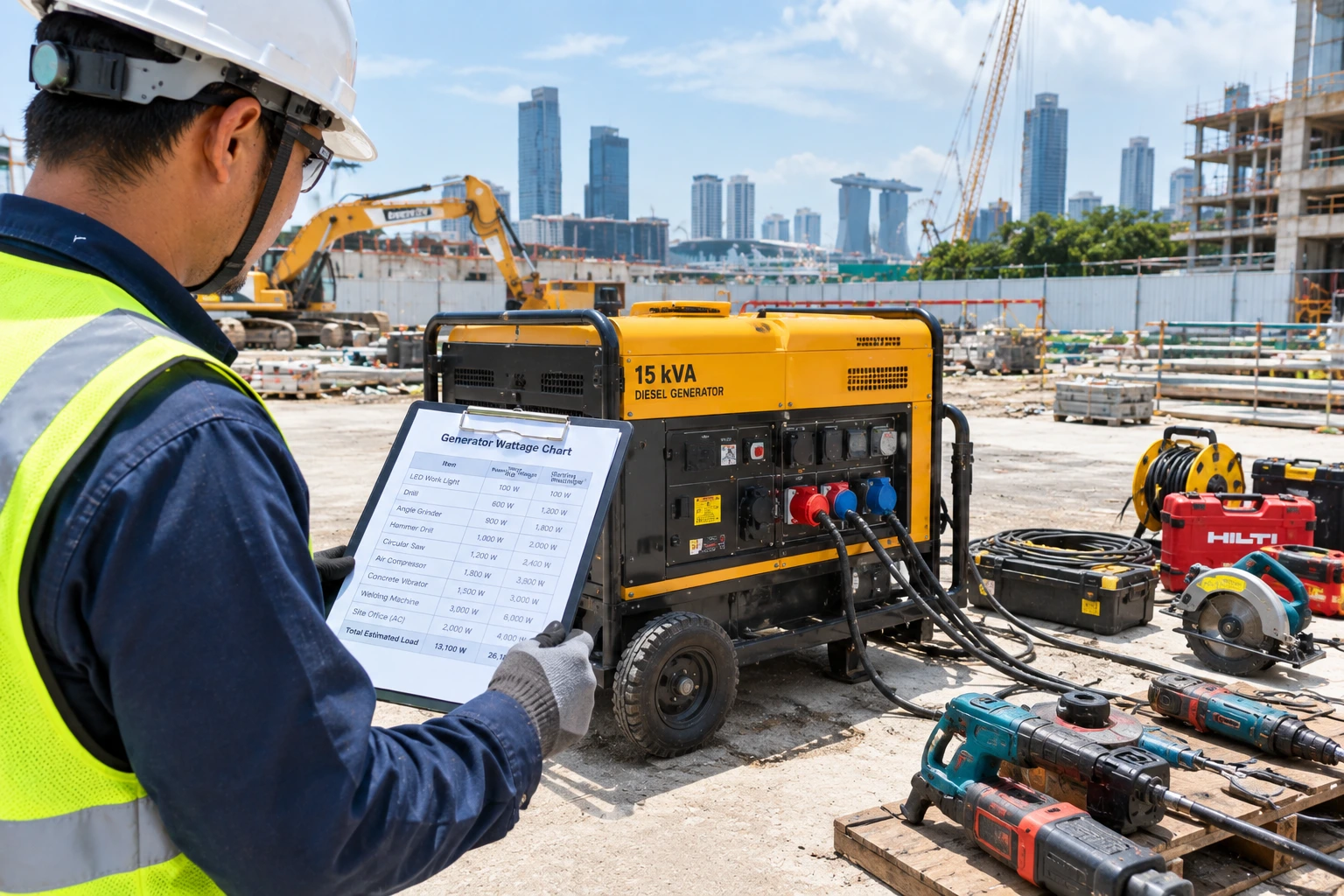
Working out how big a generator needs to be starts with knowing roughly how much power the equipment you plan to run actually draws, and this chart brings together typical running and starting wattage figures for tools and equipment commonly found on a construction site or in a small facility. Use it as a quick reference to estimate total load before working through a complete sizing calculation.
Every figure below is a typical range rather than an exact value for any specific model, since actual draw varies by brand, age, and condition. Treat this chart as a starting point for estimation, not a substitute for checking the nameplate rating on the specific equipment you intend to run. A generator that will be running valuable equipment or supporting a task where downtime is costly deserves the extra few minutes it takes to confirm actual nameplate figures rather than relying on chart estimates alone.
Why Both Running and Starting Watts Matter
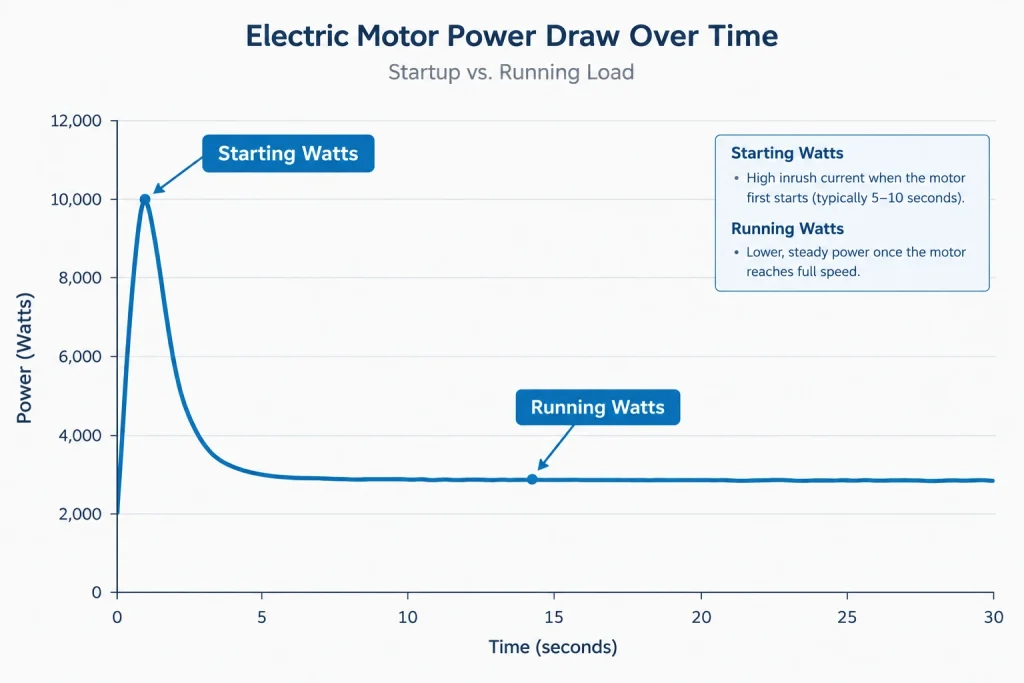
Most electric motors draw considerably more power for a brief moment when starting than they do once running at a steady speed, a surge sometimes two to three times the running figure. This happens because a motor needs extra current to overcome its own inertia and initial resistance before it reaches full operating speed, after which draw settles down to the steady running figure. A generator needs enough capacity to handle this starting surge, not just the steady running load, which is why a sizing chart lists both figures separately rather than a single wattage per item.
This distinction is the single most common source of generator undersizing, since adding up only running watts across several pieces of equipment can look comfortably within a generator’s rated capacity, right up until two motors happen to start close together and the combined starting surge exceeds what the unit can actually deliver. A generator that trips out or stalls during a motor start, even though its running capacity would have been perfectly adequate once everything was up and running, is a textbook symptom of this exact miscalculation.
Also read: How to Calculate Generator Load: A Step-by-Step Guide
Generator Sizing Chart: Common Equipment
The figures below cover equipment commonly found across construction, small industrial, and site office settings, organised so that both the steady running draw and the brief starting surge can be checked at a glance for each item.
Equipment | Typical Running Watts | Typical Starting Watts |
LED work light | 100 W | 100 W |
Halogen work light | 500 W | 500 W |
Angle grinder | 1,000 to 2,000 W | 2,000 to 2,500 W |
Circular saw | 1,200 to 1,500 W | 3,000 to 4,500 W |
Small air compressor | 1,000 to 1,500 W | 3,000 to 4,500 W |
Concrete vibrator | 700 to 900 W | 1,800 to 2,400 W |
Concrete mixer (small) | 600 to 800 W | 1,800 to 2,400 W |
Water pump (1 HP) | 750 W | 1,800 to 2,200 W |
Submersible pump (small) | 400 to 600 W | 1,200 to 1,800 W |
Site office air conditioner | 1,200 to 1,500 W | 3,500 to 4,500 W |
Refrigerator (site office) | 150 to 300 W | 800 to 1,200 W |
Desktop computer and monitor | 200 to 400 W | 200 to 400 W |
Battery charger (power tools) | 100 to 300 W | 100 to 300 W |
Portable heater | 1,500 to 2,000 W | 1,500 to 2,000 W |
These figures reflect commonly published equipment specifications rather than any single manufacturer’s exact rating, and the nameplate or user manual for a specific piece of equipment always takes priority over a general chart when the two figures differ. Where a nameplate lists amps rather than watts directly, multiplying the amp rating by the equipment’s voltage gives an equivalent watts figure that can be compared directly against this chart.
How to Use This Chart
Add up the running watts for every piece of equipment expected to run simultaneously, then identify the single largest starting watts figure among that equipment and add it on top of the combined running total, since only one motor typically starts at a time in practice rather than every motor starting simultaneously. This combined figure gives a reasonable working estimate of the generator capacity required, expressed in watts, which can then be converted to kVA using the equipment’s power factor for a more precise match against a generator’s rated output. Most general construction and site equipment uses a power factor around 0.8, meaning the kVA figure required is typically somewhat higher than the watts figure calculated from the chart alone.
Building in a genuine safety margin above this calculated figure, rather than sizing a generator to its exact calculated requirement, accommodates equipment added later, gradual wear that increases power draw over a machine’s service life, and the reality that voltage and frequency stability improve when a generator is not run at the very edge of its rated capacity. A complete, step-by-step walkthrough of this calculation, including how to handle multiple motors and diversity factors for larger sites, is available below.
Also read: What Size Generator Do I Need? A Practical Sizing Guide
Once You Have an Estimated Load
With an estimated total load in hand, the next step is matching that figure against an actual generator’s rated capacity, along with confirming the right category and configuration of generator for the application. A broader, practical framework for turning a load estimate into a final generator choice is available below, which covers the full decision process this chart feeds into.
Understanding the different generator categories available, and which type of unit suits which combination of equipment and site conditions, is covered below, useful once an estimated load figure narrows down which category is realistically suitable.
A Worked Example
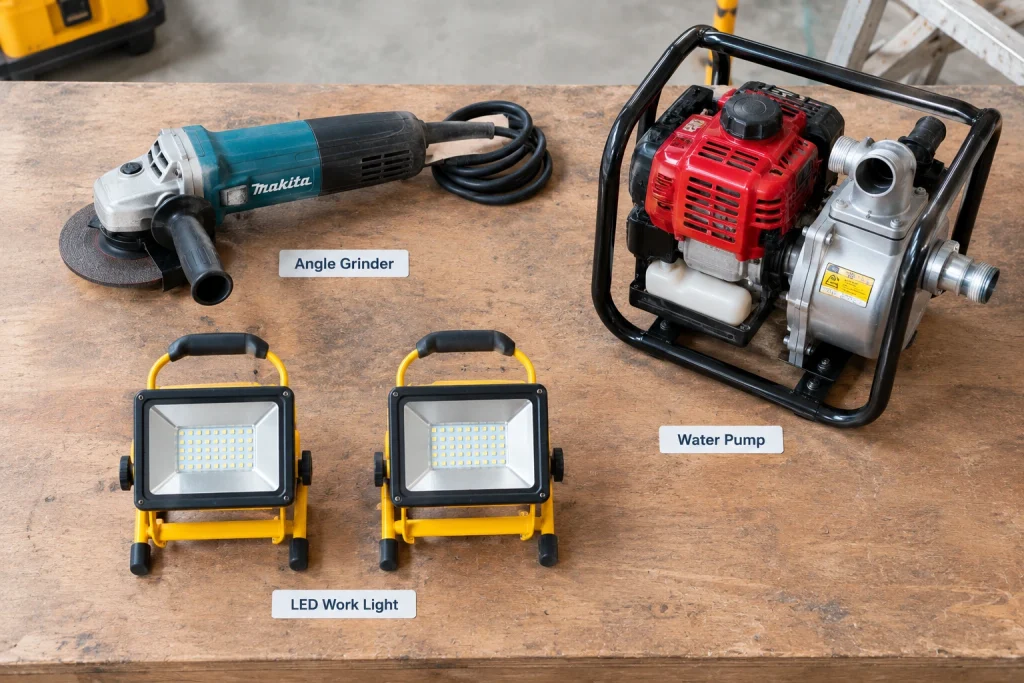
Consider a small site running an angle grinder, a water pump, and two LED work lights at the same time. Adding up running watts gives roughly 1,500 W for the grinder, 750 W for the pump, and 200 W for both lights combined, a running total of around 2,450 W. The largest single starting watts figure among this equipment is the water pump at around 2,200 W, so the working estimate becomes the running total plus that single largest starting figure, roughly 4,650 W in total, before any safety margin is added.
This worked figure illustrates why simply adding every piece of equipment’s starting watts together would significantly overstate the actual requirement, since motors rarely all start at the exact same instant in normal use, while adding only running watts would understate it by ignoring the surge entirely. The middle-ground approach, running total plus the single largest starting figure, gives a considerably more realistic working estimate for typical construction site equipment combinations, and adding a further margin on top of this figure before finalising a generator choice provides useful headroom for equipment added later in the project.
When a Chart Isn’t Enough
A general chart works well for a rough estimate covering common, individually listed equipment, but it has real limits. Equipment not listed here, unusual voltage requirements, three-phase loads, or a site running many pieces of equipment simultaneously all benefit from a more precise, site-specific calculation rather than relying on general figures alone. Power factor, the relationship between real power and apparent power in kVA, also varies by equipment type and affects the final generator rating required, a detail a quick wattage chart necessarily simplifies. Further general technical background on electrical power measurement is available through Wikipedia’s overview of electric power.
For any site combining multiple pieces of heavy equipment, or where a generator will run close to its rated capacity for extended periods, working through the complete calculation rather than relying on chart estimates alone is the more reliable approach. Sites with equipment that runs continuously alongside equipment that cycles on and off intermittently also benefit from a more detailed diversity calculation, since a simple worst-case addition of every possible load running simultaneously often significantly overstates the generator size genuinely required for typical day-to-day operation.
Getting Your Sizing Right
A generator sizing chart gives a fast, practical starting point for estimating load, but the real value comes from understanding both running and starting watts together, building in a genuine safety margin, and knowing when a quick estimate needs to be backed up with a complete calculation. Getting this right from the outset avoids both the cost of an oversized generator and the reliability risk of one that cannot handle the equipment it is actually asked to run, a distinction that matters just as much for a small residential job as it does for a large commercial site.
RR Machinery Pte Ltd offers a wide selection of power generators across every capacity range, professionally maintained and tested before every delivery. Contact us today for expert advice on matching the right generator to your equipment load.