
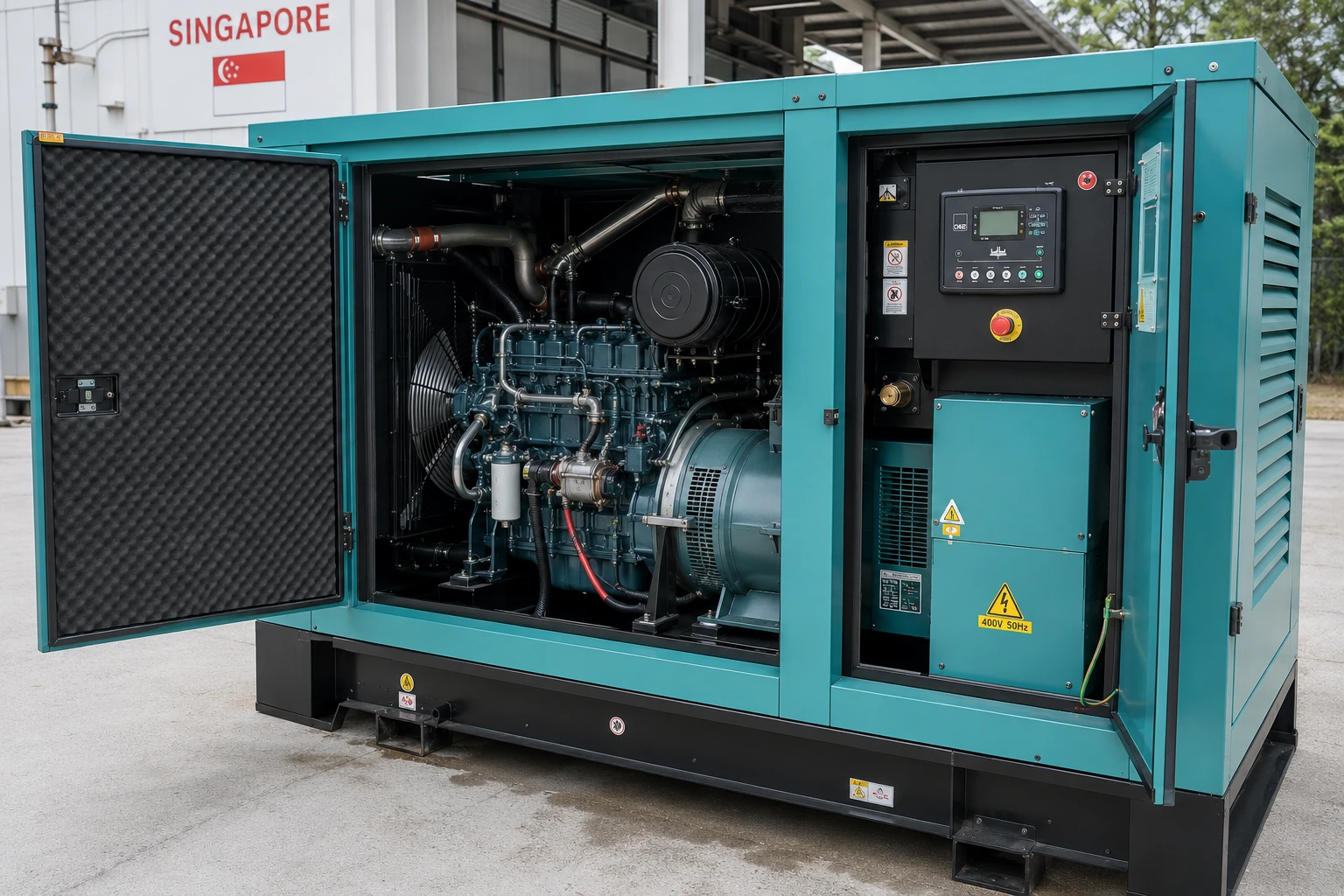
Most explanations of how a generator works stop at the same basic point, fuel burns, an engine spins, an alternator converts that motion into electricity. That is true as far as it goes, but it skips over the part of the mechanism that actually determines whether the power coming out of a generator is usable at all, the governor and voltage regulation systems that keep frequency and voltage stable regardless of how the connected load changes from moment to moment.
This guide goes beyond the basic fuel-to-electricity conversion and focuses on the full generator mechanism, the engine cycle that produces motion, the alternator that converts it, and, in particular, the governor and automatic voltage regulator systems that do the constant, invisible work of keeping a generator’s output within the narrow tolerances connected equipment actually needs.
What Do We Mean by “Generator Mechanism”?
A generator’s mechanism is not a single system but a coordinated set of mechanical and electronic controls working together continuously, not just at startup. The engine and alternator get most of the attention because they are where power is actually generated, but a generator running without functioning governor and voltage regulation systems would produce electricity at wildly fluctuating frequency and voltage, unusable and potentially damaging to anything plugged into it.
The basic energy conversion chain, fuel to mechanical motion to electrical current through electromagnetic induction, is covered in detail in our science explainer, and a broader overview of the complete operating cycle is available in a companion guide below. This guide builds on both by focusing specifically on the regulation mechanisms that keep that basic conversion process stable and usable under real-world, constantly changing load conditions.
The Engine Mechanism: Converting Fuel to Motion
The engine’s job within the overall mechanism is straightforward in principle, burn fuel to generate rotational motion, but the mechanical sequence behind that motion involves several tightly coordinated moving parts.
The Combustion Cycle
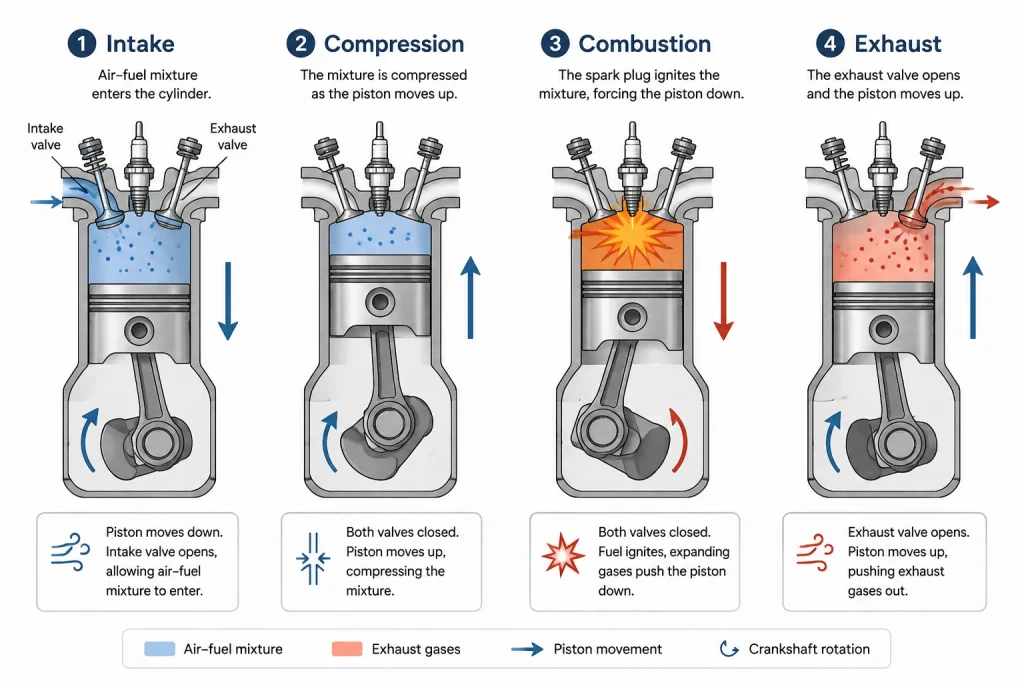
Most generator engines operate on a four-stroke cycle, intake, compression, combustion, and exhaust, repeating many times per second to produce continuous rotational force. Fuel and air are drawn into a cylinder, compressed by a rising piston, ignited to force the piston back down with considerable force, and the resulting exhaust gases are expelled before the cycle repeats. This rapid, repeated combustion is what generates the sustained rotational energy the rest of the mechanism depends on.
Diesel engines, the most common choice for generator applications, ignite this fuel-air mixture through compression alone rather than a spark, a design that delivers higher torque and better fuel efficiency under the sustained, heavy loads typical of generator operation.
Crankshaft and Flywheel
The piston’s up-and-down motion is converted into rotational motion by the crankshaft, a mechanical linkage that transforms linear piston movement into the continuous spinning motion the alternator needs to function. A flywheel, a heavy rotating disc attached to the crankshaft, smooths out this motion further, storing rotational energy between combustion strokes and releasing it steadily, which keeps the crankshaft’s rotation far more even than the pulsing nature of individual combustion strokes would otherwise produce on their own.
This smooth, steady rotational speed matters enormously to everything downstream in the mechanism, since the alternator’s output frequency depends directly on how consistently the crankshaft spins.
The Alternator Mechanism
The alternator, mechanically coupled to the engine’s crankshaft, is where rotational motion is finally converted into electrical current, through the interaction between a rotating magnetic field and stationary copper windings.
This conversion process relies on electromagnetic induction, a principle covered in much greater depth below, including how the rotor and stator interact to produce current. What matters for understanding the broader mechanism is that the alternator’s output frequency is directly tied to how fast the engine spins it, which is precisely why the next two systems, the governor and the automatic voltage regulator, exist as essential parts of the overall mechanism rather than optional extras.
Also read: How Does a Generator Get Power? The Science Explained
The Governor Mechanism: Keeping Frequency Stable
Electrical frequency, 50 hertz in Singapore and most of the world, depends entirely on how fast the alternator’s rotor spins, which in turn depends on engine speed. The governor’s job is to hold that engine speed constant regardless of how much electrical load is connected at any given moment.
Why Frequency Must Stay Constant
Connecting or disconnecting a load changes the resistance the engine has to overcome to maintain its rotational speed, in the same way pedalling a bicycle suddenly gets harder going uphill. Without correction, engine speed would sag every time a heavy load, such as a large motor starting up, is switched on, and frequency would fluctuate as a result. Most electrical and electronic equipment is designed to run within a narrow frequency tolerance, and equipment sensitive to frequency variation, certain motors, precision electronics, and some medical or laboratory equipment, can be damaged or malfunction if frequency drifts too far from standard.
Mechanical vs Electronic Governors
Older and simpler generators use a mechanical governor, a system of centrifugal weights connected to the fuel supply that physically senses engine speed and adjusts fuel delivery accordingly, speeding up fuel flow when the engine slows under load and reducing it when the engine runs too fast. Modern generators increasingly use electronic governors instead, which measure engine speed electronically and adjust fuel delivery through a controlled actuator, typically achieving faster, more precise correction than a purely mechanical system can manage.
Electronic governors also make it straightforward to integrate additional monitoring and diagnostic functions, an advantage that has made them increasingly standard on newer generator models even though mechanical governors remain reliable and are still found on many older or simpler units.
The Automatic Voltage Regulator (AVR) Mechanism
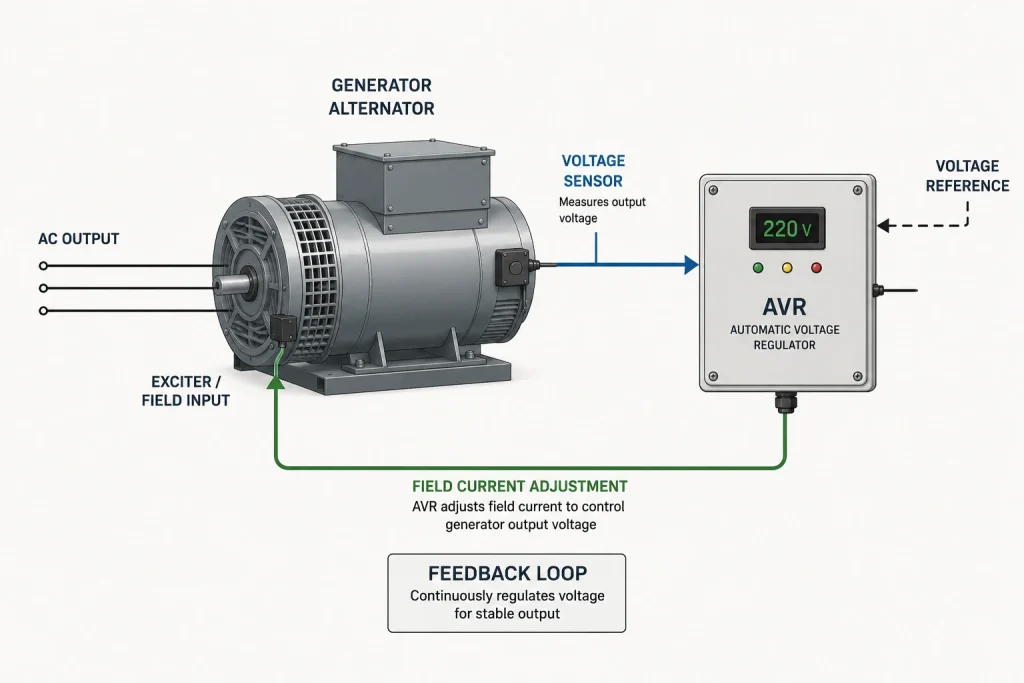
While the governor manages frequency by controlling engine speed, a separate system, the automatic voltage regulator, manages voltage by controlling the strength of the alternator’s magnetic field.
How the AVR Detects and Corrects Voltage
The AVR continuously monitors the alternator’s output voltage and adjusts the current flowing to the rotor’s electromagnets accordingly, strengthening the magnetic field to raise voltage when it sags under load, or reducing it to bring voltage back down if it rises too high. This happens many times per second, fast enough that voltage fluctuations from changing load conditions are corrected before they become noticeable to connected equipment.
This voltage control is entirely separate from the governor’s frequency control, even though both systems are responding to the same underlying trigger, a change in connected load, they correct for different electrical properties through entirely different mechanisms.
Why Voltage Regulation Matters for Connected Equipment
Equipment connected to a generator expects a stable voltage within a narrow tolerance, and voltage that runs too high can damage sensitive electronics, while voltage that sags too low can cause motors to overheat or fail to start correctly. This is why a functioning AVR is just as essential to a generator’s usability as the governor, a generator with a fast, accurate voltage regulator can support a wider range of equipment, including sensitive electronics, than one with a slower or poorly calibrated system. Reliable operation over a generator’s working life also depends on this system, along with every other part of the mechanism, being properly maintained.
Also read: Generator Maintenance Checklist: A Complete Site Guide
Cooling and Starting Mechanisms
Two further mechanical systems support the core engine, governor, and AVR functions, cooling and starting, and while less discussed than the systems above, both are essential to reliable operation.
A cooling system, typically liquid-cooled with a radiator and fan on larger generators, or air-cooled on smaller portable units, prevents the engine from overheating during sustained operation, since a generator running continuously for hours generates considerably more sustained heat than a vehicle engine used intermittently. A starting mechanism, usually an electric starter motor drawing from a dedicated battery, gets the engine running in the first place, and on standby generators this starting sequence is often fully automated, triggered the moment mains power is detected as lost, with the whole mechanism, engine, governor, and AVR, reaching stable output within seconds.
How All the Mechanisms Work Together
Bringing every system together, a generator’s full mechanism operates as a continuous feedback loop rather than a simple, one-directional process: the engine burns fuel to spin the crankshaft, the alternator converts that rotation into electrical current, the governor continuously adjusts fuel delivery to hold engine speed, and therefore frequency, steady, and the AVR continuously adjusts the alternator’s magnetic field to hold voltage steady, all while cooling and, where applicable, automated starting systems support the whole process running reliably.
Understanding this coordinated mechanism explains why a fault in any single system, a sluggish governor, a miscalibrated AVR, or an overheating engine, can degrade a generator’s output even when the basic fuel-to-electricity conversion is still functioning. It also explains why different generator applications, a small portable unit powering basic tools versus a standby system supporting sensitive data centre equipment, place very different demands on how precise and responsive these regulation mechanisms need to be, a distinction that varies across different generator categories. Further general technical background on automatic voltage regulation is available through Wikipedia’s overview of automatic voltage regulators.
A Mechanism Built for Stability
A generator’s mechanism is considerably more sophisticated than the basic fuel-to-electricity story suggests, a coordinated system of engine combustion, electromagnetic conversion, and continuous frequency and voltage regulation working together to deliver power that connected equipment can actually rely on. Understanding how the governor and AVR systems function is what separates a genuinely informed equipment decision from simply comparing kVA ratings on a spec sheet.
RR Machinery Pte Ltd offers a wide selection of power generators, professionally maintained and tested before every delivery. Contact us today to find the right generator mechanism and configuration for your needs.