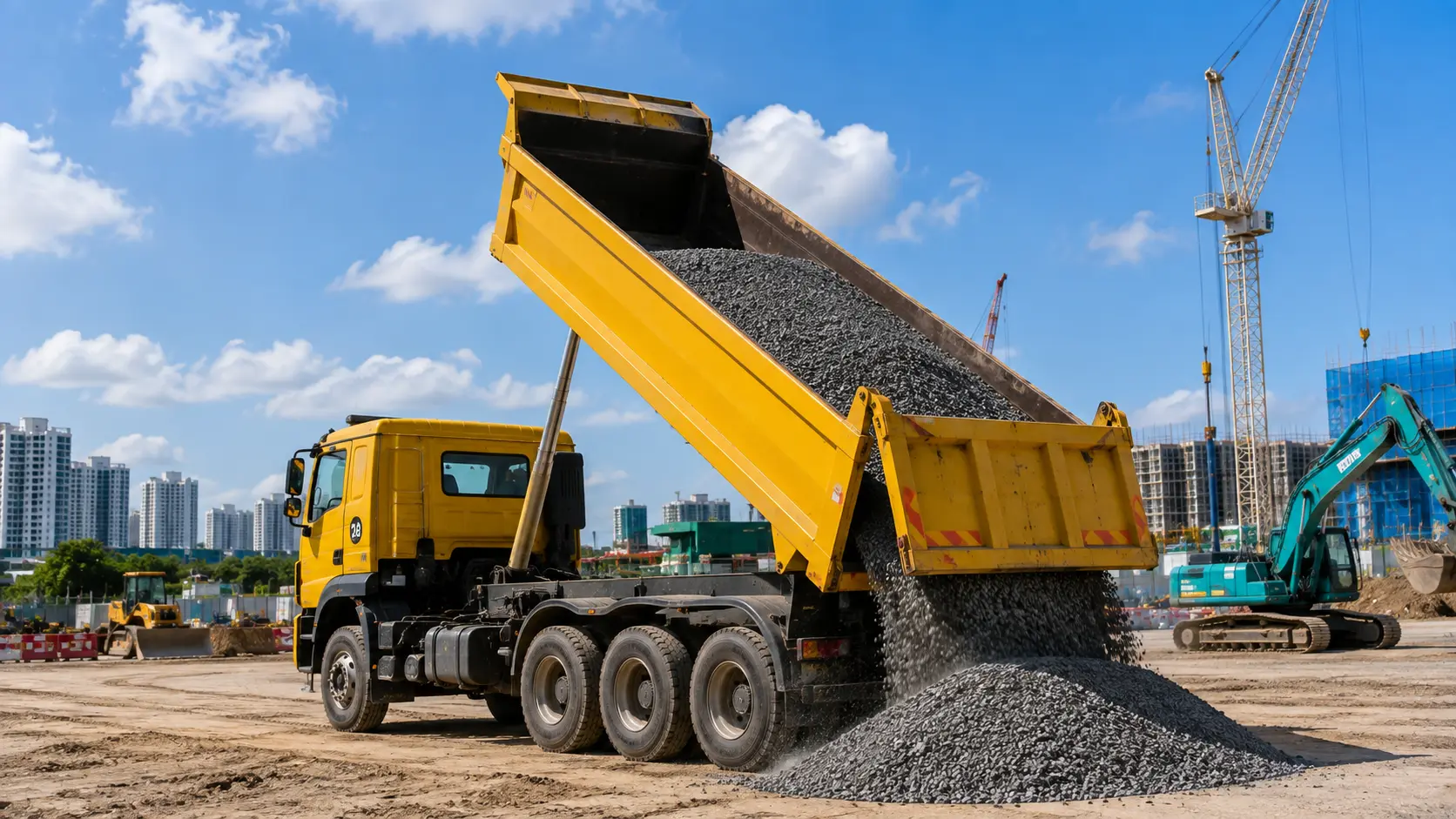
A dump truck is one of the simplest pieces of heavy equipment to recognise on a construction site, an open-bed truck that tips its cargo out the back, yet the category actually covers a surprisingly wide range of designs built for very different jobs. A compact on-highway dump truck delivering aggregate to a suburban site and a 400-tonne mining haul truck moving ore from an open pit are both, technically, dump trucks, but they share almost nothing in terms of scale, mobility, or intended use.
Understanding the different dump truck types, how each one is built, and where each performs best is essential for specifying the right vehicle for a project rather than defaulting to whichever type happens to be most familiar. This guide breaks down the main categories of dump truck, their mechanics, and the practical factors that should guide the choice between them.
What Is a Dump Truck and How Does It Work?
A dump truck is a vehicle built to transport loose material, such as sand, gravel, demolition debris, or excavated soil, and unload it by tilting its cargo bed so the material slides out under gravity, rather than requiring it to be manually unloaded.
This straightforward unloading mechanism is what defines the category, but the vehicle underneath that tipping bed varies enormously between types, from a standard rigid truck chassis to specialised articulated and off-highway designs built for conditions no ordinary truck could handle.
The Hydraulic Tipping Mechanism
Nearly every dump truck, regardless of size or configuration, uses one or more hydraulic cylinders mounted between the chassis and the underside of the bed to lift the front of the bed upward, causing the load to slide out the rear or side under gravity. The operator controls this lift from the cab, typically engaging a power take-off unit that diverts engine power to a hydraulic pump specifically for the tipping function.
The speed and angle of this tipping action matter more than they might appear, tipping too quickly or on uneven ground can shift the truck’s centre of gravity suddenly, which is why dump trucks are only tipped on level, stable ground and within the load limits specified for the bed’s raised position. Understanding this shared mechanism is a useful starting point before looking at how the vehicles built around it differ from one type to the next.
Dump Trucks vs Other Hauling Equipment
Dump trucks are sometimes confused with other earthmoving and hauling machinery, particularly front end loaders and articulated haulers, but the distinction is straightforward once the core function is understood. A front end loader scoops and carries material over short distances before loading it into another vehicle, while a dump truck is built specifically to transport that material over longer distances and unload it at a separate destination.
In practice, the two machines work together constantly on a site, a loader or excavator fills the dump truck’s bed, and the truck then hauls the material away, making the pairing between loading equipment and hauling equipment one of the most fundamental workflows in earthmoving and construction logistics. A broader view of how dump trucks fit within the full category of earthmoving machinery is available in Earth Moving Equipment: Types, Uses, and Applications.
Also read: Earth Moving Equipment: Types, Uses, and Applications
Standard (Rigid) Dump Trucks
Standard dump trucks, also called rigid dump trucks, are built on a single, non-articulating chassis, similar in basic layout to a conventional truck, with the tipping bed mounted directly over the rear axles.
This rigid, single-frame construction makes them straightforward to drive and maintain, and it remains the most widely used dump truck configuration for general construction, road work, and material delivery across both urban and semi-rural sites.
On-Highway Standard Dump Trucks
On-highway standard dump trucks are built to comply with road regulations, allowing them to travel between a quarry or supply yard and a job site under their own power on public roads. These trucks are the backbone of everyday material delivery work, hauling sand, gravel, asphalt, and demolition debris to and from sites where the truck itself also needs to travel through regular traffic.
Their axle configuration and load ratings are designed around public road weight limits, which caps their payload capacity lower than off-highway equivalents but makes them far more practical for the frequent, shorter-distance hauls typical of urban construction and general contracting work.
Off-Highway Rigid Dump Trucks
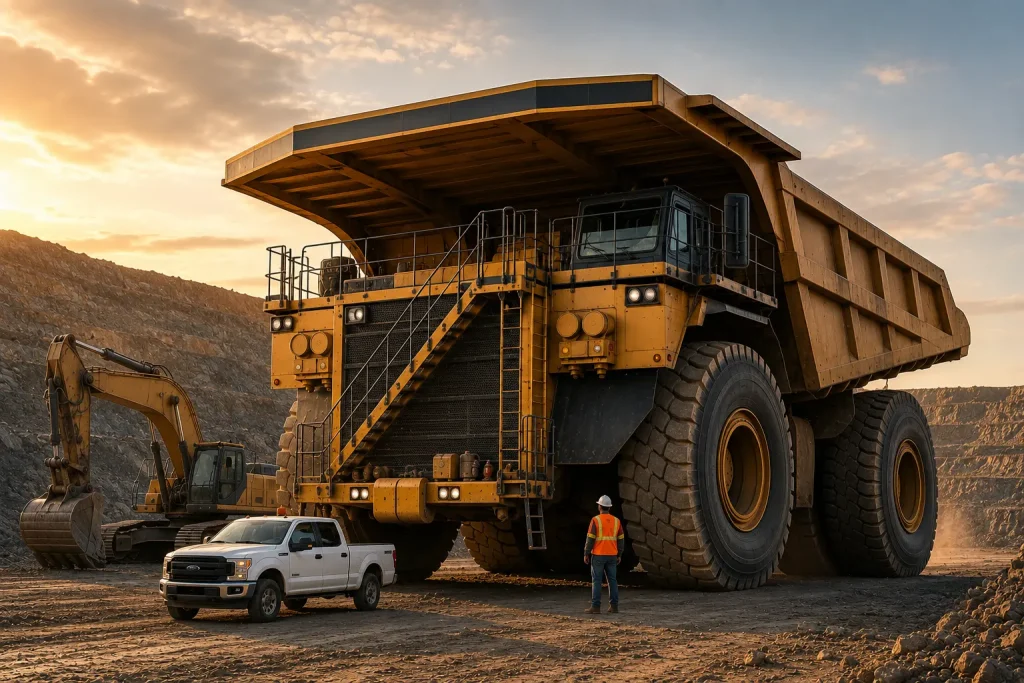
Off-highway rigid dump trucks are built exclusively for use within a job site or quarry boundary, without any requirement to comply with public road regulations, allowing them to carry significantly larger payloads on massive tyres designed for rough, unpaved ground. These trucks are common on large quarrying, mining, and major earthworks projects where material only needs to move between points within the site itself.
Because they never travel on public roads, off-highway rigid trucks can be scaled up considerably in size and capacity compared to their on-highway counterparts, with some of the largest models used in mining operations carrying payloads that would be entirely impractical, and illegal, on a public road. A closer look at how these earthmoving vehicles compare to other large-scale excavation equipment is available in Types of Excavators for Construction and Earthmoving, since the two categories are frequently specified together on major projects.
Also read: Types of Excavators for Construction and Earthmoving
Articulated Dump Trucks
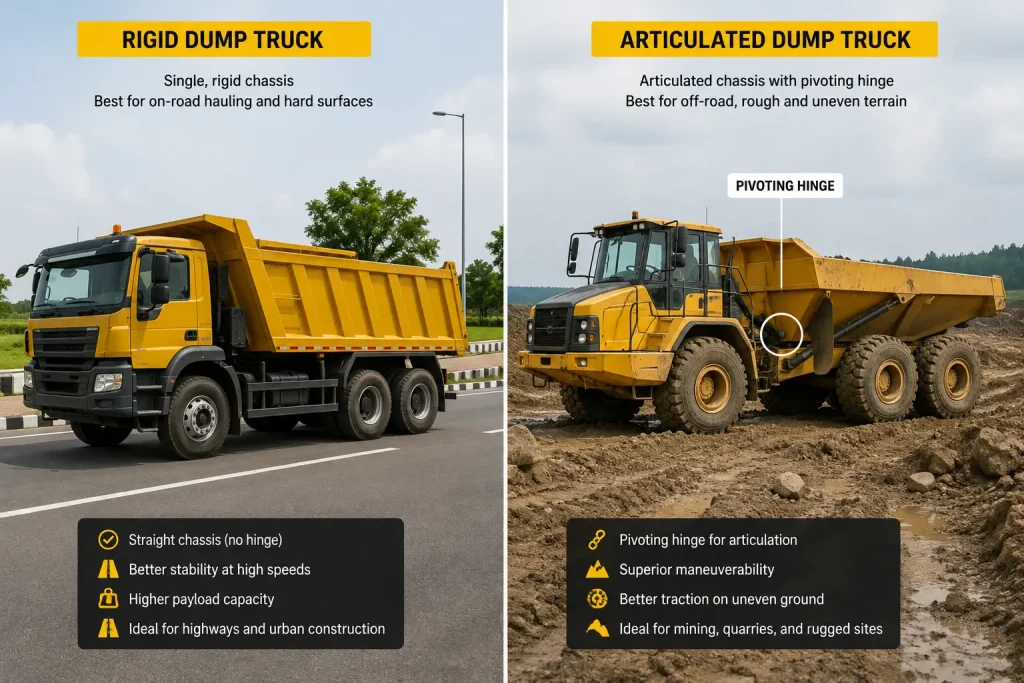
An articulated dump truck differs from a rigid model in one key structural respect: the chassis is split into two sections joined by a pivoting hinge, allowing the front cab section and the rear bed section to articulate independently of each other.
This hinged design fundamentally changes how the truck handles rough or uneven terrain compared to a rigid chassis, making articulated models the preferred choice for a specific category of demanding site conditions.
How the Articulated Joint Improves Mobility
The articulating hinge allows all wheels to maintain better contact with uneven ground, since the front and rear sections can pivot independently rather than forcing the entire rigid frame to twist across undulating terrain. This significantly improves traction and stability on soft, muddy, or heavily rutted ground where a rigid truck’s wheels might otherwise lose contact or bog down.
This same hinge also gives articulated dump trucks a noticeably tighter turning radius than a rigid truck of comparable size, since the truck effectively bends in the middle rather than relying solely on front-wheel steering to change direction, a meaningful advantage on confined sites with limited manoeuvring space.
Where Articulated Dump Trucks Excel
Articulated dump trucks are the standard choice for off-road earthworks, forestry, and construction sites with soft or wet ground conditions, where their superior traction and stability reduce the risk of becoming stuck compared to a rigid alternative. Their ability to maintain productive haul cycles even in poor weather makes them particularly valuable on projects with tight schedules that cannot afford weather-related downtime.
The trade-off for this off-road capability is generally a lower maximum payload compared to a rigid truck of similar overall size, since the articulating joint and associated structure add weight and complexity that reduce the proportion of the vehicle’s capacity available for cargo. Matching this trade-off against actual site conditions is one of the most important decisions when specifying equipment for a challenging earthworks project.
Specialised Dump Truck Types
Beyond standard rigid and articulated designs, several specialised dump truck configurations exist to solve specific hauling challenges that a conventional tipping bed cannot handle efficiently.
These specialised types are far less common on a typical construction site than standard or articulated models, but they play an essential role in the specific industries and applications they were designed for.
Transfer Dump Trucks
A transfer dump truck pairs a standard dump truck with a separate trailer that also carries a tipping container, allowing the vehicle to haul significantly more material per trip than a standalone truck bed would allow. The trailer’s container can be transferred onto the main truck bed using a hydraulic or pneumatic system once the truck bed itself has been emptied, effectively doubling the load carried between refills without needing a second driver or vehicle.
This configuration is particularly popular in regions where road regulations allow higher combined vehicle weights, since it maximises payload per trip within legal limits, improving efficiency on long-haul material delivery routes.
Side Dump and Bottom Dump Trucks
Side dump trucks tip their load out to the side rather than the rear, using a rotating mechanism that allows the truck to unload while continuing to move forward, which is particularly useful for spreading material evenly along a roadway or embankment. Bottom dump trucks, by contrast, release material through hinged doors along the underside of the bed, allowing a continuous, controlled line of material to be deposited as the truck drives forward.
Both configurations are common in road construction and paving work, where distributing material in a controlled line is more efficient than dumping an entire load in a single pile that then needs to be spread separately by a grader or bulldozer.
Mining and Ultra-Class Haul Trucks
Mining haul trucks represent the largest category of dump truck, built exclusively for off-highway use within mining operations and capable of carrying payloads far beyond anything used in general construction. These ultra-class vehicles are so large that they are typically partially assembled on-site, since transporting a fully built unit by road would be impossible.
Their scale reflects the specific economics of mining, where moving enormous volumes of ore or overburden as efficiently as possible outweighs the flexibility that a smaller, more mobile vehicle would otherwise offer. A comparison of scale across other heavy earthmoving equipment categories is available in Biggest Excavator in the World: Size and Specs Guide, useful context for understanding how mining-scale machinery compares across different equipment categories.
Also read: Biggest Excavator in the World: Size and Specs Guide
Choosing the Right Dump Truck Type for a Project
Selecting the right dump truck type comes down to matching the vehicle’s configuration to the specific combination of load requirements, site access, and ground conditions a project presents.
Defaulting to whichever dump truck type is most familiar or most readily available, rather than working through these factors systematically, is one of the most common ways a project ends up with a vehicle poorly matched to its actual hauling needs.
Load Capacity and Site Access
Projects requiring frequent trips between a site and a public road, such as general construction and demolition work, are almost always better served by an on-highway standard dump truck, since off-highway models cannot legally travel on public roads at all. Larger earthworks and quarrying projects confined entirely within a site boundary can specify off-highway rigid or ultra-class trucks, taking advantage of their considerably higher payload capacity per trip.
Understanding how dump truck capacity needs to align with the loading equipment feeding it matters just as much as the truck itself, since an undersized or oversized truck relative to the loader’s bucket capacity creates inefficient haul cycles regardless of how well-suited the truck is to the terrain.
Terrain and Site Conditions
Soft, wet, or heavily rutted ground strongly favours an articulated dump truck over a rigid alternative, since the articulating chassis maintains traction and stability in conditions that would risk a rigid truck becoming stuck. Firm, well-compacted haul roads, by contrast, allow a rigid truck to operate just as effectively while carrying a larger payload, since the ground conditions no longer demand the mobility advantage articulation provides.
Weather and seasonal variation should also factor into this decision for projects spanning several months, since ground conditions that are firm and dry for part of the year may become considerably softer during wet seasons, a consideration that often tips the balance toward articulated equipment for projects with a long-enough duration to encounter both conditions.
Safety Considerations for Dump Truck Operation
Dump trucks introduce specific safety risks distinct from general site hazards, primarily related to the tipping process itself and the vehicle’s substantial blind spots during manoeuvring.
Understanding these risks and the procedures that address them is essential for any site where dump trucks operate alongside other equipment and personnel.
Loading and Tipping Safety
Loads should always be within the truck’s rated capacity and evenly distributed across the bed before tipping begins, since an uneven or overloaded bed significantly increases the risk of the truck tipping over sideways during the unloading process. Tipping should only be carried out on level, stable ground, since tipping on a slope or soft surface can cause the truck’s centre of gravity to shift unexpectedly as the bed rises.
Operators should also remain alert to overhead obstructions such as power lines or structures before raising the bed, since a raised dump truck bed can reach a considerable height that is easy to misjudge from inside the cab.
Site Traffic and Blind Spot Awareness
Dump trucks have substantial blind spots, particularly to the rear and sides, making clear communication with ground personnel and other equipment operators essential whenever a truck is reversing or manoeuvring near other site activity. Spotters and clearly marked traffic routes significantly reduce the risk of collision between dump trucks and pedestrians or other vehicles on a busy site.
Singapore’s Ministry of Manpower publishes detailed Workplace Safety and Health guidance covering vehicle safety, site traffic management, and operator training standards that apply to heavy vehicles such as dump trucks on construction and earthworks sites.
Get the Right Equipment for Your Earthmoving Project
From compact on-highway trucks to ultra-class mining haulers, the right dump truck type depends entirely on the specific combination of payload, site access, and ground conditions a project presents, rather than any single configuration being universally superior. Further technical background on how dump trucks are engineered and classified internationally is available through Wikipedia’s overview of dump trucks, covering the broader history and design variations used across the industry.
RR Machinery Pte Ltd supports Singapore’s construction and industrial sectors with a full range of heavy machinery solutions tailored to your specific site conditions. Browse our complete heavy machinery services or contact our team today for practical advice on the right equipment for your earthmoving project.