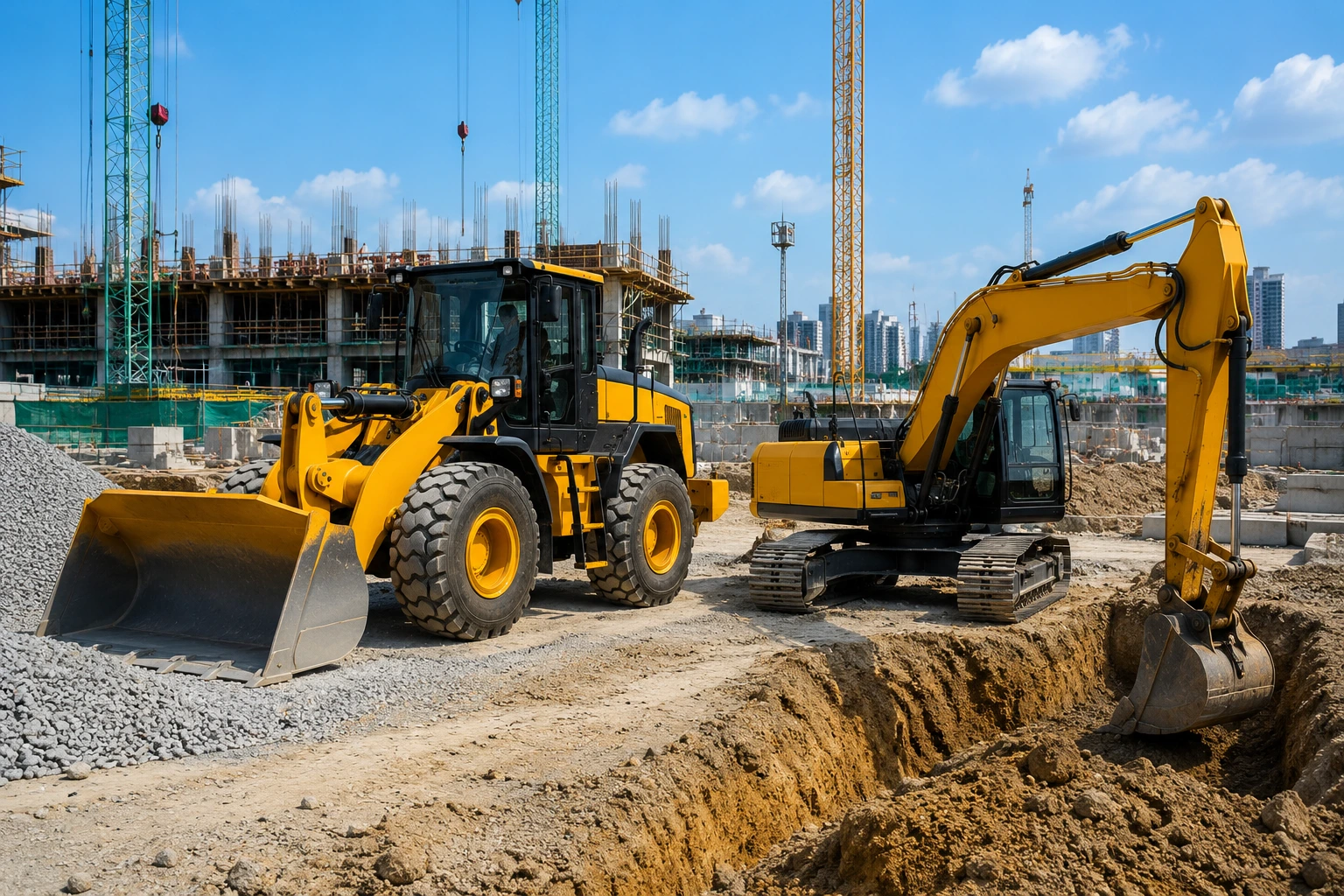
Walk onto almost any active construction or earthmoving site in Singapore and two machines are almost guaranteed to be present: a front end loader moving material in large scoops, and an excavator digging, trenching, or lifting with its articulated arm. Both are considered core earthmoving equipment, both are available in a wide range of sizes, and both can, at a glance, look like they perform overlapping jobs. In reality, they are built around fundamentally different mechanics and are rarely interchangeable for the tasks each one does best.
Choosing between a front end loader and an excavator, or recognising when a project genuinely needs both, comes down to understanding what each machine is mechanically designed to do rather than assuming one is simply a smaller or larger version of the other. This guide breaks down how each machine works, where they differ, and how to decide which one, or which combination, is right for a given job.
What Is a Front End Loader?
A front end loader, sometimes called a wheel loader or bucket loader, is an earthmoving machine built primarily to scoop, lift, carry, and load loose material using a wide bucket mounted at the front of the machine. It operates on either large rubber tyres or, in some configurations, tracks, and it is designed to move quickly across a site while carrying a full bucket load without excessive spillage.
The defining characteristic of a front end loader is that its entire design centres on forward-facing loading and short-distance transport, rather than digging below its own standing level. It drives directly into a stockpile, fills the bucket by pushing forward, lifts the arm, and either loads a truck or deposits the material elsewhere on-site. This straightforward operating cycle makes it one of the fastest machines available for moving large volumes of loose or previously excavated material.
How a Front End Loader Works
The front end loader’s bucket sits on a set of hydraulically controlled lift arms at the front of the machine. The operator drives the machine forward into a pile of material, tilts the bucket to scoop and contain the load, then raises the arms to clear the ground before reversing, turning, or driving forward to the drop-off point. Because the bucket is fixed to the front of the chassis rather than mounted on an articulated arm, the entire machine, not just an attachment, must reposition to change the loading angle.
This mechanism makes the front end loader extremely efficient at repetitive load-and-carry cycles across relatively flat, open ground. It is far less suited to precision digging, trenching, or working below grade, since the bucket’s range of motion is limited to a forward scooping and lifting action rather than the multi-directional reach of an articulated boom. Operators typically favour it for tasks where speed and volume matter more than depth or positional accuracy.
Types of Front End Loaders
Front end loaders are generally classified by their undercarriage and size. Wheeled loaders, the most common type, use large rubber tyres for speed and manoeuvrability on paved or compacted surfaces, making them the standard choice for yards, quarries, and general construction sites. Track loaders, also called crawler loaders, use tracks instead of wheels, trading some speed for significantly better traction and stability on soft, muddy, or uneven ground.
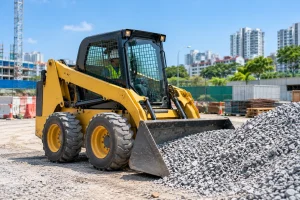
Within both categories, front end loaders range from compact skid-steer-style units suited to landscaping and small site work, up to large industrial loaders used in quarrying and bulk material handling operations. A closer breakdown of how front end loaders are engineered and where each size class fits is covered in detail in Front End Loader: How It Works and When to Use One, which also outlines bucket capacity ranges across common size classes.
Also read: Front End Loader: How It Works and When to Use One
What Is an Excavator?
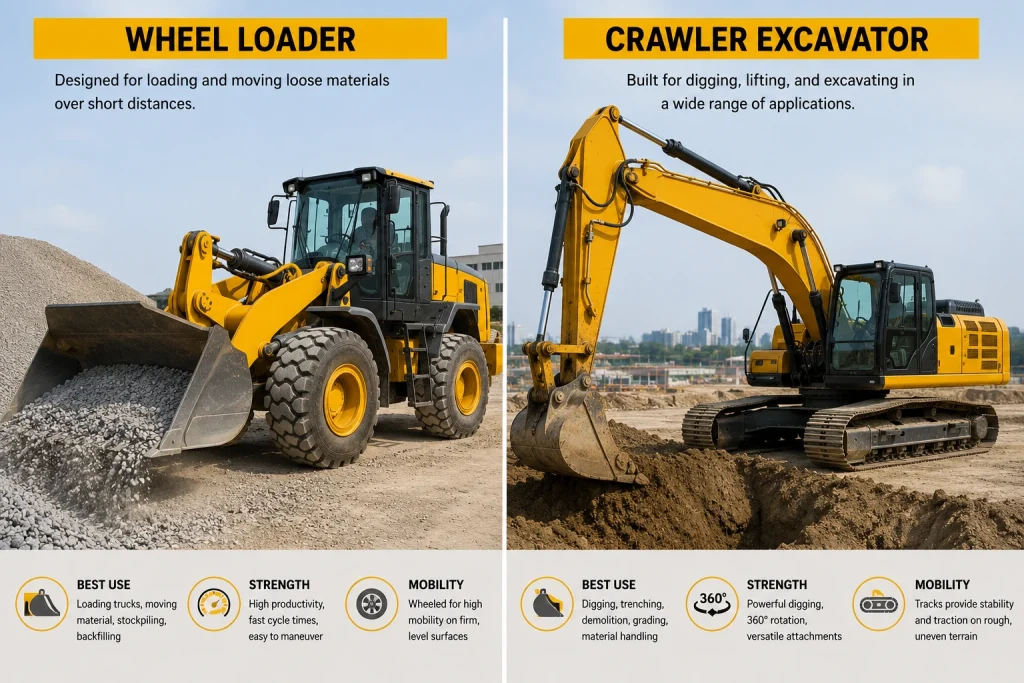
An excavator is an earthmoving machine built around a rotating platform, a hydraulic boom, an articulated arm, and a bucket that curls inward to dig, rather than scoop forward. Unlike a front end loader, an excavator’s cab and upper structure can rotate independently of its undercarriage, typically through a full 360 degrees, allowing the operator to dig, swing, and dump material without repositioning the entire machine.
This rotating, articulated design gives the excavator a fundamentally different capability: it can dig below its own standing level, reach into confined spaces, work at an angle, and place material precisely, rather than simply pushing forward and lifting. Excavators are the standard machine wherever a project requires digging, trenching, demolition, or precise material placement rather than high-speed bulk transport.
How an Excavator Works
The excavator’s digging assembly consists of three hinged sections, the boom, the arm (or stick), and the bucket, each controlled by its own hydraulic cylinder. This arrangement allows the operator to curl the bucket into the ground, drag it toward the machine to break and collect material, then lift, swing the rotating upper structure, and dump the load, all without moving the tracks or wheels beneath it. The independent rotation of the cab relative to the undercarriage is what allows an excavator to dig a trench in one spot and dump the spoil to the side, over and over, with minimal repositioning.
Because the bucket digs by curling rather than pushing, excavators can work well below ground level, cut precise trench profiles, and manoeuvre around obstacles that a front end loader’s forward-scooping bucket cannot reach. Learning the correct sequence for operating the boom, arm, and bucket together safely and efficiently is covered step by step in How to Operate an Excavator: A Step-by-Step Guide, which is worth reviewing before assigning an inexperienced operator to the machine.
Types of Excavators
Excavators are most commonly classified by their undercarriage and size class. Crawler excavators, running on tracks, are the standard choice for construction and earthmoving sites because their tracks distribute weight over a wider area, giving them stability on soft or uneven ground. Wheeled excavators, built on tyres, trade some off-road stability for the ability to travel on roads between sites, making them a common choice for urban and utility work.
Mini excavators, a compact class typically under six tonnes, are widely used for landscaping, utility trenching, and confined-space work where a full-size excavator cannot manoeuvre. A full breakdown of these classifications, along with the mid-size and large excavator classes used in heavy civil and mining work, is available in Types of Excavators for Construction and Earthmoving, which also covers how bucket and attachment choice affects each class’s suitability for different soil conditions.
Also read: Types of Excavators for Construction and Earthmoving
Front End Loader vs Excavator: Key Differences
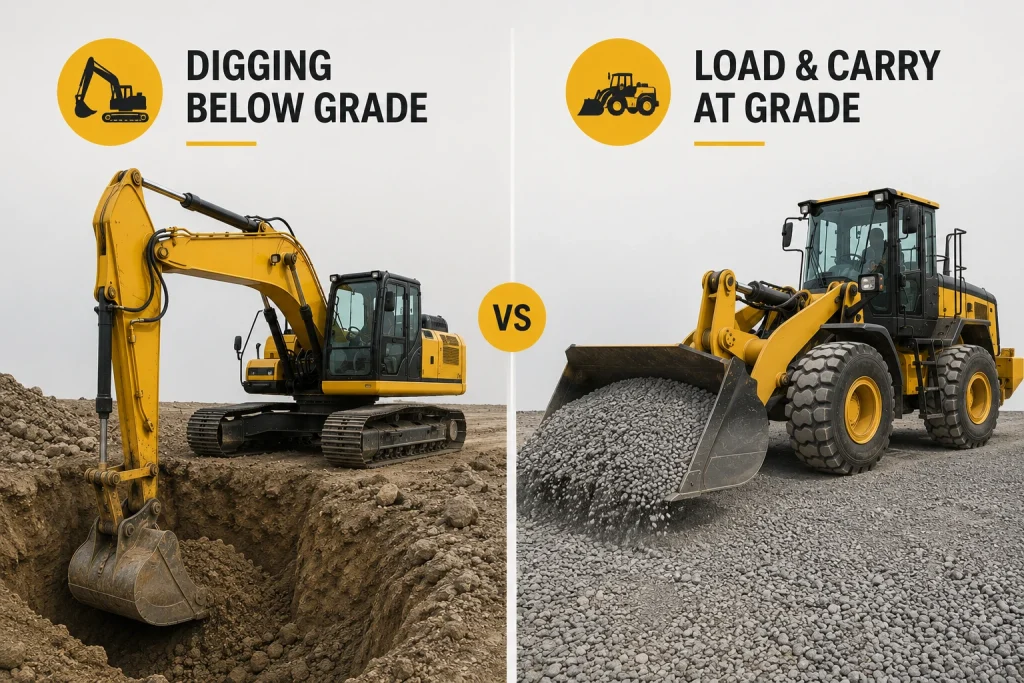
The clearest way to separate these two machines is by mechanism rather than by appearance. A front end loader is a load-and-carry machine, optimised for scooping material at or above ground level and transporting it quickly across a site. An excavator is a digging and placement machine, optimised for working below ground level, in confined spaces, and at precise angles that a loader’s fixed forward bucket simply cannot reach.
This distinction plays out across several practical dimensions that matter directly when specifying equipment for a project, from how deep each machine can dig, to how much material it can move per cycle, to how easily it can be repositioned around a site. Understanding each of these dimensions individually makes the choice between the two machines, or the decision to use both together, far more straightforward.
Digging Capability
An excavator’s articulated arm allows it to dig well below its own track or wheel level, making it the only practical option for trenching, foundation excavation, and any task requiring material to be removed from below grade. Its rotating cab also lets it work at angles and reach around obstacles without repositioning the whole machine, which is essential in tight excavation sites, near existing structures, or along the edges of slopes.
A front end loader, by contrast, has essentially no meaningful digging capability. Its bucket is designed to scoop material that is already loose or piled at or near ground level, not to cut into undisturbed ground or dig a trench. Attempting to use a front end loader for digging work quickly reveals its structural limitations, since its bucket geometry and lift-arm motion were never designed for that function.
Load Capacity and Material Handling
Front end loaders generally move more material per cycle than an excavator of comparable size, because their bucket is wider and their load-and-carry cycle is faster over short distances. This makes them significantly more efficient for tasks like loading trucks from a stockpile, clearing large volumes of loose aggregate, or moving material across a yard, where speed and volume matter more than precision.
Excavators, while capable of handling substantial loads with the right bucket or attachment, are generally slower per cycle for pure loading tasks because each cycle involves digging, swinging, and placing rather than simply scooping and driving. Where the priority is precise placement, such as loading pipe sections into a trench or placing rock with accuracy, the excavator’s control advantage outweighs the loader’s speed advantage, even though it moves less material per hour in a straight load-and-haul comparison.
Mobility and Site Versatility
Wheeled front end loaders move quickly across a site and on paved surfaces, and their forward-driving operation makes them intuitive for operators moving between a stockpile and a loading point repeatedly throughout a shift. This makes them a natural fit for yards, quarries, and any site with clear, relatively flat travel paths between the material source and the drop-off point.
Excavators, particularly crawler models, move more slowly across a site but offer far greater versatility once positioned, since the same machine can dig, lift, place, and, with the right attachment, even demolish or grade without needing to reposition constantly. For sites with tight access, uneven terrain, or a need to dig at multiple depths and angles from a single position, the excavator’s versatility typically outweighs the loader’s speed advantage. A side-by-side look at how these mobility and capability trade-offs compare against a third common alternative is available in Bulldozer vs Excavator: Key Differences and Uses, useful for sites weighing more than two machine types.
Also read: Backhoe vs Excavator: Differences, Uses & How to Choose
Common Applications for Each Machine
Beyond the mechanical differences, the clearest way to decide between a front end loader and an excavator is to look at the actual task at hand rather than the machine category. Some jobs are almost exclusively loader tasks, others are almost exclusively excavator tasks, and a large share of real projects require both machines working in sequence or in parallel.
Matching the machine to the task, rather than defaulting to whichever unit happens to be available on-site, has a direct effect on project timelines and cost. A team using an excavator to do loader work, or a loader to attempt excavation, will typically take longer, use more fuel per unit of material moved, and place more wear on components that were never designed for that specific motion.
When to Use a Front End Loader
A front end loader is the right choice whenever the task involves moving loose material that is already at or near ground level: loading trucks from a stockpile, clearing snow or debris, backfilling a previously dug trench, spreading gravel or aggregate across a surface, or handling bulk materials in a quarry or yard. Its speed and bucket capacity make it the more efficient machine whenever volume and cycle time matter more than depth or precision.
It is also the preferred machine for site clean-up and material redistribution tasks that occur after excavation work is complete, since it can quickly clear spoil piles or bring fill material back into an excavated area. A broader look at how loaders fit alongside other machines used for clearing and preparing a site is covered in Equipment to Clear Land: A Complete Guide to Every Machine, which outlines the typical equipment sequence used from initial clearing through to grading.
When to Use an Excavator
An excavator is the right choice whenever the task requires digging below ground level, working in a confined or angled space, or placing material with precision: trenching for utilities and drainage, digging foundations, demolition work, and site excavation ahead of construction. Its rotating cab and articulated arm make it the only practical option once the work requires reaching into a hole, around a corner, or below the machine’s own standing surface.
Excavators are also frequently the better choice for mixed-material sites where the ground includes compacted soil, rock, or debris that a loader’s bucket cannot break into, since the excavator’s digging motion generates far more cutting force at the bucket edge than a loader’s forward push. For a broader view of how excavators fit within the full category of earthmoving machinery used on a typical site, Earth Moving Equipment: Types, Uses, and Applications provides useful context on where excavators sit relative to graders, dozers, and loaders across a project timeline.
Choosing Between a Front End Loader and an Excavator for Your Project
For many projects, the decision is not strictly either-or. A construction site might use an excavator to dig foundations and trenches, then bring in a front end loader to clear the excavated spoil and later backfill once work below ground is complete. Recognising this sequencing, rather than treating the choice as a single either-or decision, is often the most accurate way to plan equipment needs for a project from start to finish.
Where a genuine single-machine decision is required, such as for a smaller project or a business investing in one primary earthmoving machine, the choice should be driven by which task dominates the expected workload. A business that spends most of its time moving stockpiled material, loading trucks, or clearing yards will get more value from a front end loader. A business whose work is centred on digging, trenching, or site excavation will get far more use out of an excavator.
Factors to Consider
Beyond the core task, several practical factors influence the decision. Site access and ground conditions matter significantly, tracked excavators handle soft or uneven ground better than wheeled loaders, while wheeled loaders move faster on compacted or paved surfaces. The depth of work required also matters directly, any task requiring material removal below the machine’s standing level rules out a front end loader entirely, regardless of its size or power.
Budget and utilisation rate matter just as much as raw capability. A machine that sits idle most of the time because it was chosen for a rare task, rather than the day-to-day workload, represents a poor return on investment whether purchased or rented. For most businesses, working through expected task frequency, typical material type, and site conditions systematically produces a clearer answer than comparing specification sheets in isolation.
Can You Use Both on the Same Site?
In practice, many mid-to-large construction and earthmoving projects use both machines, often at different phases of the same job. An excavator typically leads the earliest phase of site work, digging foundations, trenches, and drainage, while a front end loader follows to manage spoil removal, material redistribution, and eventual backfilling once excavation is complete. This sequencing allows each machine to work within its actual mechanical strength rather than being pushed into tasks it was not designed for.
Where budget or site space limits equipment to a single machine at a time, project planning should prioritise whichever phase carries the greater risk of delay if performed with the wrong equipment, which in most cases is the excavation phase, since digging cannot realistically be substituted with a loader. Flexible rental arrangements make this phased approach far more practical than owning both machines outright, since each unit can be brought on-site only for the phase of work it is actually needed for. For projects comparing a front end loader against a third alternative commonly confused with both machines, Front End Loader vs Bulldozer: Key Differences Explained is a useful next read before finalising an equipment plan.
Also read: Front End Loader vs Bulldozer: Key Differences Explained
Get the Right Earthmoving Equipment for Your Project
A front end loader and an excavator are built to solve different problems, one moves and loads material quickly at ground level, the other digs, places, and manoeuvres with precision at and below grade. Understanding this distinction, rather than treating the two as interchangeable general-purpose machines, is what allows a project to be resourced correctly from the outset. Further technical background on how excavator mechanisms are engineered and classified internationally is available through resources such as Wikipedia’s overview of excavators, which covers the engineering principles behind hydraulic digging arms in more depth.
Operators working with either machine should also follow proper site safety procedures at all times, including pre-use inspection, load limit awareness, and safe working distances around swinging booms and lift arms. Singapore’s Ministry of Manpower publishes detailed Workplace Safety and Health guidance covering the training and operating standards that apply to heavy earthmoving equipment across construction sites.
RR Machinery Pte Ltd supports Singapore’s construction and industrial sectors with a full range of heavy machinery solutions tailored to your specific site conditions, from earthmoving equipment to the technicians who keep it running. Browse our complete heavy machinery services or contact our team today for practical advice and a clear quotation matched to your operational requirements.