The terms “aerial lift” and “boom lift” appear in equipment specifications, rental catalogues, and site safety documentation, sometimes interchangeably, sometimes with a clear distinction intended. For project managers, site supervisors, and facilities managers who need to specify the right working-at-height equipment for a task, this ambiguity creates a practical problem: if the terms are not precisely understood, there is a real risk of specifying equipment that cannot safely or efficiently perform the work required.
The confusion is understandable because the two terms do not describe entirely separate machines. They describe different levels of classification within the same equipment family. “Aerial lift” is the broader category, it covers every type of powered, elevating work platform. “Boom lift” is one specific type within that category. Understanding where the terms overlap, where they diverge, and what the full range of aerial lift types includes is the foundation of correct equipment selection for any working-at-height task.
This guide sets out the relationship between aerial lifts and boom lifts precisely: what each term means in operational and regulatory terms, what the full family of aerial lift types includes, how boom lifts differ from other aerial lift types, and how to select the right type for any given access requirement.
What Is an Aerial Lift?
An aerial lift, also referred to as an aerial work platform (AWP) or mobile elevating work platform (MEWP), is any powered, mechanical device used to provide temporary, elevated, and mobile access to a work area for personnel and their equipment. The defining characteristic of an aerial lift is that it elevates a person in an enclosed platform, a basket, cage, or deck, to a working height above the ground.
The aerial lift category encompasses a wide range of machine types that differ in their structural configuration, their mobility method, their working height range, and the access geometry they provide. What they share is the fundamental function: elevating an operator to height in a controlled, safe platform.
In most national regulatory frameworks, including the standards published by the International Powered Access Federation (IPAF) and the American National Standards Institute (ANSI), the aerial lift or MEWP category is divided into types based on whether the platform can be positioned beyond the machine’s base footprint. This distinction, between platforms that lift vertically only and platforms that can reach horizontally beyond the base, is the most operationally significant classification within the aerial lift family.
Also read : How to Build Scaffolding: A Step-by-Step Site Guide
Types of Aerial Lifts
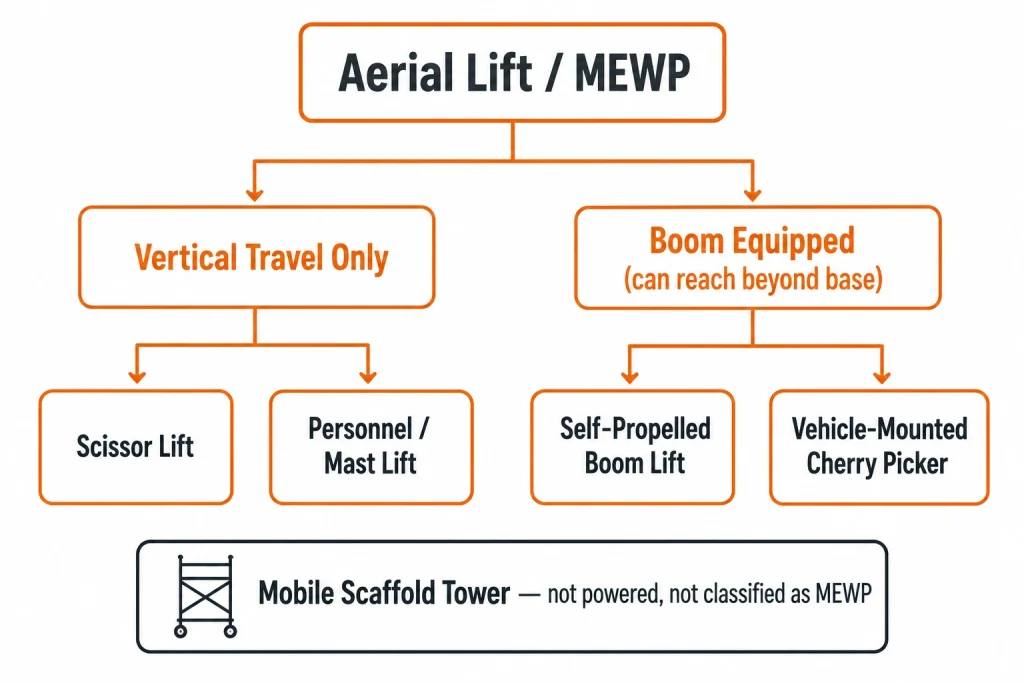
The aerial lift family includes several distinct machine types, each suited to a different category of access task. Understanding the full range of types is necessary to understand where boom lifts fit within it.
Scissor Lift
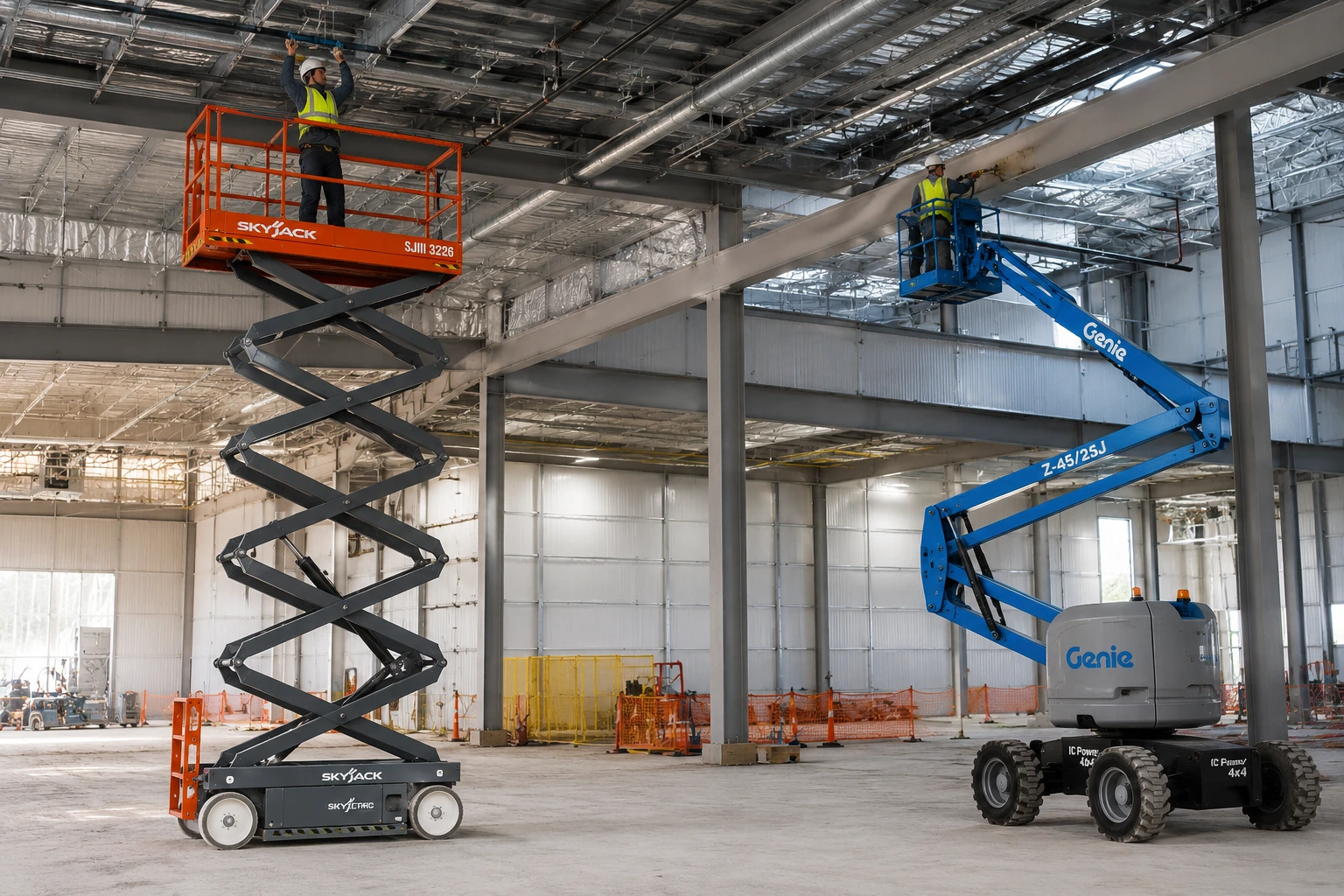
The scissor lift raises a flat work platform vertically using a scissoring mechanism, a set of linked, folding supports that extend vertically when pushed from the ends. The platform rises and lowers in a straight vertical line directly above the machine’s base. The scissor lift cannot position the platform horizontally beyond the machine’s footprint, it can only go up and down.
Scissor lifts are available in electric and diesel versions, in a wide range of platform sizes, and in working heights from approximately 4 metres to over 14 metres for standard models. They are the default choice for work that is directly above the machine’s position, maintenance on a flat ceiling, installation of overhead services, plastering and painting at height in open areas, where the work does not require the platform to be offset from the machine’s ground position.
For a detailed understanding of scissor lift battery systems, charging requirements, and operational management, including how to maximise runtime and extend battery life across a project, the complete guide to how to charge a scissor lift and manage its battery correctly covers every aspect of electric scissor lift power management.
Boom Lift
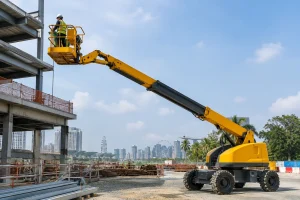
The boom lift is an aerial lift in which the platform is mounted at the end of an extendable boom arm, a structural arm that can be raised, extended, and in most configurations rotated, positioning the platform at height and at horizontal reach from the machine’s base. The boom arm is the defining feature: it allows the platform to be positioned not just above the machine but offset from it, reaching over obstacles, around structures, and into spaces that a vertical-only lift cannot access.
Boom lifts are available in two principal configurations, telescopic and articulating, and are further divided by their undercarriage type into self-propelled models for site use and vehicle-mounted models for road-based access. The full operational distinction between boom lift types and the vehicle-mounted cherry picker, including when each is the right choice, is covered in the practical guide to boom lift vs cherry picker differences and application.
Personnel Lift and Vertical Mast Lift
The personnel lift, also called a vertical mast lift or man lift, is a compact, single-operator platform that rises vertically on a telescoping mast. It is smaller, lighter, and more compact than a scissor lift, suited to very restricted access locations, narrow aisles, compact plant rooms, tight interior spaces where a scissor lift cannot manoeuvre.
Personnel lifts typically reach working heights of 4 to 10 metres and carry a single operator with a limited tool load. They are not suited to work requiring wide platforms, heavy material handling, or multiple operators.
Vehicle-Mounted Aerial Work Platform
The vehicle-mounted aerial work platform, commonly called a cherry picker, combines a boom lift mechanism with a road-going vehicle chassis, giving it public road mobility that self-propelled platforms cannot match. It drives to the work location under its own power, deploys outriggers for stability, and operates the platform from the vehicle. Vehicle-mounted platforms are the standard choice for road-based utility work, street lighting maintenance, and facade access from the pavement.
For a comprehensive explanation of what a cherry picker is, how it works, and the full range of vehicle-mounted and trailer-mounted configurations available, the definitive guide to what a cherry picker is and when to use one covers every operational aspect in detail.
Mobile Scaffold Tower
The mobile scaffold tower is not a powered aerial lift, it is a manually erected, wheeled scaffold structure that provides a fixed working height platform and is moved between locations on castors without being dismantled. It is included in the broader working-at-height equipment family but is not classified as a powered MEWP.
Mobile scaffold towers are the right choice for short-duration tasks at a fixed height where the simplicity and low cost of a manually erected platform outweigh the operational advantages of a powered lift. Their capabilities and limitations in comparison to powered access equipment are covered in full in the guide to what mobile scaffolding is and when to use it.
Aerial Lift vs Boom Lift: The Key Distinction
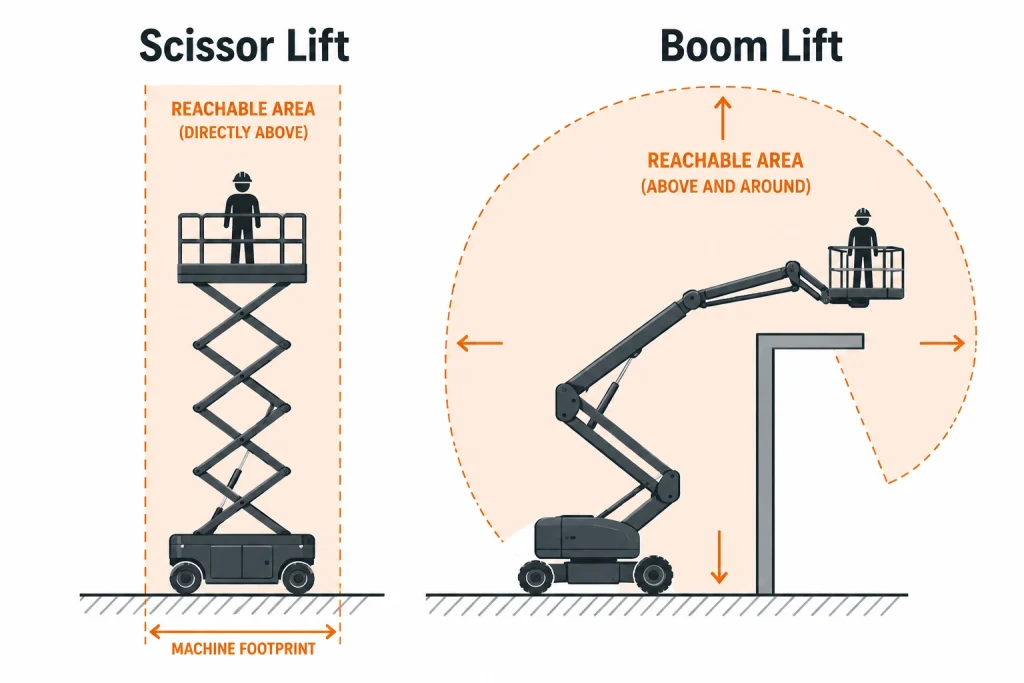
With the full aerial lift family in view, the distinction between “aerial lift” and “boom lift” becomes clear:
- Every boom lift is an aerial lift
The boom lift is one specific type within the broader aerial lift category, it meets the definition of an aerial lift (a powered platform that elevates personnel) and it adds the boom arm that provides horizontal outreach.
- Not every aerial lift is a boom lift
A scissor lift is an aerial lift but not a boom lift, it has no boom arm and cannot position the platform beyond the machine’s base footprint. A personnel lift is an aerial lift but not a boom lift. A vehicle-mounted cherry picker is a boom lift, it has a boom arm, and therefore also an aerial lift.
The practical implication: when a specification calls for an “aerial lift,” the type of aerial lift must be determined by the access requirements of the task. Specifying an aerial lift without specifying the type is not a complete equipment specification, it leaves open the question of whether a vertical-only scissor lift or a boom-equipped platform is required.
When a Boom Lift Is Required
A boom lift is required, rather than another aerial lift type, when the access geometry of the task demands it. Specifically:
- The work location is horizontally offset from where the machine can be positioned
If the machine must stand in an aisle, on a road, or beside a structure while the platform must reach over or around that structure to the work location, only a boom lift can achieve this. A scissor lift positioned in the same location would place the platform directly above the machine, not at the offset position where the work is.
- The work requires reaching over an obstruction
An articulating boom lift can raise its platform above an obstacle and then lower the outer boom section to reach down to work on the far side. No other aerial lift type can achieve this “up and over” access geometry.
- The working height requirement exceeds the practical range of scissor lifts
Standard scissor lifts reach working heights of up to approximately 14 to 18 metres. Boom lifts are available to working heights exceeding 40 metres, and vehicle-mounted cherry pickers beyond 60 metres. For high-reach access tasks, a boom lift is the only aerial lift that reaches the required height as a single self-contained machine.
- The site requires an aerial lift that can travel across rough, uneven, or soft ground
Rough terrain boom lifts, fitted with four-wheel-drive undercarriages and large-diameter tyres, can access site locations that no scissor lift can reach. The ground capability of rough terrain aerial lifts parallels the capability described for rough terrain mobile cranes operating on the same categories of difficult site conditions.
When a Scissor Lift Is the Better Choice
Within the aerial lift category, the scissor lift is the better choice than a boom lift when:
- The work is directly above the machine’s ground position
For ceiling maintenance, overhead service installation, and any task where the operator works directly above the machine rather than at an offset, the scissor lift’s wider platform, higher load capacity, and lower cost make it more appropriate than a boom lift.
- Multiple operators must work simultaneously on the same platform
Scissor lift platforms are significantly wider than boom lift baskets, accommodating two or more operators and larger quantities of materials. Boom lift baskets are designed for one to two operators and a limited tool load.
- The work is indoors on a smooth, level floor
Electric scissor lifts on non-marking tyres are the standard choice for indoor access on finished floors, quieter, zero-emission, and with a wider, more stable platform than an equivalent boom lift.
- Cost is a significant constraint
Scissor lifts are generally less expensive to rent than boom lifts of equivalent working height, reflecting their simpler structure. For tasks that a scissor lift can perform, specifying a boom lift adds cost without adding benefit.
Also read : Types of Bridges: Structures, Uses, and How They Work
How to Choose Between Aerial Lift Types: A Practical Decision Process
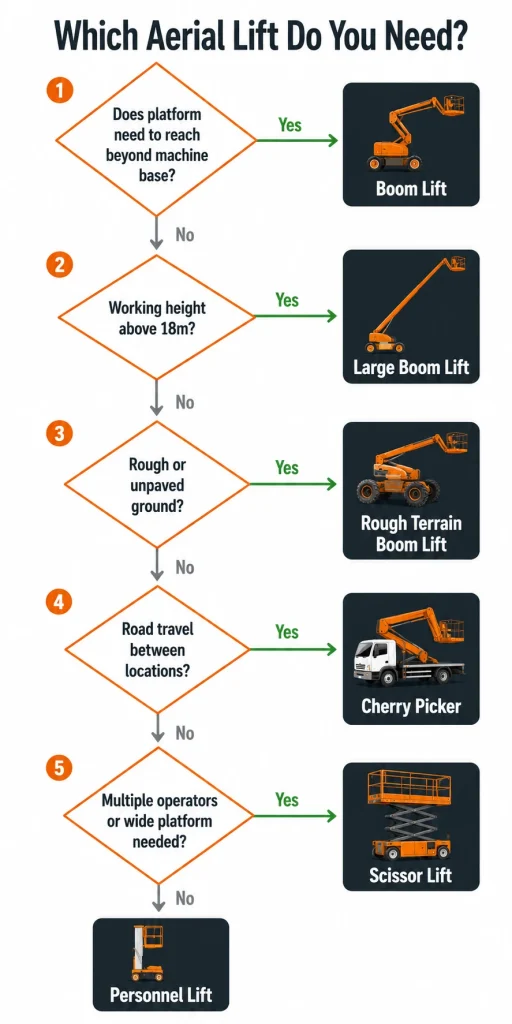
Selecting the correct aerial lift type for any task follows a logical sequence:
- First, determine whether horizontal outreach is required
If the platform must be positioned at a horizontal offset from the machine’s ground position, over an obstacle, around a structure, or beyond the machine’s base footprint, a boom lift is required. If the work is directly above the machine’s position, a scissor lift or personnel lift may be sufficient.
- Second, determine the required working height
If the working height is within the scissor lift range, typically up to 14 to 18 metres, and no horizontal outreach is required, a scissor lift is likely the most appropriate and economical choice. If the working height exceeds this range, or if outreach is required, a boom lift is needed.
- Third, assess the site conditions
Is the surface firm, smooth, and level, suited to a standard electric aerial lift? Or is it unpaved, uneven, or soft, requiring a rough terrain machine? Is the work indoors, requiring an electric, zero-emission machine, or outdoors, where diesel is acceptable?
- Fourth, determine the mobility requirement
Will the machine operate on a single site, repositioning itself across the site under its own power? Or must it travel between multiple locations on public roads? If road travel is required, a vehicle-mounted cherry picker rather than a self-propelled aerial lift is the correct specification.
- Fifth, confirm the platform capacity requirement
How many operators will work simultaneously, and what is the combined weight of operators, tools, and materials? Platform capacity varies significantly between machine types, from a single-operator personnel lift to a multi-person scissor lift platform capable of carrying several hundred kilograms.
This selection process is directly analogous to the selection process for other categories of construction plant, the systematic matching of machine capability to task requirements that determines the right crane type for a lifting task, the right excavator configuration for a ground engineering task, or the right scaffold type for an access task. Understanding the full range of lifting and access equipment and how each type fits a specific operational requirement is the foundation of effective equipment planning, as covered in the overview of crane types and their application to different lifting and access tasks.
Safety Requirements Common to All Aerial Lifts
Regardless of the aerial lift type selected, the safety obligations that apply to every elevated work platform operation are consistent in their underlying logic:
- Pre-use inspection
Every aerial lift must be inspected before each shift of use by a competent person. The inspection covers the structural condition of the platform and its supporting structure, the operation of all controls including emergency lowering, the condition of all tyres or tracks, and the function of the tilt alarm and overload indicator where fitted.
- Operator certification
Aerial lift operators must hold a current certification appropriate to the machine category. IPAF PAL card certification is the internationally recognised standard, with separate categories for different machine types, a scissor lift certification does not automatically qualify an operator to use a boom lift. Certification must be in date and appropriate for the specific machine being operated.
- Ground and surface assessment
The ground or surface beneath the machine must be assessed for bearing capacity before the machine is positioned and the platform elevated. On soft or uncertain ground, spreader boards may be required beneath the tyres or outrigger pads. On internal floors, the structural capacity of the floor must be confirmed against the machine’s wheel or outrigger loads. These ground assessment principles are consistent with those applied to all categories of heavy access and lifting equipment, as set out in guidance on lifting equipment safety and ground bearing assessment for aerial work platforms.
- Personal fall protection
All operators in a boom lift basket must wear a full-body harness with a short lanyard attached to the designated anchor point within the basket. For scissor lift platforms with full-height guardrails on all sides, harness requirements vary by jurisdiction and by the platform configuration, the applicable national standard must be consulted.
- Exclusion zones
A ground-level exclusion zone must be maintained around any elevated aerial lift platform, preventing pedestrians and site traffic from entering the area beneath the working platform where falling objects represent a hazard.
Also read : How to Choose a Generator: A Practical Buyer’s Guide
Choose the Right Platform, Not Just Any Platform
The distinction between an aerial lift and a boom lift is not semantic, it is operational. Specifying an aerial lift without determining which type of aerial lift is required is an incomplete equipment decision that can result in a machine arriving on site that cannot perform the required task, or a machine that is over-specified and unnecessarily costly for work a simpler platform could have performed.
The correct approach is to define the access requirement precisely, working height, horizontal outreach, ground conditions, indoor or outdoor, number of operators, duration, and match those requirements to the aerial lift type whose capabilities most closely fit. In most cases, this process clearly identifies whether a boom lift, a scissor lift, a personnel lift, or a vehicle-mounted cherry picker is the right choice.
RR Machinery provides a comprehensive range of aerial work platforms for rental and sale, including articulating and telescopic boom lifts, scissor lifts, and supporting access equipment, all maintained to full operational standard and available with guidance from experienced equipment specialists. Explore our full range of boom lift and aerial work platform options, or contact our team for practical advice and a clear quotation matched to your specific access requirements and site conditions.