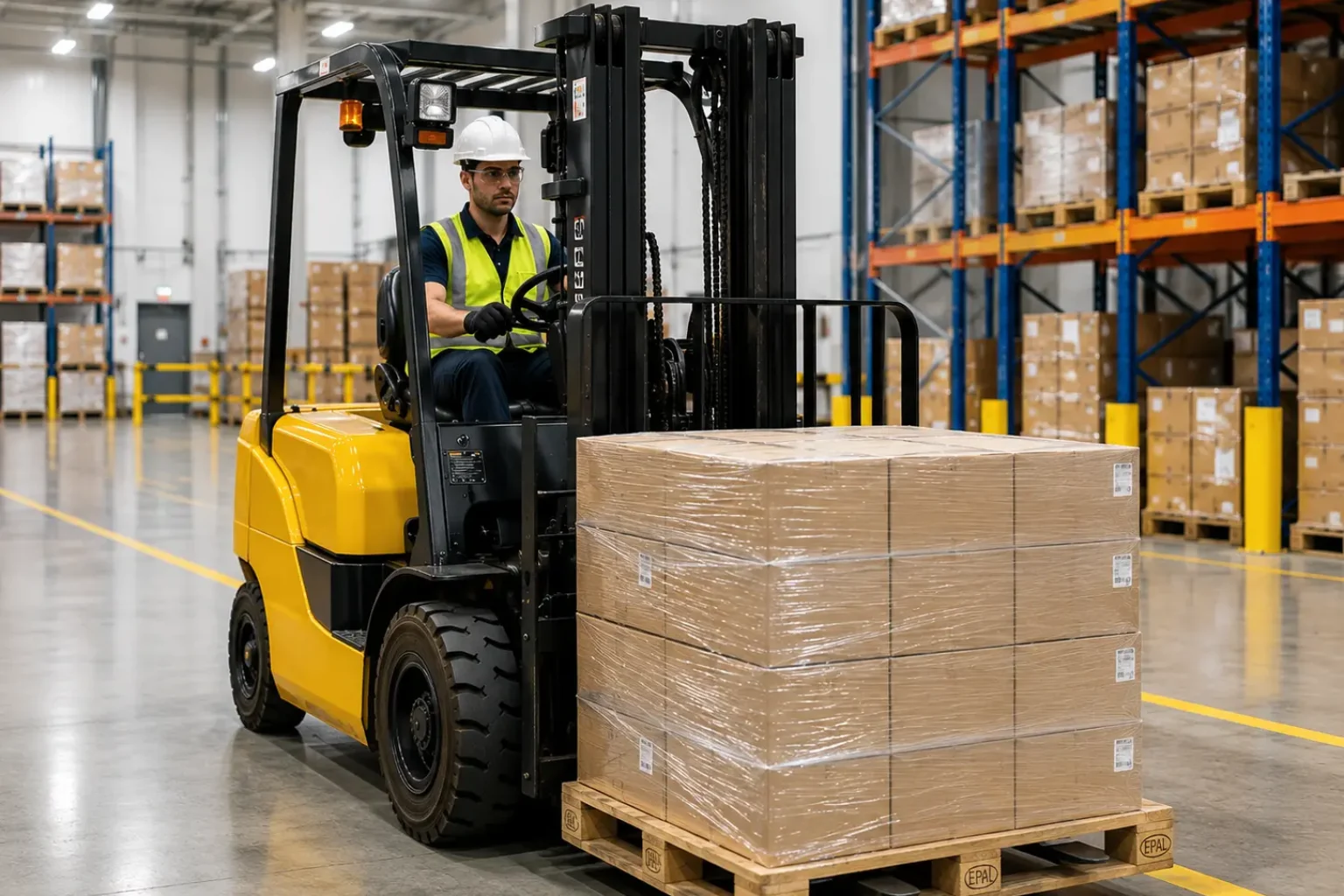
The counterbalance forklift is the most widely used material handling machine in the world. Walk into almost any warehouse, logistics hub, manufacturing facility, or construction site, and you will find one, or several. Its design is immediately recognisable: the pair of horizontal forks at the front, the upright mast through which they travel, and the heavy block of cast iron or steel at the rear that gives the machine its name and its fundamental operating principle.
Yet despite its ubiquity, the counterbalance forklift is frequently misunderstood, misspecified for the application, operated beyond its rated capacity, deployed in environments for which it was not designed, or maintained inadequately until a system failure forces an unplanned repair. These mismatches between machine and application are the primary cause of the productivity losses, safety incidents, and premature equipment failure that occur even on well-run operations.
Understanding the counterbalance forklift in depth, how its core mechanics work, what the different configurations offer, how each fuel type affects operational suitability, and what the key factors are in selecting the right model, is the foundation of getting the most from this essential piece of equipment. This guide covers all of these aspects in practical, operational terms, designed to inform the decisions of warehouse managers, fleet operators, site supervisors, and procurement teams.
How a Counterbalance Forklift Works
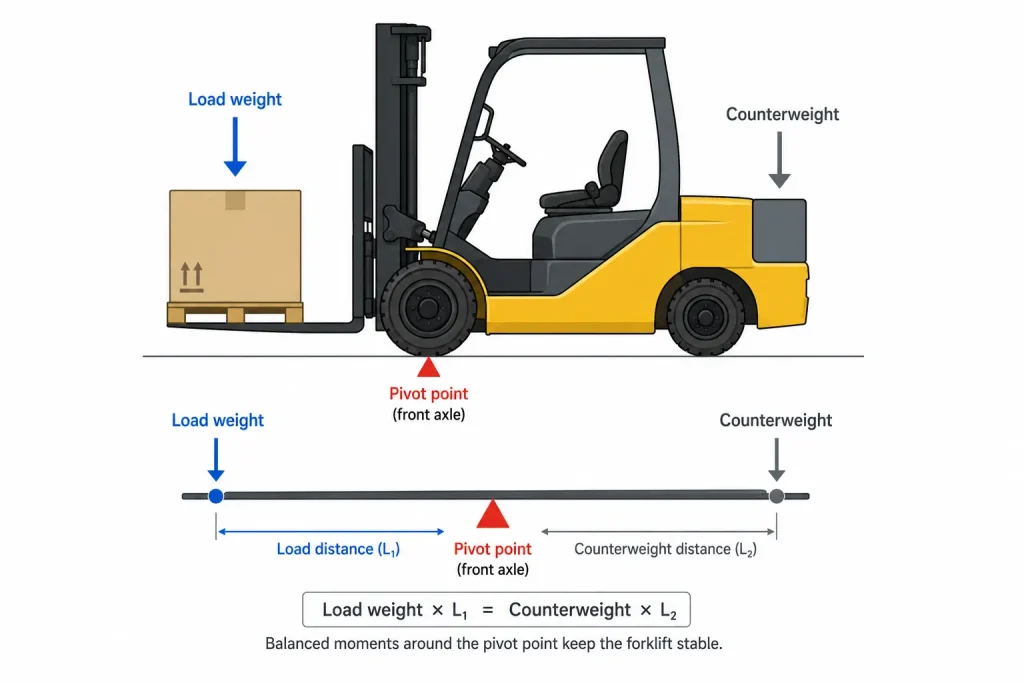
The counterbalance forklift operates on a simple but elegant mechanical principle: the machine itself serves as its own counterweight. When the forks carry a load at the front, the heavy counterweight at the rear creates an equal and opposite moment that prevents the machine from tipping forward over its front axle, which acts as the pivot point of the stability system.
This is fundamentally different from other forklift types, reach trucks extend their forks into the rack to avoid carrying the load in front of the machine’s footprint, and side loaders carry loads along the side of the machine. The counterbalance forklift carries its load directly in front, cantilevered over the front axle, balanced entirely by the rear counterweight.
Also read : Forklift Maintenance Checklist: Daily Inspections and Scheduled Service
The stability triangle
The counterbalance forklift’s stability is defined by the stability triangle, the three-point support system formed by the two front wheels and the single rear axle pivot point. The machine is stable as long as the combined centre of gravity of the machine and its load remains within this triangle. When a load is too heavy, positioned too far forward on the forks, raised too high, or the machine corners too fast, the combined centre of gravity moves outside the triangle, and the machine tips.
Understanding the stability triangle is not merely theoretical. It explains why the rated capacity decreases as the load centre distance increases, why high-speed cornering under load is dangerous, and why operators are instructed to travel with the mast tilted back and the forks at the lowest safe travel height. Every safety instruction relating to load handling in a counterbalance forklift derives from the stability triangle concept. The full mechanics of this are explained in detail in practical guides on the structural components of a forklift and how they manage load stability.
Rated capacity and load centre
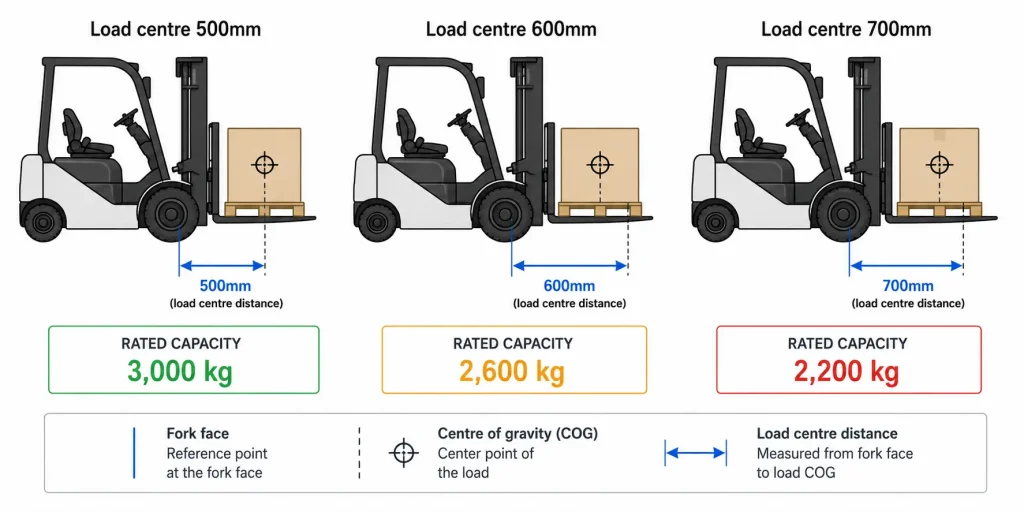
The rated capacity shown on a counterbalance forklift’s data plate is the maximum load the machine can lift safely, but only at the standard load centre distance of 500 mm. The load centre is the horizontal distance from the face of the forks to the centre of gravity of the load. For a standard wooden pallet, this is typically close to 500 mm, but for long loads, heavy items at the outer end of the load, or oversized pallets, the effective load centre may be significantly greater.
When the actual load centre exceeds 500 mm, the rated capacity must be reduced. The machine’s load chart specifies the permitted load at different load centre distances, this document is as important as the rated capacity figure itself, and any operator or fleet manager who does not consult it when handling non-standard loads is operating without critical safety information.
Key Components of the Counterbalance Forklift
The counterbalance forklift consists of several major systems that must all function correctly for the machine to operate safely and efficiently.
Mast assembly
The mast is the vertical structure at the front of the machine through which the forks travel. It consists of interlocking steel channels, outer and inner, that telescope to raise and lower the carriage and forks. The mast is powered by hydraulic cylinders: primary lift cylinders raise the inner channels, while the free-lift cylinder raises the carriage within the mast before the channels begin to extend.
Three main mast configurations are available:
Duplex (two-stage) mast: Two channels, outer and inner, telescope to the rated lift height. The collapsed mast height is relatively tall, limiting use in low-clearance environments. Standard choice for moderate lift heights in open facilities.
Triplex (three-stage) mast: Three channels provide greater lift height for a given collapsed mast height. A triplex mast can pass through a standard doorway (4 m clearance) while reaching rack positions at 6 m or higher. The standard choice for high-bay warehousing and any facility with overhead clearance restrictions.
Mast tilt: All counterbalance forklifts can tilt the mast, forward to engage and deposit loads, backward during travel to secure the load against the backrest and lower the combined centre of gravity for stability. Tilt is controlled by hydraulic tilt cylinders mounted on each side of the mast.
Hydraulic system
The hydraulic system powers the mast lift, mast tilt, sideshift (if fitted), and any auxiliary attachments. It consists of a hydraulic pump, reservoir, control valves, hoses, and cylinders. Hydraulic system integrity is fundamental to safe forklift operation, a hydraulic failure that causes uncontrolled mast descent while a load is elevated is one of the most serious failure modes for any forklift.
Drive and steering
Counterbalance forklifts are driven through the front axle (the drive axle) and steered through the rear axle (the steer axle). This rear-wheel-steering arrangement is the opposite of most road vehicles and is one of the most important handling characteristics for new operators to internalise, the rear of the machine swings outward during turns, creating a swing arc that must be accounted for when manoeuvring near racks, columns, and pedestrians.
Counterweight
The counterweight is a solid block of cast iron or ballasted steel mounted at the rear of the machine. Its mass is calculated by the manufacturer to balance the rated load at the standard load centre distance. It is not adjustable in the field, adding weight to the counterweight to increase rated capacity is a modification that invalidates the machine’s certification and creates serious structural risk.
Also read : Forklift vs Pallet Jack: Differences, Uses, and How to Choose
Fuel Types and Their Implications
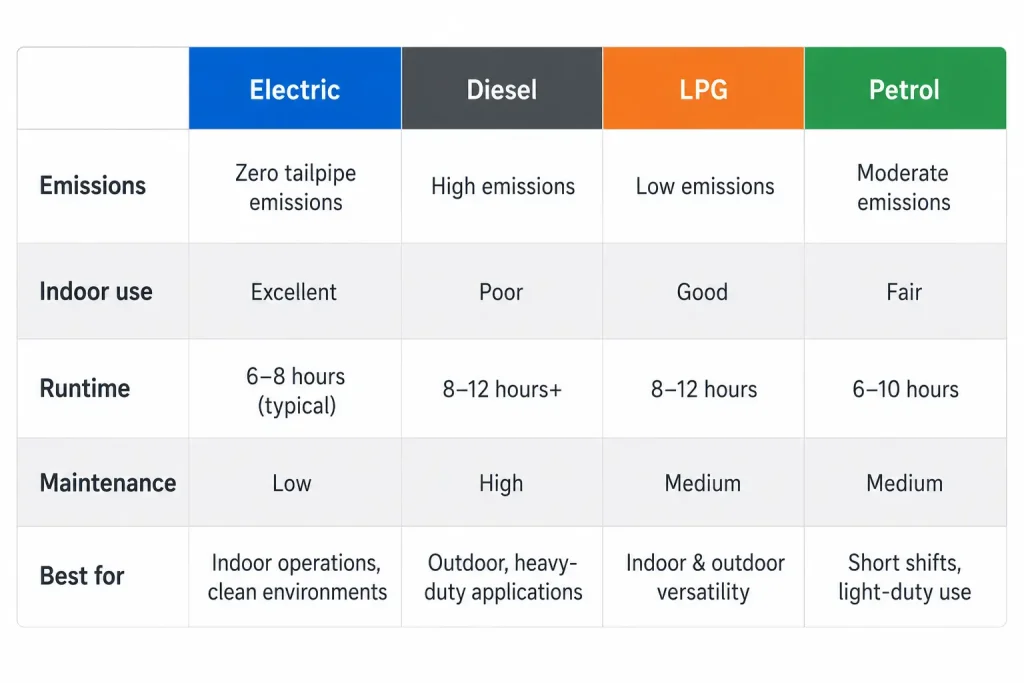
The counterbalance forklift is available in four fuel configurations, each suited to different operational environments.
Electric counterbalance forklift
The electric counterbalance forklift is powered by a large battery pack, typically lead-acid or lithium-ion, that drives both the traction motor (for travel) and the hydraulic pump motor (for lift and tilt). Electric forklifts produce zero direct emissions and operate at significantly lower noise levels than combustion alternatives.
Lead-acid battery models require 8 hours of charging after a full discharge, making them suitable for single-shift operations where the machine can charge overnight. Multi-shift operations require either a battery-swap system (keeping spare charged batteries for rapid changeover) or opportunity charging during breaks.
Lithium-ion battery models charge faster (typically 2 to 3 hours for a full charge), support opportunity charging without battery damage, and have a longer calendar life than lead-acid. Their higher upfront cost is partially offset by lower energy consumption and reduced maintenance requirements.
Electric forklifts are the standard choice for food processing, pharmaceutical manufacturing, cold storage, and any enclosed facility where air quality and noise levels are regulated. The absence of exhaust emissions and the lower operating temperature of electric machines (no engine heat) are also advantages in temperature-controlled environments.
Best suited for: Indoor warehouses, food-grade facilities, pharmaceutical and healthcare operations, cold storage, facilities with air quality or noise restrictions.
Considerations: Requires charging infrastructure; lead-acid batteries require ventilated charging area; machine weight is higher than equivalent diesel due to battery mass, relevant for floor loading assessments.
Diesel counterbalance forklift
The diesel counterbalance forklift is the standard choice for heavy outdoor work, construction sites, loading yards, timber merchants, steel service centres, ports, and any operation involving large loads on rough or unpaved surfaces. Diesel engines deliver high torque at low RPM, providing excellent performance for heavy lifting and ramp climbing, and diesel fuel has a higher energy density than LPG, giving diesel forklifts longer runtime per refuel.
Diesel forklifts produce exhaust emissions, carbon monoxide, nitrogen oxides, and particulate matter, that make them unsuitable for use in enclosed spaces without adequate ventilation. In practice, this limits diesel forklifts to outdoor use or to large, well-ventilated indoor spaces such as loading bays with open roller doors.
Best suited for: Construction sites, outdoor yards and loading docks, heavy industrial operations, ports and container handling, timber and steel operations.
Considerations: Exhaust emissions limit indoor use; higher noise levels than electric; requires diesel fuel storage on site; regular engine servicing required.
LPG counterbalance forklift
LPG forklifts run on propane cylinders, producing significantly lower emissions than diesel, the combustion of LPG produces carbon dioxide and water vapour, with very low particulate output. This makes LPG acceptable for use in many partially enclosed or semi-enclosed environments where diesel would not be permitted.
The practical advantage of LPG is its unlimited runtime through cylinder-swapping, a depleted cylinder is exchanged for a full one in minutes, unlike an electric forklift that must wait for a battery to charge. This makes LPG particularly suited to multi-shift operations and to facilities that cannot justify the infrastructure cost of a battery-swap system.
Best suited for: Mixed indoor-outdoor operations, multi-shift operations where continuous runtime is essential, facilities where diesel emissions are unacceptable but electric infrastructure investment is not justified.
Considerations: LPG cylinder storage and handling regulations apply; combustion produces some CO even at low levels, adequate ventilation is still required for sustained indoor use; cylinder cost must be factored into total operating cost.
Petrol counterbalance forklift
Petrol forklifts are relatively uncommon in industrial applications due to higher fuel costs and higher CO emissions than LPG, and lower torque than diesel. They are occasionally used in light-duty applications where both LPG supply and electric charging infrastructure are impractical, typically on smaller or more remote sites.
Selecting the Right Counterbalance Forklift
Capacity and load centre
Establish the maximum load weight and load centre distance before selecting any model. Confirm that the rated capacity at the actual load centre distance, not the headline capacity at 500 mm, meets or exceeds the maximum load. Where loads have variable dimensions or weight distribution, use the most conservative (heaviest and most offset) case.
Lift height and mast configuration
Determine the maximum height to which loads must be raised, the top rack beam level plus adequate clearance. Select the mast configuration (duplex or triplex) that achieves this height within the overhead clearance constraints of the facility. Confirm the free-lift specification if the forklift must operate in containers, vehicles, or low-clearance areas.
Operating environment
Indoor smooth floor: electric, cushion tyres. Mixed indoor-outdoor paved: LPG or electric with pneumatic tyres. Outdoor heavy use: diesel, pneumatic tyres. Rough terrain: diesel with pneumatic tyres and high ground clearance. Matching the fuel type and tyre configuration to the environment is as fundamental as matching the capacity rating.
Aisle width and turning radius
Confirm that the forklift’s turning radius, measured at full steer lock, is compatible with the available aisle width in the facility. A forklift that cannot turn in the available aisle without a multi-point manoeuvre is a productivity and safety problem that cannot be solved after the machine is on site. This consideration, alongside lift height and load centre, forms the core of the structured approach to selecting the right forklift for a specific operation.
Attachments
If the operation requires fork attachments, sideshifter, fork positioner, clamp, rotator, or carpet pole, these must be specified at the time of ordering. Attachments add weight to the front of the machine, reducing the effective rated capacity by the weight of the attachment. A machine specified for a 3,000 kg load without attachments may only be rated at 2,700 kg when a sideshifter is fitted, a reduction that must be accounted for in the specification.
Buy or rent
For sustained daily use over years, purchase is typically the more cost-effective acquisition model. For short-term projects, seasonal peaks, trials of new configurations, or operations during periods of uncertainty, rental provides the flexibility to match equipment provision to demand without capital commitment. Understanding the full range of forklift types and configurations available for sale and rental helps operations managers evaluate which model and acquisition approach best fits their current and projected needs.
For technical reference on counterbalance forklift design standards, stability testing methodology, and international regulatory frameworks for industrial truck safety, engineering resources on counterbalance forklift engineering and safety standards provide useful background on how capacity ratings and stability requirements are determined and certified.
Also read : Warehouse Equipment List: Every Machine Your Operation Needs
Choose the Right Counterbalance Forklift with Confidence
The counterbalance forklift’s dominance in material handling is not accidental, it is the result of a design that balances simplicity, versatility, and operational effectiveness in a way that no other forklift type can match across the full range of general-purpose applications. But that versatility has limits, and those limits are defined by the stability triangle, the rated capacity, the load centre, the operating environment, and the facility constraints of each specific application.
Specifying a counterbalance forklift correctly, matching capacity, mast, fuel type, tyres, and attachments to the actual operational demands, is the decision that determines whether the machine is a reliable, productive asset or a source of ongoing operational problems.
RR Machinery offers a comprehensive range of counterbalance forklifts for sale and rental, including diesel, electric, and LPG models across a wide range of lifting capacities and mast configurations, all professionally maintained and supported by factory-certified technicians. Explore our full range of forklift solutions for sale and rental or contact our team for practical advice and a clear quotation matched to your specific operational requirements.