
A construction site safety checklist is one of the most practical tools in any site manager’s repertoire. It transforms the broad, abstract obligation to maintain a safe site into a structured, systematic, and documentable routine. A checklist does not replace professional judgement or safety expertise, but it ensures that established safety controls are actually applied, consistently, on every inspection, regardless of how busy or pressured the site is at that moment.
The value of a checklist lies precisely in its routine nature. Safety lapses on construction sites almost never occur because a hazard was unknown or an appropriate control did not exist. They occur because a known control was not applied on a particular day, in a particular location, because the inspection was rushed, because the pressure to maintain programme overrode the discipline to stop and check, or because a new hazard developed overnight that the next morning’s site inspection failed to catch. A well-structured checklist, used consistently and honestly, catches these lapses before they become incidents.
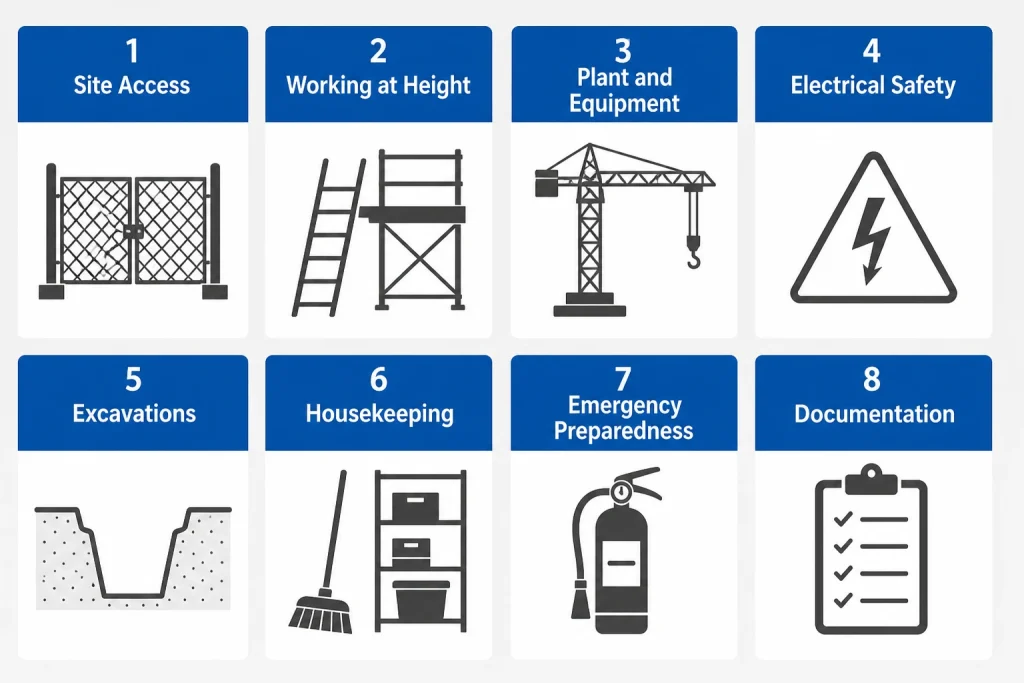
This guide provides a comprehensive construction site safety checklist organised by category, with explanations of why each item matters and what to look for during inspection. It covers the main risk categories on a typical construction site, site access and perimeter security, working at height, equipment and plant, electrical safety, housekeeping and material storage, excavations and groundworks, and emergency preparedness. It is designed to be adapted to the specific conditions of any project rather than applied as a rigid universal standard.
How to Use a Construction Site Safety Checklist
Before working through the checklist categories, three principles of effective checklist use are worth establishing:
- Inspect, don’t tick
A checklist item is answered by physically inspecting the relevant condition, not by recalling what was found yesterday or assuming that because something was correct last week it remains correct today. Conditions on a construction site change daily: new trades arrive, materials are delivered and stored, equipment moves, and weather affects ground conditions and temporary structures.
- Record findings, not just outcomes
A checklist that records only pass/fail provides limited value. Recording specific observations, “scissor lift battery at 40% charge, flagged for overnight charging” or “scaffold board on level 3 bay 2 showing surface crack, replaced”, creates a maintenance and inspection record with genuine operational value and regulatory compliance value.
- Act on findings immediately
A checklist that identifies hazards but does not trigger immediate corrective action provides a false sense of security. Every item marked as non-compliant must be assigned to a responsible person with a deadline for resolution, and the resolution must be verified before the checklist is filed.
Also read : Workplace Safety Tips for Construction and Industrial Sites
Site Access and Perimeter Security
The perimeter of a construction site is the first line of defence against unauthorised access, theft, and the inadvertent injury of members of the public, particularly children, who may be attracted to construction sites and do not appreciate the hazards present.
Hoarding and fencing
- Is the site perimeter hoarding or fencing continuous, with no gaps or damaged sections?
- Are all gates in working order, capable of being securely closed and locked when the site is unattended?
- Is hoarding of adequate height to prevent climbing, typically a minimum of 2 metres for sites adjacent to public footpaths or roads?
- Is signage on the hoarding current and legible, site name, contractor details, emergency contact number, and appropriate safety warnings?
Site access control
- Is there a single controlled point of entry through which all personnel, vehicles, and visitors must pass?
- Is a site induction being conducted for all new arrivals, workers, subcontractors, delivery drivers, and visitors, before they enter the work area?
- Are all personnel on site wearing the minimum required PPE, hard hat and high-visibility vest, at all times in the work area?
- Is a current register maintained of all personnel on site at any given time, for emergency evacuation purposes?
Vehicle and pedestrian segregation
- Are pedestrian routes through the site clearly defined, marked, and separated from vehicle routes wherever possible?
- Where pedestrian and vehicle routes unavoidably share space, are traffic management controls in place, speed limits, one-way systems, banksmen for reversing vehicles?
- Are vehicle movement areas clearly signed and free from stored materials, debris, and obstructions that reduce visibility?
Working at Height
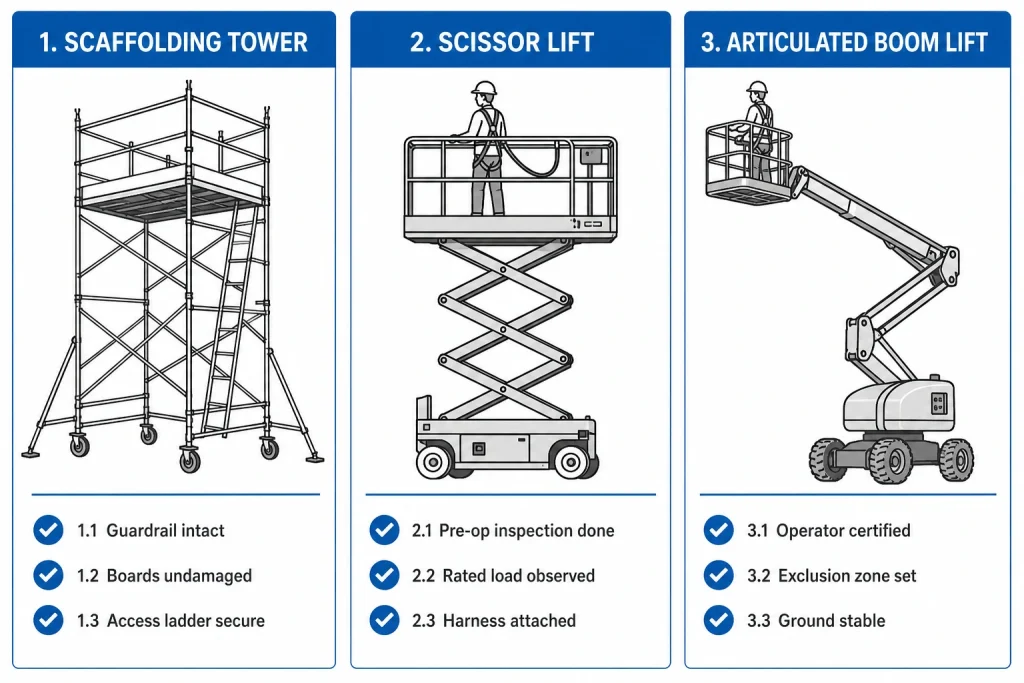
Falls from height are the leading cause of fatal and serious injury in construction. The working at height section of the site safety checklist must be completed for every area of the site where elevated work is occurring or where unprotected edges exist.
Scaffolding
- Does all scaffold on site have a current handover certificate signed by a competent scaffolder?
- Are all scaffold platforms fitted with guardrails at the correct height, intermediate rails, and toe boards on all open sides?
- Are scaffold boards fully supported, free from damage (no cracks, splits, or excessive deflection), and laid without gaps that could trap a foot?
- Are access points to scaffold platforms, ladders or stair towers, in place, secured, and extending to the correct height above the platform?
- Has the scaffold been inspected after any significant wind event, rain, or impact, and is the inspection record current?
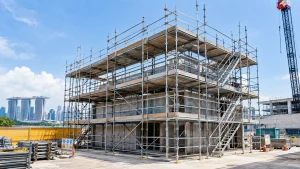
Scaffolding inspection and compliance requirements are covered in detail in practical guides on scaffolding types, components, and safety standards.
Aerial work platforms and MEWPs
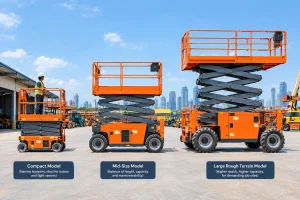
- Has each aerial work platform, scissor lift, boom lift, been inspected by the operator before use today?
- Are MEWPs being operated only by trained and certified operators?
- Is the rated working load of each MEWP clearly marked and being observed?
- Are boom lift operators wearing personal fall arrest harnesses attached to the designated anchor point inside the platform?
- Are MEWPs being operated on surfaces within their rated slope and ground bearing capacity?
- Are exclusion zones maintained beneath elevated work platforms?
Regular maintenance is the foundation of MEWP safety, the inspection and maintenance requirements that keep scissor lifts and other aerial work platforms safe and reliable underpin every pre-operation check on site.
Unprotected edges and openings
- Are all floor slab edges, stairwell openings, lift shaft openings, and service penetrations protected by guardrails, covers, or barriers?
- Are edge protection systems physically robust, capable of resisting a person falling against them, rather than merely visual indicators?
- Are covers over floor openings marked, secured to prevent displacement, and capable of supporting the load of a person walking across them?
- Is there a system to ensure that edge protection removed to allow work is reinstated immediately when work is complete?
Plant and Equipment
Cranes
- Does the crane operator hold a current and valid licence for the type of crane being operated?
- Has the crane’s pre-use inspection been completed and recorded today?
- Is the load chart available in the crane cab, and is it being referenced for every lift configuration?
- Are exclusion zones established and enforced beneath all crane lifts?
- Is a qualified slinger/signaller designated and briefed for all crane lifts?
- Has the crane been examined by a competent person within the required examination interval?
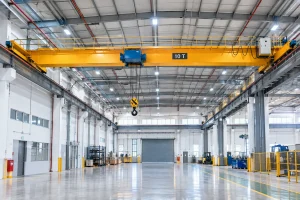
The ability to read and correctly apply a crane load chart is one of the most important safety competencies for everyone involved in crane operations, and one of the most frequently misapplied. Practical guides on how to read and correctly apply a crane load chart cover this critical skill in detail.
Forklifts and material handling equipment
- Are forklift operators licensed and restricted to operating only the class of forklift for which they hold a licence?
- Are pre-operation inspections being conducted and recorded at the start of each shift?
- Is the rated capacity of each forklift being observed, including the reduced capacity at elevated fork heights and extended load centres?
- Is the forklift travel path free of pedestrians, and are speed limits being observed?
- Are loads being carried at the correct travel height with the mast tilted back?
- Is parking brake being applied whenever the operator leaves the forklift, even briefly?
Generators and temporary power
- Is the site generator positioned in a ventilated area away from enclosed spaces where exhaust accumulation is a risk?
- Is the generator correctly earthed and connected through a properly rated distribution board?
- Are all temporary electrical cables routed to avoid vehicle traffic, water, and damage?
- Is the generator fuel level adequate for the anticipated period of use, and is fuel stored correctly in approved containers?
- Has the generator been serviced within the manufacturer’s recommended interval?
Also read : Lifting Equipment Safety: A Practical Guide
Electrical Safety
Electrical hazards, overhead power lines, temporary installations, and portable tools, account for a significant proportion of serious injuries on construction sites.
Overhead power lines
- Have all overhead power lines on or adjacent to the site been identified and their voltage confirmed with the utility provider?
- Are safe working distances from overhead lines established, marked with goal posts or other physical barriers, and enforced?
- Is plant equipment height restricted to prevent inadvertent contact with overhead lines?
- Is there a documented procedure for the event of accidental contact between plant equipment and an overhead line?
Temporary electrical installation
- Has the site’s temporary electrical installation been designed, installed, and tested by a qualified electrician?
- Are all distribution boards, socket outlets, and cables rated appropriately for the loads connected?
- Are residual current devices (RCDs) fitted to all circuits supplying portable tools and equipment?
- Is a system of regular inspection and testing of portable tools and cables in operation, with current test tags visible on all equipment?
- Are damaged cables, plugs, and tools removed from service immediately and not returned until repaired by a qualified electrician?
Excavations and Groundworks
Excavations present specific risks, collapse of unsupported excavation faces, falling into excavations, and services strikes, that require specific controls beyond the general site safety management system.
Excavation support and edge protection
- Are all excavations deeper than 1.2 metres supported by shoring, battering, or other engineered means to prevent face collapse?
- Are all excavation edges protected by barriers or edge protection to prevent personnel and vehicles from falling in?
- Are barriers set back adequately from the excavation edge to account for the potential for face collapse?
- Are excavation spoil and stored materials kept clear of the excavation edge to reduce surcharge loads on the excavation face?
Underground services
- Has a full underground services search been conducted before excavation began, including utility drawings, CAT scanning, and vacuum excavation where necessary?
- Are all identified services marked on the site plan and physically marked on the ground?
- Is hand-digging being used within the exclusion zone around identified services?
- Is there a protocol for responding to unexpected services encounters, who to call, how to isolate, when to stop work?
Dewatering
- If groundwater is present, is the dewatering system adequate to maintain the excavation in a safe, dry condition?
- Is the discharge from dewatering pumps directed to an appropriate disposal point and not causing ground saturation adjacent to the excavation?
Housekeeping and Material Storage
Site housekeeping is a direct safety control, not a cosmetic preference. Cluttered walkways, improperly stored materials, and accumulated debris create slip, trip, and fire hazards, impede emergency evacuation, and hide developing hazards beneath the surface disorder.
General housekeeping
- Are all work areas, access routes, and stairways clear of materials, debris, and tools at the end of each working day?
- Is waste material being removed from work areas regularly, not allowed to accumulate beyond manageable levels?
- Is combustible waste, timber offcuts, packaging, and formwork, being collected and removed from the site at regular intervals rather than allowed to accumulate?
Material storage
- Are all materials stored on stable, level surfaces in locations that do not obstruct access routes, emergency exits, or fire points?
- Are heavy materials, steel sections, precast elements, concrete blocks, stored on adequate bearers and dunnage to prevent ground contact and instability?
- Are hazardous materials, fuels, solvents, adhesives, LPG cylinders, stored in designated areas with appropriate containment, ventilation, and signage?
- Are LPG cylinders stored upright, secured against falling, and separated from ignition sources?
Emergency Preparedness
Fire prevention and response
- Are fire extinguishers in place at the locations specified in the fire prevention plan, of the correct type for the hazards present, and within their current inspection date?
- Are hot work activities, welding, cutting, grinding, subject to a hot work permit system with fire watch procedures?
- Is the site’s emergency evacuation plan displayed at the site entrance and at all work areas, with the muster point clearly identified?
- Is the emergency contact list current, including emergency services, utility providers, the site owner, and senior management?
First aid
- Is a sufficient number of trained first aiders present on site at all times when work is being conducted?
- Is the first aid kit fully stocked, in its designated location, and within its expiry dates?
- Are all personnel aware of the location of the first aid kit and the identity of the designated first aiders on site?
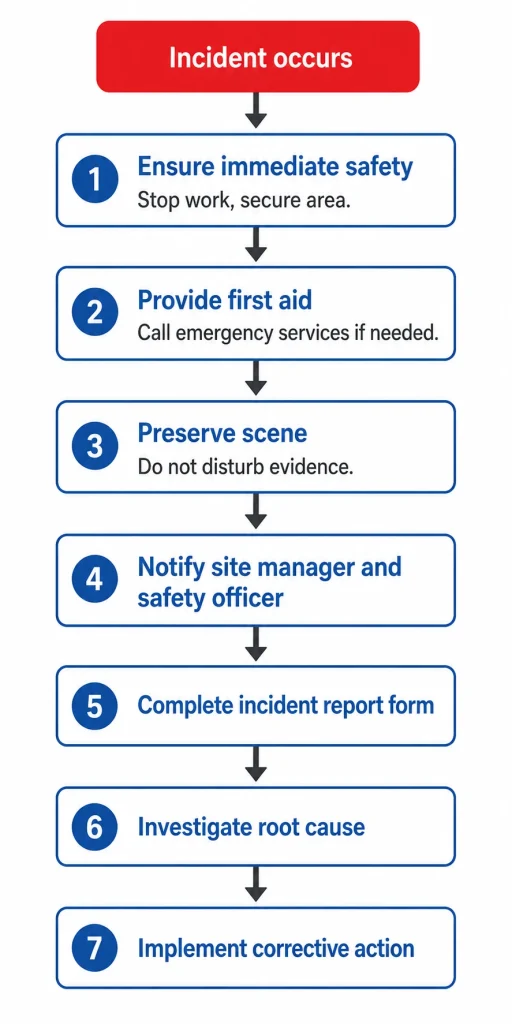
Incident reporting
- Is there a clear, known procedure for reporting near-misses, incidents, and injuries, and is it being actively used?
- Are near-miss reports being investigated and the findings communicated to all relevant personnel?
- Is the site’s accident book accessible, up to date, and stored securely in compliance with relevant data protection requirements?
Documentation and Record-Keeping
A safety checklist that is not documented has limited value, it cannot demonstrate compliance to a regulatory authority, cannot be used to identify patterns of non-compliance, and cannot support insurance or legal proceedings in the event of an incident.
For each safety checklist inspection, maintain a record that includes:
- Date and time of inspection
- Name and qualification of the inspector
- Specific observations for each checklist item, not just pass/fail
- Corrective actions required, assigned to named individuals with deadlines
- Sign-off confirming corrective actions were completed and verified
For technical reference on construction safety management systems, international standards for construction site safety inspection, and regulatory frameworks governing contractor safety obligations, resources on construction site safety management and occupational health standards provide comprehensive background on how safety management systems are structured and audited across different jurisdictions.
Also read : Types of Scaffolding Materials: A Practical Guide
Build Safety Into Every Day on Site
A construction site safety checklist is only as valuable as the discipline with which it is used. Completed honestly, acted on promptly, and maintained as a genuine record of site conditions, it is one of the most effective tools available for preventing the incidents that cause harm to workers, damage to equipment, delays to projects, and liability for organisations.
The equipment on a construction site, lifting equipment, aerial work platforms, scaffolding, generators, and material handling machinery, represents some of the most significant sources of risk on any project. Ensuring that this equipment is correctly specified, properly maintained, and operated by trained personnel is the foundation on which every other safety control rests.
RR Machinery offers a comprehensive range of construction and industrial equipment for sale and rental, including boom lifts, scissor lifts, mobile scaffolding, forklifts, and power generators, all maintained to operational standard and supported by experienced technicians. Explore our full range of safe, well-maintained construction equipment solutions or contact our team for practical advice and a clear quotation tailored to your project requirements.