Understanding the different types of scaffolding is essential for ensuring safety, efficiency, and structural stability in construction projects. Scaffolding systems provide temporary platforms that allow workers to perform tasks at height, including building, maintenance, repair, and inspection work.
In modern construction environments, proper scaffolding selection plays a critical role in improving productivity and reducing workplace risks. Choosing the right scaffolding system depends on project scale, building structure, height requirements, and load capacity. Contractors often integrate scaffolding planning with broader construction equipment selection strategies to ensure smooth coordination across lifting, access, and structural work.
This guide walks through the seven main types of scaffolding, explains what each one is best suited to, shows how they compare, and sets out the factors that decide which system fits a particular site, along with the safety practices that apply to all of them.
What Is Scaffolding?
Scaffolding is a temporary support structure used to provide safe working platforms for construction workers and materials at elevated heights. It is commonly made of steel or aluminum and designed to withstand vertical and horizontal loads during project execution. A fuller introduction to how scaffolding works and where it is used is available in What Is Scaffolding in Construction? A Complete Guide, and the materials used to build it are compared in Types of Scaffolding Materials: A Practical Guide. Further general background on scaffold design and terminology is available through Wikipedia’s overview of scaffolding.
Scaffolding is widely used in:
- Building construction
- Façade installation
- Maintenance and renovation
- Bridge and infrastructure projects
- Industrial plant maintenance
Proper scaffolding installation improves worker accessibility, enhances operational efficiency, and reduces fall risks.
Main Types of Scaffolding
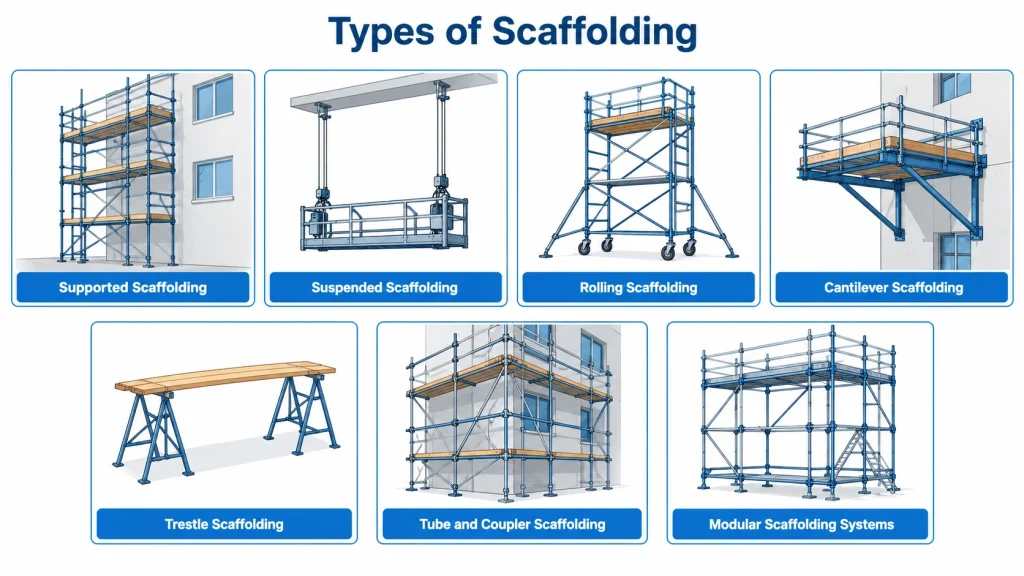
Different projects require different scaffolding systems. Below are the most commonly used types of scaffolding in construction.
Supported Scaffolding
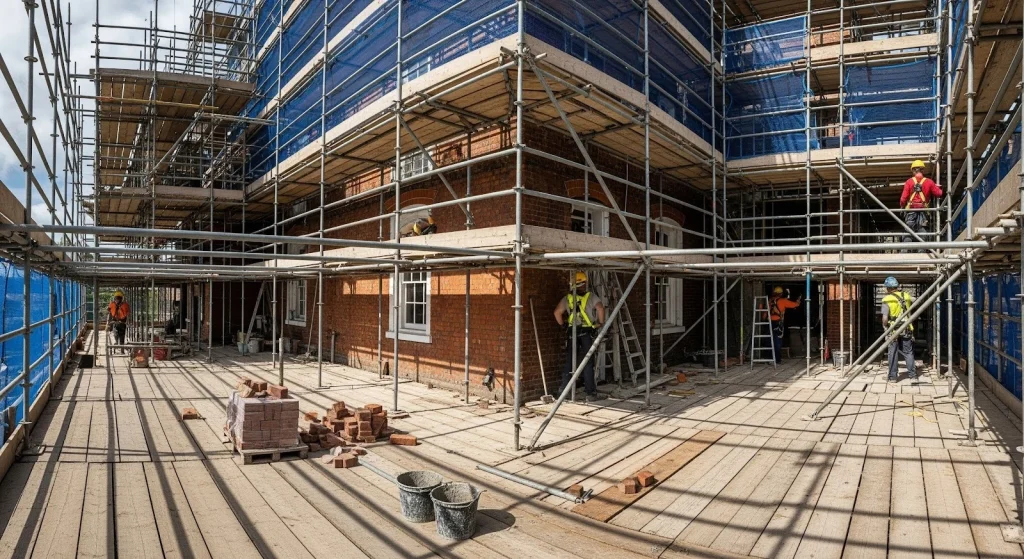
Supported scaffolding is the most common system used in building construction. It consists of platforms supported by rigid frames, poles, or legs placed directly on the ground.
In practice, a supported scaffold is built up from the ground in bays and lifts. Base plates sit on firm ground, standards rise from them, and ledgers and transoms carry the working platforms, while bracing and ties to the structure keep the whole assembly rigid. Because the load travels down to the ground, the quality of the ground beneath matters as much as the frame above it, and soft or uneven ground should be prepared with sole boards before erection begins.
Supported scaffolds can follow the shape of a building and be extended upward as work progresses, which makes them the default choice for most facade and masonry work. Their main limitation is that they need clear ground around the base, so they are less suitable where footpaths, traffic, or underground services restrict the space available at street level.
Best for:
- General building construction
- Exterior wall work
- Masonry projects
- Painting and plastering
This system is stable, cost effective, and suitable for multistory construction.
Suspended Scaffolding
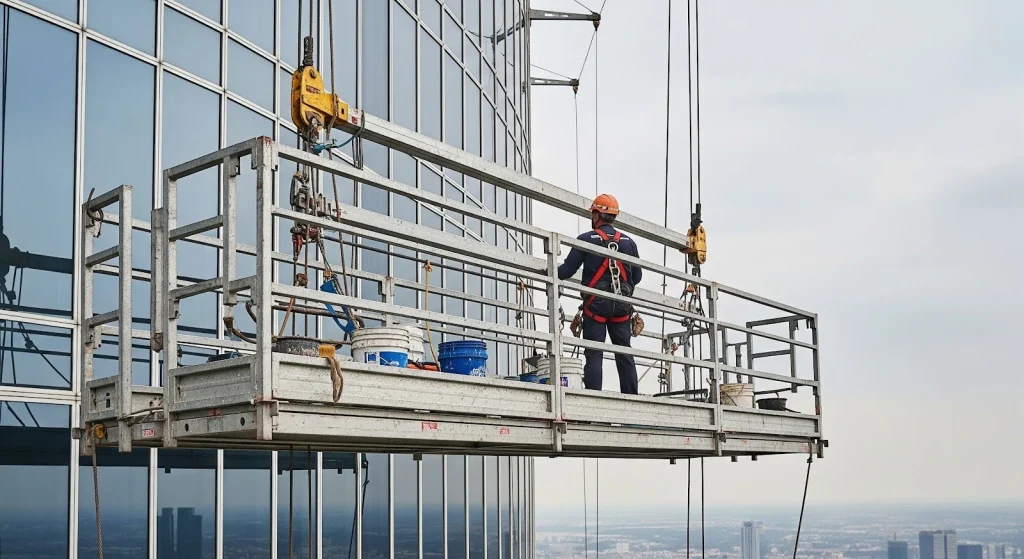
Suspended scaffolding is hung from the roof or upper structure using ropes or cables. The platform can be raised or lowered depending on the working height.
A suspended scaffold hangs from outriggers or support beams fixed to the roof, with the platform raised and lowered by hoists. Because there is nothing underneath, the safety of the whole system depends on the anchorage points, the condition of the ropes or cables, and the reliability of the hoisting equipment, all of which need to be checked before each use.
Workers on a suspended platform normally use fall protection connected to an independent anchor, separate from the platform itself, so that a failure of the platform does not become a fall. Training is particularly important for these systems, because the consequences of a mistake at height with no ground support below are severe. They suit work along the face of a tall building, but not tasks that need heavy materials stacked on the platform.
Best for:
- High rise building maintenance
- Window cleaning
- Façade repairs
- Inspection work
Suspended systems are ideal when ground based support is impractical.
Rolling (Mobile) Scaffolding
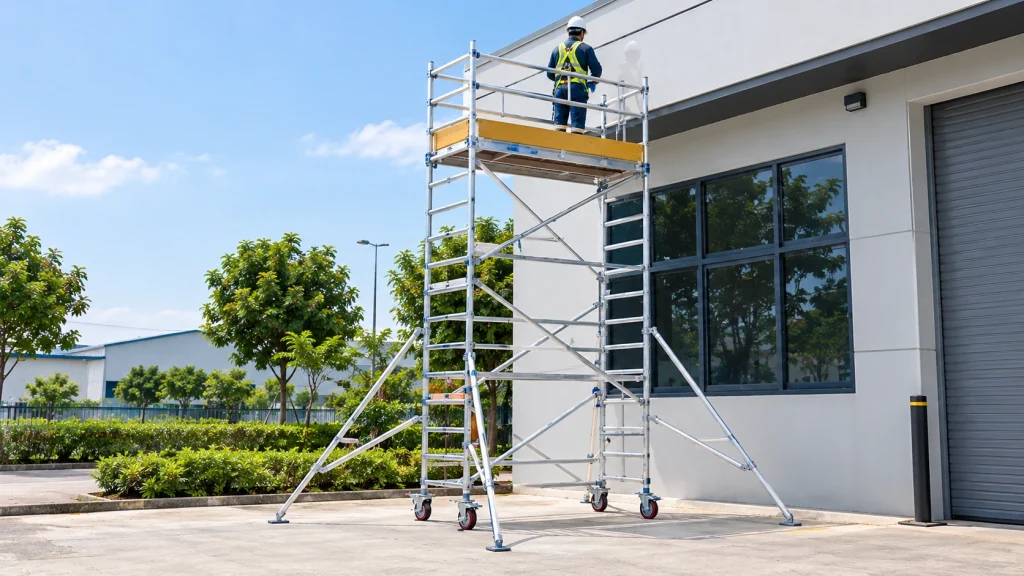
Rolling scaffolding is supported by wheels or casters, allowing it to be moved easily across flat surfaces.
A rolling scaffold is a tower of frames and platforms mounted on castors. The castors have brakes that must be locked before anyone climbs, and the tower should only be moved when it is empty and on a firm, level surface. The height a tower can safely reach depends on the width of its base, which is why manufacturers publish a maximum platform height for each configuration.
Their appeal is speed and flexibility. A small team can assemble one without specialist equipment and move it from one work position to the next, which saves time on indoor tasks such as lighting installation, ceiling work, and wiring. Outdoors, wind and uneven ground limit their use. A fuller guide to how mobile towers work, the configurations available, and their safety practices is covered below.
Best for:
- Indoor construction
- Electrical installation
- Warehouse maintenance
- Short duration tasks
This system improves flexibility and efficiency in projects requiring frequent repositioning.
Also read: What Is Mobile Scaffolding? Types, Uses and Safety
Cantilever Scaffolding
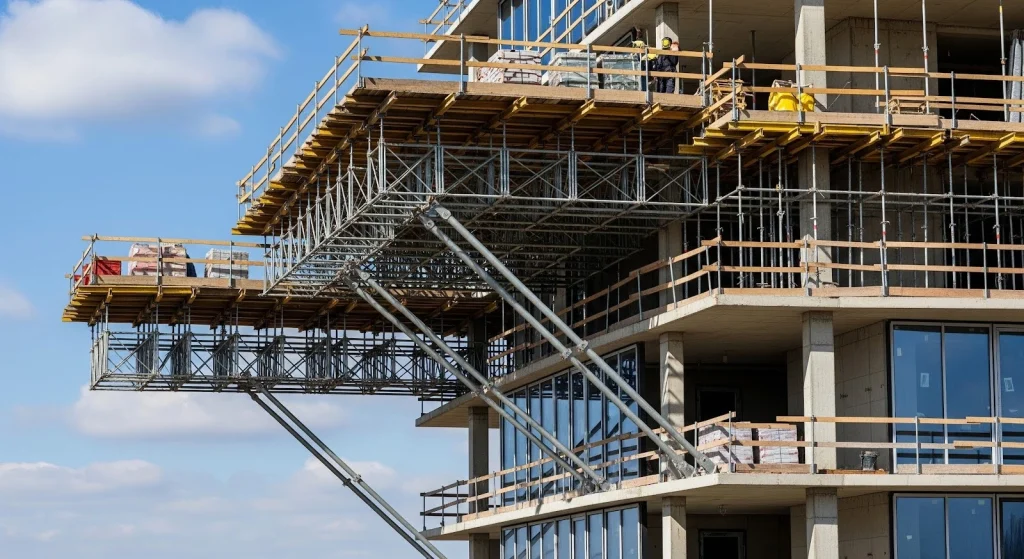
Cantilever scaffolding is supported at one end only and anchored to a building structure. It is commonly used when ground support is restricted.
In a cantilever scaffold, the platforms are carried on beams that project outward from the structure, so the load is supported by the building rather than the ground. This is why it suits sites where the ground cannot take a standard scaffold, such as busy streets, drainage, or areas where the ground floor is occupied or still under construction. Because the building has to carry the load, its strength at the anchorage points must be confirmed by a competent person before the beams are installed.
Cantilever systems are most often used when work has already progressed above ground level and the scaffold needs to start higher up, or when access beneath must be kept clear. They need careful design and are normally limited to lighter duties than a supported scaffold of similar size.
Best for:
- Urban construction sites
- Areas with limited ground space
- Projects near busy roads
It provides access in confined or obstructed environments.
Trestle Scaffolding
Trestle scaffolding uses movable ladders or tripods as support. It is typically used for indoor tasks at lower heights.
A trestle scaffold uses a pair of A frame trestles or a similar support, with boards laid across them to form a low working platform. It sits entirely on the floor and is often erected without tools, making it one of the fastest systems to set up. The boards must be properly supported and secured, and the trestles must stand on a firm, level surface.
Because the platform is low, this system is intended for work at modest height, and it should never be stacked or extended beyond what the manufacturer allows. For anything higher, a tower or supported system is the safer choice. Its strength is speed and convenience for short tasks inside buildings, where a larger structure would be out of proportion.
Best for:
- Interior painting
- Ceiling repairs
- Light maintenance work
This system is simple and suitable for low rise applications.
Tube and Coupler Scaffolding
This traditional scaffolding system uses steel tubes connected with clamps or couplers. It is highly adaptable and flexible for complex structures.
In a tube and coupler system, steel or aluminum tubes of a standard diameter are joined at any angle with clamps called couplers. Standards, ledgers, transoms, and braces are all made from the same tube, so the structure can be built around corners, columns, projections, and unusual shapes that prefabricated systems cannot follow.
The flexibility comes at a cost in time and skill. Every joint is made by hand, so erection is slower than with a modular system, and the quality of the result depends heavily on the competence of the crew. Couplers must be the right type for each connection and tightened correctly. The practical sequence for erecting a scaffold, from base plates to the top platform, is covered below.
Best for:
- Irregular building shapes
- Large scale industrial projects
- Infrastructure construction
Its adaptable design allows customization according to project needs.
Also read: How to Build Scaffolding: A Step-by-Step Site Guide
Modular Scaffolding Systems
Modular scaffolding features prefabricated components that are assembled quickly on site. It improves efficiency and safety during installation.
Modular scaffolding is built from prefabricated components with fixed connection points, such as a rosette or cup lock node that accepts several members at set angles, so parts lock together quickly with little or no loose hardware. Because the spacings are fixed, the result is consistent, and erection is quick and easier to inspect.
The trade off is reduced flexibility. Components come in set lengths and heights, so very irregular structures can be harder to fit, and parts from different systems are not interchangeable. For repetitive layouts, however, the speed and consistency of a modular system often outweigh this limit, which is why it is favored on large commercial and industrial projects.
Best for:
- Large commercial buildings
- Industrial facilities
- Repetitive construction projects
Many modern construction companies prefer modular systems due to speed and structural reliability.
Which Type Suits Which Situation
The seven types overlap, but each has a situation where it clearly fits best:
- Standard building work with clear ground around the base: supported scaffolding
- Tall buildings or structures with no ground access: suspended scaffolding
- Frequent repositioning on a flat, firm floor: rolling scaffolding
- Ground that is blocked, occupied, or unable to carry load: cantilever scaffolding
- Low height interior finishing and light maintenance: trestle scaffolding
- Irregular shapes and complex structures: tube and coupler scaffolding
- Large, repetitive structures where speed and consistency matter: modular scaffolding
Many projects use more than one type, for example a supported or modular scaffold for the main facade and rolling towers for interior finishing, so the question is often which combination fits rather than which single type.
Choosing the Right Scaffolding System
Selecting the right scaffolding depends on:
- Building height
- Load requirements
- Ground conditions
- Project duration
- Worker safety requirements
Building height and shape come first. A straight, low facade can be served by a simple supported scaffold, while a tall building with no ground access may call for a suspended system, and an irregular shape often points to tube and coupler or a carefully planned modular layout. The number of working levels also affects how much material and time the structure will need.
Load requirements decide how strong the platform must be. Light finishing work places little weight on the platform, while masonry and stored materials place a great deal, and a platform rated for one duty should not be used for another. If workers will stack bricks, blocks, or equipment on the platform, this should be said when the system is specified.
Ground conditions and available space determine whether a system can be supported from below at all. Soft ground needs spreader boards, restricted ground may rule out a standard supported scaffold, and the space around a building, including footpaths and access routes, is part of the wider site layout covered in Construction Site Planning: A Complete Guide.
Project duration and reuse matter too. A short task favors a quick system such as a rolling tower or trestle, while a long project may justify the extra setup effort of a supported or modular structure that will stay in place for months. Whatever the choice, the scaffold should be designed, erected, and inspected by competent people rather than selected by appearance alone.
Proper planning ensures safe installation and compliance with construction safety standards. Many contractors integrate scaffolding planning with broader heavy machinery coordination and construction workflow management to maintain efficiency across all project phases.
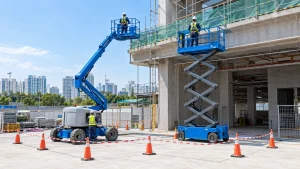
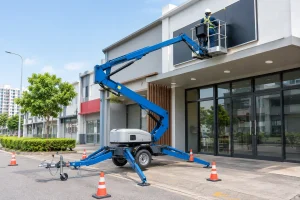
For projects involving elevated access equipment alongside scaffolding, understanding different aerial work platform types can help optimize site access solutions and improve safety performance.
Safety Considerations for Scaffolding
Safety is the most critical factor in scaffolding use. Incorrect installation or improper maintenance can lead to serious accidents.
Key safety practices include:
- Regular inspection before use
- Proper anchoring and stabilization
- Guardrails and fall protection systems
- Load capacity compliance
- Certified installation procedures
Inspection deserves particular attention. A scaffold should be checked by a competent person before it is first used, after any alteration, and after events that could affect it, such as strong wind or an impact, and defects should be fixed before anyone climbs. Erection and dismantling carry their own risks, because a structure is least stable while it is incomplete, so these stages should be carried out only by trained crews following the planned sequence.
Training and supervision are central to scaffolding safety, for erection, use, and dismantling alike. Singapore’s Ministry of Manpower publishes detailed Workplace Safety and Health guidance covering work at height and scaffolding on local worksites. The wider principles that apply to any task above ground are explained below.
For reference, international safety authorities such as OSHA provide detailed scaffolding regulations that help guide safe construction practices.
Benefits of Using Proper Scaffolding
Using the right scaffolding system provides multiple advantages:
- Improved worker accessibility
- Enhanced productivity
- Better project coordination
- Reduced accident risk
- Stable material handling support
Scaffolding remains a foundational element in construction planning, especially for multilevel projects.
The Role of Scaffolding in Modern Construction
Modern construction demands efficient vertical access solutions. As buildings become taller and project timelines tighter, scaffolding systems have evolved to provide faster assembly, stronger materials, and enhanced safety features.
Today’s modular and mobile scaffolding systems support not only traditional construction but also infrastructure maintenance, industrial servicing, and specialized installations.
When integrated with broader equipment strategies such as earthmoving operations and structural preparation, scaffolding contributes significantly to overall project efficiency.
Get Reliable Access Solutions and Professional Support
Choosing between these systems is easier when the supplier understands the job. When you get in touch, it helps to share the height and shape of the structure, the ground conditions around it, the loads the platform will carry, how long the access is needed, and whether it must be moved during the work. With those details, the right system can be recommended from the start rather than adjusted after delivery.
RR Machinery Pte Ltd supports construction and industrial sites across Singapore with reliable mobile scaffolding suited to indoor and outdoor work at height. Contact us today for expert guidance, equipment recommendations, and a quotation tailored to your project.