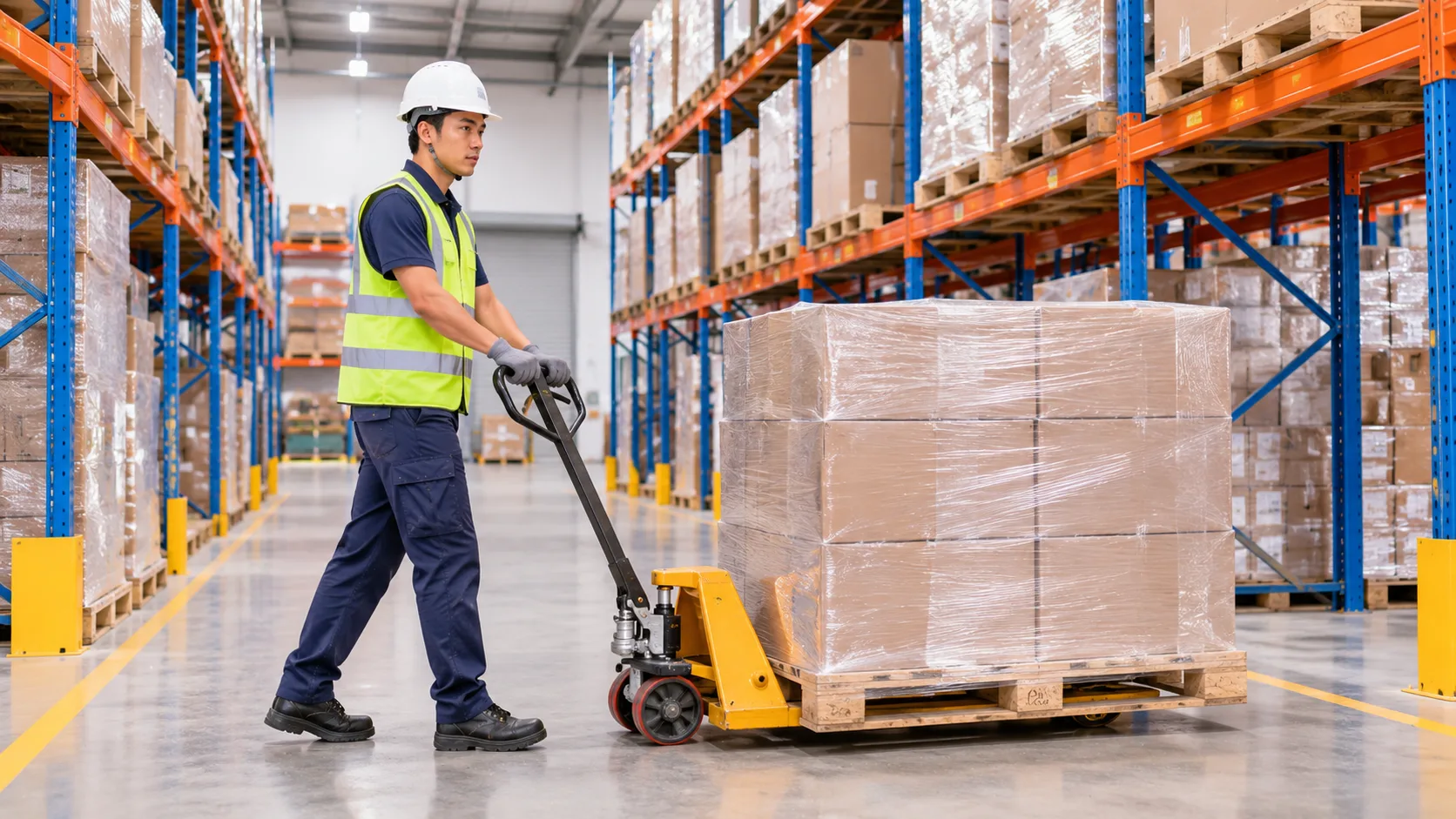
To use a pallet jack, check it is in good working order, lower the forks fully, slide them all the way into the pallet, set the control lever to lift and pump the handle until the pallet just clears the floor, then move to neutral and push or pull the load slowly to its destination before lowering it and withdrawing the forks. The steps are simple, but doing them correctly is what prevents strained backs, crushed feet, and dropped loads.
Pallet jacks, also called pallet trucks or pump trucks, are among the most widely used material handling tools in warehouses, retail stores, factories, and construction site storage areas. This guide explains what a pallet jack is, the checks to make before using one, how to operate a manual pallet jack step by step, how to move loads safely around corners, ramps, and loading docks, how electric pallet jacks differ, the most common mistakes, and when a forklift is the better choice.
What Is a Pallet Jack?
A pallet jack is a wheeled tool with two forks that slide under a pallet, a small hydraulic pump that raises the forks just enough to lift the pallet off the floor, and a handle used to steer and move the load. It is designed for moving pallets horizontally across flat floors over short distances, not for stacking or lifting loads to height. General background on the equipment is available in Wikipedia’s article on pallet jacks.
There are two main types. Manual pallet jacks are pumped and pushed by hand, while electric pallet jacks, also called powered pallet trucks, use a battery to lift and drive the load. Powered pallet trucks are a recognised class of powered industrial truck and are often grouped with other warehouse machines in forklift classifications.
Main Parts of a Pallet Jack
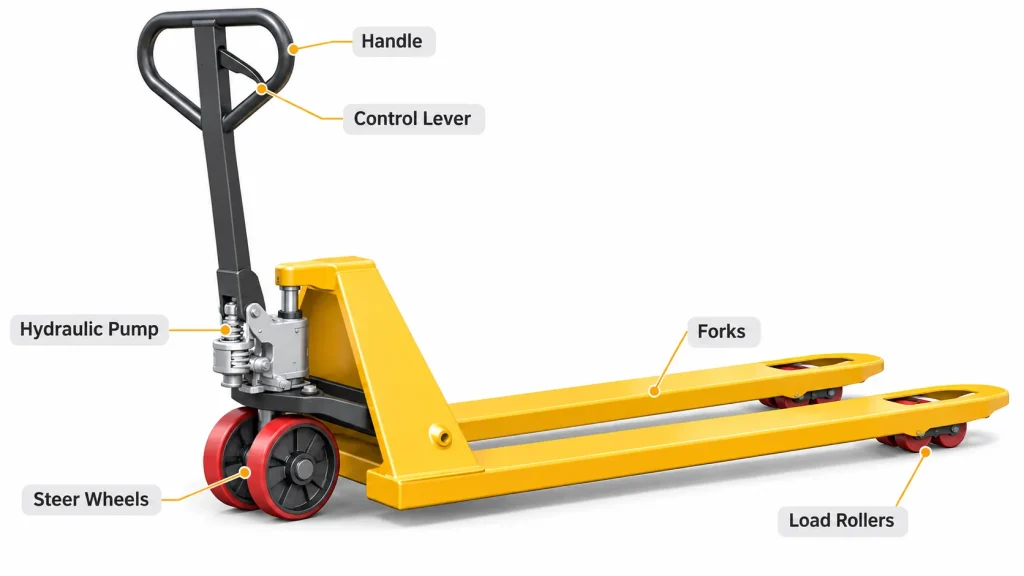
Knowing the main parts makes the operating steps and safety checks easier to follow. Most manual pallet jacks share the same basic layout.
Handle and control lever. The tall handle steers the jack and works the pump, while a lever near the grip selects raise, neutral, or lower. The exact positions vary between models, so check the markings or manual.
Hydraulic pump unit. Located at the base of the handle, it converts each pump stroke into lifting force.
Forks. Two steel forks slide into the pallet’s openings and carry the load.
Steer wheels. Two wheels under the pump unit turn with the handle to steer the jack.
Load rollers. Small rollers near the fork tips lift and support the pallet as the forks rise, and roll it along the floor.
Before You Start: Pre-Use Checks
A quick inspection before each shift catches most problems before they cause an accident or damage a load. It takes only a minute or two and should be done every time, even with a jack used every day.
If you find a fault, tag the jack out of service and report it rather than trying to work around the problem. Building these checks into a routine such as a daily construction site safety checklist helps make them a habit.
Inspect the Pallet Jack
Check that the wheels and load rollers turn freely and are free of wrapped plastic, strapping, or debris. Look for bent or cracked forks, hydraulic oil leaks, and damage to the handle. Then test the controls: the forks should rise smoothly when pumped, hold their height in neutral, and lower under control when released.
For electric pallet jacks, also check the battery charge, the horn, the brake, and the emergency reverse or belly switch on the handle, and confirm that the jack stops when the handle is released.
Check the Load and the Route
Find the jack’s rated capacity on its plate and compare it with the weight of the load. Many manual pallet jacks are rated at around 2,000 to 2,500 kilograms, but the figure for your specific model is the one that counts. Make sure the pallet is undamaged and the load is stable, secured, and evenly spread across both forks.
Walk the route before moving the load. Look for slopes, uneven floors, gaps, cables, drains, and tight corners, and check that the destination has space to set the pallet down.
How to Use a Manual Pallet Jack Step by Step
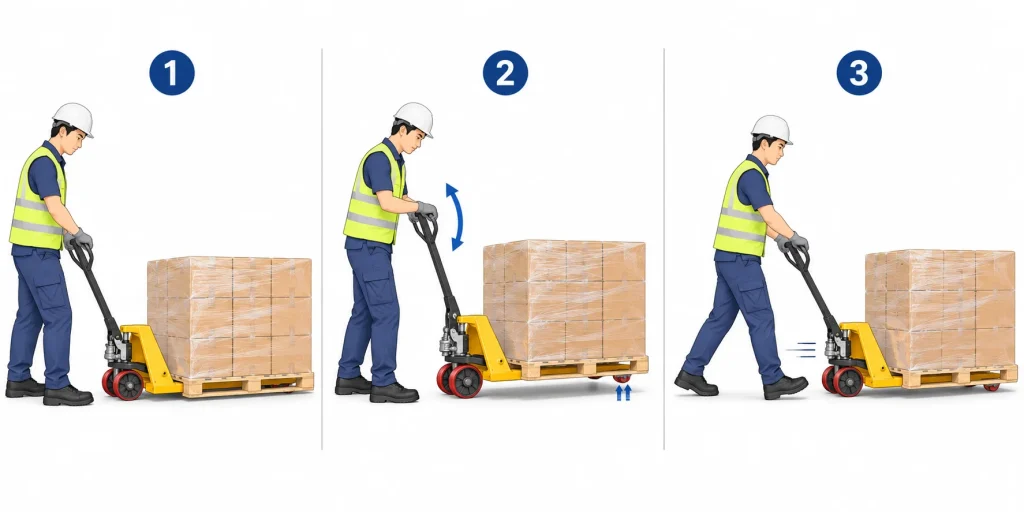
Once the checks are done, the operating sequence is the same for almost every manual pallet jack. Take each step deliberately, especially when you are new to the equipment or handling a heavy or unfamiliar load.
Keep your feet clear of the forks and wheels throughout, and wear safety footwear, since crushed toes are one of the most common pallet jack injuries.
- Lower the forks fully. Set the control lever to lower so the forks drop to their lowest position and can slide easily into the pallet.
- Line up with the pallet. Approach the pallet straight on, centred between the openings, so both forks enter evenly.
- Insert the forks all the way. Push the jack in until the forks extend fully under the pallet and the pallet sits against the back of the forks. Short insertion puts the load on the fork tips and can tip or damage the pallet.
- Lift the load. Move the lever to raise and pump the handle with smooth, full strokes until the pallet clears the floor by a few centimetres. There is no need to lift it higher, and a low load is more stable.
- Set the lever to neutral. This stops further lifting and lets the handle move freely for steering without pumping.
- Move the load. Start slowly, keep a steady walking pace, and maintain a clear view of your path. The next section explains how to push, pull, turn, and handle slopes.
- Lower and withdraw. At the destination, check the area is clear, set the lever to lower so the pallet settles gently on the floor, then pull the forks straight out.
- Park the jack safely. Leave it with the forks lowered, the handle upright, and out of walkways, so no one trips over the forks.
Load position matters just as it does on larger machines. A load that is off centre or sits toward the fork tips is less stable and puts more strain on the jack, the same principle that governs forklift load center and rated capacity.
Moving the Load Safely
Most pallet jack injuries happen while the load is moving, not while it is being lifted. A loaded pallet can weigh more than a small car, and once it is rolling it takes effort and space to stop.
Planning each move and keeping control at walking pace prevents most strains, collisions, and runaway loads.
Pushing vs Pulling
On level floors, pushing is generally preferred. It lets you use your body weight with a straighter back, keeps the load in view, and means the load stops in front of you rather than running into your heels. Keep your arms close to your body and use your legs to start the load moving.
Pulling can be useful in tight spaces or when manoeuvring into position, but walk to one side of the handle rather than directly in front of the load, and never walk backwards toward a wall, rack, or other obstacle where you could be pinned.
Turning and Tight Spaces
Slow down before every corner and make wide, gradual turns so the load does not swing out and strike racking, doorframes, or people. Remember that the back end of the load sweeps a wider arc than the handle.
Where visibility is limited, stop at blind corners and doorways, check for pedestrians and other vehicles, and use mirrors or a spotter where they are provided.
Ramps, Slopes, and Loading Docks
Manual pallet jacks have no brakes, so avoid slopes with a loaded jack whenever possible. If a gentle ramp cannot be avoided, keep yourself on the uphill side of the load, never let the load get ahead of you, and move slowly. For regular slope work, use a powered pallet truck with brakes instead.
At loading docks, check that the truck or trailer is secured and the dock plate is in place and rated for the load before crossing. Keep well back from dock edges, which are a common source of falls when a jack rolls further than expected.
How to Use an Electric Pallet Jack
Electric pallet jacks take the physical effort out of lifting and moving heavy loads, which makes them well suited to long distances, frequent moves, and heavier pallets. They also move faster and with more force than a manual jack, so they demand more care and proper training before use.
Because they are powered industrial trucks, electric pallet jacks fall under the same kind of safety guidance as forklifts in many countries. OSHA’s guidance on powered industrial trucks, for example, covers training and safe operation, and employers should also follow local requirements and manufacturer instructions.
Controls to Know
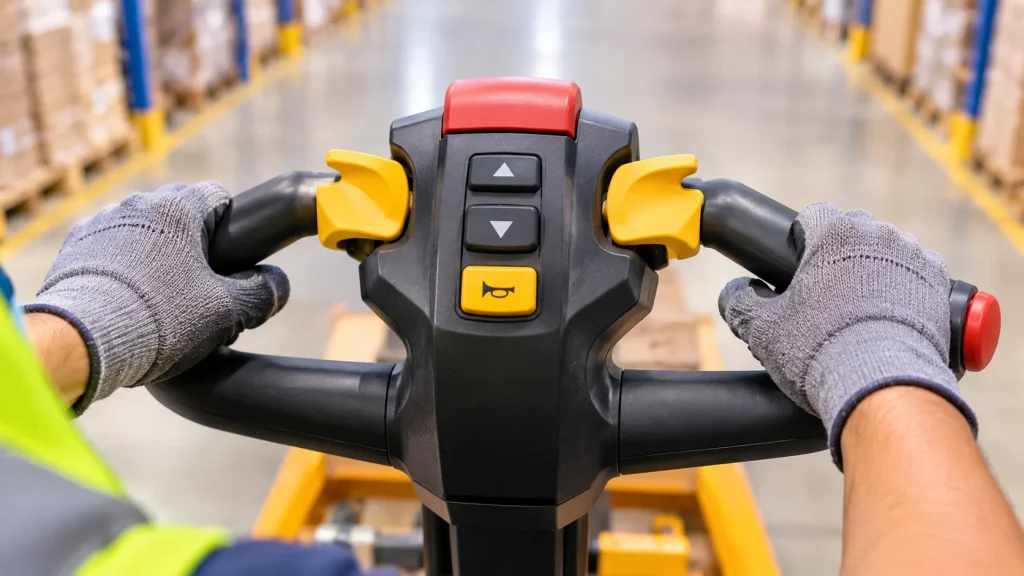
Most walk-behind electric pallet jacks are controlled from the head of the tiller handle. A thumb throttle, often butterfly shaped, sets direction and speed, while buttons raise and lower the forks. A horn button warns people nearby.
The brake usually applies automatically when the handle is fully upright or fully lowered, and the jack only drives with the handle in the middle operating zone. A reverse safety switch on the end of the handle, often called a belly button, reverses the jack away from the operator if it presses against their body.
Operating Steps
With the forks lowered, insert them fully into the pallet at low speed, then raise the forks just enough to clear the floor. Walk beside the handle rather than in front of the jack, keep both hands on the controls, and travel at a steady speed you can easily stop from.
Use the lowest speed setting when turning, in congested areas, and on ramps. At the destination, stop completely, lower the forks, withdraw the jack slowly, and park it with the forks down, the key removed, and the battery connected to the charger if needed.
Also read: How a Forklift Really Works: The Mechanism Explained
Common Pallet Jack Mistakes to Avoid
Pallet jacks look simple, which is exactly why they are often used carelessly. Most incidents come from a handful of repeated mistakes that are easy to avoid once you know them.
In Singapore, employers are responsible for managing these risks under the Workplace Safety and Health framework, and the Ministry of Manpower publishes Workplace Safety and Health guidance that applies to material handling in warehouses and on worksites.
Overloading the jack. Exceeding the rated capacity can damage the hydraulics, bend the forks, and make the load impossible to stop or steer.
Riding on the jack. Pallet jacks are not designed to carry people. Standing on the forks or frame is a common cause of falls and crushing injuries.
Partial fork insertion. Lifting with the forks only partly under the pallet puts the load on the tips, risks breaking the pallet, and can tip the load.
Moving too fast. Running or letting a heavy load build speed removes your ability to stop or turn in time.
Poor posture. Twisting while pulling, jerking the handle, or pumping with a bent back leads to strains. Use your legs, keep your back straight, and get help or use a powered jack for very heavy loads.
Ignoring unstable loads. Tall, uneven, or unsecured loads can topple during turns. Restack, wrap, or strap the load before moving it.
Leaving the jack in a walkway. An unattended jack with raised forks or the handle down is a serious trip hazard.
Pallet Jack vs Forklift: When to Use Each
Pallet jacks and forklifts both move pallets, but they are built for different jobs. Choosing the right one saves effort, protects workers, and avoids using a large machine where a simple tool would do, or forcing a small tool beyond its limits.
The table below compares the two for typical material handling tasks.
| Factor | Pallet jack | Forklift |
|---|---|---|
| Lift height | Just clears the floor | Lifts to racking, trucks, and upper levels |
| Typical distance | Short moves on flat floors | Short to long moves, including yards |
| Floor and ground | Smooth, level indoor floors | Indoor floors or rough ground, depending on type |
| Space needed | Very compact, fits narrow aisles | Needs more room to turn and lift |
| Training | Basic instruction, more for electric models | Formal operator training and certification |
| Cost | Low purchase and running cost | Higher purchase or rental cost |
A pallet jack is the right tool for moving pallets across a warehouse floor, into a lift, or from a delivery truck’s tail lift to a storage area. A forklift is needed when loads must be lifted onto racking, loaded onto or off a truck deck from the ground, or moved over rough or sloping ground, as is common on construction sites and outdoor yards.
Also read: How to Choose a Forklift: A Complete Buyer’s Guide
Handle Heavier Loads With the Right Equipment
A pallet jack is ideal for short, flat moves, but when loads need to be lifted onto racking, unloaded from a truck deck, or moved across a construction site, a forklift is the safer and more productive choice.
RR Machinery Pte Ltd offers forklift rental across Singapore for warehouses, industrial facilities, and construction sites, alongside boom lifts, scissor lifts, mobile scaffolding, and power generators, backed by servicing support. Contact us today to find the right forklift for your loads or to request a quotation.