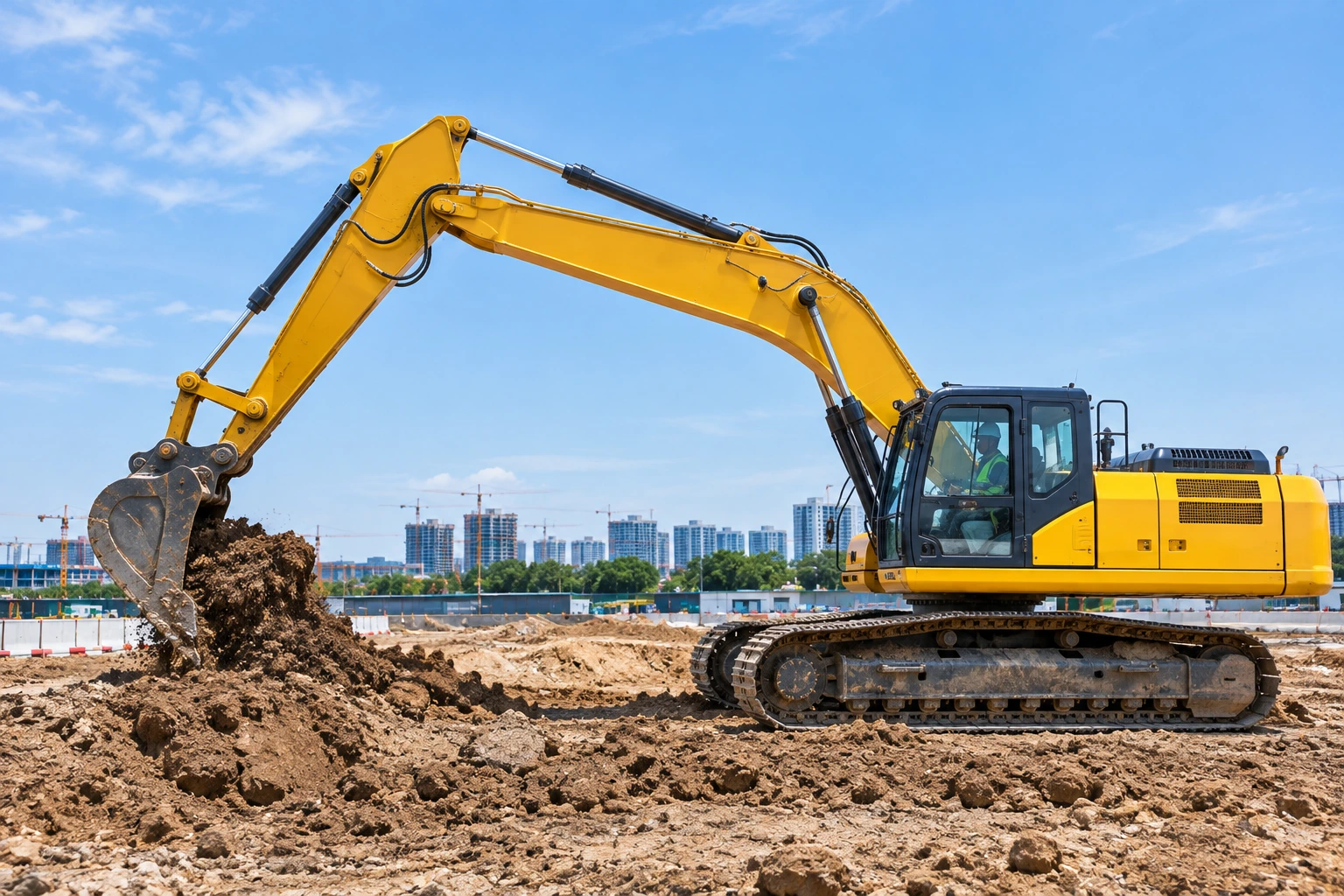
An excavator looks mechanically simple from a distance, a cab, an arm, and a bucket, but the machine is actually a coordinated system of structural, hydraulic, and mechanical components, each performing a specific role in how the machine digs, lifts, and moves. Understanding what each part does is useful for more than satisfying curiosity, it makes pre-use inspection more meaningful, helps operators understand why certain operating limits exist, and makes communicating with a mechanic about a specific fault considerably easier.
This guide breaks down the individual components that make up a typical excavator, from the digging attachment at the front through to the undercarriage that carries the whole machine, organised around the same major systems a technician would check during a thorough inspection.
The Digging Attachment
The digging attachment is the business end of the excavator, the assembly of components that actually contacts and moves material.
Bucket
The bucket is the attachment that scoops, carries, and dumps material, and its design varies considerably depending on the task, a standard digging bucket for general excavation, a wider grading bucket for levelling work, or a narrower trenching bucket for utility work. Bucket capacity is one of the key figures used to compare excavator productivity, since a larger bucket moves more material per digging cycle, though at the cost of requiring more breakout force to fill effectively in dense material. Many excavators also use a quick-coupler system, allowing the bucket to be swapped for an alternative attachment, a breaker or grapple among them, without needing to manually disconnect and reconnect hydraulic pins individually.
Bucket Teeth and Cutting Edge
Teeth mounted along the bucket’s leading edge concentrate digging force into a smaller contact area, allowing the bucket to penetrate compacted or rocky ground that a smooth edge alone could not break into effectively. Teeth are replaceable wear items, and monitoring their condition matters directly for digging efficiency, since worn or missing teeth force the machine to work harder to achieve the same digging result, increasing both cycle time and hydraulic system strain.
The Boom and Arm
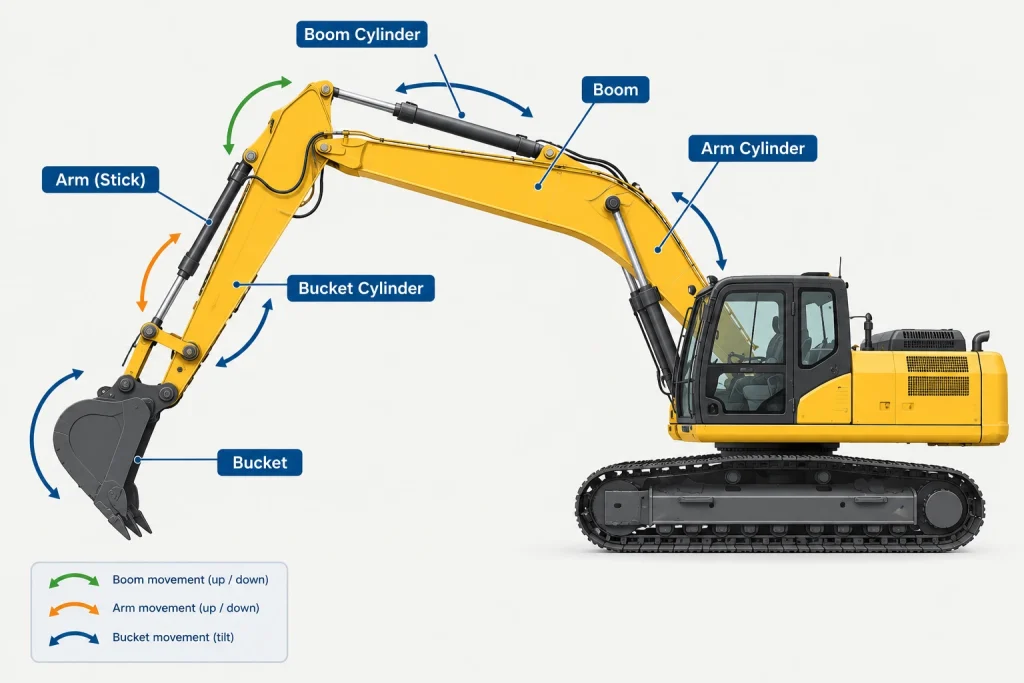
The boom and arm form the jointed structure that positions the bucket, translating the machine’s hydraulic power into precise digging motion.
Boom
The boom is the first hydraulically controlled section, connected directly to the excavator’s rotating upper structure, and its primary job is raising and lowering the arm and bucket assembly. Boom length and configuration directly affect maximum dig depth and reach, and some excavators offer a variable-angle or two-piece boom specifically to improve reach flexibility in confined working conditions, allowing the arm to fold closer to the machine when digging near an obstacle that a fixed single-piece boom could not work around.
Arm (Stick)
The arm, sometimes called the stick, connects the boom to the bucket and provides the digging motion itself, curling inward to draw the bucket through material toward the machine. Arm length involves a genuine trade-off, a longer arm increases reach and dig depth, while a shorter arm generally provides greater breakout force for a given hydraulic system, a relationship worth understanding when comparing specifications across different machine classes.
The Hydraulic System
Every moving component on an excavator, boom, arm, bucket, and travel, is ultimately powered by the hydraulic system, making it the machine’s true source of digging force.
Hydraulic Cylinders
Hydraulic cylinders, one each for the boom, arm, and bucket at minimum, extend and retract to move each component through its range of motion, converting hydraulic fluid pressure directly into the mechanical force that lifts, curls, and digs. Cylinder condition matters considerably to overall machine performance, since a leaking or worn cylinder loses force progressively, reducing digging power even while the machine otherwise appears to operate normally.
Hydraulic Pump and Motors
A hydraulic pump, driven by the excavator’s engine, pressurises fluid and sends it through the system to the cylinders and travel motors, while separate hydraulic motors drive the tracks for travel and the upper structure for rotation. This hydraulic power distribution is what allows an excavator to perform digging, rotating, and travelling functions simultaneously, since each function draws from the same pressurised fluid supply through its own dedicated circuit. Hydraulic fluid condition and filtration also matter considerably to overall system health, since contaminated fluid accelerates wear across every component the fluid passes through, from the pump itself down to the smallest cylinder seal.
Also read: Operating a Mini Excavator Safely: A Step-by-Step Guide for First-Time Users
The Undercarriage
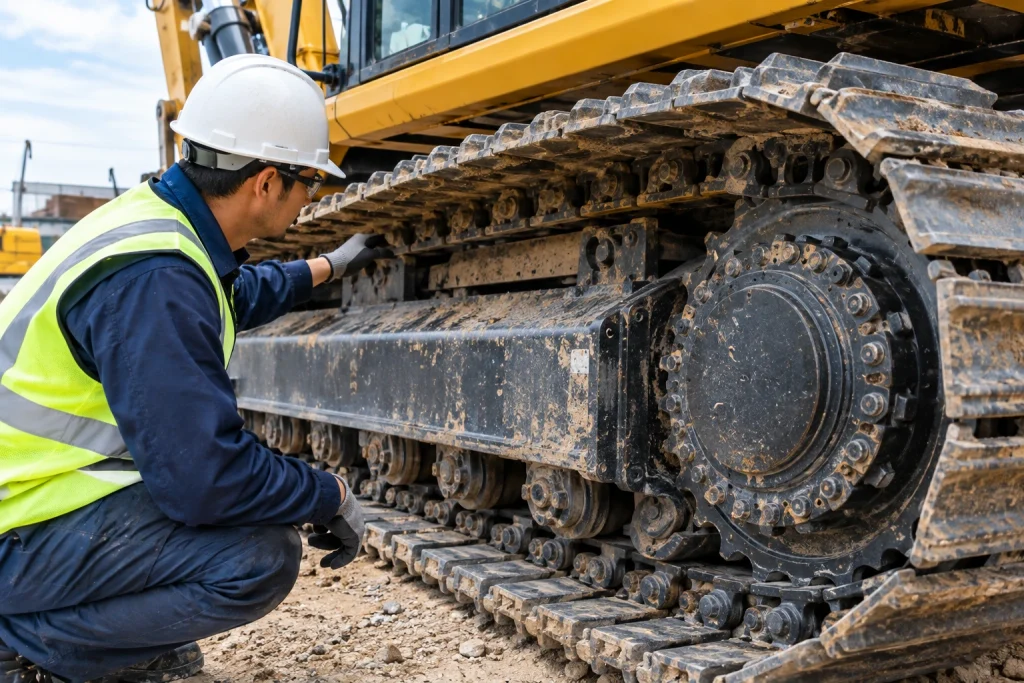
The undercarriage carries the excavator’s entire weight and provides the stability and mobility the upper structure depends on to work effectively.
Tracks and Track Rollers
Tracks distribute the machine’s weight across a wide ground contact area, providing the stability needed to dig without tipping and the traction needed to travel across soft or uneven ground that wheeled equipment would struggle with. Track rollers guide and support the track chain as it cycles around the undercarriage, and both tracks and rollers are wear items requiring regular inspection, since worn components here directly affect stability and travel performance. Track tension also needs periodic adjustment, since a track that has stretched or loosened over time increases wear on the rollers and sprocket while reducing the machine’s overall stability during digging.
Swing Bearing and Rotation Mechanism
The swing bearing, sometimes called the slew ring, connects the upper structure to the undercarriage, allowing the cab, boom, and arm assembly to rotate independently of the tracks below. This rotation capability is what allows an excavator to dig, then rotate to dump material, without needing to reposition the entire machine between each cycle, a fundamental efficiency advantage over equipment lacking independent upper structure rotation. The swing bearing also carries substantial load throughout this rotation, making it a component worth including in any thorough periodic inspection rather than assuming it will simply continue functioning indefinitely without attention.
The Operator Cab and Controls
The cab houses the operator and the control systems that translate operator input into the hydraulic commands controlling every other component on the machine.
Modern excavator cabs typically include joystick controls for boom, arm, bucket, and rotation functions, along with pedals or levers for track travel, all arranged to allow an experienced operator to coordinate multiple functions simultaneously for smooth, continuous digging motion. Understanding how these controls translate into the mechanical sequence of digging is covered in more practical detail below, useful background even for operators working on larger standard machines, since the fundamental control logic remains consistent across most excavator sizes.
How These Parts Work Together
An excavator functions as a coordinated system rather than a collection of independent components, the hydraulic pump generates pressure, cylinders convert that pressure into boom, arm, and bucket movement, the swing bearing allows the upper structure to rotate between digging and dumping positions, and the undercarriage provides the stability that makes precise digging possible in the first place. A fault or excessive wear in any single component affects the whole system’s performance, not just the immediate function that component controls, which is why comprehensive inspection matters more than checking only the most visibly active parts.
Understanding how excavator design varies across different configurations built around these same core components is covered below. Further general technical background on excavator design and terminology is available through Wikipedia’s overview of excavators.
Also read: Types of Excavators for Construction and Earthmoving
Understanding the Machine You Operate
Knowing what each excavator component does, the bucket and teeth that break and carry material, the boom and arm that position the attachment, the hydraulic system that powers every movement, and the undercarriage that keeps the whole machine stable, gives operators and site managers a genuinely useful frame of reference for inspection, troubleshooting, and communicating with maintenance staff. This same component knowledge also makes it considerably easier to spot a developing issue early, before a minor wear pattern becomes a costly failure or an unplanned breakdown partway through a task.
RR Machinery Pte Ltd supports Singapore’s construction and industrial sectors with reliable heavy machinery solutions tailored to your specific project needs. Browse our complete heavy machinery services or contact our team today for practical advice on the right excavator for your project.