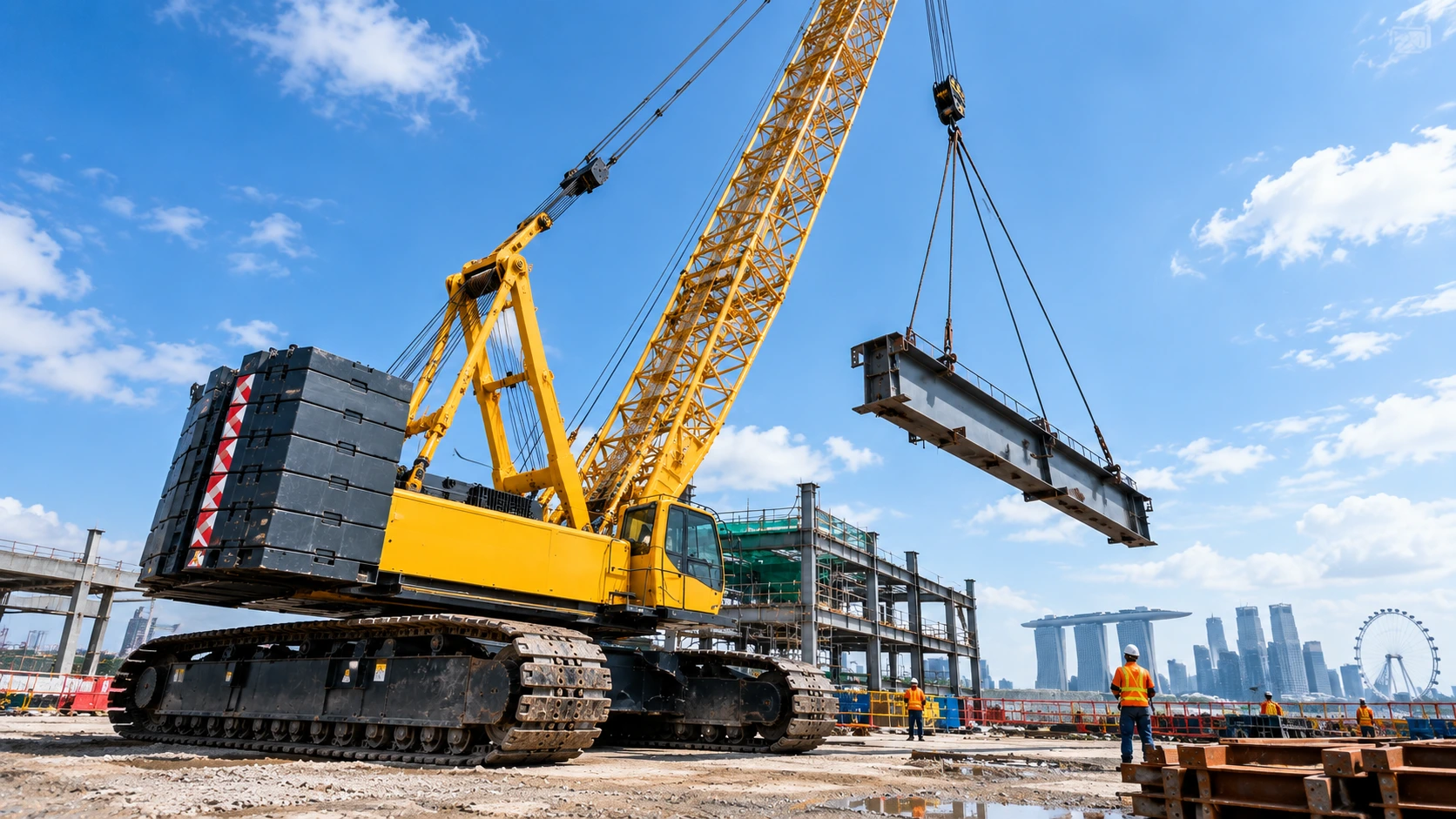
Among the many types of mobile cranes used in construction and heavy industry, the crawler crane stands out immediately by its undercarriage, a set of continuous tracks rather than the wheels or truck chassis most other mobile cranes use. That track-based design is not just a mobility choice, it is the foundation of how a crawler crane achieves the stability needed to lift some of the heaviest loads in construction without the outrigger setup nearly every other mobile crane depends on.
This guide explains exactly what a crawler crane is, how its track-based stability works, the main configurations available, and how it compares to other mobile crane categories, helping clarify when its specific combination of capacity and ground stability makes it the right choice for a lift.
What Is a Crawler Crane?
A crawler crane is a crane mounted on a set of continuous tracks, similar in principle to those used on an excavator or bulldozer, rather than on wheels or a truck-style chassis. This track-based undercarriage distributes the machine’s substantial weight over a wide surface area, giving it inherent stability on soft, uneven, or unprepared ground that would be impractical for a wheeled crane to operate on safely.
Crawler cranes are typically among the largest and highest-capacity mobile cranes available, used for lifts that exceed what smaller, more mobile crane categories can safely handle. Their scale and stability come at the cost of speed and road mobility, a trade-off that shapes exactly where and how crawler cranes are specified for a project.
How a Crawler Crane Works
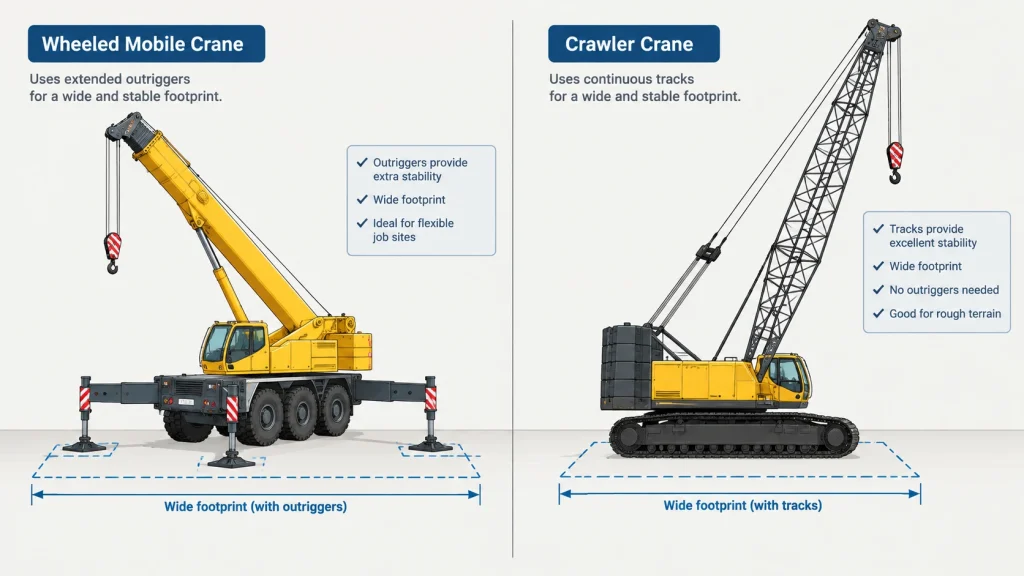
A crawler crane’s defining engineering advantage is that it does not require outriggers to achieve a stable lifting platform, a genuinely different approach from most other mobile crane categories.
Track-Based Stability Without Outriggers
Wheeled mobile cranes rely on outriggers, extendable legs that widen the machine’s effective footprint before a lift begins, to achieve the stability needed to lift heavy loads safely. A crawler crane’s tracks already provide a wide, continuous footprint across the entire length and width of the undercarriage, distributing the machine’s weight and any lifted load across a considerably larger ground contact area without needing any additional setup.
This built-in stability means a crawler crane can often begin lifting almost immediately after positioning, without the outrigger deployment and levelling process a wheeled crane requires, a meaningful time advantage on projects involving frequent repositioning across a large site.
Boom Configurations
Crawler cranes are fitted with either a lattice boom, a lightweight, truss-like structure assembled from triangulated steel sections, or, less commonly, a telescopic boom similar in principle to those used on wheeled mobile cranes. Lattice booms can be configured in various lengths and combined with a luffing jib, a secondary boom section that can be angled independently, to extend reach and capacity for specific lift geometries.
This boom flexibility, combined with the stability the tracks provide, is what allows crawler cranes to achieve some of the highest lifting capacities available in mobile crane equipment, since the combination of a wide, stable base and a long, capable boom supports loads that would be impossible for a smaller, less stable machine to lift safely.
Also read: Mobile Crane vs Tower Crane: Key Differences and Uses
Types of Crawler Cranes
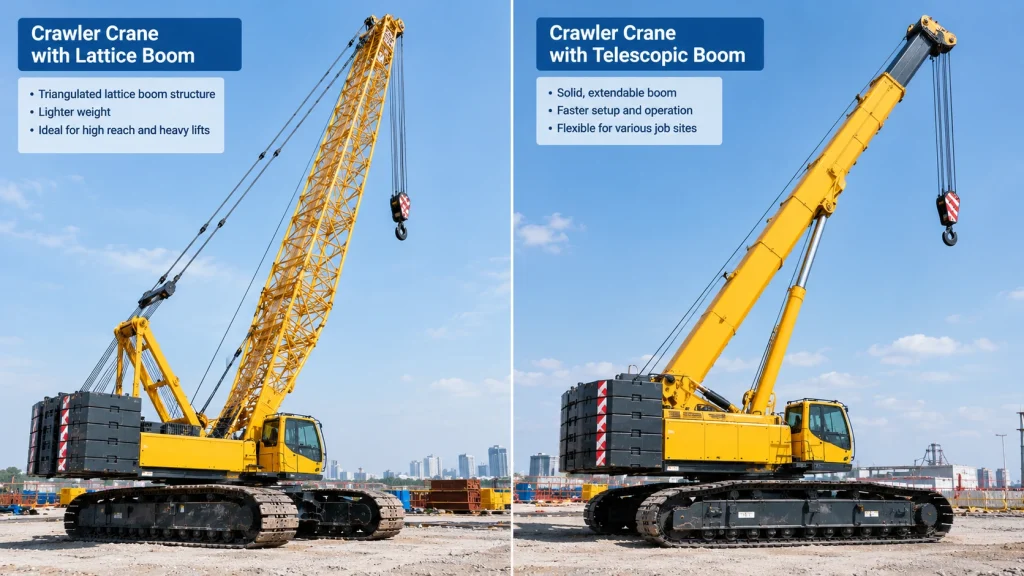
Crawler cranes are most commonly distinguished by their boom type, which directly affects their capacity, reach, and how they are assembled and transported to a site.
Lattice Boom Crawler Cranes
Lattice boom crawler cranes use a modular, triangulated steel boom assembled from individual sections on-site, allowing the boom length to be configured specifically for a given lift’s height and reach requirements. This modular assembly means the crane’s overall boom length is not fixed at manufacture, additional sections can be added for taller lifts, and the boom disassembled into transportable sections when the crane needs to move between sites.
This configuration typically offers the highest lifting capacities available in mobile crane equipment, making lattice boom crawler cranes the standard choice for major infrastructure projects, heavy industrial lifts, and any application requiring capacity beyond what a telescopic boom crane can provide.
Telescopic Boom Crawler Cranes
Telescopic boom crawler cranes combine the track-based stability of a crawler undercarriage with a telescoping boom that extends and retracts hydraulically, similar in principle to the boom on a wheeled mobile crane. This configuration sacrifices some of the maximum capacity a lattice boom provides in exchange for considerably faster setup, since a telescopic boom does not require on-site assembly the way a lattice boom does.
Telescopic crawler cranes suit projects that value crawler-level ground stability but do not require the extreme capacity of a large lattice boom configuration, offering a practical middle ground between mobility and lifting power.
Crawler Crane vs Other Mobile Cranes
Understanding where a crawler crane fits relative to other mobile crane categories clarifies exactly when its specific combination of stability and capacity offers a genuine advantage.
Crawler Crane vs Rough Terrain Crane
A rough terrain crane uses large rubber tyres and outriggers rather than tracks, trading some of the crawler crane’s inherent ground stability for considerably greater speed and mobility around a site. Rough terrain cranes suit projects needing frequent repositioning between multiple lift points, while crawler cranes suit projects with a smaller number of very heavy lifts where maximum capacity and stability matter more than repositioning speed.
Crawler Crane vs Tower Crane
A tower crane remains fixed in one location for the duration of a project, offering exceptional height for high-rise construction but no mobility once erected. A crawler crane, while far less mobile than a wheeled crane, can still reposition across a site under its own power, making it the more practical choice for projects requiring heavy lifts at multiple locations rather than sustained lifting from a single fixed point over an entire project’s duration.
Common Applications
Crawler cranes are specified wherever a project’s lift requirements exceed what smaller mobile crane categories can safely handle, or where ground conditions rule out a wheeled alternative entirely:
- Heavy industrial lifts, including power plant components, large structural steel sections, and process equipment installation
- Major infrastructure projects, such as bridge construction, where individual lift weights often exceed the capacity of wheeled mobile cranes
- Wind turbine installation, where extreme height and capacity are needed to lift turbine components into position
- Sites with soft, uneven, or unprepared ground, where a crawler crane’s track-based stability allows operation without the ground preparation a wheeled crane’s outriggers would require
Understanding a specific crawler crane model’s rated capacity at different boom lengths and radii remains essential for planning any lift regardless of how much stability the machine’s tracks provide, covered in detail below.
Advantages and Limitations
A crawler crane’s core advantage is the combination of high lifting capacity and inherent ground stability, achieved without the outrigger setup and site preparation that wheeled cranes typically require, making it the practical choice for the heaviest lifts and the softest or most uneven ground conditions.
This same track-based design limits road mobility considerably, crawler cranes generally cannot travel on public roads under their own power and require disassembly and transport by trailer between distant sites, a logistical undertaking that wheeled mobile cranes avoid entirely. This trade-off is why crawler cranes are typically specified for large, extended-duration projects where their capacity and stability advantages outweigh the added mobilisation cost and time, rather than for smaller projects needing quick, flexible crane access. Further general technical background on crawler crane design and classification is available through Wikipedia’s overview of crawler cranes.
Also read: Crane Lifting Capacity Explained for Construction Projects
Specifying the Right Crane for Your Lift
A crawler crane’s track-based stability and high lifting capacity make it the right choice for heavy, large-scale lifts and challenging ground conditions, but its limited road mobility and longer mobilisation time mean it is far from the universal choice across every project. Matching a project’s actual lift weights, site conditions, and duration against the trade-offs each crane category presents is what determines the right equipment decision.
RR Machinery Pte Ltd supports Singapore’s construction and industrial sectors with reliable heavy machinery solutions tailored to your specific project needs. Browse our complete heavy machinery services or contact our team today for practical advice on the right lifting equipment for your project.