Almost every warehouse, port, and construction site in Singapore relies on a forklift in some form, but not every forklift is built the same way. The choice between an electric and a diesel model is one of the first and most consequential decisions a business makes when specifying a fleet, since it affects everything from daily running cost to where the machine can actually be used.
This comparison breaks down how each power source works, where each type of forklift performs best, and the practical factors, cost, capacity, environment, and maintenance, that should drive the final decision for a given operation.
What Is an Electric Forklift?
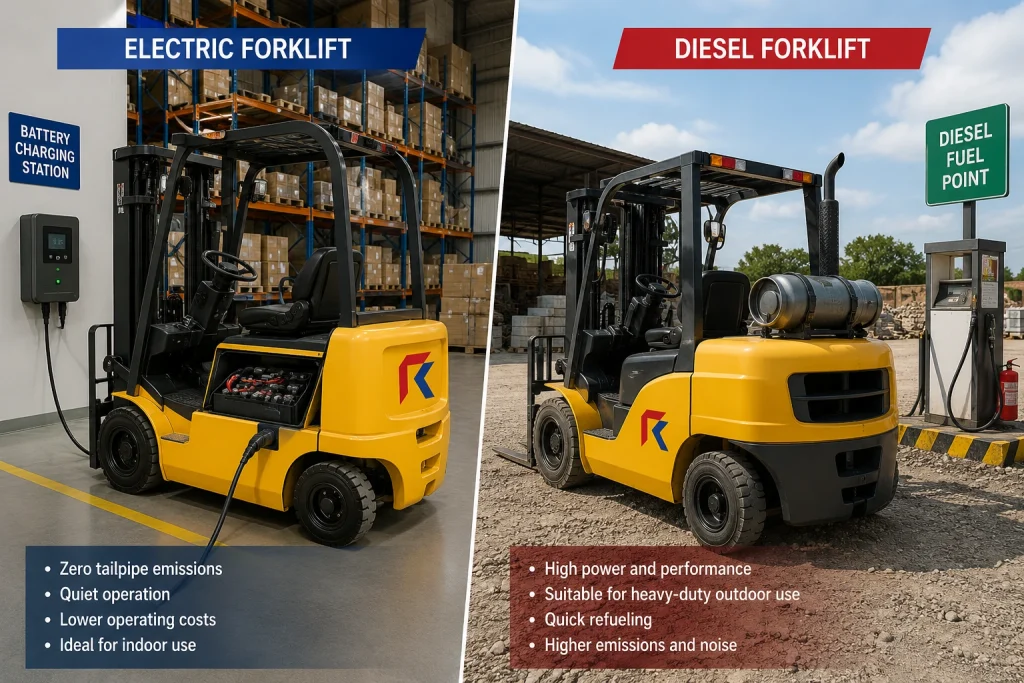
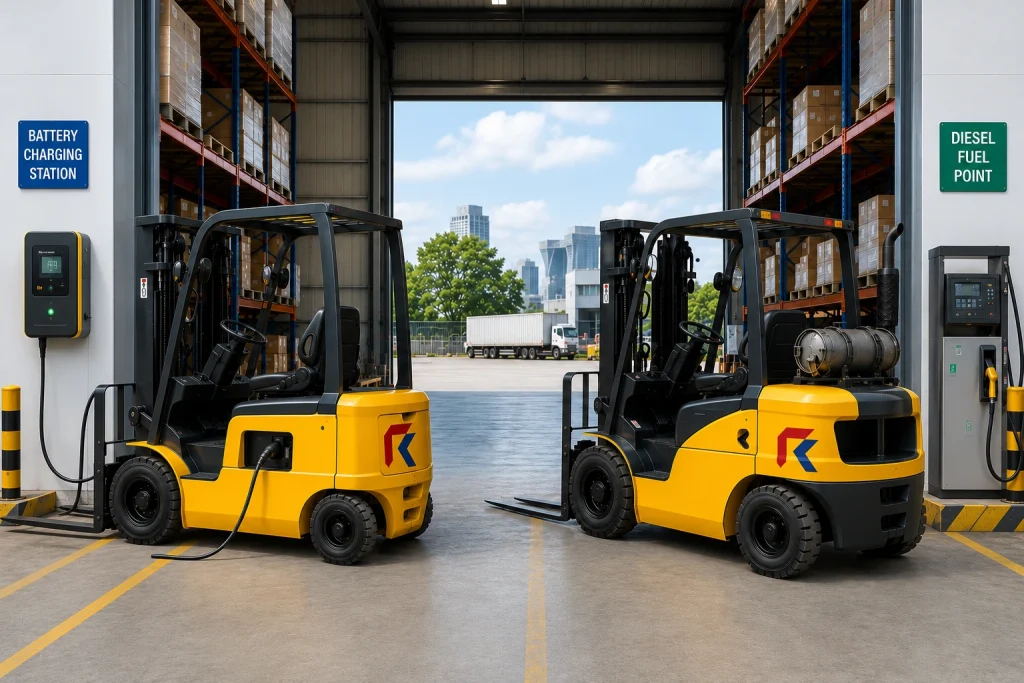
An electric forklift is a forklift powered entirely by a battery-driven electric motor rather than an internal combustion engine, drawing stored electrical energy to power its drive system and hydraulics. It is most commonly recognised by the absence of an exhaust or fuel tank, replaced instead by a battery compartment that is either charged in place or, on some models, swapped out between shifts.
This power source has made electric forklifts the standard choice across warehouses, cold storage, and other enclosed environments where clean, quiet operation matters as much as lifting performance.
How Electric Forklifts Work
An electric forklift stores energy in a large battery pack, typically lead-acid or lithium-ion, which powers an electric motor connected to the drive wheels and a separate hydraulic pump for lifting. Because there is no combustion process involved, the machine produces no exhaust emissions and generates significantly less noise and vibration than an engine-driven alternative.
Most electric forklifts are recharged by plugging into a charging station between shifts, with lithium-ion models increasingly supporting fast, opportunity charging during short breaks rather than requiring a full battery swap or lengthy overnight charge. This charging profile has a direct effect on how a fleet is scheduled, since battery capacity and recharge time need to be planned around actual shift patterns.
Types of Electric Forklifts
Electric forklifts are available across several configurations, from compact three-wheel counterbalance models suited to tight aisles, to four-wheel counterbalance units built for higher capacities, to narrow-aisle reach trucks designed specifically for tall warehouse racking. Each configuration trades off manoeuvrability, lift height, and load capacity differently, which is why specifying the right electric configuration matters as much as choosing electric power in the first place.
A closer breakdown of how these configurations compare, along with the other major forklift categories on the market, is covered in Different Types of Forklifts Explained, which is useful background before narrowing down a specific electric model.
Also read : 7 Different Types of Forklifts You Should Know
What Is a Diesel Forklift?
A diesel forklift is a forklift powered by an internal combustion engine running on diesel fuel, generating mechanical power for both the drive system and the hydraulics through a conventional engine and transmission. It is easily identified by its fuel tank, exhaust system, and radiator, components that set it apart structurally from a battery-powered equivalent.
This engine-driven design has made diesel forklifts the long-standing default for outdoor and heavy-duty applications, where sustained power, quick refuelling, and durability in exposed conditions matter more than quiet, emissions-free operation.
How Diesel Forklifts Work
A diesel forklift’s engine burns fuel to drive a transmission connected to the wheels, while a separate hydraulic pump, powered off the same engine, operates the mast and attachments. This mechanical arrangement gives diesel forklifts significantly more torque and sustained power output than most electric equivalents, particularly under continuous heavy load or on inclines.
Refuelling a diesel forklift takes only a few minutes, and a full tank typically lasts an entire shift or longer even under demanding use, which removes the battery capacity planning that electric fleets require. This makes diesel forklifts particularly well suited to operations that run long, uninterrupted shifts with heavy, continuous lifting demands.
Where Diesel Forklifts Are Typically Used
Diesel forklifts are the standard choice for outdoor yards, ports, timber and steel handling, and construction sites, environments where ventilation is not a constraint and where rough or uneven ground favours the engine’s higher torque and typically more robust chassis. Ports and open-air logistics yards in particular rely heavily on diesel forklifts for their combination of power, quick refuelling, and durability in exposed conditions.
Rough terrain variants take this further, adding larger tyres and reinforced undercarriages specifically for construction sites and unpaved yards. A closer look at how these rough terrain models are built and where they fit is available in Rough Terrain Forklift: Features, Uses, and Benefits, useful reading for any outdoor or construction-focused operation.
Also read: Rough Terrain Forklift: Features, Uses, and Benefits
Electric vs Diesel Forklifts: Key Differences
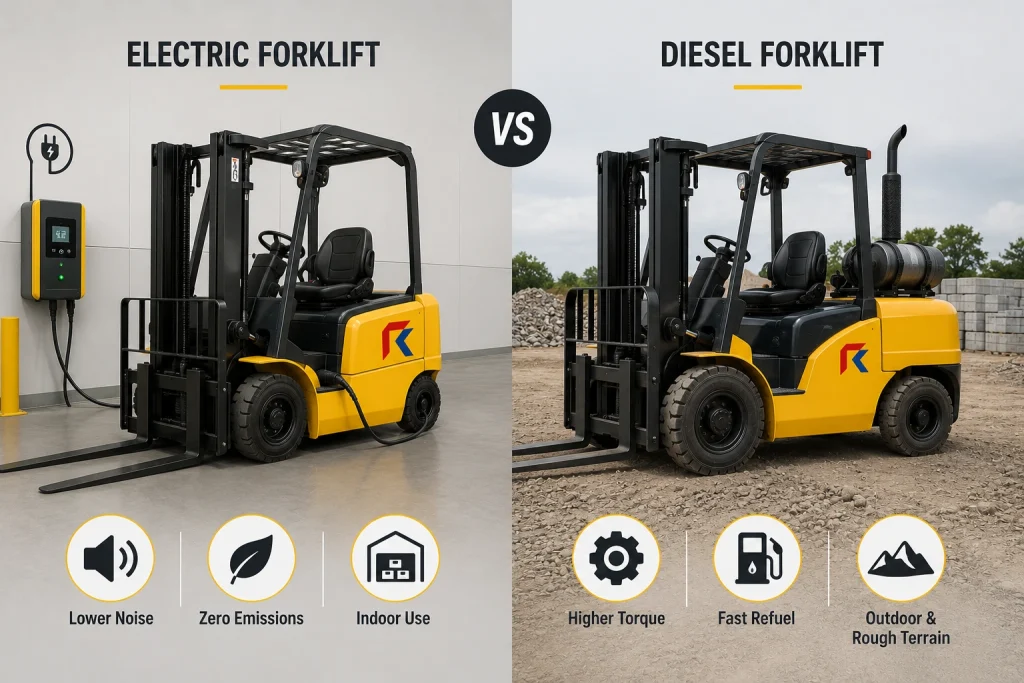
Beyond how each machine is powered, the practical differences between electric and diesel forklifts show up clearly across cost, power, environment, and emissions.
Operating Cost and Fuel
Electric forklifts generally cost less to run per hour of operation, since electricity is cheaper than diesel fuel per unit of energy delivered, and electric drivetrains have fewer moving parts subject to wear, such as no engine oil, exhaust system, or radiator to maintain. Battery replacement, however, represents a significant cost later in the machine’s life, particularly for older lead-acid battery technology, which needs to be factored into any long-term cost comparison.
Diesel forklifts have a lower upfront purchase price in many size classes but carry higher ongoing fuel costs, along with the added expense of engine servicing, oil changes, and emissions-related components over the machine’s working life. For operations weighing purchase against flexible access to either power source, exploring rental options can spread this cost differently depending on expected utilisation.
Power and Load Capacity
Diesel engines deliver higher sustained torque, particularly useful for repeated heavy lifting, towing, or working on gradients where an electric motor may need to work harder to maintain the same output over a full shift. This is part of why diesel remains the default choice for the heaviest-duty counterbalance applications.
Electric forklifts have closed much of this gap in recent years, particularly in mid-range capacity classes, and modern electric motors deliver smooth, immediate torque that many operators find easier to control precisely at low speed. For a detailed look at how counterbalance models compare across both power sources at a given capacity, Counterbalance Forklift: Features, Uses, and Capacity breaks down the specification differences in more depth.
Indoor vs Outdoor Use
Electric forklifts produce zero exhaust emissions, making them the only practical option for enclosed warehouses, food storage facilities, and any indoor environment where ventilation is limited. Their quieter operation also makes them preferable in noise-sensitive indoor settings such as retail distribution centres.
Diesel forklifts, by contrast, must be used outdoors or in well-ventilated spaces due to exhaust emissions, but their weatherproof build and higher ground clearance in rough terrain variants make them far better suited to yards, ports, and construction sites exposed to the elements. Facilities operating diesel equipment indoors or in partially enclosed spaces should ensure ventilation meets workplace exposure standards before deployment.
Noise and Emissions
Electric forklifts run significantly quieter than diesel models, a meaningful advantage in shared indoor spaces, residential-adjacent sites, or operations running extended or overnight shifts where noise regulations may apply. The absence of exhaust also removes the need for exhaust-related ventilation systems in enclosed storage areas.
Diesel forklifts are noticeably louder and produce combustion emissions that require adequate ventilation, which is one of the main reasons they are restricted from most indoor warehouse environments regardless of how much power or cost advantage they might otherwise offer for a specific task.
Also read: Classes of Forklifts and Their Uses in Material Handling
Maintenance Requirements Compared
Electric and diesel forklifts require fundamentally different maintenance routines, driven directly by the mechanical systems each one depends on. Electric models need regular battery inspection, water level checks for lead-acid batteries, and periodic motor and controller servicing, but avoid the oil changes, fuel filters, and exhaust system upkeep that a combustion engine requires.
Diesel forklifts follow a maintenance schedule closer to a conventional vehicle, with regular engine oil changes, fuel and air filter replacement, and exhaust system checks in addition to the hydraulic and drivetrain maintenance both types share. A detailed maintenance schedule for keeping either type running reliably is covered in Forklift Maintenance: A Complete Guide, alongside a practical Forklift Maintenance Checklist that can be adapted for either power source.
Which One Should You Choose?
The right choice comes down to matching the power source to where and how the forklift will actually be used, rather than defaulting to whichever type is more familiar or currently available.
When to Choose an Electric Forklift
An electric forklift is the right choice for indoor warehouses, food and pharmaceutical storage, retail distribution centres, and any environment where emissions, noise, or ventilation are a concern. It also suits operations with predictable shift patterns that allow battery charging to be scheduled without disrupting throughput.
Businesses prioritising lower running costs and reduced maintenance complexity over the machine’s working life, and operating primarily on smooth, indoor floors, will generally get the most value from an electric fleet.
When to Choose a Diesel Forklift
A diesel forklift is the right choice for outdoor yards, ports, construction sites, and any application involving rough terrain, continuous heavy lifting, or long shifts where refuelling speed matters more than running cost. Its higher torque and rapid refuelling make it the more practical option wherever ventilation is not a constraint.
Operations that value uptime above all else, where a few minutes at a fuel pump is preferable to battery charging logistics, will typically find diesel the more dependable option despite its higher fuel and servicing costs. A structured framework for weighing these factors against a specific operation’s needs is covered in How to Choose a Forklift for Your Business.
Also read: How to Choose a Forklift: A Complete Buyer’s Guide
Find the Right Forklift for Your Operations
Both electric and diesel forklifts remain essential to Singapore’s warehouses, ports, and construction sites, and the right choice depends entirely on where the machine will work, how it will be used, and what a business values most between running cost and raw power. Operators of either type should also follow proper training and inspection procedures, as outlined in the Ministry of Manpower’s Workplace Safety and Health guidance for powered industrial trucks, and further technical background on forklift design and classification is available via Wikipedia’s overview of forklifts.
RR Machinery Pte Ltd offers a diverse selection of diesel, electric, and gasoline forklifts suited to every application and budget. Contact us today for expert advice on which power source and configuration best fits your operations.