Every structure that stands above ground begins with a decision made below it. The choice between a shallow and a deep foundation is not a minor technical detail resolved quietly in the background of a project, it is one of the most consequential structural engineering decisions made in the entire design and construction process. Get it right and the structure performs as designed for its full intended life. Get it wrong and the consequences range from cracking and settlement to structural failure, none of which are easily or cheaply corrected once construction is complete.
The difference between shallow and deep foundations comes down to a single fundamental question: where is the load-bearing soil? If competent load-bearing material exists close to the surface, a shallow foundation can transfer the building’s weight directly into it at modest depth. If the surface and near-surface soils are too weak, too compressible, or too variable to support the structure safely, a deep foundation is required to carry the load down to stronger material below, sometimes tens of metres below the surface.
This guide explains what shallow foundations and deep foundations are, how each type works, when each is the correct engineering choice, the specific conditions that make one appropriate and the other inadequate, and the practical implications for construction programmes and equipment requirements in Singapore and across the region.
What Is a Shallow Foundation
A shallow foundation is a foundation system that transfers the load of a structure into the ground at a relatively shallow depth, typically less than three metres below the finished surface level, though the precise definition varies across engineering standards and local codes. The defining characteristic of a shallow foundation is not the exact depth of excavation but the mechanism by which it transfers load: it relies on the bearing capacity of the soil or rock at or close to the surface to resist the structural load bearing down from above.
The principle behind a shallow foundation is straightforward. If the soil at a shallow depth is dense, stable, and has sufficient bearing capacity, the foundation can spread the structural load across a wide enough area at that depth to keep the pressure applied to the soil within its safe bearing limit. The wider the foundation, the more area over which the load is distributed, and the lower the bearing pressure applied to any given point in the soil beneath.
Shallow foundations are simpler to construct, faster to build, and significantly less expensive than deep foundations in most cases. They are the preferred choice wherever the ground conditions at shallow depth are adequate to support the proposed structure safely.
Also read : Types of Pile Foundation: A Complete Guide
Types of Shallow Foundation
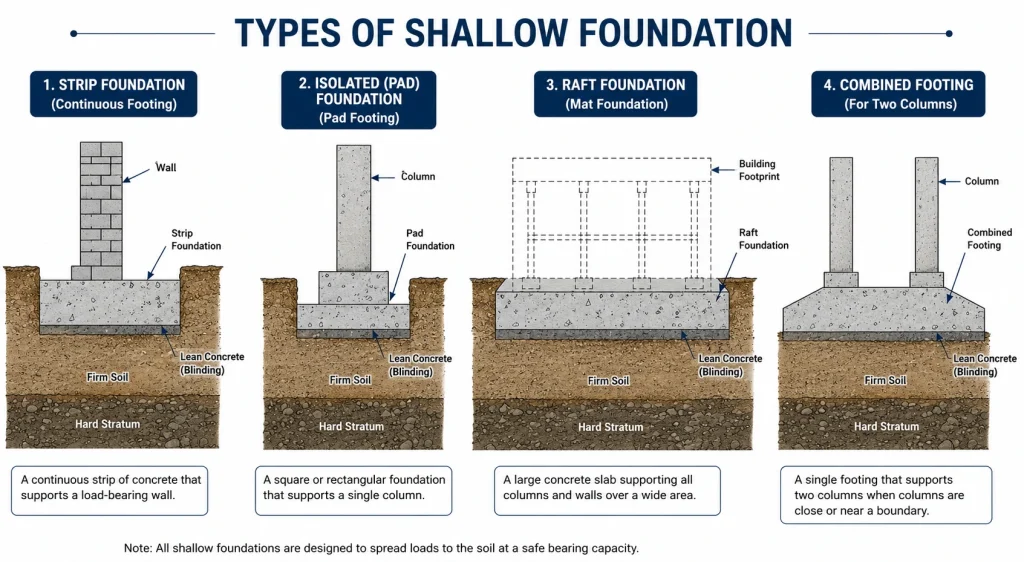
Shallow foundations are not a single solution but a family of foundation types, each suited to different loading conditions and soil profiles.
- Strip foundation
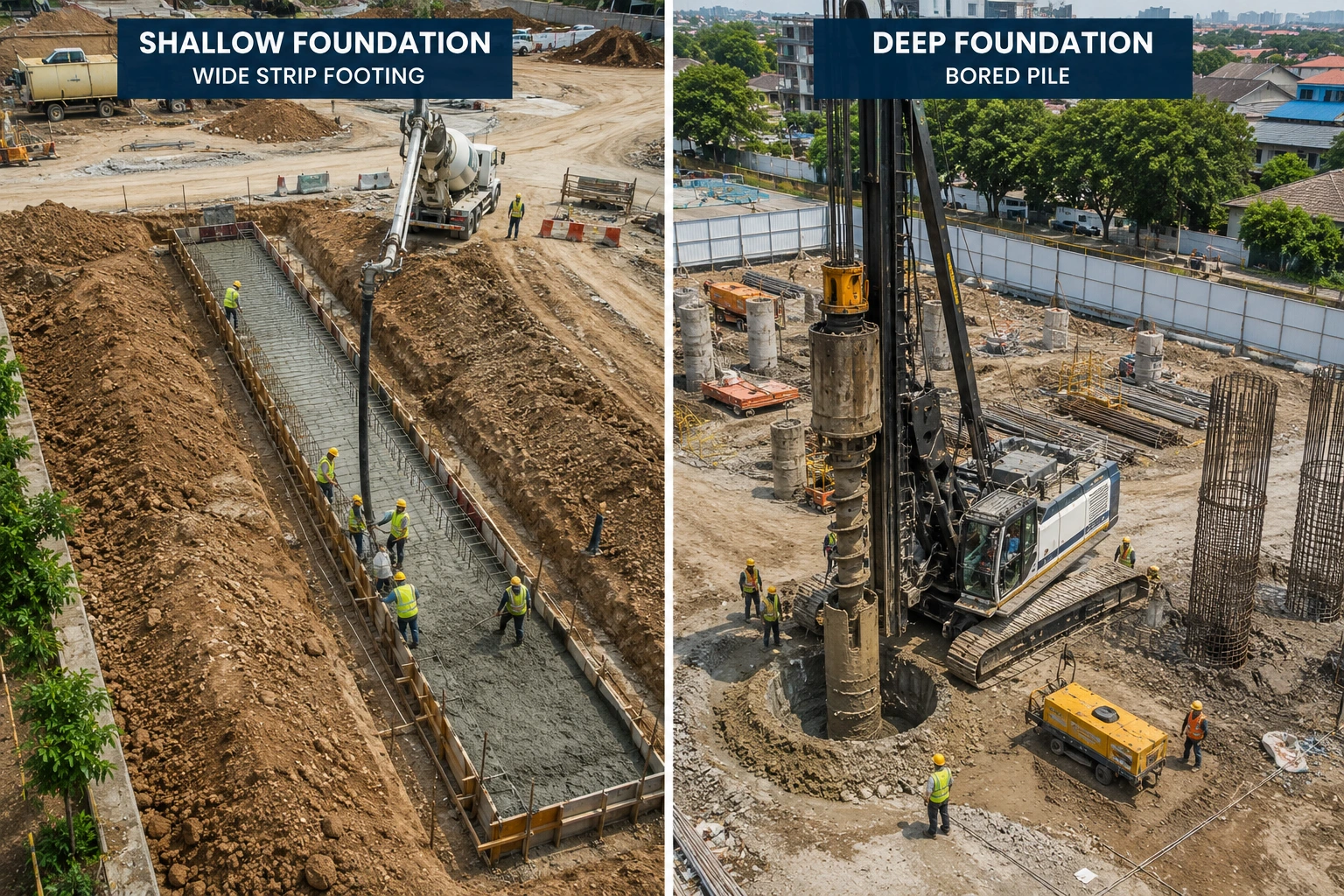
A continuous concrete footing running beneath a load-bearing wall, distributing the wall’s linear load into the soil below across the full length of the wall. The most common shallow foundation type for low-to-medium rise residential construction.
- Pad foundation (isolated footing)
A discrete concrete pad placed beneath an individual column to distribute the column’s point load into the soil. Used in steel and reinforced concrete framed structures where loads are concentrated at column points rather than distributed along walls.
- Raft foundation (mat foundation)
A continuous reinforced concrete slab covering the full footprint of the building, distributing the total structural load across the entire plan area. Used when individual pad or strip footings would overlap, when soil bearing capacity is low but still adequate at shallow depth, or when differential settlement control is critical.
- Combined footing
A footing that supports two or more columns on a single base, used when columns are closely spaced, near a property boundary, or when individual pad footings for adjacent columns would interfere with each other.
When Shallow Foundations Work
A shallow foundation performs as designed when the soil at the founding depth meets three conditions: it has sufficient bearing capacity to support the applied load without shear failure, it is stable enough to limit settlement to within acceptable bounds over the life of the structure, and it is consistent enough across the building footprint that differential settlement, where one part of the foundation moves more than another, remains within tolerable limits.
Dense sands and gravels, stiff clays, weathered rock, and compacted fills with verified bearing capacity can all support shallow foundations adequately. The challenge arises when these conditions are not present close to the surface, when the near-surface soils are soft, loose, highly compressible, or variable in strength across the site.
What Is a Deep Foundation
A deep foundation is a foundation system that transfers the structural load down through weak near-surface soils to stronger, more competent material at significant depth below the ground surface. Where a shallow foundation distributes load horizontally across a wide base at shallow depth, a deep foundation carries load vertically downward, bypassing the inadequate near-surface material entirely, until it reaches soil or rock with sufficient strength and stiffness to support the structure.
The most widely used type of deep foundation is the pile, a slender structural element, circular, square, or H-shaped in cross-section, driven or bored into the ground to the required founding depth. The pile transfers load through two mechanisms: end bearing, where the tip of the pile presses against strong soil or rock at its base, and skin friction, where the surface of the pile along its length generates resistance through adhesion and friction with the surrounding soil. Most piles in practice transfer load through a combination of both.
Deep foundations are more complex to design, require specialist plant and equipment to install, and are significantly more expensive than shallow foundations. They are not chosen by preference but by necessity, when the ground conditions at shallow depth are genuinely inadequate and a shallow foundation cannot be made to work safely within the constraints of the project.
Types of Deep Foundation
- Driven piles
Steel or precast concrete piles installed by a hydraulic hammer or vibratory driver that forces the pile into the ground. Driven piles are fast to install, do not require the removal of soil, and are well-suited to sites where skin friction in granular soils contributes significantly to pile capacity.
- Bored piles (drilled shafts)
Piles installed by drilling a hole to the required depth and filling it with reinforced concrete. Bored piles produce no vibration during installation, which makes them the preferred choice on sites near sensitive existing structures, and they can be installed to greater depths and larger diameters than most driven pile systems.
- Micro-piles
Small-diameter drilled piles used in constrained access conditions, underpinning of existing foundations, or locations where equipment size makes standard piling systems impractical.
- Caissons (drilled shafts with bell-out)
Large-diameter bored elements, sometimes with an enlarged bell-shaped base to increase end bearing area on rock or strong soil. Used for very heavy column loads where conventional pile groups would require a large number of individual piles.
- Sheet piles
Interlocking steel sections driven to form a continuous wall, primarily used for temporary or permanent earth retention rather than direct structural load support, but often part of a deep foundation construction programme.
When Deep Foundations Are Required
Deep foundations become the engineering requirement rather than a design choice when specific ground conditions are encountered. The three most common triggers are soft or highly compressible soils at shallow depth, such as the marine clays, reclaimed land, and peaty soils found across significant parts of Singapore; the presence of a strong bearing stratum at depth that is the only reliable load transfer horizon available; and high structural loads, such as those from high-rise buildings, bridge piers, or heavy industrial structures, that exceed what the near-surface soils can support regardless of the foundation area.
Shallow vs Deep Foundation: The Key Differences
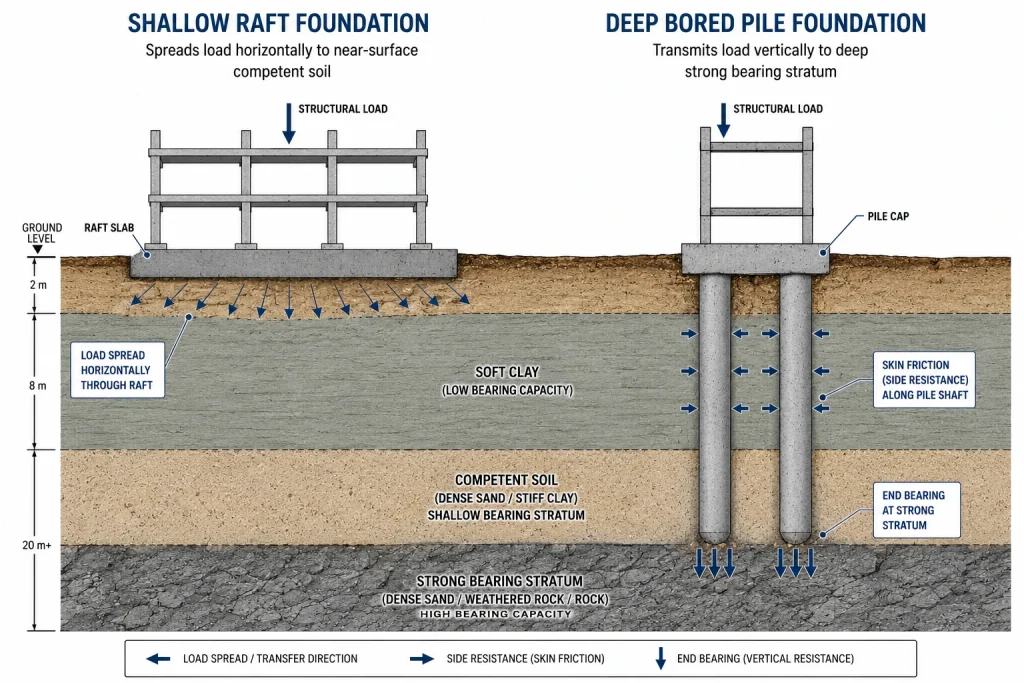
The distinction between shallow and deep foundations is not simply a matter of how far down the foundation goes. The two systems differ in their load transfer mechanism, the ground conditions they require, their construction methods, cost profiles, programme implications, and the equipment needed to build them. Understanding these differences is what allows an engineer, a project manager, or a site supervisor to engage meaningfully with foundation design decisions and their practical consequences.
Load Transfer Mechanism
A shallow foundation transfers load laterally, spreading it across a wide base area at shallow depth so that the pressure applied to the soil beneath remains within safe bearing limits. A deep foundation transfers load vertically, bypassing weak near-surface material and delivering the structural load to competent material at depth through end bearing, skin friction, or a combination of both. This fundamental difference in load path is what determines which system is appropriate for a given combination of structure and ground conditions.
Ground Conditions Required
Shallow foundations require adequate bearing capacity, stiffness, and consistency at or near the surface. Deep foundations are used precisely when those conditions are absent at shallow depth, which is why they are common in Singapore’s coastal and reclaimed land areas, where marine clays and loose fill materials extend for many metres below the surface before stronger material is encountered.
Also read : Types of Foundations Used in Construction Projects
Construction Method and Equipment
Shallow foundation construction involves excavation to the founding depth, preparation of the formation, formwork, reinforcement, and concrete placement. The work is accessible, involves familiar construction trades, and is executed with standard earthmoving and concrete plant. For the excavation work that precedes shallow foundation construction, crawler excavators and backhoe loaders are the primary machines.
Deep foundation construction requires specialist piling plant, whether driven pile hammers, rotary drilling rigs, or CFA (Continuous Flight Auger) rigs, that is entirely different from the plant used for shallow foundation work. For projects that combine piling with crane-dependent operations such as precast pile handling, lifting, and positioning, understanding the crane types suited to each lifting task is covered in the guide to types of cranes used in construction, which sets out how different crane configurations are deployed across construction programmes.
Cost and Programme
Shallow foundations are substantially less expensive in almost all cases where the ground conditions allow their use. The materials are the same, concrete and reinforcement steel, but the construction is faster, involves less specialist plant, and requires less complex geotechnical investigation to verify. Where ground conditions make shallow foundations viable, they will nearly always be the preferred choice from both a cost and programme perspective.
Deep foundations carry higher unit costs driven by specialist plant, longer construction cycles per element, and the need for more extensive geotechnical data to design the piles with confidence. For high-rise construction and structures on difficult ground, the higher cost of deep foundations is not a design choice to be optimised but a non-negotiable requirement of building safely on the available site.
Settlement Behaviour
Settlement, the downward movement of a foundation as the soil beneath it compresses under load, behaves differently for shallow and deep foundations. Shallow foundations on compressible soils can experience significant settlement, particularly long-term consolidation settlement in clay soils, which may take years or decades to fully develop. Deep foundations that bypass the compressible near-surface layer and bear on competent material at depth typically experience much less settlement, and it develops more quickly, which makes it easier to account for in the structural design.
Differential settlement, where different parts of the same structure settle by different amounts, is often the more critical design consideration, because it induces bending and shear in the structure above the foundation in a way that uniform settlement, even if larger in total magnitude, does not.
How to Choose Between Shallow and Deep Foundation
Foundation selection is fundamentally a geotechnical and structural engineering decision, requiring ground investigation data, structural load information, and site-specific analysis before a recommendation can be made with confidence. That said, there are clear conditions that consistently point toward one system or the other, and understanding these conditions helps project managers, contractors, and clients engage with foundation engineering recommendations on an informed basis.
Conditions That Point to a Shallow Foundation
- The site investigation confirms competent load-bearing soil at shallow depth, typically stiff clay, dense sand, gravel, or decomposed rock
- The proposed structure is low to medium rise with structural loads that can be spread over an adequate footing area without exceeding the soil’s bearing capacity
- Settlement analysis confirms that anticipated settlement, including long-term consolidation, is within the structure’s tolerance
- The site is not in an area known for soft marine clays, loose reclaimed fill, or other problem soils that extend to significant depth
- The project programme and budget favour the speed and cost-efficiency of a shallow foundation over the certainty of a deep foundation on marginal ground
Conditions That Require a Deep Foundation
- The site investigation identifies soft, loose, or highly compressible soils extending to depth, making shallow founding impractical
- The structure is a high-rise building, bridge, or heavy industrial facility where structural loads exceed what near-surface soils can support
- The site is on reclaimed land, near the coast, or in a known area of thick marine clay deposits, which are widespread in Singapore
- Settlement analysis for a shallow foundation exceeds the structure’s tolerance, particularly for differential settlement
- The founding depth required for a shallow foundation to reach competent material is so great that a deep foundation becomes more practical and economical
The Role of Ground Investigation
Neither a shallow nor a deep foundation should be selected without adequate ground investigation data. Site investigation, which typically involves boreholes, in-situ testing such as Standard Penetration Tests and cone penetrometer tests, and laboratory testing of soil samples, provides the information that engineers need to characterise the ground profile, identify the depth and bearing capacity of the founding stratum, and assess consolidation and settlement potential.
In Singapore, where ground conditions are highly variable, with everything from competent Bukit Timah granite near the surface in the central region to thick marine deposits in the coastal and reclaimed areas, ground investigation is not a formality but the essential first step in any foundation design process.
Also read : Road Construction Equipment List: Every Machine Explained
Construction Equipment for Foundation Work
The type of foundation selected has direct consequences for the plant and equipment required to build it, which in turn affects programme planning, cost estimation, and site logistics.
Shallow Foundation Construction Equipment
Excavation to founding depth for a shallow foundation is standard earthmoving work, executed primarily by crawler excavators and backhoe loaders. The excavation must reach the confirmed founding level without over-excavating or disturbing the formation, both of which compromise the bearing capacity that the foundation design relies on. Once the excavation is complete, the formation is trimmed level, blinding concrete is placed, and reinforcement and formwork follow before the structural concrete pour.
For shallow foundation pours involving large volumes of concrete or time-critical placement windows, concrete pump access and appropriate boom reach to cover the full foundation footprint are important logistics considerations. For larger raft foundations, concrete delivery scheduling, continuous pour management, and curing discipline are as critical as the structural design itself.
Deep Foundation Construction Equipment
Bored pile construction requires a rotary drilling rig of appropriate diameter and torque capacity for the pile size specified, along with a bentonite or polymer slurry system for temporary bore support in water-bearing or unstable ground. The reinforcement cage must be fabricated and lifted into the bore before concreting, which typically requires a crawler crane sized to handle the cage’s weight and length.
Driven pile construction uses a hydraulic impact hammer or vibratory driver mounted on a crane or dedicated piling rig. Steel H-piles and precast concrete piles must be pitched, aligned, and driven to the required set, the penetration per blow that indicates the pile has reached its design bearing stratum. Handling and pitching long precast piles, often twelve to fifteen metres in length, requires a crane with adequate reach and capacity for the pile weight at the handling radius.
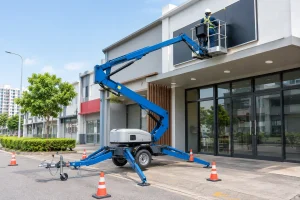
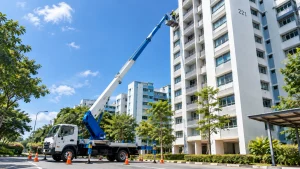
For both bored and driven pile programmes, crane selection, capacity planning, and ground condition assessment at the crane position are all critical safety and productivity factors. Aerial work platforms, including scissor lifts and boom lifts, are also cxommonly deployed alongside foundation construction for reinforcement cage fabrication, formwork work at depth, and access to pile cut-off operations. The full range of aerial work platform options suited to construction site access is available through RR Machinery’s boom lift range, which includes both articulating and telescopic models suitable for the varying access conditions of active foundation sites.
For a comprehensive technical reference on foundation design principles, soil classification, and the geotechnical engineering standards that underpin both shallow and deep foundation selection, the geotechnical foundation engineering guidelines published by the Federal Highway Administration provide detailed methodology covering load transfer mechanisms, settlement analysis, bearing capacity calculation, and site investigation requirements applicable to a wide range of construction environments.
Build on the Right Foundation with the Right Equipment
Foundation selection shapes every aspect of a construction project that follows it, the programme, the plant, the logistics, and the long-term performance of the structure above. Understanding whether the ground beneath a proposed building calls for a shallow or a deep foundation is the starting point from which every subsequent decision follows, and making that determination on the basis of proper ground investigation and competent geotechnical engineering is what separates projects that perform as designed from those that do not.
RR Machinery supports construction teams across Singapore with a comprehensive range of construction and lifting equipment for sale and rental, including aerial work platforms, forklifts, mobile scaffolding, and power generators, all maintained to full operational standard and supported by experienced equipment specialists with over ten years of experience across civil engineering, building, and industrial projects in the region.
Explore our full range of construction and site equipment solutions, browse our boom lifts and aerial work platforms suited for foundation construction access work, or contact our team for practical advice and a clear quotation matched to your project scope and site conditions.