A retaining wall is a permanent civil structure whose function is straightforward in concept and demanding in execution: it holds back a mass of soil or rock on one side while maintaining a stable, usable surface on the other. Without retaining walls, sloped terrain cannot be terraced for construction, road cuttings cannot be maintained without wide and unsafe batters, river banks erode freely into waterways, and urban development on hillside sites is impractical.
The range of retaining wall types available is broader than many project managers and site engineers realise. Each type uses a different structural mechanism to resist the lateral earth pressure of the retained material, and each is suited to a different combination of retained height, ground conditions, site access constraints, material availability, and cost requirements. Selecting the wrong wall type for an application wastes cost, creates maintenance problems, and in severe cases leads to wall failure with consequences for adjacent structures and for public safety.
Understanding the types of retaining wall available, how each works structurally, what it is suited to, what its limitations are, and how it compares to the alternatives, is essential knowledge for civil engineers, project managers, and anyone responsible for specifying or managing retaining wall construction on a development or infrastructure project.
How Retaining Walls Work: The Structural Principles
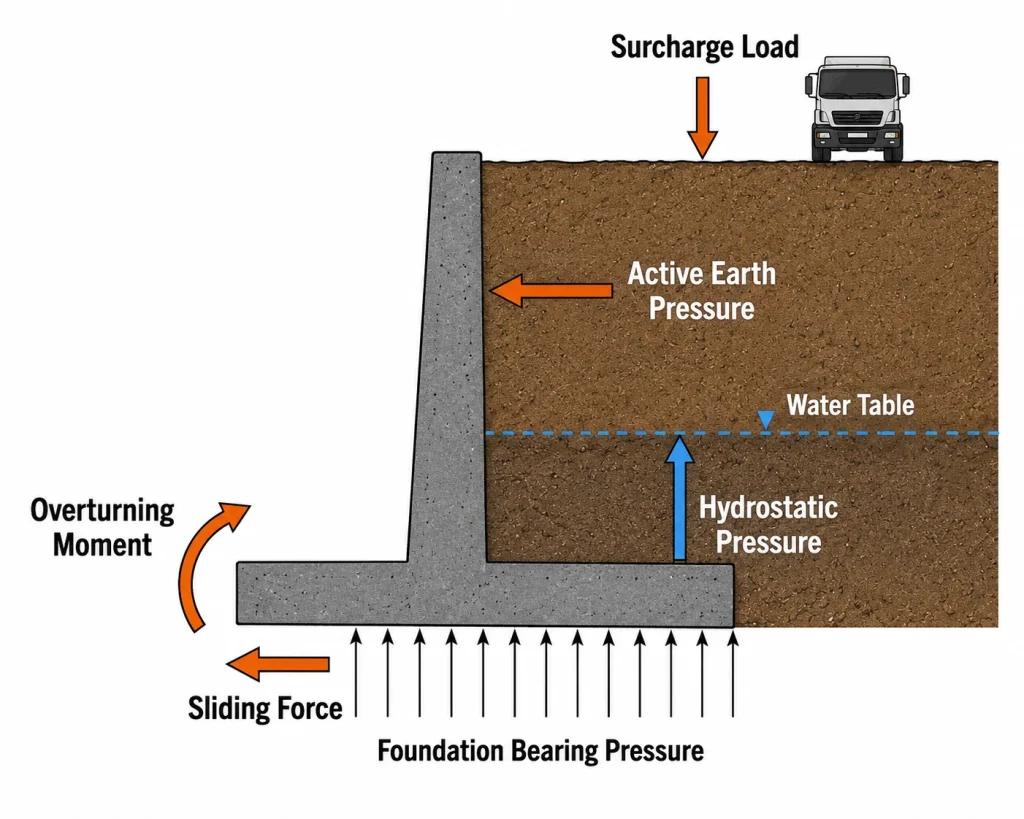
All retaining walls resist the same fundamental force: lateral earth pressure, the horizontal force that the retained soil mass exerts on the back face of the wall. This pressure increases with depth below the top of the wall, with the weight and density of the retained material, with the presence of water in the retained soil (which adds hydrostatic pressure to the earth pressure), and with surcharge loads placed on the retained soil surface.
A retaining wall must resist lateral earth pressure without sliding forward, without overturning about its toe, and without failing structurally in bending or shear. It must also be founded on ground capable of sustaining the bearing pressure transmitted through its base, and it must be designed to drain the water that accumulates behind it, undrained water pressure is the single most common cause of retaining wall failure.
Different wall types achieve these requirements through different structural mechanisms, their own mass, reinforcement, embedment, tie-backs, or geotextile reinforcement in the retained fill. Each mechanism suits a different combination of wall height, site conditions, and construction constraints.
The step-by-step construction process for the most common retaining wall types, including drainage installation, backfill compaction, and foundation preparation, is covered in full in the practical guide to how to build a retaining wall on civil and construction sites.
Also read : Types of Bridges and How They Work in Construction
Types of Retaining Walls
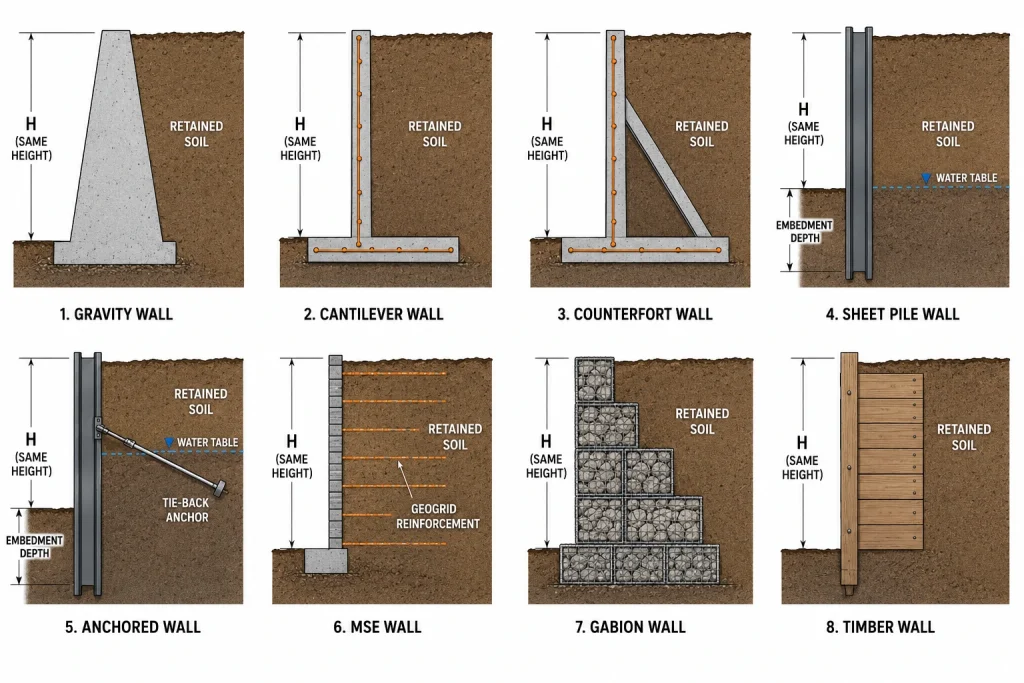
The main retaining wall types used in civil engineering and construction each represent a different structural approach to resisting lateral earth pressure. The selection between types is determined by the retained height, the available site space, the ground conditions, the construction access, and the project budget.
Quick Comparison: Retaining Wall Types at a Glance
| Wall Type | Typical Height | Best Suited To |
| Gravity | Up to 1.5-2.0m | Sites with space available; simple mass concrete or masonry construction |
| Cantilever | 1.5-6.0m | Road embankments, basement walls, bridge abutments |
| Counterfort / Buttressed | Above 6.0m | Major highway walls, large bridge abutments, port structures |
| Sheet Pile | Varies | Confined urban sites; temporary excavation support; waterfront structures |
| Anchored | Tall / varies | Deep basements; difficult ground; tall walls needing extra support |
| MSE (Reinforced Earth) | Varies | Large-scale highway and rail projects; variable foundation conditions |
| Gabion | Varies | Rural sites, river bank protection, environmentally sensitive locations |
| Timber | Up to 1.0-1.5m | Residential gardens and landscaping; short-term rural use |
Gravity Retaining Wall
The gravity retaining wall is the oldest and simplest retaining wall type. It resists lateral earth pressure entirely through its own mass, the wall is heavy enough that the friction between its base and the foundation soil prevents sliding, and the weight of the wall creates a sufficient restoring moment to prevent overturning about the toe.
Gravity walls are typically constructed from mass concrete, stone masonry, or dry-stacked masonry. They require no reinforcement and no deep foundation, the wall’s width and weight do all the structural work. Their simplicity makes them durable and low-maintenance, and their use of locally available materials, stone, concrete, makes them economical in many locations.
The limitation of the gravity wall is its dimensional requirement. To be stable, a gravity wall must be wide enough at the base to generate sufficient restoring moment, typically 0.5 to 0.7 times the retained height in base width. For wall heights above approximately 1.5 metres, this width requirement makes the gravity wall uneconomical in material volume and impractical where space behind or in front of the wall is limited. Gravity walls are therefore suited to low-to-medium retained heights where space is available and where the construction simplicity of a mass-concrete or masonry structure is valued.
Suited to: Retained heights up to 1.5 to 2.0 metres; sites with adequate horizontal space; applications where construction simplicity and material availability are priorities.
Cantilever Retaining Wall
The cantilever retaining wall uses a reinforced concrete base slab that extends beneath the retained soil, with a reinforced concrete stem projecting upward from the base slab. The retained soil sitting on the heel of the base slab provides a gravity component, its weight bears down on the base slab, resisting uplift and providing additional restoring moment. The reinforced stem resists the bending moment from lateral earth pressure as a cantilever element, with tension in the rear face reinforcement balancing the compression in the front face.
The cantilever design is more economical in material than a gravity wall for heights above approximately 1.5 metres, because the reinforcement in the stem allows a much thinner section to carry the same bending moment that a thick mass of unreinforced concrete would require. The base slab extends beyond the wall face on both the heel (retained) side and sometimes the toe (exposed) side, providing stability without the excessive width of a gravity wall.
Cantilever walls are the most common type for medium-height retaining walls in civil and building construction, road embankment walls, basement retaining walls, bridge abutments, and cut-and-fill walls on development sites. Their design is well-understood, their construction is straightforward, and their material quantities are efficient.
Suited to: Retained heights from 1.5 to 6.0 metres; sites with adequate foundation bearing capacity; applications requiring an economical balance between material use and structural performance.
Counterfort and Buttressed Retaining Wall
For retained heights above approximately 6 metres, the cantilever wall’s stem becomes increasingly thick and the bending moments increasingly large, the required stem reinforcement and concrete volume become uneconomical. The counterfort retaining wall resolves this by adding triangular reinforced concrete cross-walls, counterforts, at regular intervals along the retained face of the wall, connecting the stem to the base slab heel. The counterforts act as tension members that support the stem and reduce the effective span of the stem between counterforts, dramatically reducing the bending moments and therefore the required stem thickness.
The buttressed retaining wall is the mirror image, the buttresses are on the exposed face of the wall rather than the retained face. Buttresses act in compression rather than tension and are architecturally more prominent, making the buttressed wall suited to situations where the exposed face is visible and the buttresses can serve an aesthetic or functional purpose.
Both counterfort and buttressed walls are used for high retaining walls, typically above 6 to 8 metres, where the material efficiency of the counterfort or buttress arrangement outweighs the additional formwork complexity compared to a simple cantilever.
Suited to: Retained heights above 6 metres; major civil infrastructure including highway walls, large bridge abutments, and port retaining structures.
Sheet Pile Retaining Wall
The sheet pile retaining wall is built from interlocking steel, precast concrete, or vinyl sheet pile sections driven vertically into the ground before excavation. The piles interlock at their edges to form a continuous wall, and their embedment depth below the excavation base provides the passive earth resistance that balances the active pressure on the retained side.
Sheet pile walls are uniquely suited to situations where horizontal space is limited, where the wall must be installed on the existing ground surface before excavation begins, without the need for excavation and formwork that concrete walls require. In urban environments where a basement or underground structure must be constructed adjacent to existing buildings, the sheet pile wall can be installed from the surface with minimal disturbance to adjacent ground and structures.
Steel sheet piles are the standard specification for temporary excavation support, cofferdams, basement excavation, trench support, where the piles are driven before excavation, the excavation proceeds within the sheeted area, and the piles are extracted and reused after the permanent structure is complete. For permanent retaining walls in marine and waterfront environments, harbour walls, river walls, coastal protection, steel or concrete sheet piles are the standard solution, driven to depth and anchored with tie-backs or ground anchors where required.
Suited to: Confined urban sites; temporary excavation support; waterfront and marine retaining structures; sites where installation before excavation is required.
Anchored Retaining Wall
The anchored retaining wall, also called a tied-back wall or ground anchor wall, adds tension anchors to a sheet pile or concrete wall that would otherwise be unable to resist the lateral earth pressure through embedment alone. The anchors, steel bars or multi-strand cables, are drilled through the wall and grouted into stable ground behind the retained zone at an angle, transferring the lateral load from the wall into the anchor bond zone in the stable soil or rock mass behind it.
Anchored walls allow taller and more slender wall sections than embedment alone would permit, and they can be applied to walls in ground where adequate embedment for a cantilever sheet pile would be impossible, very deep soft clays, loose sands, or sites where the bedrock or stable stratum is far below the base of the excavation.
The installation of ground anchors requires specialist drilling equipment and injection grouting capability, and the anchors must be load-tested to confirm their capacity before the wall is relied upon. Anchored walls are typically used for major infrastructure, deep basement construction, highway cut walls, river bank stabilisation, where the cost of the anchoring system is justified by the retained height or the site constraints.
Suited to: Tall walls in difficult ground; deep urban basements; waterfront walls where passive resistance alone is insufficient; sites with very soft or loose foundation soils.
Also read : Types of Excavators for Construction and Earthmoving
Mechanically Stabilised Earth (MSE) Wall
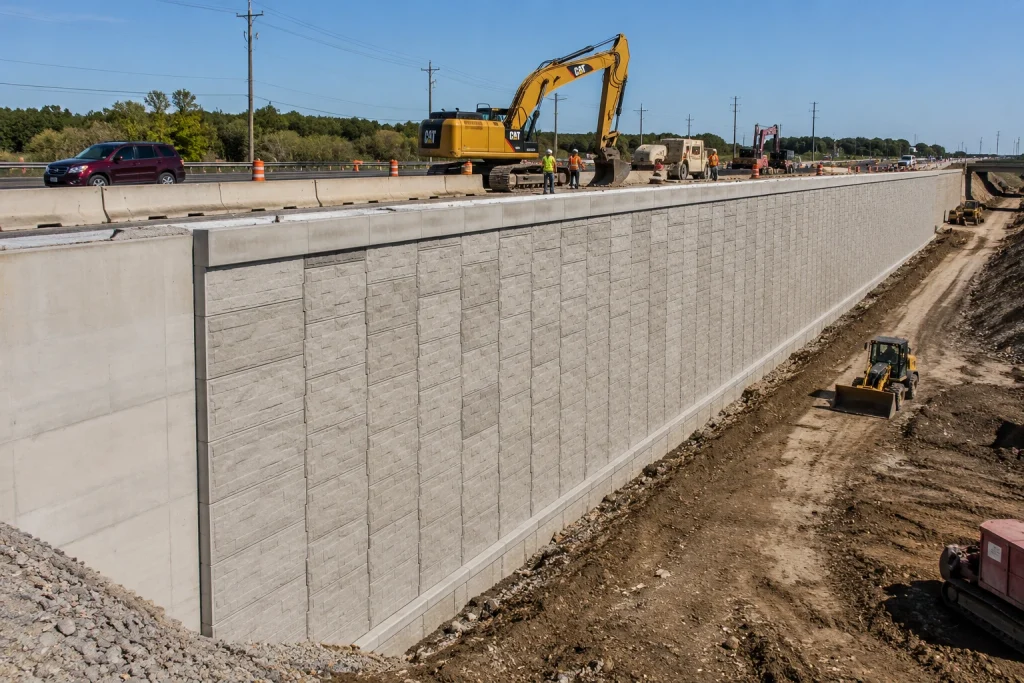
The mechanically stabilised earth wall, also called a reinforced earth wall or geosynthetic reinforced wall, does not function like a conventional retaining wall at all. Instead of a structural wall element resisting earth pressure from the front, the MSE wall reinforces the retained soil mass itself, weaving horizontal layers of metal strips, geogrids, or geotextile sheets into the fill as it is placed, turning the fill mass into a composite structure capable of resisting its own lateral pressure.
The wall face, typically precast concrete panels, segmental blocks, or a wrapped geotextile face, is a relatively thin, non-structural facing element that provides erosion protection and an aesthetic finish. The structural resistance to overturning and sliding comes from the reinforced fill mass itself, which is anchored by friction on the reinforcement layers extending well back from the face into the retained zone.
MSE walls are among the most economical retaining wall types for large-scale highway and infrastructure applications, their material and construction costs per square metre of wall face are typically lower than equivalent reinforced concrete walls at the same height, and their construction does not require heavy formwork or large concrete pours. They are also highly tolerant of differential settlement, making them suited to sites with variable foundation conditions.
Suited to: Large-scale highway and rail infrastructure; walls on sites with variable or compressible foundation conditions; applications where wall face area is large and construction cost per square metre is a priority.
Gabion Retaining Wall
The gabion retaining wall is a gravity wall built from rectangular wire mesh baskets, gabions, filled with rock, stone, or rubble and stacked in a stepped or battered configuration. The filled gabions are heavy, and like a mass concrete gravity wall, the gabion wall relies on its own weight to resist sliding and overturning.
The gabion wall’s key advantages over mass concrete are its flexibility, the wire mesh baskets can accommodate movement and settlement without cracking, its drainage, water passes freely through the rock fill without building up hydrostatic pressure, and its use of locally available materials. Gabion walls are particularly suited to rural and remote locations where concrete materials are expensive or difficult to deliver, where local stone is available, and where some aesthetic integration with the natural landscape is desired.
Gabion walls are widely used for river bank protection, slope stabilisation, road embankment walls in rural and mountainous terrain, and any application where drainage, flexibility, and local material use are valued. Their open structure also provides habitat for small animals and supports vegetation growth, making them a preferred choice in environmentally sensitive locations.
Suited to: Rural and remote sites; river bank protection and slope stabilisation; environmentally sensitive locations; sites with available local stone.
Timber Retaining Wall
The timber retaining wall uses horizontal timber members, treated railway sleepers, hardwood planks, or round timber logs, supported by vertical timber posts driven or concreted into the ground. The vertical posts carry the lateral earth pressure in bending, transferring it to the embedded depth of ground below the excavation level.
Timber retaining walls are simple to construct, economical for low heights, and visually compatible with residential garden and landscape contexts. Their limitation is service life, timber in contact with soil, particularly in moist or wet conditions, deteriorates over time through rot and insect attack. Properly treated hardwood or railway sleepers have a service life of 15 to 25 years in typical conditions; untreated softwood deteriorates much faster.
For permanent infrastructure where service life of 50 or more years is required, timber walls are not appropriate, concrete, steel, or masonry structures provide the durability that permanent civil infrastructure demands. For residential landscape applications, agricultural fencing and small-scale land management, and any application where the wall will be replaced or removed within the timber’s service life, the simplicity and cost of timber construction makes it a practical choice.
Suited to: Retained heights up to 1.0 to 1.5 metres; residential garden and landscape applications; agricultural and rural contexts where service life of 15 to 25 years is acceptable.
Choosing the Right Retaining Wall Type
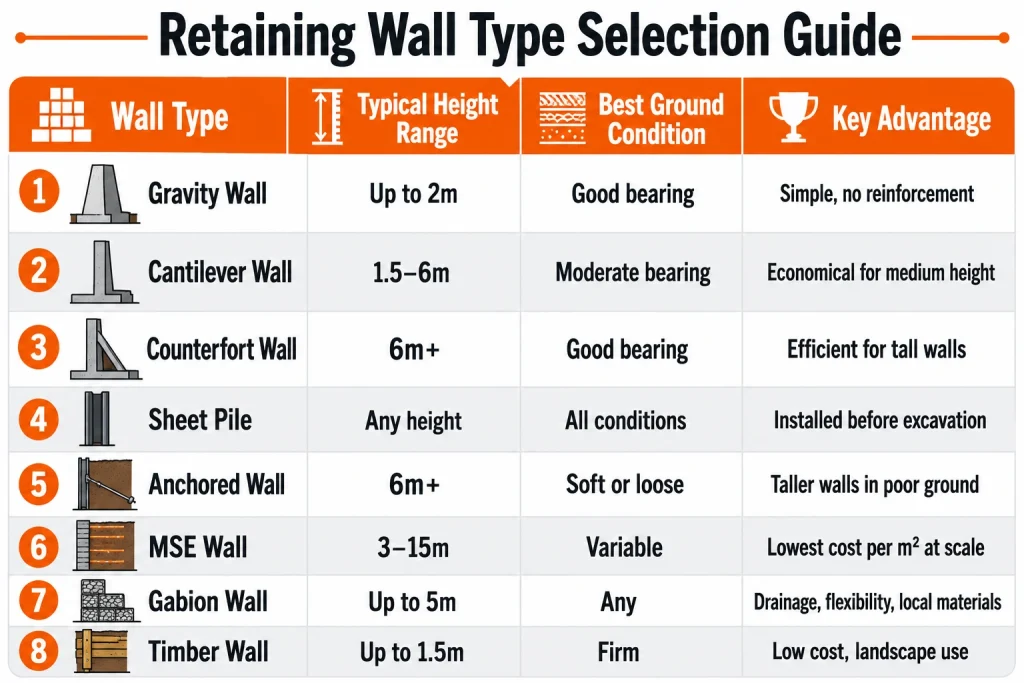
The selection between retaining wall types is determined by several variables working in combination:
- Retained height
This is the most decisive variable. For heights up to 1.5 metres, gravity walls, gabion walls, and timber walls are all practical. For heights from 1.5 to 6 metres, the cantilever wall is typically the most economical concrete option; segmental block walls with geogrid reinforcement are an alternative. For heights above 6 metres, counterfort or buttressed walls, sheet pile walls with anchors, or MSE walls become the appropriate options.
- Site access and space
Where horizontal space is limited, in urban environments, adjacent to existing structures, or where the site boundary constrains the wall footprint, sheet pile walls installed before excavation are often the only practical option. Where space is available, mass concrete gravity or cantilever walls provide economical solutions.
- Ground conditions
The bearing capacity and settlement characteristics of the foundation soil influence the choice between wall types. MSE walls are tolerant of settlement; rigid concrete walls crack if differential settlement occurs. In very soft ground, piled foundations or sheet pile walls with anchors may be required. Understanding foundation types and their bearing characteristics is directly relevant to retaining wall specification, as covered in the guide to types of pile foundation and their application in civil and structural construction.
- Construction access and equipment
Sheet pile walls require a pile driver, a specialist machine. MSE walls require compaction equipment for each layer of reinforced fill. Concrete cantilever walls require formwork, reinforcement, and concrete delivery. The plant available on site and the access for specialist equipment must be considered when selecting the wall type. The earthmoving and compaction equipment used in retaining wall construction, and how it is coordinated with wall construction activities, is part of the broader road construction and heavy plant coordination framework for civil projects.
- Drainage requirements
All retaining wall types require drainage provisions, filter material, perforated drainage pipes, and weepholes, to prevent water pressure buildup behind the wall. The drainage specification must match the wall type and the groundwater conditions at the site. Gabion walls and MSE walls are inherently well-drained through their open structure; concrete walls require designed drainage provisions to achieve the same drainage performance.
- Service life and maintenance
Infrastructure retaining walls must last 50 to 100 years with minimal maintenance. Residential landscape walls may be replaced after 20 to 30 years. The required service life influences material selection, concrete, steel, and masonry for long service life; timber and some gabion applications for shorter-term use.
The heavy plant used for retaining wall construction, excavators for foundation trenching, compactors for backfill, concrete pumps for wall construction, must be coordinated safely on site. The principles of ground assessment and plant safety that govern all construction plant operations are set out in the guide to heavy equipment safety and plant management for construction and civil operations.
Also read : Bulldozer vs Excavator: Key Differences and Uses
The Wall That Holds the Site Together
Retaining walls are not glamorous structures, they are buried, backfilled, and invisible in the finished development. But they are among the most structurally critical elements on any site with grade changes, and their failure has consequences that are immediate, visible, and often dangerous. The investment in correct type selection, competent design, and disciplined construction is the minimum requirement for a structure that will be loaded every day of its service life by the weight of the retained earth.
RR Machinery provides a comprehensive range of construction and civil engineering equipment for sale and rental, including excavators, compactors, motor graders, and supporting plant for every phase of retaining wall and civil construction, all maintained to full operational standard and supported by experienced equipment specialists. Explore our full range of construction and earthmoving equipment solutions, or contact our team for practical advice and a clear quotation matched to your project scope and site conditions.