Choosing the wrong size generator is one of the most avoidable and most consequential mistakes in power planning. A generator that is too small cannot sustain the electrical loads connected to it, it overloads, trips, and in sustained overload conditions can damage both itself and the equipment it is powering. A generator that is too large runs inefficiently, burns more fuel than the load requires, accumulates carbon deposits in the engine from running at low load, a condition called wet stacking in diesel generators, and costs more to purchase or rent than the application justifies.
Getting the size right requires more than reading the nameplate of the largest piece of equipment on site and rounding up. It requires a systematic assessment of every load that will be connected to the generator simultaneously, an understanding of how different load types behave when they start and when they run, and an application of the correct sizing margin to ensure stable operation under real-world conditions.
This guide sets out the complete process for generator sizing: what the key electrical units mean and how they relate to each other, how to calculate the total load for any application, how to account for starting loads and power factor, and how to apply the results to select the correct generator size for construction sites, industrial applications, events, and emergency standby power.
Key Electrical Units for Generator Sizing
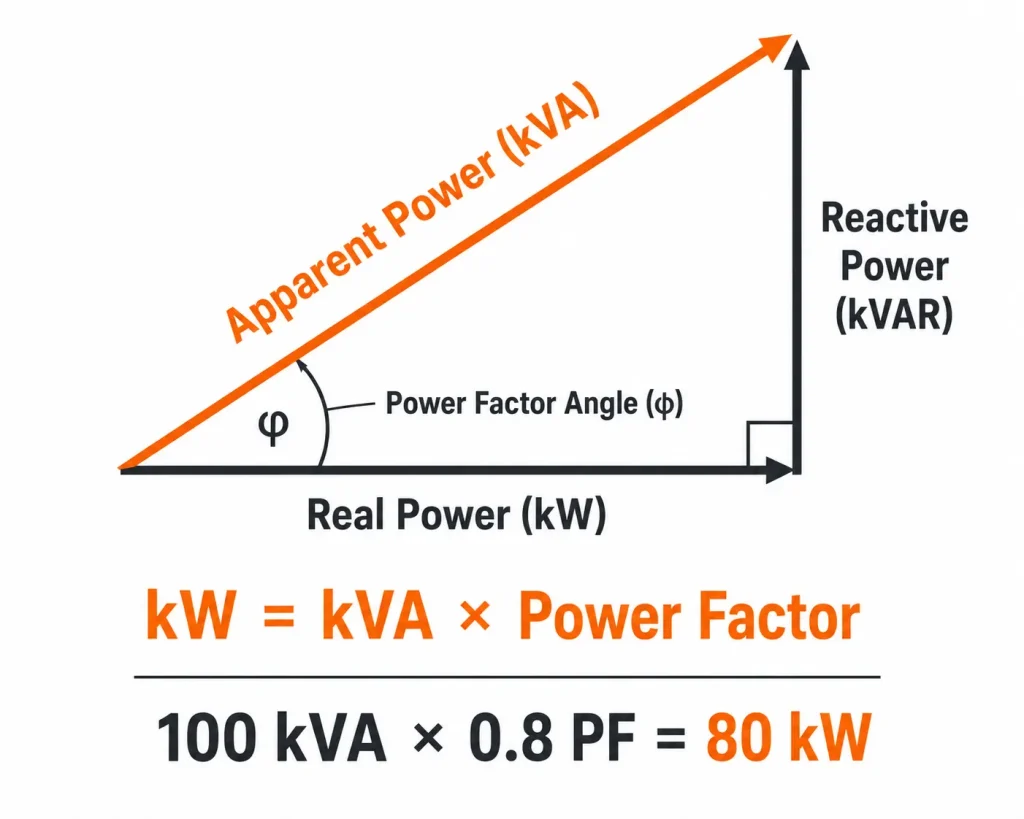
Before calculating loads, it is necessary to understand the units used to describe generator output and equipment power requirements. Confusion between these units is the most common source of generator sizing errors.
- Watts (W) and kilowatts (kW)
The watt is the unit of real power, the power that performs actual work. A kilowatt is 1,000 watts. Most equipment nameplates express power consumption in watts or kilowatts. When a generator is described by its kilowatt rating, this is its real power output capacity.
- Kilovolt-amperes (kVA)
The kilovolt-ampere is the unit of apparent power, the total power drawn from the generator, including both the real power that does work and the reactive power that maintains electromagnetic fields in inductive loads such as motors and transformers. Generator output is typically rated in kVA because the generator must supply apparent power, not just real power.
- Power factor (PF)
The ratio of real power to apparent power, expressed as a decimal between 0 and 1. A purely resistive load, such as a heating element or incandescent light, has a power factor of 1.0: all apparent power is real power. An inductive load, such as an electric motor, air conditioning compressor, or welding transformer, has a power factor below 1.0, typically between 0.7 and 0.9, meaning a significant proportion of the apparent power drawn does not perform useful work but must still be supplied by the generator.
The relationship between the three units is: kW = kVA × power factor. A generator rated at 100 kVA with a power factor of 0.8 delivers 80 kW of real power. If equipment consuming 80 kW of real power at 0.8 power factor is connected to this generator, it is fully loaded. If the power factor of the connected load is lower than 0.8, the generator reaches its kVA limit before its kW limit, it becomes apparent-power-limited, not real-power-limited.
Most generator specifications assume a power factor of 0.8. When comparing generator ratings, confirm whether the kVA and kW figures are based on 0.8 power factor, if not, the comparison is not valid.
Also read : Types of Excavators: A Complete Guide for Every Job
How to Calculate the Right Generator Size
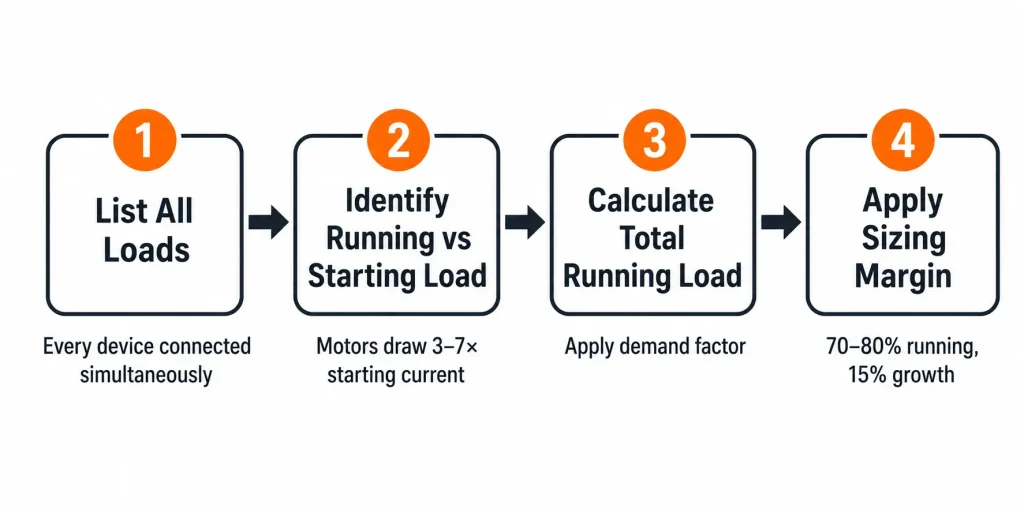
Generator sizing follows a four-step process, each step builds on the previous one, and skipping any step is the most reliable way to end up with a generator that is either too small to run the site or too large to run efficiently. Work through the steps in sequence for any new application, and revisit the calculation whenever the load on site changes significantly.
List Every Load to Be Connected
The starting point for generator sizing is a complete list of every piece of electrical equipment that will be connected to the generator simultaneously during normal operation. Every load matters, including loads that seem minor but run continuously.
For a construction site generator, the load list typically includes:
Power tools and equipment: Angle grinders, circular saws, rotary hammers, and similar tools. Individual tool loads range from 700 W to 2,500 W. Tools are intermittent, they run only when in use, but in practice multiple tools are in use simultaneously on an active site.
Lighting: Temporary site lighting, floodlights, and welfare facility lighting. LED floodlights consume 50 to 200 W each. Older metal halide or sodium floodlights consume 400 to 1,000 W each. Lighting typically runs continuously throughout the shift.
Welfare facilities: Site office and welfare unit loads include computers, printers, kettle, microwave, space heaters, and air conditioning. A fully equipped welfare unit may draw 3 to 8 kW depending on the season and the equipment installed.
Large plant: Concrete mixers, compactors with electric drives, dewatering pumps, compressors, hoists, and tower crane auxiliary systems all represent significant loads. A site concrete mixer may draw 3 to 7.5 kW. A dewatering pump may draw 2 to 15 kW depending on its size. These loads include motors, which have high starting currents, and must be assessed not just for their running load but for their starting load.
Charging equipment: Battery chargers for cordless tools, MEWP batteries, and electric site vehicles. Individually small, but in aggregate on a large site they add up.
For industrial and standby applications, the load list follows the same principle: every load that will be connected, assessed for its running wattage and its power factor.
Identify Running Load vs Starting Load
For resistive loads, lights, heaters, computers, the running load is the same as the starting load. The equipment draws a consistent current from the moment it is switched on.
For inductive loads, electric motors of any kind, including pumps, compressors, air conditioning units, and power tool motors, the starting current is significantly higher than the running current. An electric motor typically draws 3 to 7 times its full-load running current for the first few seconds of starting, as it accelerates from zero to operating speed. This starting surge lasts only a few seconds, but during those seconds the generator must supply the full starting current without the voltage dropping enough to cause problems for other equipment already running on the system.
The generator’s ability to handle starting loads is described by its transient response specification, how much the voltage dips when a large motor starts, and how quickly it recovers. A generator sized only for running loads will experience unacceptable voltage dips or will trip on overload every time a significant motor is started.
As a practical rule, the largest single motor load on the generator, in kVA terms, should not exceed approximately 65 to 70 percent of the generator’s total kVA rating, to ensure the starting surge can be absorbed without damaging voltage dips. For applications with multiple large motors, a specialist load analysis may be required.
On construction sites where multiple large motors, dewatering pumps, compressors, concrete mixers, may be started sequentially during the shift, the starting load assessment is a critical element of the generator sizing process. This is directly relevant to the power planning requirements for construction sites where multiple categories of heavy plant must be powered simultaneously, including the generator sizing considerations discussed in the context of construction site planning and temporary power supply management.
Calculate Total Running Load
Sum the running loads of all equipment that will operate simultaneously. This is the total running load in watts or kilowatts.
For equipment with a nameplate in amps rather than watts, convert using: W = V × A × power factor (for single-phase) or W = √3 × V × A × power factor (for three-phase), where V is the supply voltage and A is the nameplate current.
For equipment with a nameplate in horsepower (common on pumps and compressors), convert using: 1 horsepower = 746 watts, but note that motor efficiency means the electrical input is higher than the mechanical output. A 10 hp pump motor with 90 percent efficiency draws approximately 8.3 kW electrically.
Not all equipment will run at full load simultaneously, and not all equipment will be in use at every moment. A demand factor, typically 0.7 to 0.8 for a busy construction site, can be applied to the total installed load to reflect the fact that not every tool and every piece of equipment will be running at full power at exactly the same instant. However, demand factors should be applied conservatively, an underestimated demand factor is a common cause of generator undersizing.
Apply the Sizing Margin
Once the total running load is calculated and the starting load of the largest motor is assessed, apply the sizing margin that ensures reliable, efficient operation:
Running load margin: Size the generator so that the total running load represents no more than 70 to 80 percent of the generator’s rated kW output. Operating a generator continuously at more than 80 percent of its rated output accelerates wear, reduces engine life, and leaves no headroom for load surges. Operating below 30 percent of rated output causes wet stacking in diesel generators, leading to carbon accumulation and fuel inefficiency.
Starting load margin: Confirm that the largest motor’s starting kVA does not exceed 65 percent of the generator’s rated kVA. If it does, a larger generator is required, or a soft starter or variable frequency drive (VFD) must be fitted to the motor to reduce its starting current.
Growth margin: On construction sites, loads typically increase as the project advances and more trades arrive on site. A 10 to 15 percent additional margin above the calculated peak load provides headroom for load growth without requiring a generator upgrade mid-project.
The result of applying these margins is the minimum generator kVA rating required for the application. Select the next standard generator size above this figure from the available range.
Also read : Bulldozer vs Excavator: Differences and When to Use Each
Generator Sizing by Application
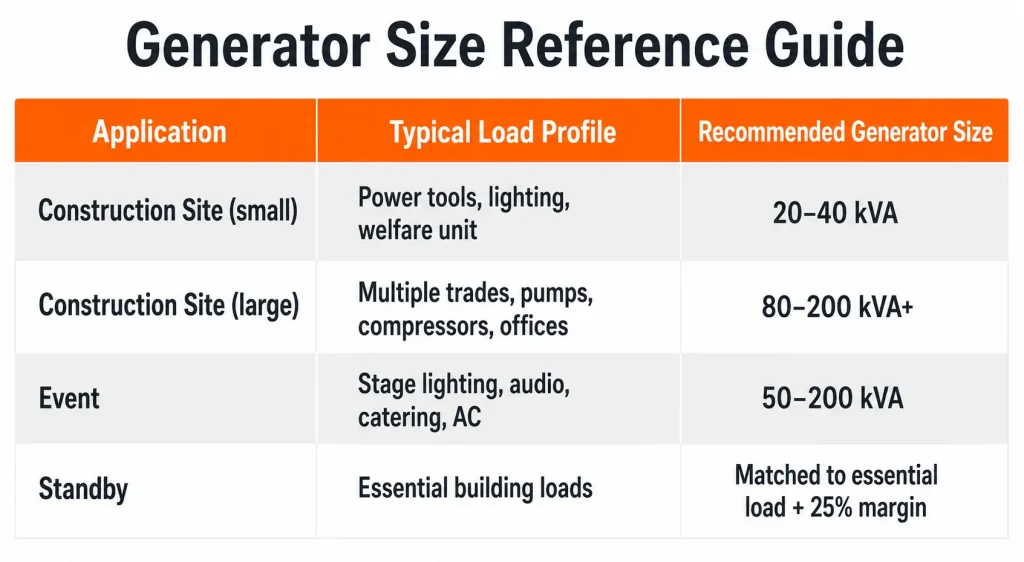
Construction Site Generator
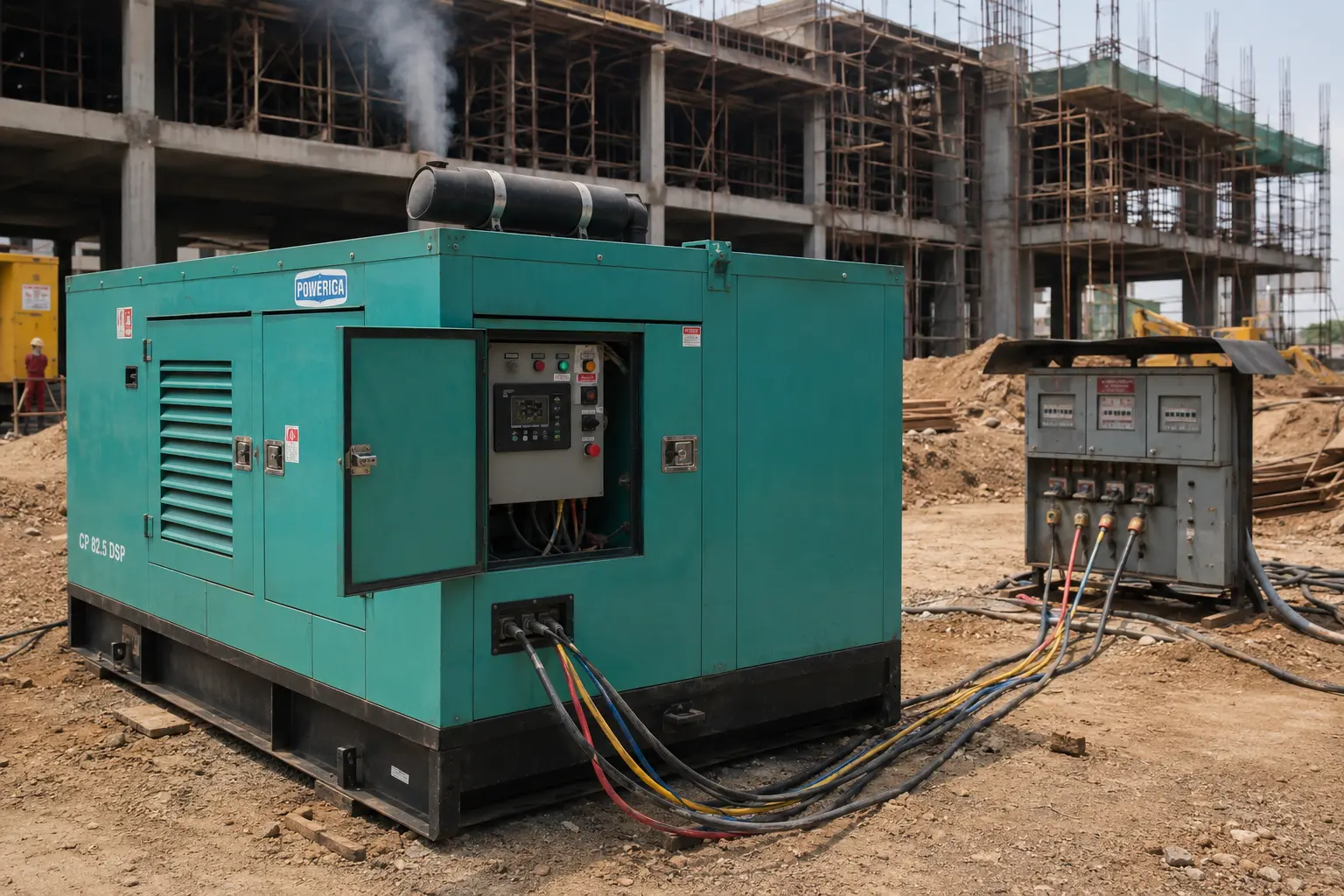
A small residential construction site, one or two trades, basic power tools, site lighting, and a small welfare unit, typically requires a generator in the 20 to 40 kVA range. A medium commercial construction site with multiple trades, a concrete mixer, dewatering pump, tower crane auxiliary systems, and a fully equipped site office may require 80 to 200 kVA. A large infrastructure or civil project with multiple large pumps, compressors, workshops, and extensive lighting will require 200 kVA and above, often supplied by multiple generators or a large prime power unit.
The generator on a construction site is typically a prime power unit, it is the primary power source, running continuously during working hours and sometimes around the clock for dewatering or security systems. Prime power generators are rated for continuous full-load operation, unlike standby generators which are rated for intermittent use during mains outages.
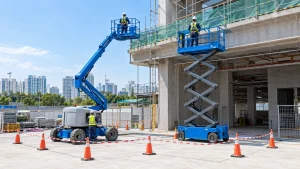
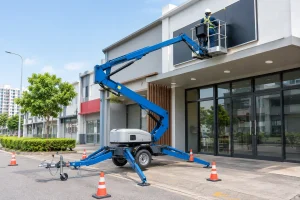
For construction sites where the generator must also power lifting and access equipment, including battery charging for electric boom lifts, scissor lifts, and mobile scaffold, the aggregate charging load of the MEWP fleet must be included in the site load calculation. The power requirements of aerial work platforms and their interaction with site power supply are directly relevant to generator sizing on sites where powered access equipment is a significant part of the operation, as covered in the context of boom lifts, scissor lifts, and aerial work platform selection for construction sites.
Event and Temporary Power
For events, outdoor concerts, exhibitions, film sets, sporting events, the load calculation follows the same process but with different load types: stage lighting rigs, audio systems, video screens, catering equipment, and air conditioning units for marquees and hospitality areas.
Stage lighting for a medium-sized event may require 50 to 150 kVA. Professional audio systems for large outdoor events may require 30 to 80 kVA. Catering operations, commercial ovens, refrigeration, hot water systems, are heavily resistive loads with high running demands. Air conditioning and refrigeration units are inductive loads with significant starting currents.
Event generators are typically synchronised in parallel when multiple units are required, two or more generators operating as a single power source, sharing the load and providing redundancy if one unit trips. Parallel operation requires generators of compatible specification and a synchronising control panel, adding complexity and cost that must be factored into the power planning for large events.
Standby and Emergency Power
A standby generator is sized differently from a prime power unit. It is not expected to run continuously, it starts automatically when mains power fails and runs until mains power is restored. Standby ratings are typically 10 percent higher than prime power ratings for the same generator, reflecting the less demanding duty cycle.
For standby power in commercial buildings, hospitals, data centres, and industrial facilities, the load calculation must identify which loads are on the essential power circuit, those that the standby generator must support, and which loads can be shed during a mains outage. The essential load list is then sized and margined using the same process as for prime power applications.
Automatic transfer switches (ATS) automatically disconnect the mains supply and connect the generator when mains power fails, typically within 10 to 30 seconds. For loads that cannot tolerate a 30-second interruption, servers, medical equipment, certain industrial processes, an uninterruptible power supply (UPS) must bridge the gap between mains failure and generator availability.
Industrial and Mining Applications
Industrial generator applications, powering remote processing plants, mining operations, offshore platforms, and large manufacturing facilities, involve loads that dwarf typical construction site requirements. Multi-megawatt generator sets, operating in parallel, are standard on large mining sites and offshore installations.
The sizing methodology is the same as for smaller applications, but the complexity of the load analysis increases significantly. Motor loads in industrial applications are large, hundreds of kilowatts each, and their starting sequences must be carefully managed to prevent the generator from being overloaded at startup. Staged starting sequences, soft starters, and VFDs are standard tools for managing starting loads in industrial generator applications.
Common Generator Sizing Mistakes
- Sizing to peak nameplate only
Adding up the nameplate ratings of all equipment and selecting a generator to match the total, without applying a demand factor or a running margin, almost always results in significant oversizing and unnecessary cost.
- Ignoring starting loads
Sizing for running loads only, without accounting for the starting current of motors, results in voltage dips and tripping every time a motor starts. This is the most common cause of generator problems on construction sites.
- Confusing kW and kVA
Selecting a generator based on its kW rating without checking whether the connected loads’ power factor is compatible with the generator’s kVA limit results in apparent-power overloading even when the real power load appears within limits.
- No growth margin
Sizing exactly to the calculated peak load with no headroom means any addition to the site, a new trade, an additional pump, a temporary heater, overloads the generator. A 15 percent growth margin prevents this.
- Using a standby-rated generator as prime power
A generator with a standby rating is not designed for continuous full-load operation. Running a standby-rated generator as a prime power source accelerates wear and can void the manufacturer’s warranty.
For sites where the generator must also support the operation of lifting equipment, mobile cranes, aerial work platforms, or other plant with significant electrical demands, the power supply requirements of the lifting operation must be incorporated into the generator load plan. The interaction between site power supply and the requirements of mobile lifting and access equipment is part of the broader site services planning process covered in guidance on lifting equipment safety and site services coordination for construction operations.
Also read : Types of Graders: How Each Works and When to Use One
Size It Right, Run It Right
Generator sizing is not guesswork and it is not a matter of selecting the largest available unit and hoping it is sufficient. It is a systematic process, list the loads, assess the starting demands, apply the correct margins, and select the generator whose rated output meets the calculated requirement with appropriate headroom.
A correctly sized generator runs efficiently, lasts longer, costs less to fuel, and provides stable power to every piece of equipment connected to it. An incorrectly sized generator, too small or poorly matched to its load, creates operational disruption, equipment damage, and costs more to operate and maintain than a correctly specified unit.
RR Machinery provides a comprehensive range of power generators for rental and sale, diesel prime power generators, standby units, and silent canopy generators across a wide kVA range, all maintained to full operational standard and supported by experienced power specialists. Explore our full range of power generator rental and sales options, or contact our team for load analysis support, practical sizing advice, and a clear quotation matched to your power requirements and site conditions.