Scaffolding is one of the most fundamental temporary structures in construction, maintenance, and industrial operations. But while the function of scaffolding, providing safe, elevated access for workers and materials, is well understood, the choice of scaffolding material is often treated as secondary to design and configuration. This is a mistake that can lead to structural underperformance, excessive weight on floor slabs, regulatory non-compliance, accelerated corrosion, and unnecessary costs over the life of a project.
The material a scaffold is made from determines its load capacity, weight, corrosion resistance, electrical conductivity, lifespan, cost, and suitability for specific environments. In Singapore’s tropical climate, with its high humidity, frequent rainfall, and salt-laden coastal air in many locations, material selection is especially consequential for any scaffolding that will remain erected for weeks or months.
This guide covers all the main types of scaffolding materials used in construction and industrial projects today, with a practical assessment of each material’s properties, strengths, limitations, and most appropriate applications.
Why Scaffolding Material Selection Matters
Before comparing individual materials, it is worth establishing why material selection deserves careful attention in the first place.
Every scaffold is a structural system. Its tubes, frames, couplers, and boards all carry load, the weight of workers, tools, materials, and the wind pressure acting on the structure, and transfer it to the ground or to the building it is tied against. If the material is not strong enough for the load, the scaffold fails. If the material corrodes faster than anticipated, connections loosen and structural integrity deteriorates. If the material conducts electricity and is erected near live power lines, it becomes a serious electrocution hazard.
Beyond safety, material selection also affects project economics. A material with higher upfront cost but lower maintenance requirements and longer service life may be significantly more cost-effective over a multi-year project than a cheaper alternative that requires frequent inspection and replacement. Understanding these trade-offs is as important for scaffolding as it is for selecting the right type of lifting and access equipment for any given phase of work.
It is worth noting that material selection is a separate decision from system selection. Before settling on a material, it helps to be clear on which scaffolding system your project requires, whether supported, suspended, cantilever, tube-and-coupler, or modular. Our guide covering the main types of scaffolding systems and their applications provides a practical overview of each configuration to help inform your overall scaffolding specification.
Also read : What Is Scaffolding in Construction? Types, Uses, and Key Components
Main Types of Scaffolding Materials
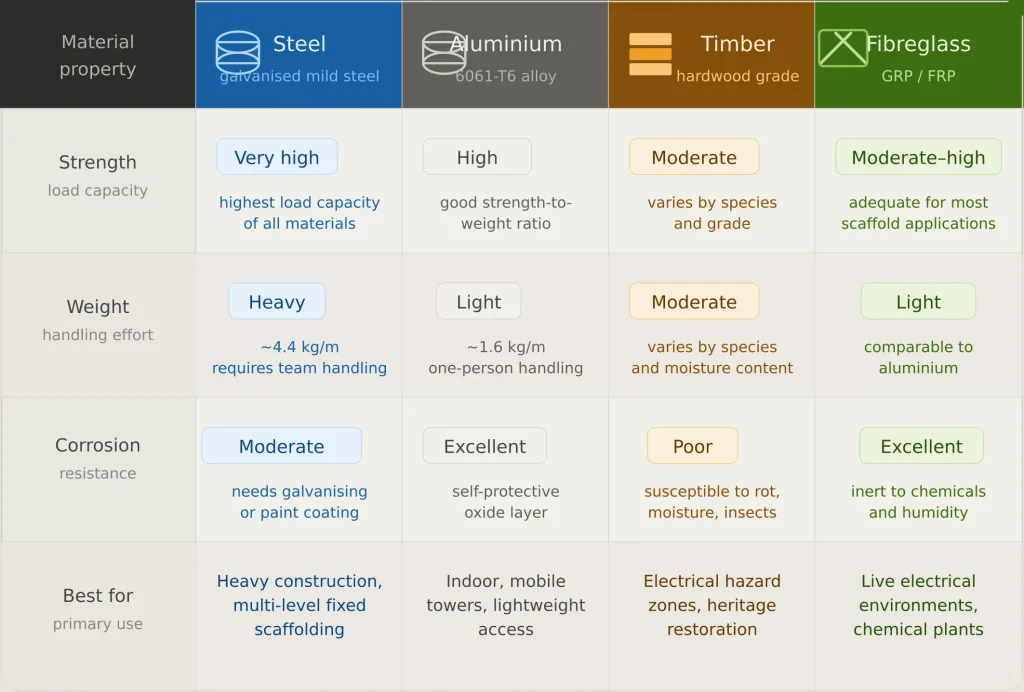
Scaffolding materials fall into four main categories, each with distinct structural properties, environmental performance characteristics, and appropriate applications. Understanding what each material offers, and where it falls short, is the foundation of a well-specified scaffolding solution for any project in Singapore.
Steel Scaffolding
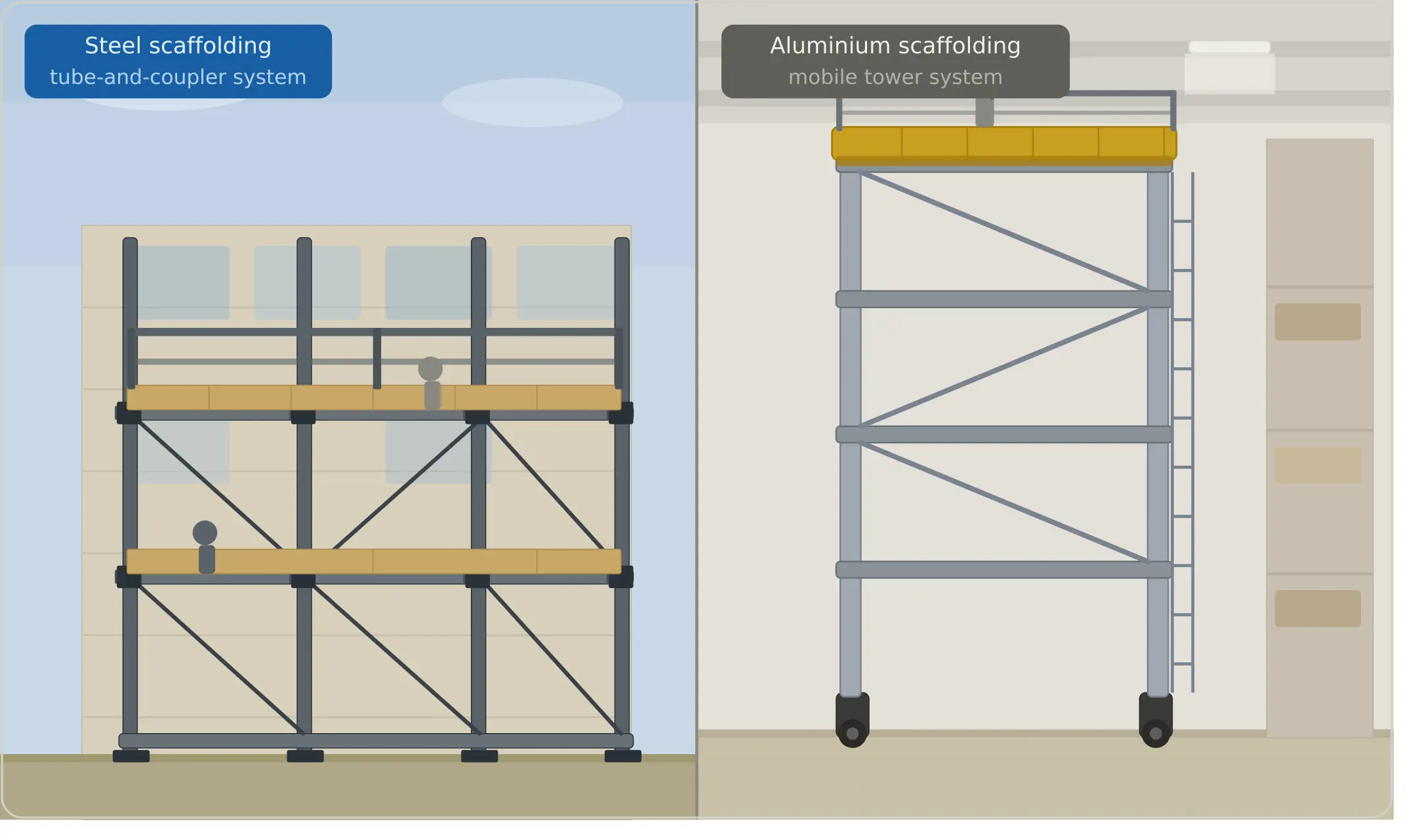
Steel is the most widely used scaffolding material in Singapore and globally. The majority of fixed scaffolding systems, both tube-and-coupler and modular system scaffolding, are manufactured from mild steel, typically with a hot-dip galvanised or painted finish to retard corrosion.
Properties
Steel scaffolding tube is manufactured to standard dimensions, most commonly 48.3 mm outer diameter, and is available in standard lengths that can be cut or extended as required. Its key structural properties are:
- High tensile strength, steel can carry very heavy loads without deforming, making it suitable for multi-lift scaffolding with multiple workers and heavy material loads simultaneously
- High stiffness, steel deflects less under load than aluminium or timber, which is important for maintaining platform levelness and structural stability on tall scaffolds
- Consistent, predictable properties, the mechanical properties of steel tube are well-defined by manufacturing standards, allowing engineers to calculate scaffold loads with precision
- Weldability, steel components can be welded, cut, and modified on site to suit unusual geometries
Advantages
Steel scaffolding’s principal advantage is its load-carrying capacity. For heavy construction work, concrete forming, bricklaying, stone cladding, structural steel installation, steel scaffolding can support the loads that other materials cannot match at a comparable cost. Steel is also the default material for scaffolding in Singapore because of its wide availability, standardised dimensions, and the familiarity of the local workforce with its assembly.
Steel scaffolding systems are also extremely modular and reusable. A well-maintained steel scaffold can be erected, dismantled, and re-erected many times over its service life, which, for hot-dip galvanised components, can extend to decades if handled correctly.
Limitations
Steel’s primary limitation is weight. Steel scaffolding tube is significantly heavier than aluminium of equivalent length, which increases the physical labour required for erection and dismantling, limits the height at which manual handling is practical, and may exceed the floor loading capacity of lightweight structures or elevated slabs.
Corrosion is steel’s other major vulnerability. Without adequate protective coating, galvanising or paint, steel tube corrodes rapidly in Singapore’s humid, coastal environment. Even galvanised tube requires periodic inspection for coating damage, particularly at cut ends and at contact points with couplers where galvanising is often worn through by repeated assembly.
Steel is also electrically conductive. Scaffolding erected near overhead power lines or electrical equipment requires careful planning and, in many cases, the use of non-conductive materials or insulating measures at hazard points.
Aluminium Scaffolding
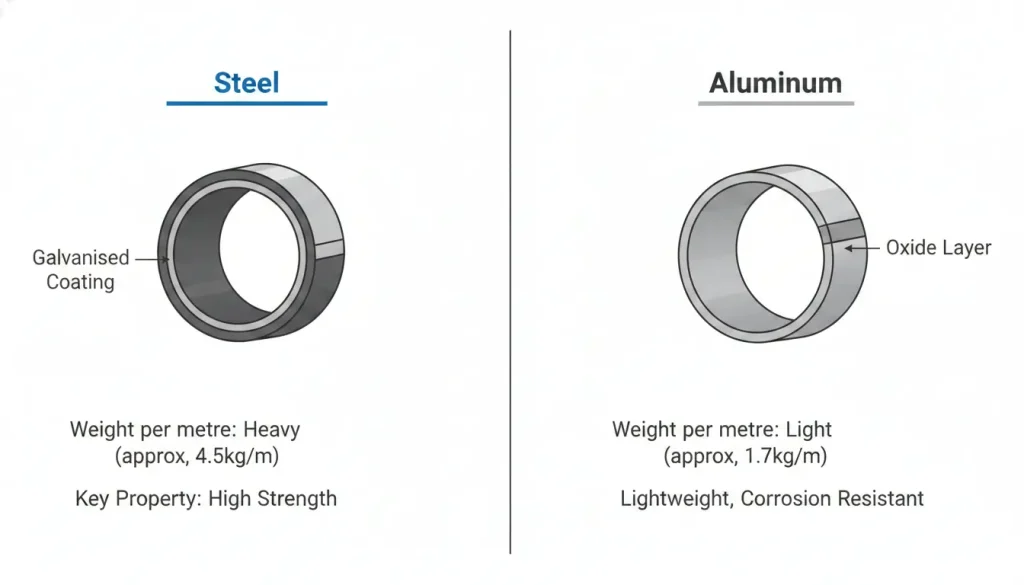
Aluminium has become the dominant material for mobile scaffolding towers, lightweight modular systems, and access platforms in Singapore and across Southeast Asia. Its combination of low weight and adequate structural performance makes it the practical choice for a wide range of short-duration and indoor applications.
Properties
Aluminium scaffolding is typically manufactured from alloy grades, most commonly 6061-T6 or similar, that offer a good balance of strength, formability, and corrosion resistance. Compared to steel:
- Significantly lighter, aluminium is approximately one-third the density of steel. An aluminium tube of the same dimensions as a standard steel scaffold tube weighs roughly one-third as much
- Naturally corrosion-resistant, aluminium forms a thin oxide layer on its surface that protects it from further oxidation without any additional coating, making it well-suited for humid outdoor environments
- Good strength-to-weight ratio, while aluminium is weaker than steel in absolute terms, its strength-to-weight ratio means that for many applications, an aluminium structure can carry the required load at a fraction of the weight
- Non-sparking, aluminium does not produce sparks when struck, making it safer in environments where flammable materials or gases may be present
Advantages
The primary advantage of aluminium scaffolding is ease of handling. Lighter components mean faster erection and dismantling, reduced manual handling injury risk, and the ability to work in areas where structural floors cannot support the weight of steel scaffolding. A single worker can carry and position aluminium scaffold frames that would require two workers to handle in steel.
For mobile scaffolding towers in particular, used in warehouses, retail spaces, offices, facilities maintenance, and events, aluminium is the standard material because the castor wheel base needs to be repositionable by hand. A heavy steel tower would be impractical to move without mechanical assistance.
Aluminium’s corrosion resistance also significantly reduces maintenance requirements over the life of the equipment. Unlike steel, aluminium scaffolding does not require periodic repainting or inspection of protective coatings.
For businesses and contractors in Singapore looking for flexible elevated access, mobile scaffolding systems made from high-grade aluminium offer the best combination of portability, durability, and safety compliance for most indoor and light outdoor applications.
Limitations
Aluminium is more expensive than steel on a per-kilogram basis, and aluminium scaffolding components, particularly system scaffolding, typically carry a higher initial cost than equivalent steel systems. This cost premium is usually offset by lower transport costs, reduced labour for handling, and longer service life in corrosive environments, but it is a relevant factor for cost-sensitive procurement decisions.
Aluminium is also softer than steel and more susceptible to surface damage, dents, gouges, and thread damage, from rough handling. While surface damage does not necessarily compromise structural integrity, it requires regular visual inspection to distinguish cosmetic from structural damage.
Aluminium is electrically conductive. The same precautions that apply to steel scaffolding near live electrical infrastructure apply equally to aluminium.
Also read : Construction Equipment Names: A Complete Reference Guide
Timber Scaffolding
Timber is the oldest scaffolding material, it was the original choice for thousands of years of construction history, from ancient Egypt to the pre-modern era. In Singapore and most of Southeast Asia, timber scaffolding has been largely displaced by steel and aluminium for new construction work. However, it remains in use in specific contexts and deserves to be understood as part of the scaffolding material landscape.
Properties
Scaffolding-grade timber is typically hardwood selected for structural density and freedom from defects, splits, large knots, and grain irregularities that reduce load capacity. In Singapore, the most common timber used for scaffolding historically was tropical hardwood species from the region.
- Naturally non-conductive, timber does not conduct electricity, making it inherently safer near live electrical infrastructure
- Low thermal conductivity, timber does not transmit heat or cold, which is relevant in very hot or very cold environments
- Moderate strength, adequate for light-to-medium loads in low-rise applications
- Biodegradable, unlike steel or aluminium, timber degrades over time and cannot be reused indefinitely
Advantages
Timber’s non-conductivity is its primary safety advantage in electrical environments. For scaffolding erected in close proximity to live power lines or electrical switchgear, where an inadvertent contact with a metal scaffold could cause electrocution, timber provides an inherent safety margin that metal scaffolds do not.
Timber is also locally available and relatively low-cost as a raw material. In some contexts, particularly in developing markets or on very remote sites, this accessibility makes it a practical choice where manufactured scaffold systems cannot be economically sourced.
Limitations
Timber scaffolding has significant limitations in modern construction practice. It is susceptible to moisture, rot, insect damage, and UV degradation, all of which are relevant in Singapore’s tropical environment. Timber that has been exposed to repeated wetting and drying cycles weakens over time in ways that may not be visually apparent, creating a hidden structural risk.
Timber scaffolding also requires more frequent inspection than steel or aluminium, as deterioration can develop quickly and is not always evident from surface appearance alone. Singapore’s MOM regulations set minimum standards for scaffolding materials and inspection, and timber used for load-bearing scaffold members must meet specific grade requirements.
For most applications in Singapore, timber has been superseded by aluminium and steel, and its use is now primarily confined to traditional building methods, heritage restoration work, and specific overseas markets.
Fibreglass Scaffolding
Fibreglass, also referred to as glass-fibre-reinforced polymer (GRP) or fibre-reinforced plastic (FRP), represents the most specialised category of scaffolding material. It is not the default choice for any standard construction application, but in specific high-risk environments it is the only appropriate option.
Properties
Fibreglass scaffolding is manufactured from glass fibres embedded in a polymer matrix, typically polyester or vinyl ester resin. Its key properties are:
- Electrically non-conductive, fibreglass does not conduct electricity under any normal circumstances, making it the material of choice for work on or near live electrical infrastructure
- Non-magnetic, relevant for certain specialist industrial environments involving magnetic fields
- Corrosion-resistant, fibreglass does not rust or corrode in the conventional sense and performs well in chemical environments that would rapidly degrade steel or aluminium
- Lightweight, comparable to or lighter than aluminium, depending on the construction method
- Moderate strength, adequate for most scaffolding applications, though not matching steel for very heavy loads
Advantages
The defining advantage of fibreglass scaffolding is electrical non-conductivity. Electrical utilities, substations, power generation facilities, and any environment where workers may come into contact with live conductors require scaffolding that cannot carry electrical current. In these environments, steel and aluminium are categorically unsuitable regardless of other performance characteristics. Fibreglass is the only commercially available scaffolding material that provides adequate structural performance alongside complete electrical isolation.
Fibreglass is also chemically inert to a wide range of acids, alkalis, and solvents. In chemical processing plants, wastewater treatment facilities, and industrial environments where metal scaffolding would be attacked by process chemicals, fibreglass provides the durability that metal cannot.
Limitations
Fibreglass scaffolding is significantly more expensive than steel or aluminium, often by a factor of two to four times. This cost is justified in environments where it provides a genuine safety advantage that no other material can match, but it makes it impractical for general construction use where steel or aluminium is appropriate.
Fibreglass is also brittle compared to metals, it does not deform plastically before failure, which means it can fracture suddenly under impact loads without prior visible warning. This characteristic requires careful handling and regular inspection for surface cracking, particularly at joint areas and attachment points.
Scaffold Boards and Decking Materials
Beyond the structural tubes and frames, the working platform surface, scaffold boards, decking planks, or metal platforms, represents a distinct material selection decision.
Timber Scaffold Boards
Timber boards have been the traditional scaffold platform surface for generations. In Singapore, scaffold boards must meet minimum dimensional and grade requirements under MOM regulations. Timber boards are lightweight, low-cost, and provide good grip underfoot. Their limitations are the same as for structural timber, susceptibility to moisture, rot, and degradation under repeated loading, requiring regular inspection and replacement of boards that show signs of splitting, cracking, or excessive deflection.
Steel and Aluminium Decking Panels
Metal decking panels, typically perforated or grated steel or aluminium, are increasingly common on system scaffolding and modular access platforms. They are more durable than timber boards, resist weather and UV degradation, and can be inspected visually for damage much more easily. Their higher initial cost is typically offset by longer service life and lower inspection and replacement requirements.
Composite and Plastic Decking
Composite decking products, typically glass-fibre-reinforced or polypropylene-based panels, offer a combination of the non-conductivity of fibreglass with the lightweight characteristics of plastic. They are used in electrical environments and chemical facilities where timber is inadequate and metal presents an electrocution or corrosion hazard.
Comparing Scaffolding Materials: A Summary
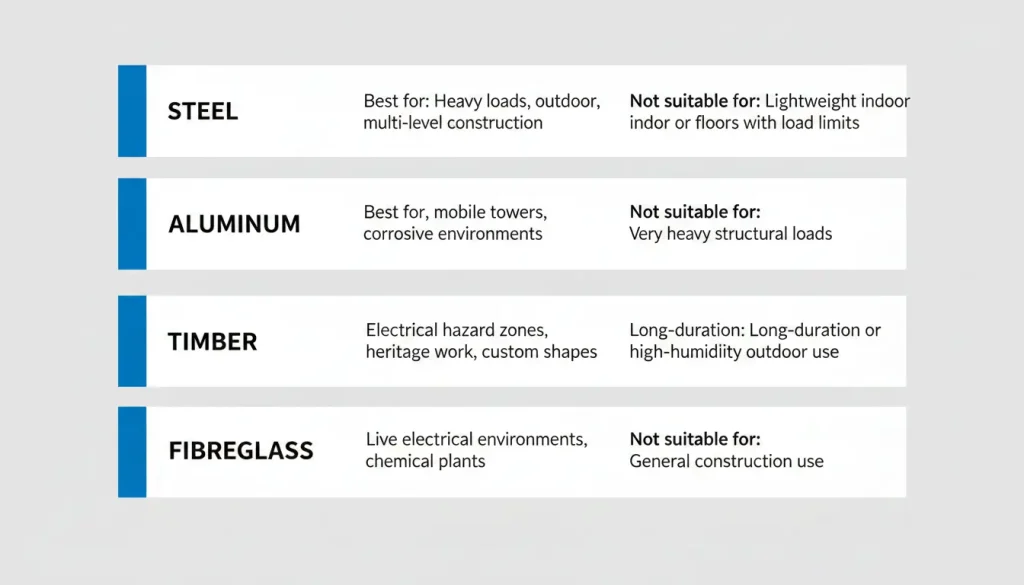
The right scaffolding material is determined by the specific demands of the project, not by default preference or lowest initial cost. The key factors to evaluate are load requirements, site environment (humidity, chemical exposure, electrical hazards), weight constraints, project duration, and total cost including maintenance and replacement.
For the vast majority of construction, maintenance, and industrial projects in Singapore, steel and aluminium cover the full range of practical requirements. Steel for heavy fixed scaffolding where maximum load capacity is needed, aluminium for mobile, lightweight, and indoor applications where handling efficiency and corrosion resistance are the priority. Fibreglass fills the specific niche of electrical and chemical environments where neither steel nor aluminium is safe.
Understanding the full range of scaffolding materials and systems also informs decisions about how scaffolding integrates with other access equipment on a project site. In many operations, scaffolding works alongside boom lifts and other powered access platforms, with each type of access solution assigned to the tasks and conditions it is best matched to.
For technical reference on scaffolding materials, standards, and international testing protocols, engineering resources on construction scaffolding systems and material specifications provide useful background on how material grades and dimensional standards are defined across different regulatory frameworks.
Also read : Types of Excavator Buckets and Their Uses Explained
Get the Right Scaffolding for Your Project
Choosing the right scaffolding material is a decision with direct consequences for worker safety, project productivity, regulatory compliance, and total cost of ownership. Whether your project needs a heavy steel tube-and-coupler system for a major construction facade, a lightweight aluminium mobile tower for internal maintenance work, or specialist fibreglass access for an electrical environment, the right material choice starts with an accurate understanding of the conditions your scaffold will face.
RR Machinery offers a comprehensive range of mobile scaffolding systems for sale and rental across Singapore, available in multiple height configurations and designed for both indoor and outdoor applications. Every unit meets MOM and international safety standards, and our team can advise on the right configuration and material for your specific project requirements.
Explore our full range of mobile scaffolding solutions for sale and rental, or contact our team for a practical recommendation and clear quotation tailored to your project needs.