Two machines dominate the earthmoving phase of almost every construction, mining, and civil infrastructure project: the bulldozer and the excavator. Both move earth. Both operate on tracks. Both are essential to site development and ground engineering. And both are frequently misunderstood, deployed on tasks the other machine would perform more efficiently, or specified interchangeably when the operational difference between them is in fact decisive.
The bulldozer and the excavator are not competing solutions to the same problem. They are complementary machines, each optimised for a distinct category of earthmoving task, and each capable of tasks the other cannot perform at all. The bulldozer pushes, it applies horizontal force to move large volumes of material across the ground surface in a single operation. The excavator digs, it applies downward and pulling force to break into the ground, lift material, and deposit it precisely at a different location. These two actions are mechanically different, structurally different, and suited to different phases and different conditions of a construction programme.
Understanding the difference between a bulldozer and an excavator, in structural terms, in operational capability, in the conditions each is suited to, and in the tasks each performs better than the other, is essential knowledge for project managers, site engineers, plant managers, and equipment planners on any project involving significant earthmoving.
How a Bulldozer Works
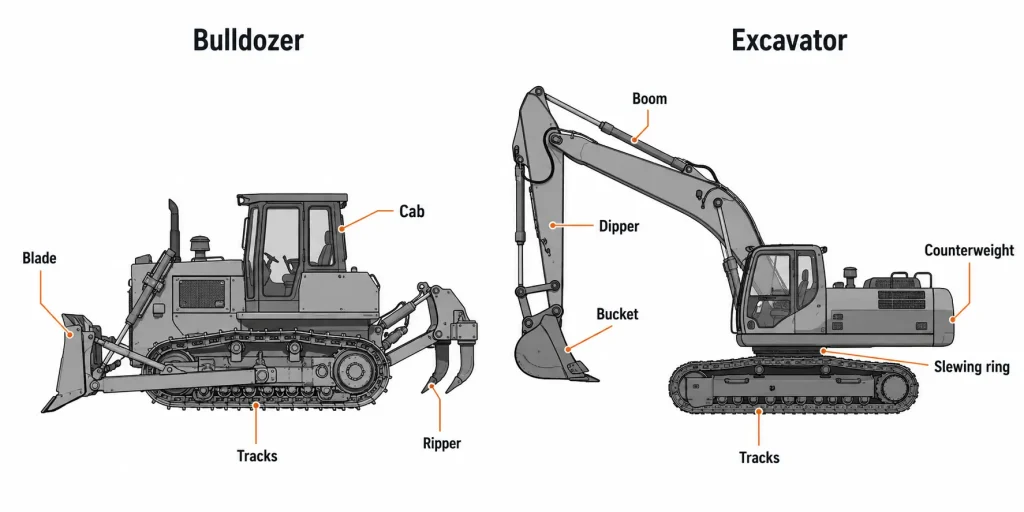
A bulldozer is a tracked machine that moves material by pushing it with a large steel blade mounted at the front of the machine. The blade, called a dozer blade or push blade, is hydraulically controlled, allowing the operator to raise, lower, tilt, and in some configurations angle the blade relative to the machine’s direction of travel. As the bulldozer advances, the blade contacts the material surface, cuts into it at the leading edge, and pushes the accumulated material forward in a rolling mass ahead of the blade.
The bulldozer’s power comes from its ability to apply the full tractive effort of its engine and tracks to the blade, converting engine torque directly into horizontal pushing force. On a large bulldozer, this pushing force can exceed 80 tonnes, a figure that no excavator bucket can approach in horizontal force terms. This concentrated pushing power, applied across the full width of the blade, is what makes the bulldozer the most productive machine available for bulk material movement over short to medium distances.
The tracks that carry a bulldozer are wide, long, and heavily built, they are designed to maximise ground contact, minimise ground pressure on soft material, and provide the grip needed to push against high resistance. A large bulldozer on wide tracks can operate on ground conditions that would stop most other plant.
The bulldozer has no rotating superstructure. It faces one direction and moves in that direction, or reverses. It cannot reach to the side, swing material around, or lift and place loads at an offset. Every cubic metre it moves travels in the direction the machine is pointed, pushed by the blade or, on machines fitted with a rear ripper, broken up at the back before being pushed by the blade on the return pass.
Also read : Types of Graders: How Each Works and When to Use One
How an Excavator Works
An excavator is a machine that digs, lifts, and places material using a hydraulic arm, the boom and dipper assembly, mounted on a rotating superstructure that can swing 360 degrees independently of the undercarriage. The bucket or attachment at the end of the dipper arm breaks into the ground, fills with material, and lifts it clear of the excavation. The superstructure then swings to position the bucket over the dump location, a truck, a stockpile, a trench, and the bucket is opened to release the load.
The excavator’s fundamental capability is precision, it can place the bucket at a specific point in three-dimensional space, control the force applied at that point, and deposit the material at a precise location offset from the machine’s position. No other earthmoving machine matches the excavator’s combination of reach, swing, and placement control.
The 360-degree rotating superstructure is the defining structural feature that separates the excavator from the bulldozer. It means the excavator can dig in front, swing material to either side, load trucks positioned beside or behind it, and work in a fixed position while covering a large arc of ground, all without the machine itself repositioning. A bulldozer must reposition for every new push direction.
For a detailed breakdown of the excavator family, crawler excavators, wheeled excavators, mini excavators, long reach excavators, and the full range of attachment options, the complete guide to types of excavators and their applications covers every variant and its operational niche in detail.
Bulldozer vs Excavator: A Direct Comparison
Material Movement Method
The bulldozer moves material by pushing, a continuous, high-force horizontal action that accumulates material ahead of the blade and carries it forward as the machine advances. The material stays on the ground surface throughout. The bulldozer cannot lift material above ground level, cannot load it into a truck, and cannot deposit it at a point that is not directly in front of the machine’s travel path.
The excavator moves material by digging and lifting, a cyclical action in which the bucket fills, lifts clear of the ground, swings, and dumps. Each cycle moves a defined bucket load, typically 0.5 to 5 cubic metres depending on the machine size, from the dig point to the dump point. The excavator can load trucks, fill embankments, excavate below its own track level, and deposit material at any point within its swing arc.
Productivity on Bulk Earthmoving
For moving large volumes of material across the ground surface, stripping topsoil, pushing fill into an embankment, clearing a large area of loose material, the bulldozer is significantly more productive than an excavator. A bulldozer can move several hundred cubic metres per hour on a favourable push distance, compared to an excavator loading trucks that is limited by its cycle time and truck availability.
The bulldozer’s productivity advantage diminishes as push distance increases. Beyond approximately 100 metres, the time the bulldozer spends travelling back to the cut after each push reduces its effective output significantly. For long-distance material movement, scrapers or trucks loaded by excavators become more economical.
Precision and Placement
The excavator has no competitor for precision earthmoving, work that requires cutting to a defined line, excavating to a specified depth and profile, loading material into trucks for disposal, or placing material at a specific location offset from the machine. A bulldozer cannot dig a trench, cannot load a truck, cannot excavate a foundation pit to a precise depth, and cannot work in a fixed position while placing material at multiple different locations around it.
For foundation excavation, trench digging, drainage channel formation, pile cap excavation, and any task that requires removal of material to a defined geometric profile, the excavator is the only appropriate machine. These are tasks the bulldozer physically cannot perform.
Ground Conditions
Both machines operate on tracks, giving them lower ground pressure than wheeled plant of equivalent weight. However, the bulldozer, by virtue of its longer, wider track arrangement relative to its operating weight, typically achieves lower ground pressure than a crawler excavator of similar class. Large bulldozers on wide swamp tracks are among the lowest-ground-pressure machines available for soft ground operations.
The excavator’s ground pressure is concentrated under the track pads and can be higher than a bulldozer’s on comparable ground. When an excavator is digging with its boom extended, the reaction forces are transferred through the tracks to the ground, creating localised high pressures under the track ends. On very soft or waterlogged ground, a bulldozer may be able to operate where an excavator cannot without additional ground support measures.
Ground bearing assessment, establishing whether the ground beneath the machine can sustain the loads imposed by the tracks and the digging or pushing forces, is a prerequisite for deploying either machine on ground of uncertain capacity. The principles of ground assessment for heavy plant are consistent across all categories of earthmoving and lifting equipment, as covered in guidance on lifting equipment safety and ground bearing capacity evaluation for construction plant.
Slope Capability
Bulldozers are designed to work on slopes, pushing material up gradients, cutting into hillsides, and maintaining their own stability on cross-slopes that would make other plant unstable. A large bulldozer can typically operate on gradients up to 30 degrees or more in favourable conditions, though the specific limit depends on the machine, the blade configuration, and the material being pushed.
Excavators can work on moderate slopes but are more sensitive to gradient than bulldozers, particularly when the superstructure is rotated and the boom is extended, conditions that shift the machine’s centre of gravity significantly from its static position. An excavator working on a steep slope with a full bucket extended at reach is operating in conditions that require careful stability assessment.
Also read : How to Build Scaffolding: A Step-by-Step Site Guide
Versatility Through Attachments
The excavator’s attachment system, which allows the machine to be converted from a digging machine to a breaker, crusher, grab, pile driver, or grading tool, gives it a versatility that the bulldozer cannot match. An excavator with an appropriate attachment library can perform demolition, material handling, piling, rock breaking, and grading in addition to its primary digging function.
The bulldozer’s primary attachment is the rear ripper, one or more downward-pointing tines that break up compacted or rocky material before the blade pushes it. Some bulldozers can be fitted with a winch for pulling operations. Beyond these, the bulldozer’s attachment range is limited compared to the excavator.
When to Use a Bulldozer
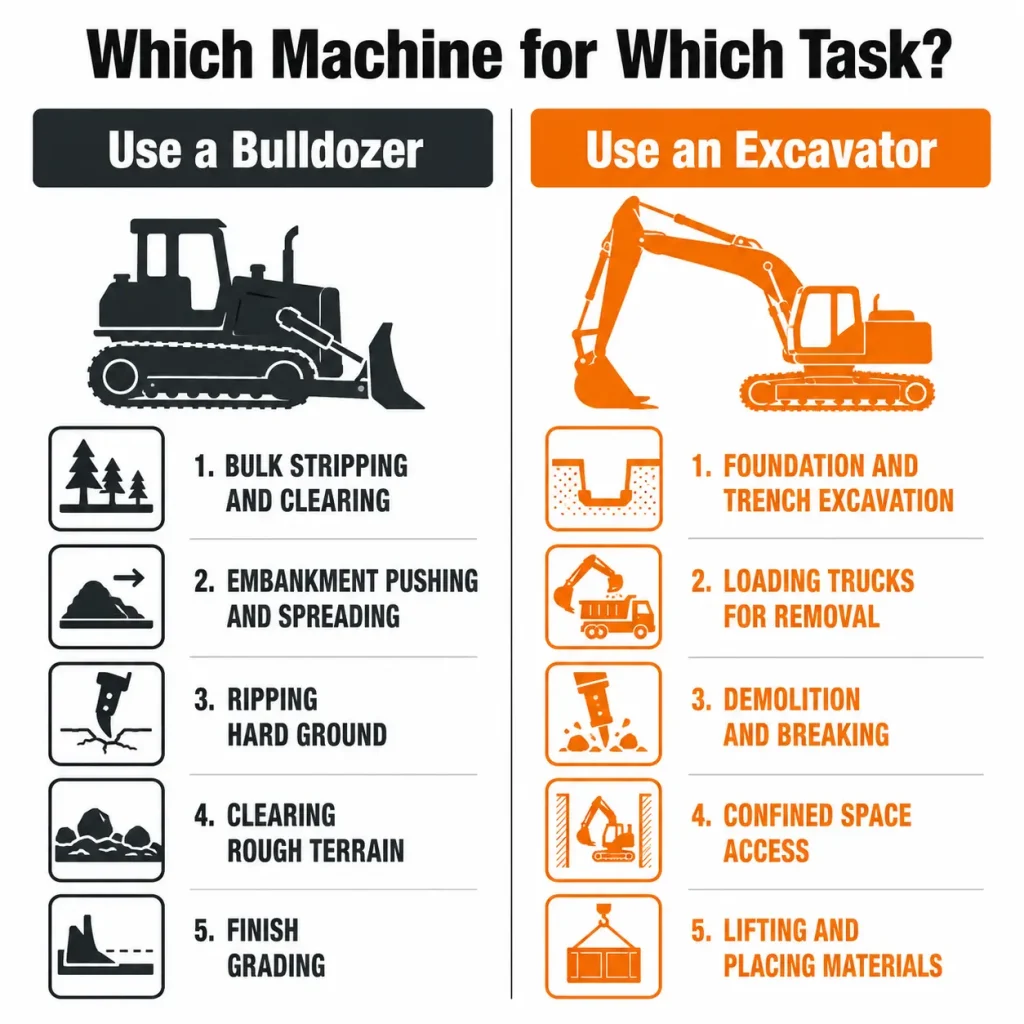
The bulldozer is the right machine when the primary requirement is:
- Bulk stripping and clearing
Removing topsoil, vegetation, and loose surface material from a large area before earthworks begin. The bulldozer’s blade width and pushing power cover large areas in a short time at lower cost than an excavator.
- Embankment pushing and spreading
Pushing fill material delivered by dump trucks into an embankment, spreading it in layers for compaction, and pushing it to the required embankment profile. The bulldozer’s blade is the most productive tool for this task.
- Ripping hard ground
Where the surface material is too hard for a dozer blade to cut directly, compacted gravel, weathered rock, cemented soils, the rear ripper breaks it up before the blade pushes it. No other single machine combines ripping and pushing in one operation as efficiently.
- Clearing rough terrain
Opening new access roads through bush, clearing construction sites with mixed debris and vegetation, and pushing large quantities of loose material over short distances, all tasks where the bulldozer’s pushing power and ground capability are decisive.
- Fine grading and finish grading
Large bulldozers equipped with laser or GPS grade control systems can achieve finish grade tolerances comparable to a motor grader over large areas. For projects where a grader is not on site, a grade-controlled bulldozer can perform finish grading of road formations and building platforms. The precision grading capability of motor graders and how they complement bulldozers in the earthmoving sequence is covered in the guide to types of graders and their role in road and site construction.
When to Use an Excavator
The excavator is the right machine when the primary requirement is:
- Foundation and trench excavation
Digging to a defined depth and profile, building foundations, service trenches, drainage channels, pile caps, is the excavator’s core function. No other machine can match the precision, depth capability, and placement control of an excavator for confined, geometric excavation.
- Loading trucks for material removal
Where excavated material must be removed from site, unsuitable ground, surplus cut material, demolition debris, the excavator loads dump trucks in a continuous cycle. A bulldozer cannot perform this function at all.
- Demolition and breaking
With a hydraulic breaker or demolition attachment, the excavator breaks concrete structures, removes pavements, and demolishes masonry, tasks entirely outside the bulldozer’s capability.
- Working in confined spaces
A mini excavator can access locations, inside buildings, through narrow gates, in rear gardens, that no bulldozer can reach. The compact excavator’s ability to work in confined access situations extends the reach of earthmoving operations to locations where bulldozers are impractical.
- Lifting and placing materials
With a lifting hook or a grab attachment, the excavator functions as a crane, lifting precast elements, pipes, and heavy materials into position. The safe lifting capacity of an excavator at a given radius must be assessed from the machine’s load chart before any lifting operation is carried out, applying the same principles used to assess lifting capacity for mobile cranes and other lifting equipment, as set out in guidance on how to read a crane load chart for safe capacity assessment.
Using Bulldozers and Excavators Together
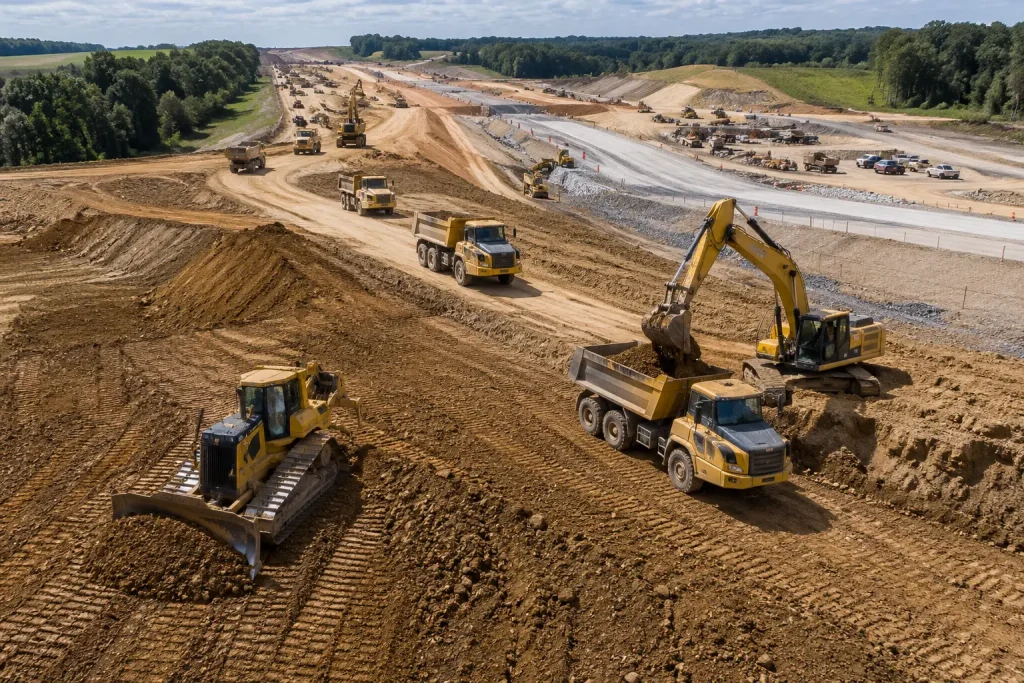
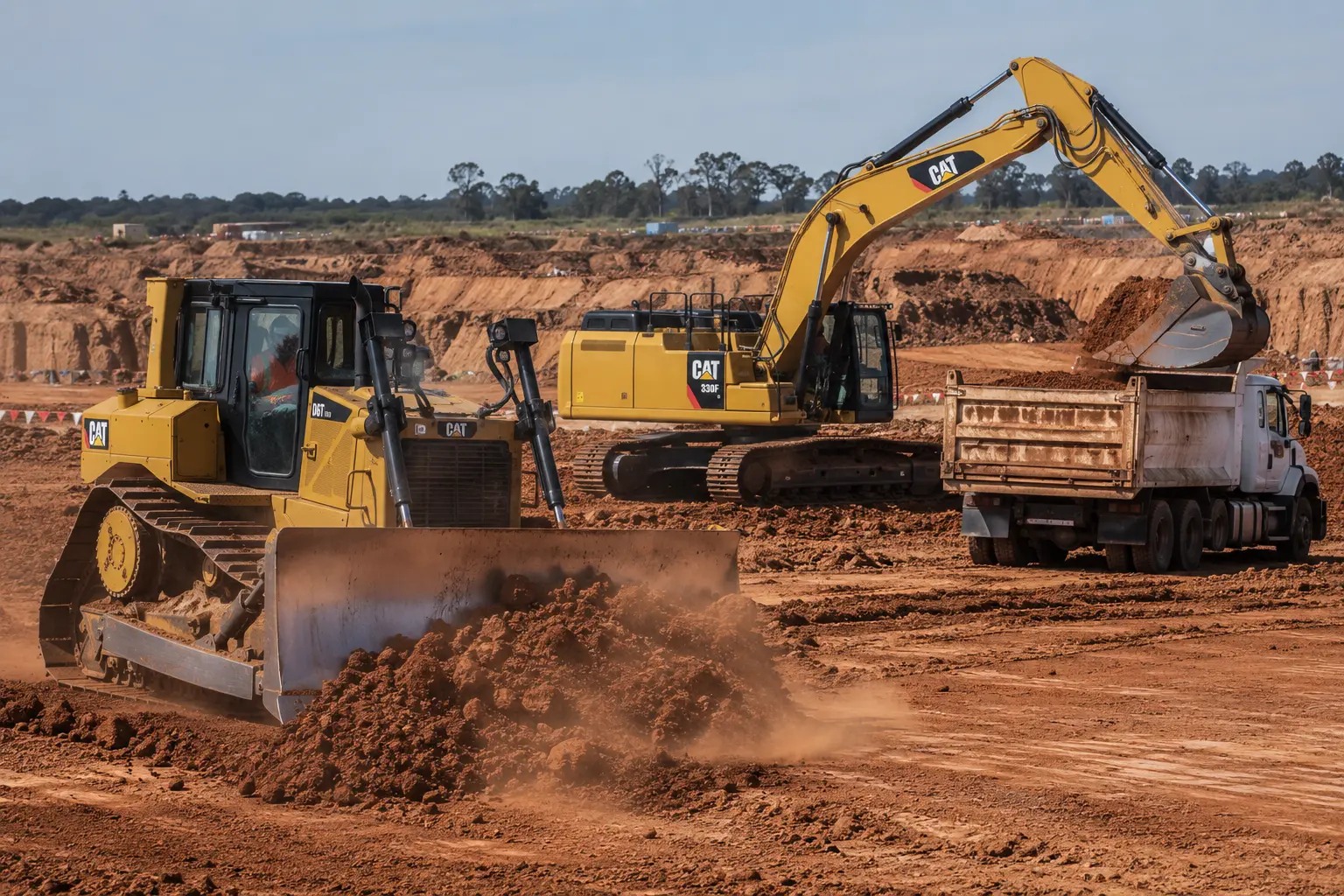
On most significant earthmoving projects, the bulldozer and excavator are not alternatives, they are used together in a coordinated sequence, each performing the tasks it does best.
The excavator typically leads in areas requiring precision removal, cutting to formation level in areas where bulk pushing would overrun the design grade, excavating drainage structures and utility trenches, breaking hard material in localised areas. The bulldozer follows with bulk pushing, spreading fill delivered by trucks, pushing loose material to the embankment face, ripping and clearing areas that the excavator has prepared.
On large road and civil projects, the plant fleet typically includes multiple excavators and multiple bulldozers working simultaneously in different areas of the site, coordinated by a plant manager who sequences their movements to avoid conflicts and maintain productivity across the site. Planning the movement of multiple heavy plant items, their routes, their exclusion zones, and their interaction with other operations including cranes, trucks, and concrete placement, is a core element of construction site planning and heavy plant coordination on active civil projects.
Also read : What Is Mobile Scaffolding? Types, Uses and Safety
Two Machines, One Earthmoving Programme
The bulldozer and the excavator are not the same machine performing the same function at different scales. They are structurally different, operationally different, and suited to categorically different earthmoving tasks. The bulldozer pushes large volumes of material across the surface with unmatched force and productivity. The excavator digs, lifts, and places material with precision and versatility that the bulldozer cannot approach.
Understanding which machine to deploy, and when to deploy both in sequence, is fundamental to earthmoving productivity, programme efficiency, and cost control on any project where significant ground movement is required.
RR Machinery provides a comprehensive range of construction and earthmoving equipment for sale and rental, including bulldozers, excavators, motor graders, compactors, and supporting plant, all maintained to full operational standard and supported by experienced equipment specialists. Explore our full range of earthmoving and construction equipment solutions, or contact our team for practical advice and a clear quotation matched to your site conditions, earthmoving volumes, and project programme.