
Table of Contents
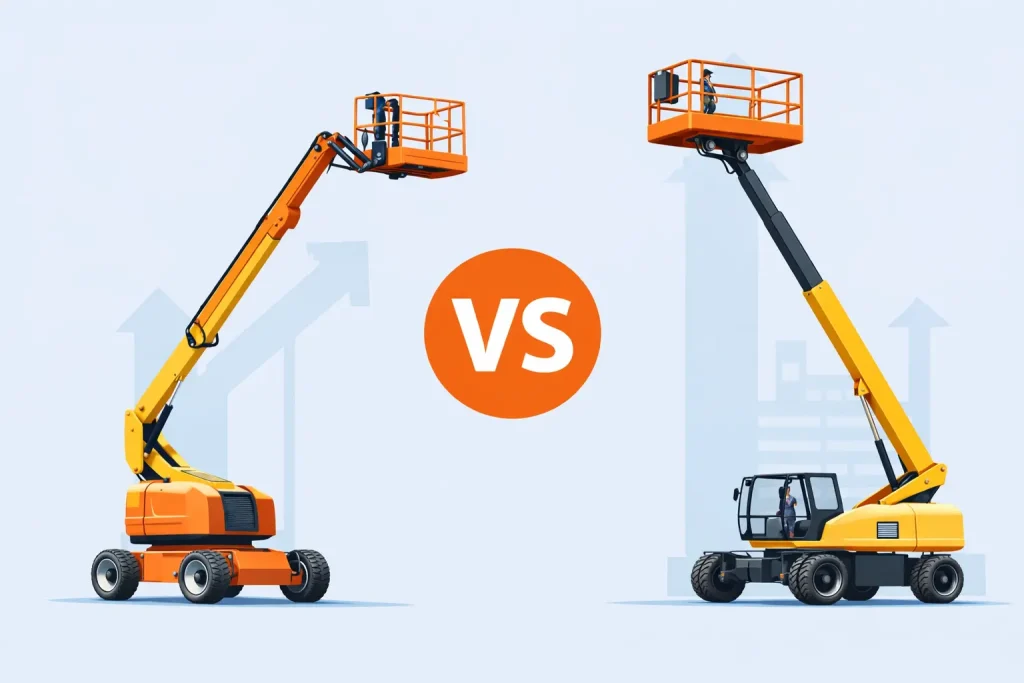
Boom lifts are widely used across construction sites, industrial facilities, and maintenance projects where safe access at height is required. However, not all boom lifts are designed to handle the same site conditions. One of the most common equipment selection questions is the difference between an articulating boom lift vs telescopic boom lift.
Although both machines fall under the category of mobile elevating work platforms, they behave very differently on site. Understanding how each type works, and where it performs best, helps project teams choose equipment that improves safety, reduces repositioning time, and keeps work progressing efficiently.
What Is a Boom Lift?
A boom lift is an access machine that uses an extendable arm to raise a work platform vertically and horizontally. Unlike scissor lifts, which only move straight up and down, boom lifts allow operators to reach areas that are set back from the base of the machine.
In general access equipment discussions, mobile elevating work platforms are categorised based on how they provide reach and manoeuvrability on site.
Boom lifts are commonly used for façade work, steel installation, mechanical maintenance, and outdoor construction tasks. When planning work at height, many teams review available boom lift equipment early to ensure the selected machine matches both working height and outreach requirements.
Also read : Boom Lift vs Scissor Lift: What’s the Difference?
What Is an Articulating Boom Lift?
An articulating boom lift, often called a knuckle boom lift, uses multiple hinged sections in its arm. These joints allow the boom to bend and articulate, making it possible to move the platform up, over, and around obstacles.
This flexibility makes articulating boom lifts particularly useful on congested sites or in areas with structural obstructions. They are commonly used inside industrial plants, on maintenance jobs around machinery, or on construction sites where direct vertical access is blocked by beams, piping, or building features.
In practice, teams choose articulating boom lifts when careful positioning and obstacle avoidance are more important than maximum reach.
What Is a Telescopic Boom Lift?
A telescopic boom lift, sometimes referred to as a straight boom lift, uses a single extendable arm that moves outward in a straight line. This design allows the machine to achieve greater horizontal reach and higher working heights compared to most articulating models.
Telescopic boom lifts are commonly used on large, open sites where obstacles are minimal. Typical applications include bridge construction, steel erection, façade installation, and infrastructure projects where long reach is required to access distant work areas efficiently.
For projects that prioritise reach and height over manoeuvrability, telescopic boom lifts are often the more suitable option.
Key Differences Between Articulating and Telescopic Boom Lifts
When comparing an articulating boom lift vs telescopic boom lift, the main differences come down to movement, flexibility, and site suitability.
Articulating boom lifts are designed for complex environments. Their ability to bend around obstacles reduces the need to constantly reposition the machine, which can improve efficiency and safety in tight spaces. However, this flexibility usually comes with slightly reduced maximum reach.
Telescopic boom lifts focus on straight-line reach. They excel at accessing high or distant areas quickly, but they require clearer access paths and more open working areas. Their simpler arm design provides strong stability at extended reach.
Understanding these differences helps narrow down equipment selection before work begins.
Also read : How to Operate a Boom Lift Safely: A Simple Step-by-Step Guide
Which Boom Lift Is Right for Your Project?
Choosing between an articulating and a telescopic boom lift depends largely on site layout and the nature of the work. Projects with overhead obstructions, limited access points, or confined working areas typically benefit from articulating boom lifts.
On the other hand, projects that involve working across open ground or require extended horizontal reach often benefit more from telescopic boom lifts. These machines reduce the need to reposition frequently when working on large structures.
Other considerations include ground conditions, working height, platform capacity, and how often the lift will need to be moved during the job.
Common Applications for Each Type
Articulating boom lifts are commonly used for industrial maintenance, mechanical installation, and work inside facilities where access paths are restricted. They are also useful for construction sites with complex structural layouts.
Telescopic boom lifts are widely used in heavy construction, infrastructure projects, and large-scale exterior works. Their reach and stability make them suitable for steelwork, bridge construction, and façade installation on tall buildings.
Industry guidance from powered access organisations highlights how different boom lift designs are selected based on access challenges rather than height alone.
Articulating Boom Lift vs Telescopic: A Practical Summary
Both articulating and telescopic boom lifts are essential access solutions, but they are built to solve different problems. Articulating models offer flexibility and obstacle avoidance, while telescopic models provide reach and height in open environments.
The most effective choice comes from understanding real site conditions rather than relying on specifications alone.
Also read : Your Ultimate Guide to Boom Lifts in Singapore
Get the Right Boom Lift with RR Machinery
Choosing the right boom lift is not just about working height or outreach. What matters more for day-to-day site operations is having equipment that fits site conditions and is supported by reliable servicing.
At RR Machinery, access equipment is supplied to support both short-term projects and longer-term operational needs. Many teams start by reviewing available boom lifts to match machine capability with site requirements, then plan maintenance support to keep equipment performing reliably throughout the project.
For longer projects, having access to dependable equipment servicing and technical support helps reduce downtime and avoid delays caused by unexpected issues.
If you need help comparing articulating and telescopic boom lifts or would like a quotation, you can contact RR Machinery team to discuss your project requirements.


