A boom lift can place a single worker at a precise point 30, 60, or even 180 feet in the air, hold them steady while they work, and bring them back down safely, all under the control of one person standing in the platform itself. To anyone who has not operated one, the machine can look almost like it moves on its own, arm folding and unfolding, platform swinging out over obstacles, base staying perfectly still the whole time. Understanding what is actually happening underneath that motion changes how the machine is specified, operated, and maintained.
This guide breaks down exactly how a boom lift works, from the hydraulic system that powers every movement, to the structural components that make articulation and outreach possible, to the controls an operator uses to translate a joystick movement into a precise position at height. It also covers how this mechanism compares to other aerial equipment, and the safety principles that follow directly from how the machine is built.
What Is a Boom Lift and How Does It Work?
A boom lift is a type of aerial work platform that uses a hydraulically powered arm, called a boom, to lift a platform or bucket carrying one or two workers to an elevated position. Unlike a simple vertical lift, a boom lift’s arm can extend, raise, lower, and in most models rotate, allowing the platform to reach up and outward simultaneously rather than moving in a single straight line. This combination of vertical height and horizontal outreach is what separates a boom lift from other categories of aerial lift equipment.
At its core, the entire machine works by converting hydraulic fluid pressure into mechanical motion. A diesel or electric power unit drives a hydraulic pump, which pressurises fluid that is then directed, through a network of valves and hoses, to cylinders at each joint of the boom and at the base. Extending a cylinder pushes a joint further apart, retracting it pulls the joint back in, and the combined, coordinated movement of several cylinders at once is what allows the boom to trace a smooth path through the air rather than moving in disconnected steps.
The Core Mechanism: Hydraulics and the Boom
Every function on a boom lift, raising, extending, rotating, and levelling the platform, is driven by the same underlying hydraulic principle. The power unit pressurises hydraulic fluid, which is stored in a reservoir and circulated through hoses to cylinders positioned at each hinge point along the boom. When the operator moves a control, a valve opens to direct pressurised fluid into a specific cylinder, and the resulting force extends or retracts that cylinder, which in turn moves the section of boom it is attached to.
This is why a boom lift can hold a heavy platform steady at height for extended periods without the arm drifting downward: the hydraulic fluid in each cylinder is effectively locked in place by the valve system once movement stops, resisting the load rather than simply relying on mechanical friction. The same principle allows fine, controlled movement, since the operator can modulate how far a valve opens to control how quickly a cylinder extends, translating a small joystick input into a smooth, proportional movement of the boom.
The Rotating Turret and Base
Beneath the boom itself sits a turret, a rotating platform mounted on the machine’s chassis that allows the entire boom assembly to swing horizontally, typically through a full 360 degrees, without the base of the machine moving at all. This turret sits on a large bearing, often called a slewing ring, which is driven by its own hydraulic motor and allows the operator to reposition the platform anywhere around the machine simply by rotating the turret rather than repositioning the entire vehicle.
The base beneath the turret carries the weight of the entire machine and, in most models, includes outriggers or stabiliser legs that extend outward and lower to the ground before the boom is raised. These outriggers widen the machine’s effective footprint and lock it in place, which is what allows a boom lift to safely support a platform extended many metres away from its centre of gravity without tipping. Understanding how the turret and base work together explains why setup on level, stable ground is not just a formality but a structural requirement built directly into how the machine functions.
Also read: What Is a Cherry Picker? Definition, Types, Uses & Safety Guide
Key Components That Make a Boom Lift Work
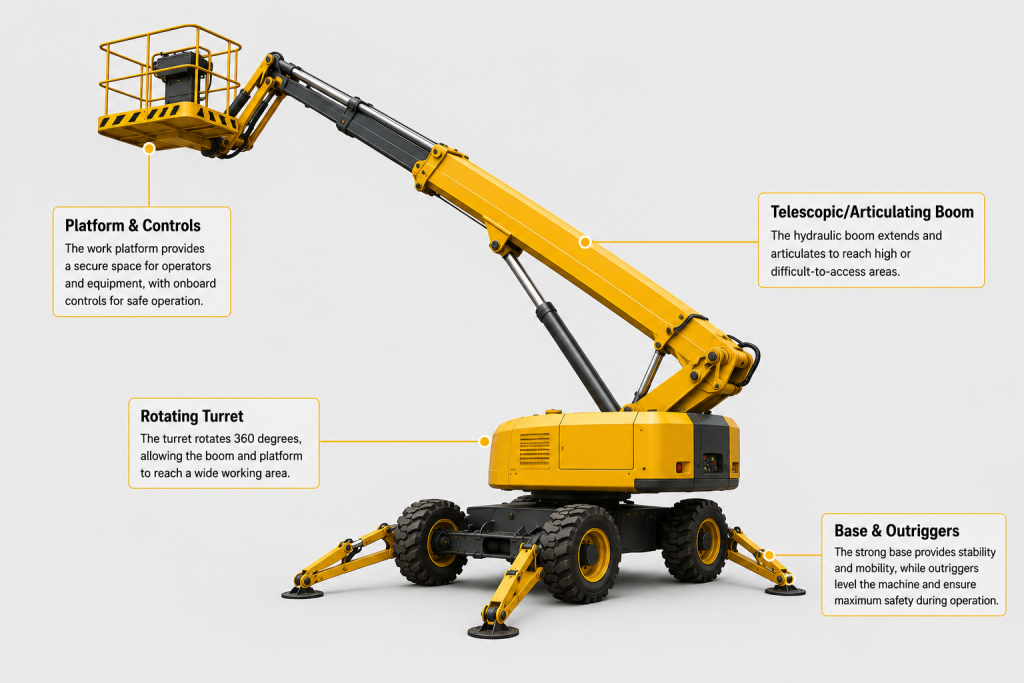
Beyond the hydraulic principle itself, a boom lift is built from a specific set of structural components, each playing a distinct role in how the machine ultimately positions a worker at height. Understanding these components individually makes it far easier to understand why boom lifts are specified, inspected, and maintained the way they are.
These components fall into three broad groups: the base and stabilising structure that keeps the machine anchored, the boom arm itself that provides reach, and the platform and control systems that the operator interacts with directly. Each group depends on the others functioning correctly, which is why a fault in even one hydraulic cylinder or one control valve can affect the safe operation of the entire machine.
The Base and Outriggers
The base of a boom lift houses the engine or electric motor, the hydraulic pump and reservoir, and, on most models, the outriggers that extend and lower before the boom is raised. On rough terrain models, the base also includes four-wheel drive and larger tyres to maintain stability on uneven or soft ground, while models designed for firm, level surfaces use a simpler two-wheel-drive configuration.
The outriggers work by widening the machine’s base of support far beyond the width of its wheels or tracks, which directly increases the platform’s safe working envelope, how far the boom can extend and how much load it can carry at that extension without tipping. This is why every reputable boom lift includes a load moment or stability system that continuously calculates the machine’s actual stability based on boom angle, extension, and load, cutting off further extension if the calculated envelope is exceeded.
The Boom Arm: Telescopic vs Articulating
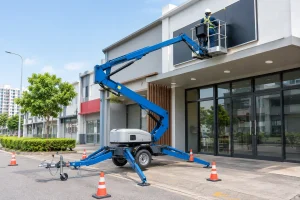
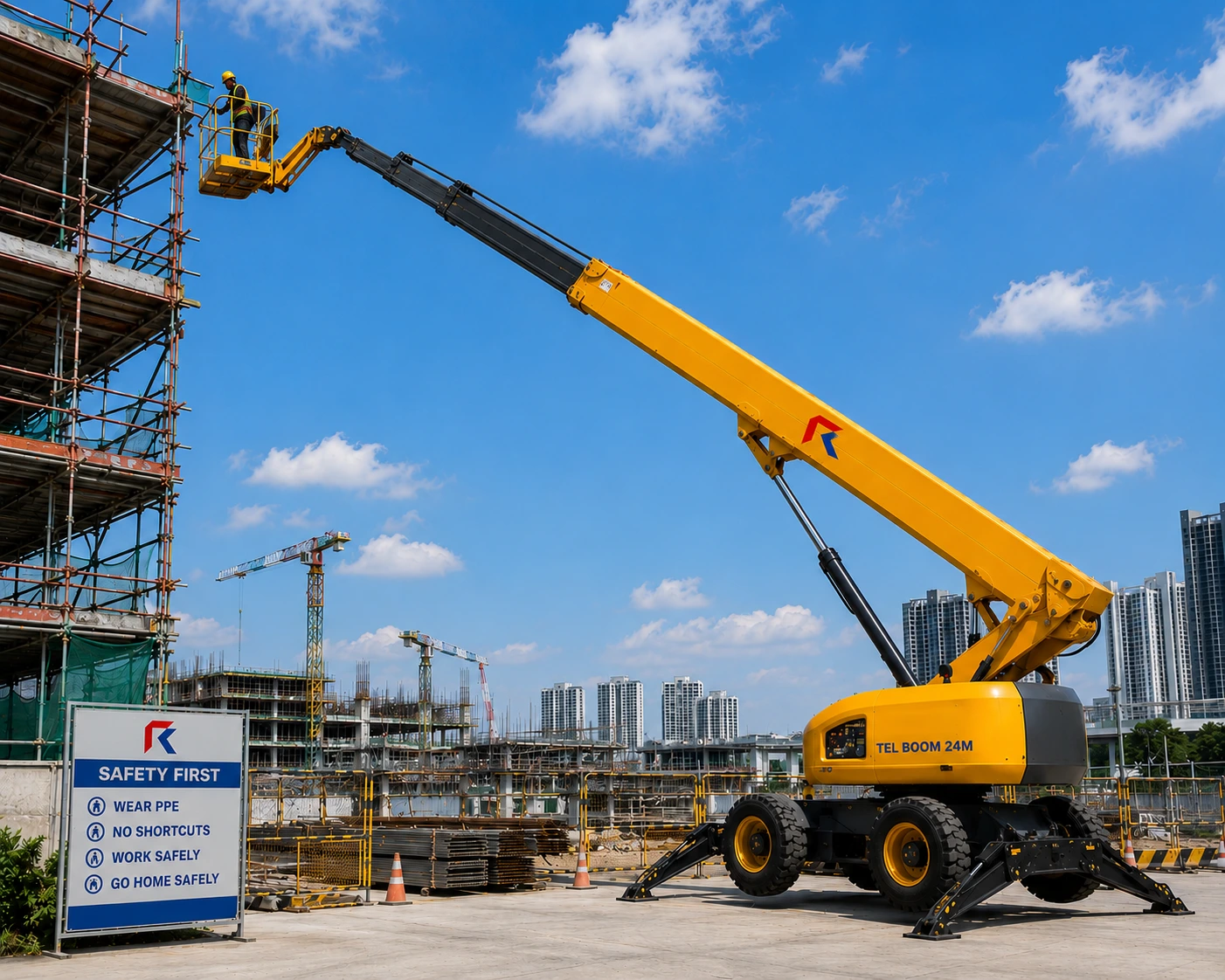
The boom arm itself comes in two main configurations, telescopic and articulating, and the difference in how each is built directly determines how each moves. A telescopic boom consists of nested sections that slide out from one another in a straight line, similar to an extending ladder, giving it the greatest outreach and height in a direct path for a given size of machine. An articulating boom instead has multiple hinged sections that fold and unfold independently, allowing the platform to travel up and over an obstacle rather than only in a straight line.
This structural difference is the reason the two boom types suit different jobs: a telescopic boom’s straight-line reach makes it the more efficient choice for open-area work with no obstructions, while an articulating boom’s ability to bend around obstacles makes it the only practical option when the target point sits behind a wall, beam, or piece of equipment. A detailed side-by-side comparison of how each mechanism performs in practice is covered in Choosing Between Articulating and Telescopic Boom Lifts, which is useful reading before specifying either type for a project.
The Platform and Control Systems
At the end of the boom sits the platform, a basket fitted with guardrails, a harness anchor point, and a control panel that duplicates the primary controls found at the machine’s base. This platform-mounted control panel is what allows a single operator to manage the entire machine, raising, extending, rotating, and levelling, from the same position where they are performing their actual work task.
A levelling system, usually a separate set of hydraulic cylinders or a mechanical linkage, keeps the platform floor horizontal automatically as the boom angle changes, regardless of how far it has extended or rotated. Without this self-levelling function, the platform would tilt as the boom moved, making it unsafe to stand in at anything other than specific boom positions, which is why this component is considered as essential to the machine’s basic function as the boom itself.
Also read: Types of Boom Lifts: Which One Does Your Job Need?
How the Operator Controls a Boom Lift
Understanding the mechanics of a boom lift only tells half the story, since the machine still requires a trained operator to translate a work task into a precise sequence of control inputs. The control system is designed specifically to make this translation as intuitive as possible, even though the underlying hydraulic movements being commanded are quite complex.
Every boom lift includes two separate sets of controls, one at the base of the machine and one on the platform itself, each serving a distinct purpose in how the machine is safely operated from setup through to shutdown. Both sets of controls are connected to the same hydraulic and electronic systems, but they are deliberately given different levels of authority to reflect who should be making which decisions at each stage of operation.
Ground Controls vs Platform Controls
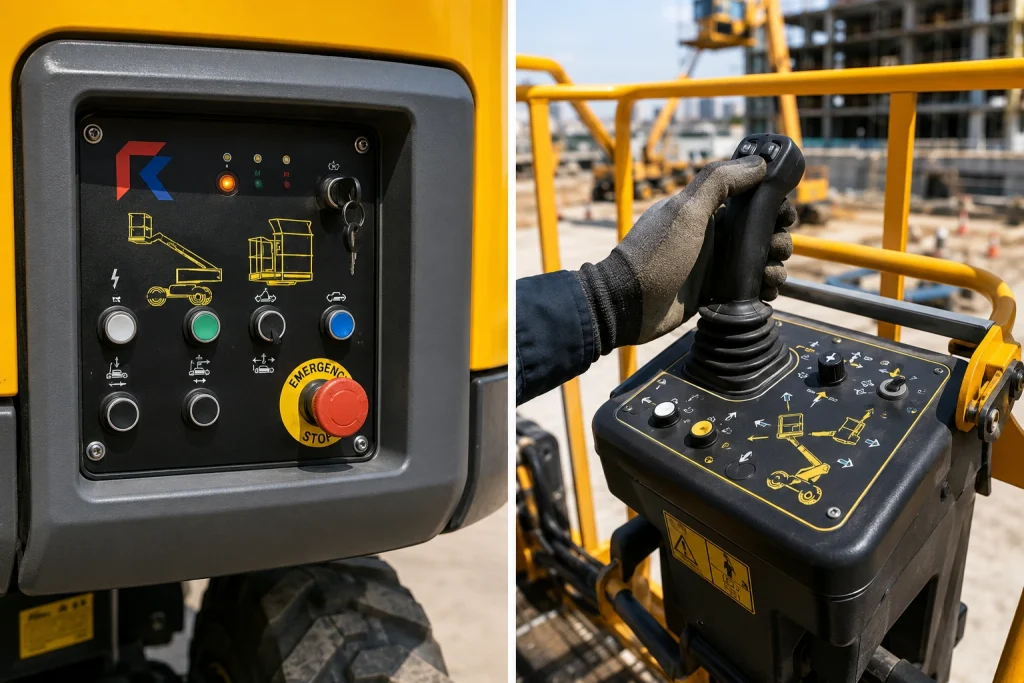
The ground-level controls, usually located at the base near the turret, are primarily used for initial setup, emergency lowering, and functional testing before a worker enters the platform. These controls typically allow a second person on the ground to override or take control of the machine in an emergency, which is why every job involving a boom lift should have a trained ground-based spotter in addition to the platform operator.
The platform controls, by contrast, are what the operator uses for the vast majority of actual work, extending, rotating, raising, and lowering the boom while remaining in the basket. These controls are typically proportional, meaning the further a joystick is pushed, the faster the corresponding hydraulic function moves, giving the operator fine control for precise positioning near a work surface and faster movement when repositioning across a larger distance. Reviewing the correct sequence for using these controls safely is covered step by step in How to Operate a Boom Lift: A Step-by-Step Safety Guide, which every new operator should study before their first supervised use of the machine.
Safety Interlocks and Load Sensing Systems
Modern boom lifts include multiple electronic and hydraulic interlocks that prevent the operator from commanding a movement the machine cannot safely perform. A load sensing system continuously measures the weight in the platform and compares it against the rated capacity at the boom’s current extension and angle, automatically restricting further extension or triggering an alarm if the safe limit would otherwise be exceeded.
Additional interlocks typically prevent the machine from driving at height beyond a set speed, prevent outrigger retraction while the boom is raised, and can include tilt sensors that halt operation if the machine’s chassis is not within its rated level tolerance. These systems exist because the hydraulic mechanism, powerful and precise as it is, has no inherent sense of its own safe operating limits, that awareness has to be engineered in separately through sensors and software layered on top of the core hydraulic system.
Step-by-Step: How a Boom Lift Works in Practice
Bringing the mechanical components and control systems together, a boom lift moves through a consistent operating sequence on every job, regardless of the specific task at height. Understanding this sequence end to end shows how each component discussed earlier plays its part at a specific stage of the process.
Skipping or rushing any stage in this sequence is one of the most common causes of incidents involving boom lifts, precisely because each stage exists to confirm that the stage before it was completed correctly. A machine that is not properly stabilised before the boom is raised, for example, is operating outside the conditions its stability system was designed to assume.
Setup and Stabilisation
Before the boom is raised, the operator positions the machine on level, load-bearing ground and deploys the outriggers, where fitted, extending and lowering them until the machine’s chassis is stable and, on most models, lifted slightly clear of its tyres. Sensors confirm the machine is within its rated level tolerance before allowing the boom to be raised at all, an automatic check that reflects how directly stability depends on correct setup.
Once stabilised, the operator conducts a functional test of all controls from the ground station, confirming that raising, extending, rotating, and emergency lowering all respond correctly before anyone enters the platform. This test exists because it is far safer to discover a hydraulic or control fault at ground level than after a worker has already been raised to height.
Raising, Extending, and Positioning
With setup confirmed, the operator enters the platform, clips into the harness anchor point, and begins raising the boom using the platform controls, typically raising the boom to a safe angle before extending it outward, rather than extending first at a low angle where structural loads are higher. The self-levelling system keeps the platform floor horizontal automatically throughout this movement, while the turret can be rotated at any point to reposition the platform’s horizontal direction without needing to lower the boom first.
As the platform approaches its target position, the proportional controls allow the operator to slow movement for fine positioning, aligning the platform precisely against a wall, piece of equipment, or work surface. Throughout this stage, the load sensing and stability systems continue to monitor the machine in the background, ready to restrict further movement automatically if the boom’s current extension and angle approach the edge of its rated capacity.
Lowering and Stowing
Once work is complete, the operator reverses the sequence, retracting the boom before lowering its angle, which keeps structural loads within safe limits throughout the descent in the same way the raising sequence did. The turret is typically rotated back to the machine’s direction of travel before the boom is fully stowed, since most machines are only rated to drive with the boom in a specific stowed position.
With the boom fully lowered and stowed, the outriggers are retracted, returning the machine’s full weight to its wheels or tracks so it can be safely repositioned or transported to the next task. This closing sequence matters because a machine driven with its boom partially raised, or its outriggers still partially deployed, is operating outside the conditions its stability and drive systems were designed around.
Also read: How to Operate a Boom Lift: A Step-by-Step Safety Guide
Boom Lift vs Other Aerial Equipment: Why the Mechanism Matters
Understanding how a boom lift’s hydraulic, articulated mechanism works also explains why it is not interchangeable with other categories of aerial and lifting equipment, even though several machines are sometimes grouped together informally. The specific way a boom lift moves, extending and rotating from a fixed base, gives it capabilities that other machines simply are not built to replicate, and takes away capabilities that other machines have instead.
Recognising these mechanical differences is what allows a project to specify the right machine the first time, rather than discovering partway through a job that the equipment on-site cannot actually perform the task required. The two comparisons that come up most often on a construction or maintenance site are against scissor lifts and against mobile cranes.
Boom Lift vs Scissor Lift
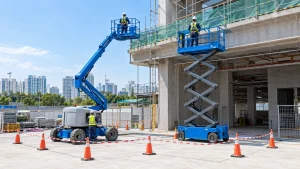
A scissor lift raises a platform using a crossed, folding support structure directly beneath it, which means the platform can only travel straight up, positioned directly above wherever the machine’s base is standing. A boom lift’s hydraulic arm, by contrast, can extend and rotate outward from its base, reaching over obstacles and to points offset from the machine itself, a movement a scissor lift’s mechanism is structurally incapable of.
This is why a scissor lift suits tasks spread across a wide, flat area directly above the machine, such as ceiling work across an open floor, while a boom lift suits tasks concentrated at a single point that may be offset, elevated, or obstructed, such as reaching over rooftop equipment or around a building’s edge. A full breakdown of this mechanical distinction and where each machine fits is available in Boom Lift vs Scissor Lift: Key Differences and Uses.
Boom Lift vs Crane
A mobile crane and a boom lift both use a hydraulic or lattice arm to move something through the air, but the fundamental purpose behind each mechanism is different. A crane’s arm is engineered to lift and move heavy external loads, materials, equipment, or structural components, suspended from a hook or attachment, with no platform for a worker at all in most configurations. A boom lift’s arm is engineered to carry a worker safely in a platform at the end of the boom, prioritising stability and precise positioning for a person rather than raw lifting capacity for cargo.
This difference in purpose is reflected directly in how each machine’s stability and control systems are designed: a crane’s load charts and outrigger requirements are built around calculating the maximum weight it can safely lift at a given radius, while a boom lift’s load sensing and levelling systems are built around keeping a platform stable and level for a person working inside it. RR Machinery’s own range of boom lifts reflects this worker-positioning purpose specifically, engineered for safe, precise access rather than heavy load lifting.
Safety Considerations Rooted in How Boom Lifts Work
Every major safety rule associated with boom lift operation follows directly from the mechanical principles already covered, rather than being an arbitrary set of external requirements layered on top of the machine. Understanding the mechanism is, in a very practical sense, understanding why the safety rules exist in the first place.
This connection between mechanism and safety matters because operators who understand why a rule exists are far less likely to work around it under time pressure than operators who were simply told to follow a rule without understanding its purpose. Two areas in particular, wind and weather limits, and load capacity and fall protection, illustrate this connection clearly.
Wind and Weather Limits
A fully extended boom acts as a long lever arm, and wind pressure against the platform and operator at height generates far more force at the base of the machine than the same wind would generate at ground level, because that force is multiplied by the length of the extended boom. This is a direct mechanical consequence of the boom’s structure, not an arbitrary caution, which is why every boom lift has a manufacturer-rated maximum wind speed that must never be exceeded regardless of how urgent the task at height might feel.
Rain and lightning introduce a separate risk specific to the machine’s hydraulic and electronic control systems, since water intrusion can affect sensors, valves, and the load sensing system that the machine’s entire stability calculation depends on. Suspending work during adverse weather is therefore not just a general safety precaution but a direct response to the specific ways the machine’s own mechanism can be compromised.
Load Capacity and Fall Protection
The platform’s rated load capacity is not a fixed number but a variable one, calculated continuously by the machine’s load sensing system based on the boom’s current extension and angle, which is why exceeding the combined weight of the operator, tools, and materials at any point during a task can trigger an automatic restriction or alarm. Understanding that this capacity actively decreases as the boom extends further out explains why materials and tools should be kept to the minimum necessary for the task at hand.
Fall protection, specifically wearing a full-body harness clipped to the platform’s designated anchor point at all times, exists because the platform’s self-levelling and stability systems are engineered to keep the floor level under normal operating conditions, not to prevent a fall in the event of a sudden mechanical fault or an unexpected impact. Singapore’s Ministry of Manpower publishes detailed Workplace Safety and Health guidance on the training, harness use, and equipment inspection standards that apply to aerial work platform operation across construction sites, and a closer look at how these obligations apply specifically to elevated work is covered in Working at Height: Safety Guidelines, Risks, and Best Practices.
Also read: Boom Lift vs Crane: Key Differences and Uses
Get a Boom Lift That’s Built to Perform
Every function a boom lift performs, extending, rotating, levelling, and holding steady at height, comes down to the same hydraulic principle applied through a purpose-built structure of booms, turrets, and control systems. Understanding how that mechanism actually works, rather than simply learning which lever does what, is what allows a project to specify the right machine, operate it safely, and recognise early when something is not functioning as it should. For further technical background on the engineering principles behind hydraulic aerial platforms, Wikipedia’s overview of aerial work platforms provides useful additional context.
RR Machinery Pte Ltd offers an extensive range of boom lifts for both articulating and telescopic applications, reaching heights of up to 185 feet, with every unit backed by factory-certified technicians ready to help match the right machine and mechanism to your job. Contact us today for expert advice and a clear quotation tailored to your operational needs.