How a Motor Grader Works
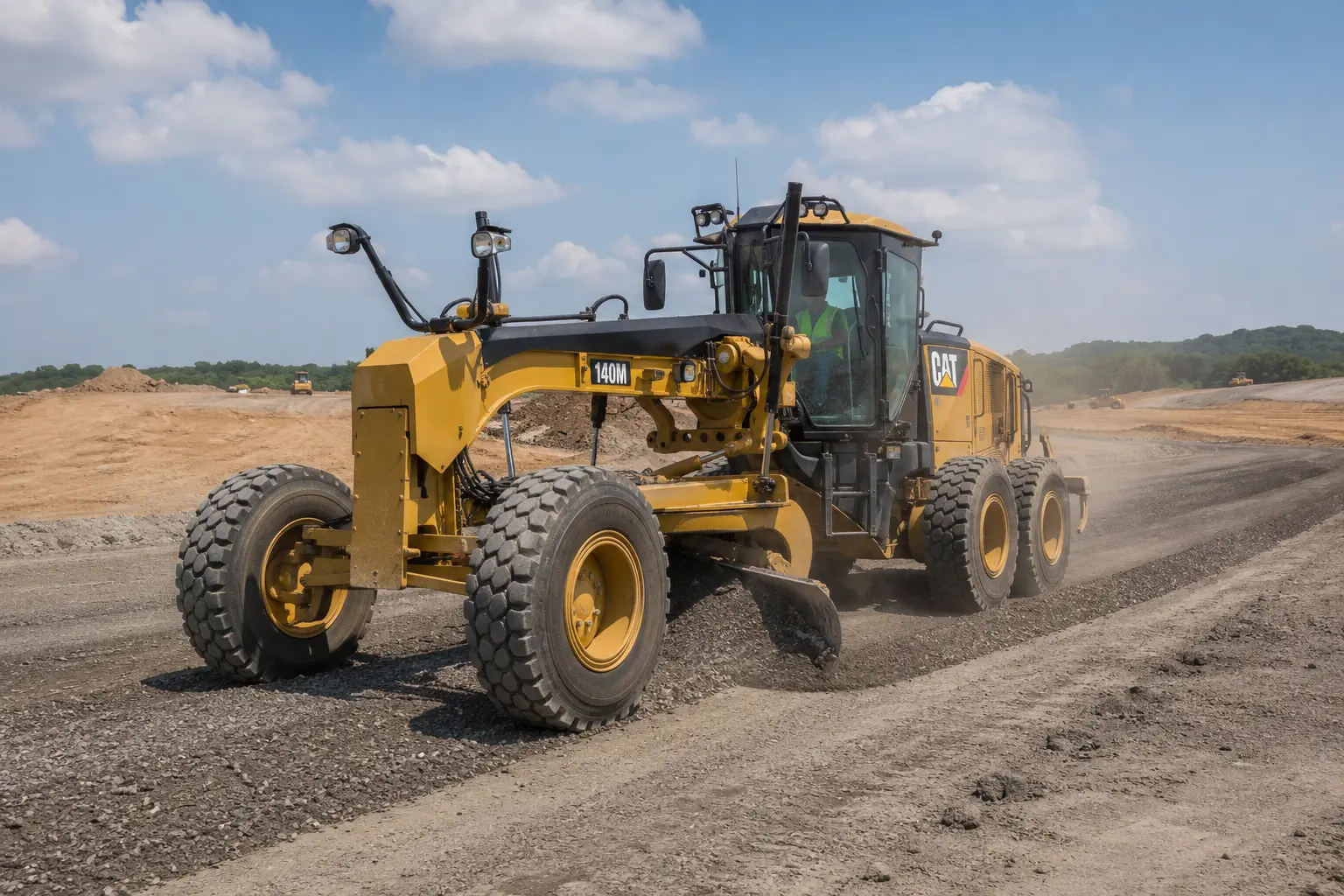
The motor grader’s defining component is its blade, formally called the moldboard, a long, curved steel plate mounted on a rotating circle assembly beneath the machine’s frame, between the front and rear axles. The circle allows the blade to be rotated to any angle relative to the machine’s direction of travel, and the blade can be tilted, shifted laterally, and raised or lowered hydraulically to achieve the exact cutting angle, cross-slope, and elevation required. As the grader moves forward, the blade cuts into the material surface at the leading edge, lifts it, and casts it laterally to one side, or both sides, depending on the blade angle. By making successive passes with the blade set at different angles and elevations, the operator progressively shapes the surface to the required profile. The long wheelbase of a motor grader, the distance between the front axle and the rear tandem axle group, is not incidental. It is a fundamental design feature. A long wheelbase means the machine bridges over undulations in the surface rather than following them, producing a far flatter finished grade than a short-wheelbase machine could achieve. This bridging effect is the mechanical basis of the grader’s precision. The rear tandem axle group, typically two axles in a bogie arrangement, provides the tractive effort to push the blade through the material and gives the grader its characteristic stability under load. The front axle steers and provides the reference point for the blade’s height control. Most modern motor graders are equipped with automatic grade control systems, laser receivers, GPS, or machine control systems linked to a digital terrain model, that adjust the blade height and cross-slope automatically to maintain the designed grade without manual intervention from the operator. These systems have significantly improved grading accuracy and productivity, particularly on large road and site projects where manual grade control is slow and prone to human error.Also read : Types of Excavators: A Complete Guide for Every Job
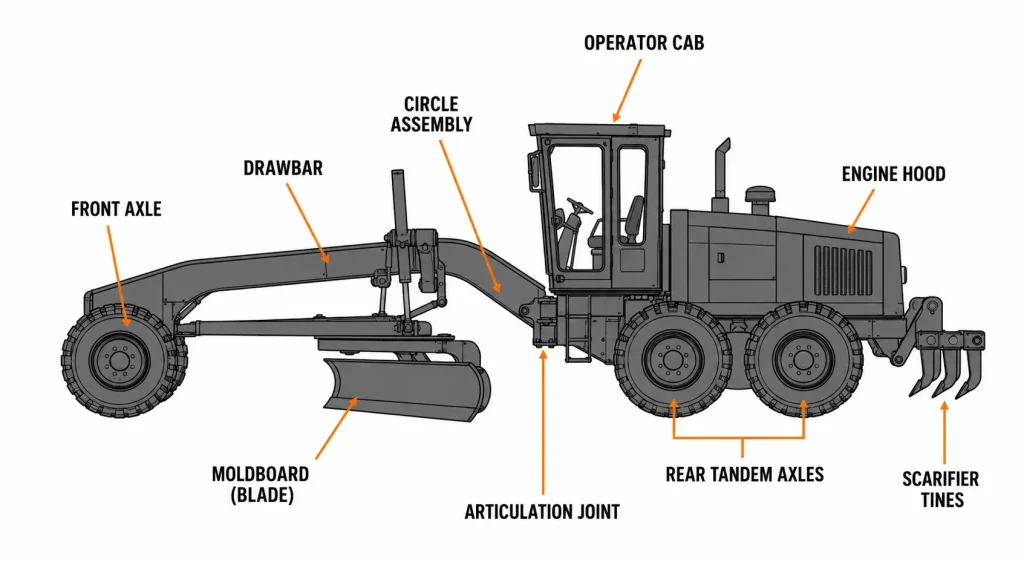
Key Components of a Motor Grader
-
- Moldboard (blade)
The primary working component. Typically 3.0 to 7.3 metres wide depending on the machine size. The blade’s geometry, its height, curvature, and the angle at which it meets the material, determines the cutting and casting characteristics of each pass.
-
- Circle
The large-diameter ring gear assembly that rotates the blade relative to the machine frame. The circle is driven by a hydraulic motor and allows the blade to be set at any angle from fully perpendicular to the direction of travel (for cross-cutting) to nearly parallel (for casting material at a shallow angle).
-
- Drawbar
The structural frame connecting the circle and blade assembly to the front axle. The drawbar can be shifted laterally, moving the blade off-centre relative to the machine, allowing the grader to cut in locations offset from its travel path.
-
- Front axle
Steerable and typically capable of leaning, tilting inward on curves, to reduce the side forces on the tyres during tight turns and to improve stability on cross-slopes.
-
- Rear tandem axles
The primary drive axles, providing the tractive effort that pushes the blade through the material. The tandem configuration, two axles in a bogie, distributes the machine’s weight over a longer contact length, reducing ground pressure and improving traction on soft or loose surfaces.
-
- Articulation joint
Present on articulated graders, this joint in the machine frame between the front and rear sections allows the front and rear to be angled relative to each other, improving manoeuvrability and enabling the machine to work closer to kerbs, walls, and other fixed constraints.
-
- Scarifier
A set of downward-pointing tines mounted ahead of the blade, used to break up compacted or hard material before the blade grades it. The scarifier is lowered hydraulically into the surface, ripping it loose so the blade can then shape it. Without a scarifier, a grader blade cannot effectively cut hard or compacted material.
Types of Graders
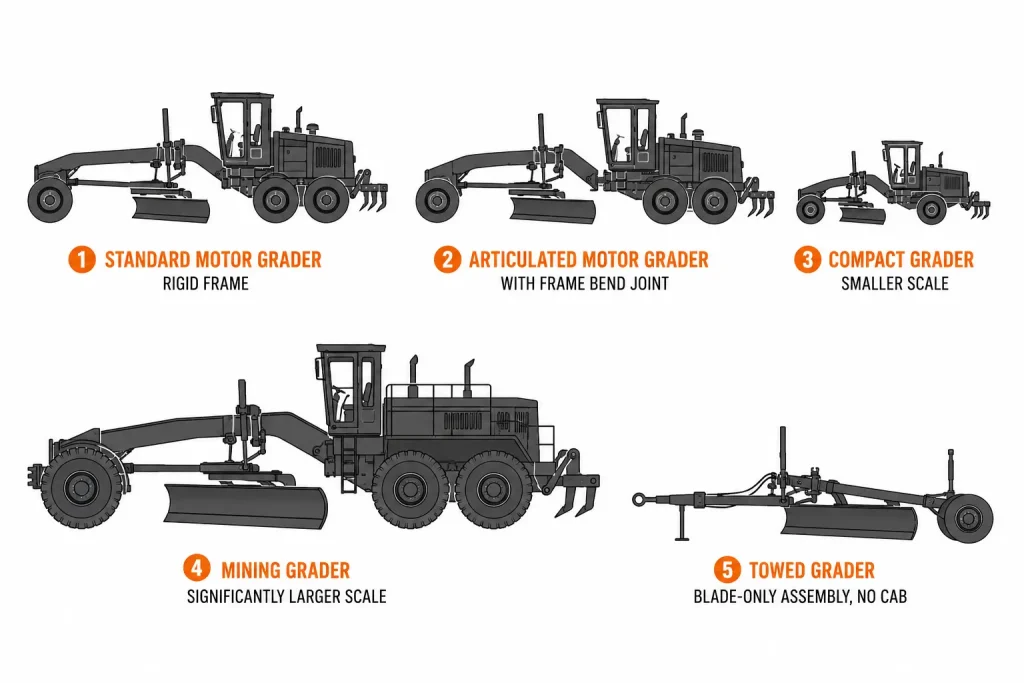 Motor graders are available in a range of configurations, each suited to a different scale of work, site environment, or operational requirement. The choice between types is determined by the project size, the material being graded, the required precision, and the access constraints of the site.
-
-
Standard Motor Grader
-
The standard motor grader is the most widely used configuration across road construction, site development, and civil infrastructure projects. It is a rigid-frame or lightly articulated machine in the 10 to 20 tonne operating weight range, powered by a diesel engine in the 100 to 200 horsepower range, with a blade width of 3.7 to 4.9 metres.
Standard motor graders are the default choice for road base preparation, subgrade grading, haul road maintenance, drainage channel shaping, and the finish grading of large areas of prepared ground. Their combination of blade width, engine power, and wheelbase length makes them productive across a wide range of material types and site conditions.
On construction sites where grading must be coordinated with other earthmoving and lifting operations, the motor grader typically works in sequence with bulldozers that perform the bulk push and excavators that remove unsuitable material, the grader arriving after bulk earthmoving to bring the surface to its finished grade. The coordination of multiple plant types on a single site, including managing their movement routes, exclusion zones, and sequencing, is a critical aspect of construction site planning and the management of heavy plant operations.
-
-
Articulated Motor Grader
-
The articulated motor grader has a frame that bends at a joint between the front and rear sections of the machine, the same articulation principle used in articulated dump trucks and some wheeled loaders. The articulation joint allows the front wheels and blade to be positioned independently of the rear drive axles, giving the machine a significantly tighter turning radius than a rigid-frame machine of equivalent size.
Articulated graders are better suited to confined sites, urban road construction, subdivision development, and work in areas with tight turning constraints at the end of each grading pass. They are also more manoeuvrable around fixed obstacles such as kerbs, drainage structures, and service access covers that interrupt the grading path.
The articulation capability also improves the grader’s ability to work on cross-slopes, the machine can articulate to keep the rear axles tracking straight while the front and blade are angled to the slope, reducing the side-slip tendency that rigid-frame machines experience on steep cross-gradients.
-
-
Small or Compact Grader
-
The compact motor grader, operating weight typically below 10 tonnes, blade width 2.5 to 3.5 metres, is designed for applications where a full-size machine is too large for the site constraints, or where the volume of grading work does not justify the cost and logistics of a larger machine.
Compact graders are widely used in municipal maintenance work, grading unsealed local roads, maintaining rural tracks, shaping drainage channels on smaller infrastructure projects, and finish grading on residential subdivision developments where the lot sizes and road widths are too narrow for a standard machine to work efficiently.
Their lower operating weight also reduces the ground pressure imposed on the surface being graded, relevant on soft or recently placed fill where a heavier machine would cause rutting or disturbance of the prepared layer.
Also read : What Is a Cherry Picker? Types, Uses and How It Works
-
-
Mining Grader
-
At the opposite end of the size range from the compact grader, the mining motor grader is purpose-built for haul road maintenance in large open-cut mining operations. Mining graders typically exceed 60 tonnes operating weight, with engine outputs above 500 horsepower and blade widths of 6.0 to 7.3 metres, dimensions that reflect the scale of mining haul roads, which must carry 200-tonne dump trucks at sustained operating speeds.
The primary function of the mining grader is haul road maintenance, keeping the road surface smooth, correctly crowned, and free of the berms and ruts that heavy truck traffic creates. A poorly maintained haul road increases rolling resistance, raises fuel consumption, accelerates tyre wear on the dump trucks, and increases the risk of vehicle incidents. Continuous haul road maintenance by a grader dedicated to that function is a significant contributor to mining productivity.
Mining graders are also used for construction of new haul road sections, drainage maintenance across the mine site, and preparation of areas for new infrastructure. Their size, power, and durability are matched to the 24-hour operating cycles and the severe conditions of large mining operations.
-
-
Towed Grader
-
The towed grader, also called a pull grader or blade grader, is not a self-propelled machine. It is a grading blade assembly mounted on its own wheels or frame and towed behind a tractor or bulldozer. The towing machine provides the motive power and the operator controls the blade from the towing vehicle’s cab.
Towed graders are a low-cost alternative to self-propelled motor graders for applications where the volume of grading work is modest and the precision requirement is limited, rural road maintenance, farm track grading, and basic site levelling on small projects. They are significantly less precise than a self-propelled motor grader because the towing machine’s shorter effective wheelbase and the indirect control of the blade reduce the operator’s ability to achieve tight grade tolerances.
On projects where precision grading to a design specification is required, road construction to a design cross-section, formation grading to drainage gradients, or surface preparation for pavement, a self-propelled motor grader is the correct choice. The towed grader is suited only to maintenance and rough grading where approximate levels are acceptable.
Motor Grader Attachments and Accessories
Like excavators, motor graders can be configured with attachments that extend their capability beyond standard blade grading:-
- Scarifier
As described in the components section, the scarifier is fitted to most standard and large graders and is essential for breaking up compacted or hard material before blade grading. On sites where the surface material is heavily compacted, existing road base, hardened natural ground, or dried clay, the scarifier is the difference between productive grading and a blade that simply slides over the surface.
-
- Ripper
A heavier-duty tine assembly than the standard scarifier, mounted at the rear of the machine, capable of breaking up harder material including soft rock and heavily compacted gravel. Used in mining and heavy civil applications where the scarifier lacks the penetration force required.
-
- Snow blade or V-blade
Fitted to graders used in winter maintenance applications, clearing snow from roads and airport runways. The V-blade parts the snow to both sides simultaneously, improving clearance speed on heavy snowfall. In tropical and equatorial construction markets, this attachment is rarely specified but is standard on graders in northern markets.
-
- Dozing blade
A front-mounted blade that converts the grader into a limited-capacity bulldozer for pushing material short distances. Used when the grader must perform both pushing and grading in the same work cycle without a dedicated bulldozer on site.
Choosing the Right Grader Type
Selecting the correct grader for a project requires matching the machine’s capability to the specific demands of the work:-
- Project scale and blade width requirement
Large road construction projects require a standard or large grader with sufficient blade width to cover the road formation in a manageable number of passes. Small projects, narrow roads, or confined sites require a compact machine that can manoeuvre effectively within the site constraints.
-
- Material hardness
Soft, recently placed fill can be graded with a blade alone. Compacted existing material requires a scarifier. Hard material, gravelled road base, compacted natural ground, may require a rear ripper before grading is possible. Specifying a grader without the correct scarifier or ripper configuration for the material type results in poor productivity and blade wear.
-
- Required grade precision
Projects graded to a tight design specification, road formations, airport aprons, prepared surfaces for pavement, require a machine equipped with grade control technology. Projects where approximate levels are acceptable, rural track maintenance, rough site clearance, can be completed with manual grade control.
-
- Site access and turning constraints
On confined sites with short grading runs and tight turnaround areas, an articulated grader is more productive than a rigid-frame machine. On open sites with long straight runs, the rigid-frame standard grader is typically more stable and easier to control.
-
- Ground conditions
On soft or waterlogged sites, a lighter compact grader imposes lower ground pressure and is less likely to cause surface disturbance during grading. On firm ground, machine weight is less of a constraint. The same ground bearing assessment that applies to all heavy plant, including the considerations relevant to crawler excavators and mobile cranes operating on variable site conditions, applies to grader positioning and travel routes on soft ground. The approach to ground assessment for heavy plant is discussed in the context of lifting equipment safety and ground bearing capacity evaluation for site plant.
Motor Graders and Road Construction
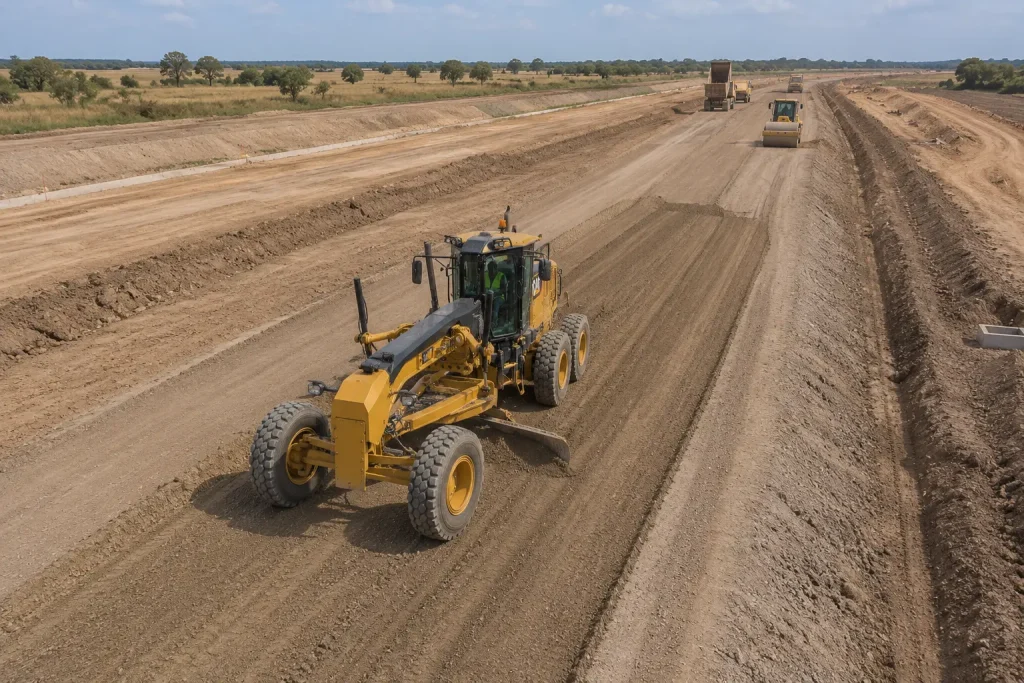 The motor grader is inseparable from road construction. Every road, from a rural access track to a major highway, passes through a grading phase in which the formation is brought to its design cross-section, drainage gradients are established, and the surface is prepared for the pavement layers that follow.
In road construction sequencing, the grader typically works after bulk earthworks, cut and fill by excavators and scrapers, have brought the formation to within a few hundred millimetres of design level, and before compaction by rollers and the placement of base course and pavement materials. The grader’s role in this sequence is to achieve the precise grade, cross-fall, and surface regularity that the pavement design requires.
On road projects, the grader also shapes the drainage features, table drains, mitre drains, cut batters, that protect the road formation from water ingress and erosion. Getting drainage right at the grading stage is critical: a road that sheds water effectively from its surface and its formation will perform better and require less maintenance throughout its life.
For large infrastructure projects that combine road construction with bridge works, utility installation, and structural earthworks, the types of foundation used to support road structures, including bridge abutments and culvert headwalls, have a direct influence on the earthwork and grading programme. An understanding of pile foundation types and their application in road and bridge infrastructure provides useful context for how foundation construction integrates with the grading programme on major road projects.
The motor grader is inseparable from road construction. Every road, from a rural access track to a major highway, passes through a grading phase in which the formation is brought to its design cross-section, drainage gradients are established, and the surface is prepared for the pavement layers that follow.
In road construction sequencing, the grader typically works after bulk earthworks, cut and fill by excavators and scrapers, have brought the formation to within a few hundred millimetres of design level, and before compaction by rollers and the placement of base course and pavement materials. The grader’s role in this sequence is to achieve the precise grade, cross-fall, and surface regularity that the pavement design requires.
On road projects, the grader also shapes the drainage features, table drains, mitre drains, cut batters, that protect the road formation from water ingress and erosion. Getting drainage right at the grading stage is critical: a road that sheds water effectively from its surface and its formation will perform better and require less maintenance throughout its life.
For large infrastructure projects that combine road construction with bridge works, utility installation, and structural earthworks, the types of foundation used to support road structures, including bridge abutments and culvert headwalls, have a direct influence on the earthwork and grading programme. An understanding of pile foundation types and their application in road and bridge infrastructure provides useful context for how foundation construction integrates with the grading programme on major road projects.
Also read : Types of Bridges: Structures, Uses, and How They Work
Precision on Every Pass
The motor grader is a precision instrument in an industry of heavy machinery. Its value lies not in moving large volumes of material but in bringing what has been moved to exactly the right level, grade, and profile, the final act of preparation before a road, a runway, a building platform, or a haul road is ready for the next stage of construction. Choosing the right grader type, the right size, the right frame configuration, the right attachments, and the right grade control technology, is the difference between a grading operation that meets its programme and budget and one that falls short on precision, productivity, or both. RR Machinery provides a comprehensive range of construction and earthmoving equipment for sale and rental, including motor graders, excavators, bulldozers, compactors, and supporting plant, all maintained to full operational standard and supported by experienced equipment specialists. Explore our full range of earthmoving and road construction equipment solutions, or contact our team for practical advice and a clear quotation matched to your project scope, site conditions, and grading requirements.