Anyone who has watched a technician trim a tall tree, an electrician service a streetlight, or a contractor paint the exterior of a three-storey building has probably seen a cherry picker in action, even if they did not know the machine by that name. The bright yellow arm extending upward with a small platform or bucket at the end, carrying a single worker safely to a height that would otherwise require scaffolding or a ladder, is one of the most recognisable pieces of access equipment in the construction and maintenance industries.
Despite how familiar the machine looks, the term “cherry picker” is often used loosely, sometimes correctly, sometimes to describe equipment that is technically a different category of aerial work platform altogether. Understanding exactly what a cherry picker is, how it works, the types available, and where it fits among other elevated access equipment is essential before specifying, renting, or operating one for any project.
This guide explains the cherry picker in detail: its definition, its origin, its mechanics, its main variants, and the practical considerations that determine whether it is the right choice for a given job.
What Is a Cherry Picker?
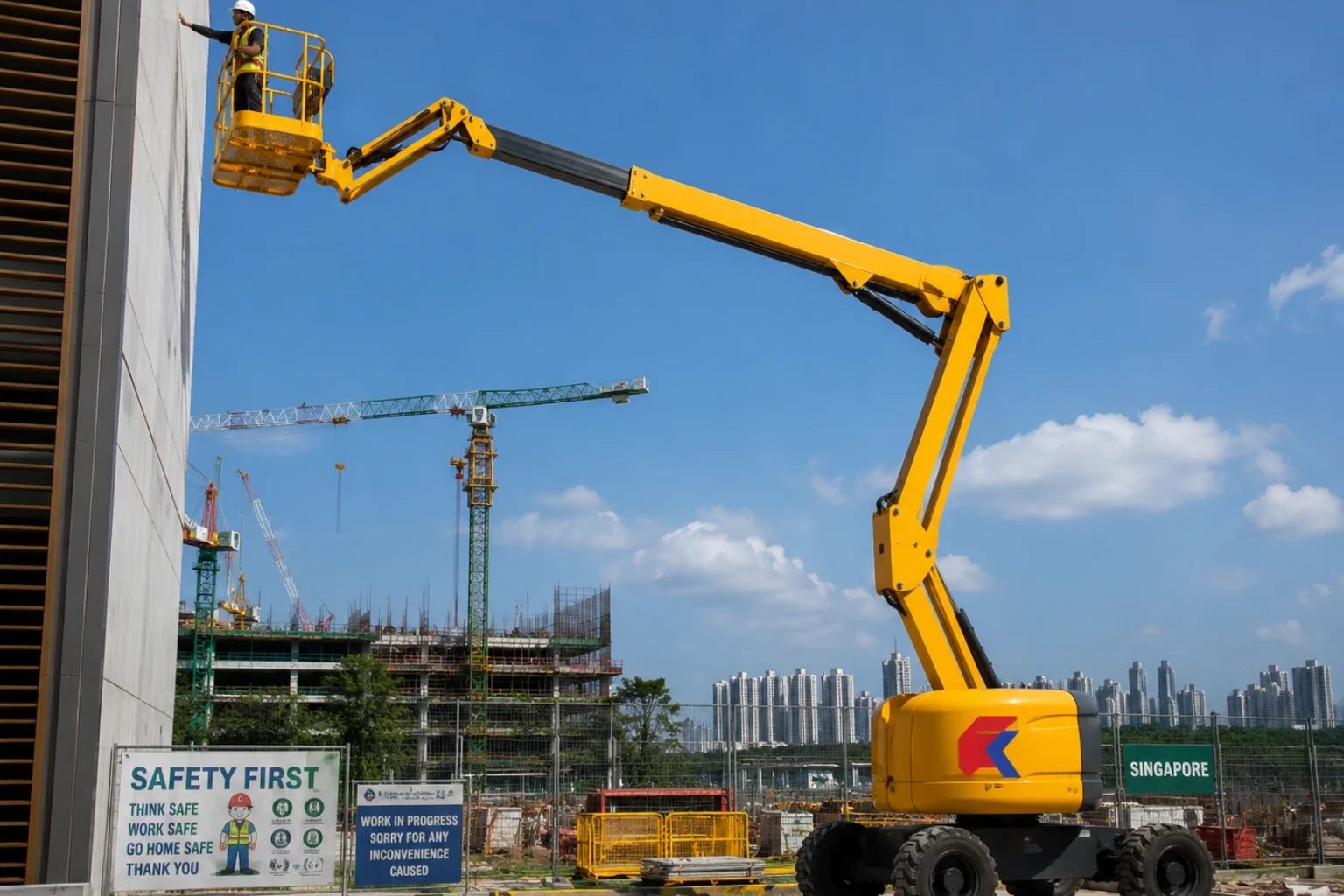
A cherry picker is a type of aerial work platform (AWP) that uses a hydraulic arm, commonly called a boom, to lift a worker in a platform or bucket to an elevated position. The boom can extend, raise, lower, and often rotate or articulate around obstacles, allowing the operator to reach specific points at height with precision that a fixed ladder or static scaffold cannot match.
In everyday site conversation, “cherry picker” is generally used as an informal, catch-all name for what professionals more precisely call a boom lift, one specific category within the broader family of aerial lifts. The two terms are frequently used interchangeably, and in this broad, everyday sense the underlying function is the same: providing safe, elevated access to a single point in space that would otherwise be difficult or dangerous to reach.
Used more precisely, however, cherry picker traditionally refers specifically to a truck-mounted or vehicle-mounted boom lift, a machine that combines road vehicle mobility with a hydraulic lifting arm, allowing it to travel on public roads under its own power and deploy its platform directly at the work location. A self-propelled boom lift built for repositioning within a single site is mechanically similar and often called a cherry picker in casual conversation, but is not one in this stricter sense. This distinction matters most when specifying equipment for a project, and is covered in full in our detailed comparison below.
RR Machinery’s own range of boom lifts reflects this same category of equipment, engineered to reach heights of up to 185 feet while manoeuvring around obstacles that would stop a simpler platform in its tracks.
Also read: Boom Lift vs Cherry Picker: Key Differences Explained
Where Does the Name “Cherry Picker” Come From?
The name has a genuinely agricultural origin. Before hydraulic aerial platforms existed, orchard workers used ladders to pick fruit from tall cherry trees, a slow and physically demanding task. In the mid-20th century, manufacturers began adapting hydraulic boom equipment, originally developed for utility line work, into platforms that could lift a single worker into the tree canopy. These early machines were literally used to pick cherries, and the nickname stuck.
Over the following decades, the same boom-and-platform design proved far more valuable to construction, utilities, telecommunications, and building maintenance than it ever was to agriculture. The equipment evolved dramatically, gaining hydraulic controls, rotating turrets, and far greater reach, but the informal name carried over and is now used worldwide, even though very few cherry pickers are used anywhere near an actual orchard.
How Does a Cherry Picker Work?
A cherry picker operates through a combination of a hydraulic boom system and a mobile or fixed base. The core components are:
- Base or chassis
Provides stability and, in mobile units, allows the machine to be driven or towed between locations. Larger models use outriggers that extend and stabilise the machine before the boom is raised.
- Turret
Mounted on the base, the turret rotates the boom assembly, typically 360 degrees, allowing the operator to position the platform in any horizontal direction without repositioning the entire machine.
- Boom
The hydraulic arm that lifts the platform. Depending on the type of cherry picker, the boom may extend telescopically, articulate at one or more joints, or combine both movements.
- Platform or bucket
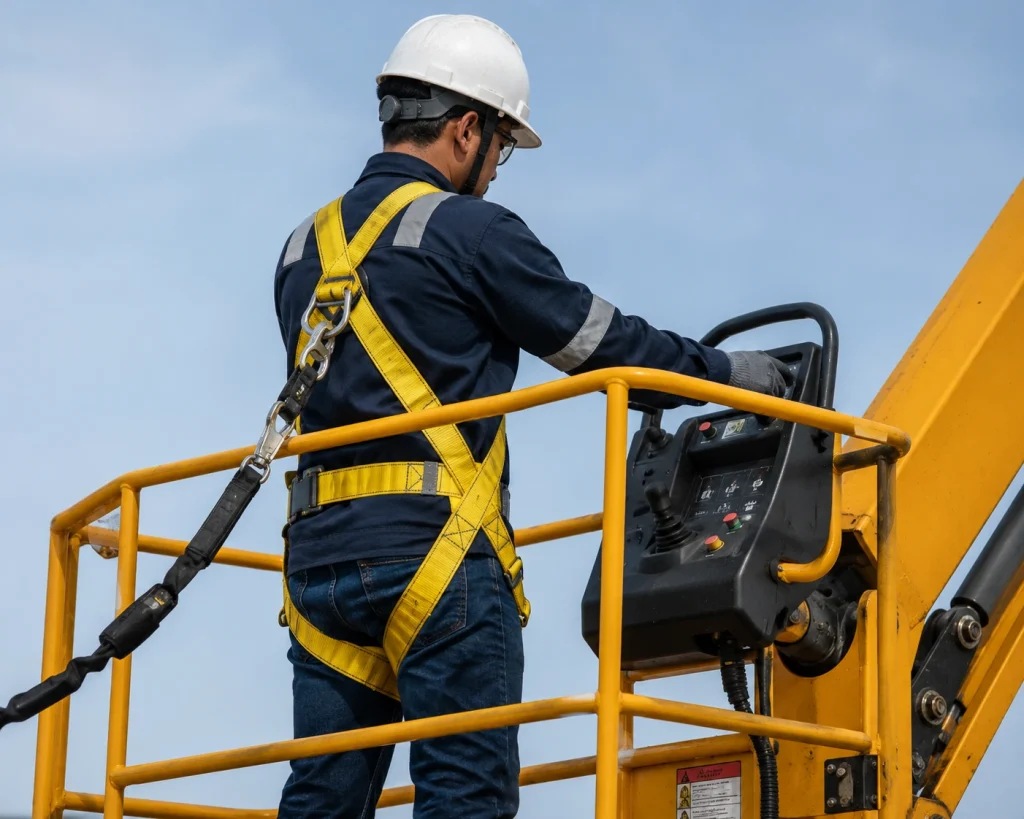
The elevated basket where the operator stands. It includes a control panel that allows the worker to operate the boom’s movement directly from height, along with guardrails and a safety harness anchor point.
- Hydraulic power unit
Diesel, electric, or hybrid systems supply the hydraulic pressure that raises, lowers, extends, and rotates the boom.
Once positioned and stabilised, the operator controls the entire lifting sequence from the platform itself, raising, extending, and rotating the boom until the platform reaches the exact point of access required, whether that is a light fixture, a building facade, or a tree branch several storeys up.
Types of Cherry Pickers
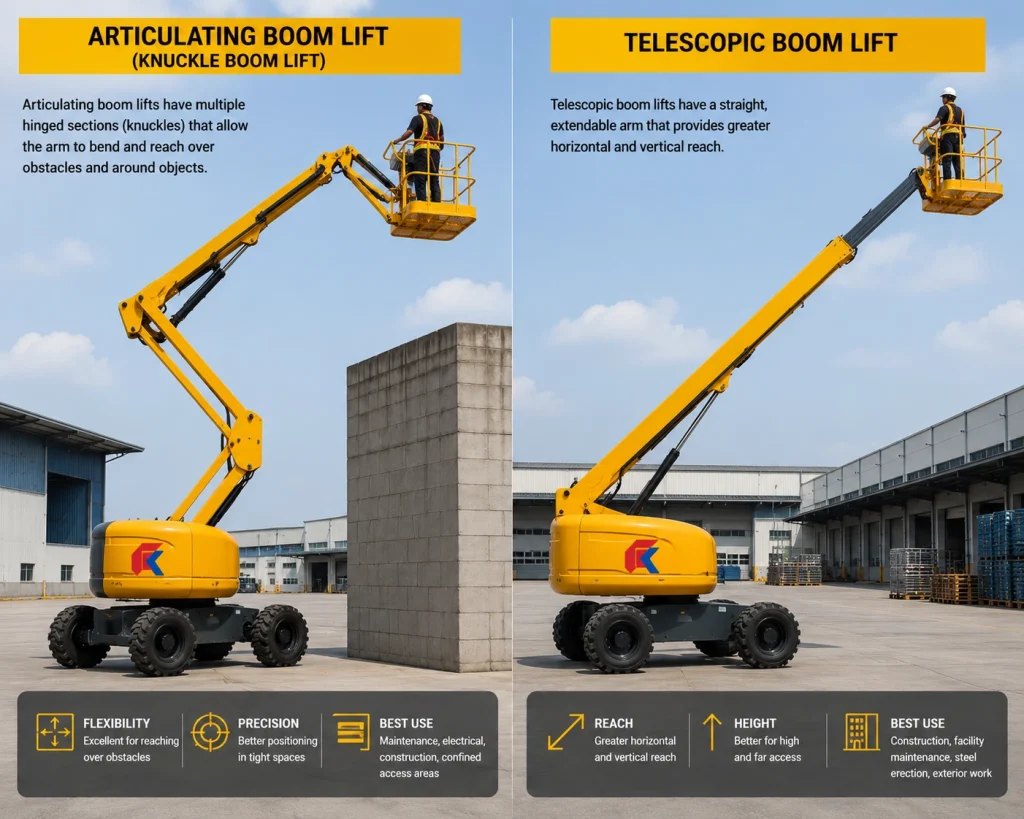
Not all cherry pickers are built the same way, and the differences between them determine which jobs each one is suited for.
Articulating Boom Lift (Knuckle Boom)
An articulating boom lift has multiple hinged sections that fold and unfold like a knuckle, allowing the platform to move up, out, and over obstacles in a single continuous path. This makes articulating boom lifts, sometimes called knuckle booms, the preferred choice for jobs where the target point at height is not directly above the machine, such as reaching over a wall, around structural beams, or above rooftop equipment.
Telescopic Boom Lift (Straight Boom)
A telescopic boom lift extends in a straight line, similar to a extending fishing rod, rather than folding at multiple joints. This design typically achieves greater horizontal outreach and higher maximum working heights than an articulating model of comparable size, making it well suited for open-area tasks such as steel erection, bridge inspection, or reaching straight up and out with no obstacles in the path.
Truck-Mounted Cherry Picker
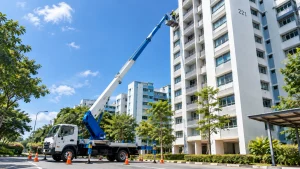
A truck-mounted cherry picker has the boom assembly fitted directly onto a truck chassis, giving it road mobility between job sites without needing a separate trailer or low-loader. These units are the standard choice for utility companies, telecommunications providers, and tree surgeons who need to move frequently between multiple locations in a single day.
Trailer-Mounted Cherry Picker
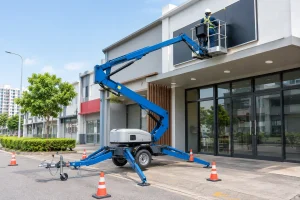
A trailer-mounted cherry picker is a compact boom unit fitted to a towable trailer, offering a lower-cost, easily transportable option for smaller jobs. These are common on residential maintenance work, small commercial sites, and short-duration tasks where a full self-propelled boom lift would be unnecessary.
Also read: Choosing Between Articulating and Telescopic Boom Lifts
What Is a Cherry Picker Used For?
Because a cherry picker can position a worker precisely at a single elevated point, it is used across a wide range of industries wherever tasks cannot be safely or efficiently performed from a ladder:
- Construction
Installing cladding, steel structures, glazing, and facade elements at height
- Building maintenance
Cleaning windows, repainting exteriors, and servicing signage or awnings
- Electrical and telecommunications work
Accessing streetlights, overhead cables, and telecom towers
- Tree care and arboriculture
Pruning, trimming, and removing branches from tall trees
- Events and entertainment
Rigging lighting, sound equipment, and stage structures
- Warehousing and industrial facilities
Reaching high racking, overhead pipework, and ceiling-mounted equipment
Across nearly every one of these applications, the value of a cherry picker comes down to the same principle: it gets one person safely and precisely to a fixed point at height, without the setup time, footprint, or fall risk associated with scaffolding or ladders.
Cherry Picker vs Scissor Lift vs Other Aerial Equipment
Cherry pickers are frequently confused with scissor lifts, and while both fall under the broader category of aerial work platforms, they are built for different tasks. A scissor lift raises a wide, rectangular platform straight up using a crossed “scissor” mechanism beneath it, and it can carry multiple workers along with tools and materials, but it can only move vertically, directly above its base. A cherry picker, by contrast, can extend, rotate, and reach outward and over obstacles, but its platform is smaller and generally rated for one or two workers.
In practical terms, a scissor lift suits tasks spread across a flat, wide area, such as installing ceiling panels across an entire warehouse floor, while a cherry picker suits tasks concentrated at a single, specific, and sometimes hard-to-reach point, such as trimming one section of a tree canopy or accessing a light fixture set back behind an obstruction. A closer breakdown of how a boom lift compares against a scissor lift across height, capacity, and manoeuvrability is useful reading before specifying either machine. RR Machinery’s scissor lift range covers heights up to 50 feet for exactly this kind of wide, flat-area access work, complementing the outreach capability of a boom lift.
Forklifts and mobile scaffolding are sometimes mistakenly grouped with cherry pickers too, but neither is designed to elevate a worker at height in the same way. A forklift is built to lift and transport palletised loads at ground and moderate racking levels, while mobile scaffolding provides a static elevated platform that must be manually assembled and repositioned, rather than a hydraulically operated one that can be repositioned in seconds.
Key Features and Specifications to Know
When evaluating a cherry picker for a specific job, a few specifications matter more than any brand name or model number:
- Working height
The maximum height the platform can reach, usually measured from the ground. This should always allow clearance above the actual task height, not just match it exactly.
- Horizontal outreach
How far the boom can extend sideways from the base, critical for jobs where the target point is offset from where the mac hine can be positioned.
- Platform capacity
The maximum combined weight of the operator, tools, and materials the platform can safely carry, which decreases as the boom extends further out.
- Power source
Diesel models suit outdoor and rough terrain use with higher torque, while electric models are quieter, produce no emissions, and are preferred for indoor or noise-sensitive environments.
- Terrain compatibility
Rough terrain models with larger tyres and four-wheel drive are built for construction sites and uneven ground, while standard models are designed for firm, level surfaces.
Matching these specifications to the actual job conditions, rather than simply choosing the tallest or most powerful available unit, is what keeps a project both efficient and within budget.
Also read: Types of Boom Lifts: Which One Does Your Job Need?
Safety Considerations When Operating a Cherry Picker
Working at height carries inherent risk, and a cherry picker must be operated with strict attention to safety procedure at every stage:
- Operator training and certification
Only trained and authorised personnel should operate a cherry picker, and operators should be familiar with the specific model’s controls before use.
- Fall protection
Workers in the platform should wear a full-body harness with a lanyard attached to the designated anchor point at all times, not just during movement.
- Pre-use inspection
Hydraulic lines, controls, tyres or outriggers, and safety interlocks should be checked before every shift.
- Ground conditions and stabilisation
The machine must be positioned on stable, level ground, with outriggers fully deployed where applicable, before the boom is raised.
- Load limits
Platform capacity limits, including the combined weight of workers, tools, and materials, must never be exceeded, particularly as the boom extends further from the base.
- Weather awareness
Operation should be suspended in high winds, lightning, or other adverse conditions that can affect stability at height.
In Singapore, aerial work platform operation is subject to Workplace Safety and Health regulations enforced by the Ministry of Manpower, and employers are required to ensure equipment is properly maintained and operators are properly trained before any lift is authorised. Guidance on these requirements is available directly from the Ministry of Manpower’s Workplace Safety and Health resources, which set out the compliance standards that apply to elevated work equipment across all industries in Singapore.
Buy or Rent a Cherry Picker in Singapore
For most businesses, the decision between buying and renting a cherry picker comes down to frequency of use. A company that requires elevated access on an ongoing basis, across multiple sites or on a near-continuous schedule, may find ownership more cost-effective over time, particularly when paired with a reliable maintenance partner. A business with occasional or project-based needs, on the other hand, is usually better served by renting, avoiding the capital outlay, storage requirements, and depreciation that come with ownership.
RR Machinery supports both paths with a full range of new and used boom lifts available for sale as well as flexible daily, weekly, monthly, and long-term rental plans, so businesses can match their equipment access to their actual operational tempo rather than committing to one model of ownership by default.
Choosing the Right Cherry Picker for Your Project
Selecting the right cherry picker comes down to matching the machine’s specifications to the task at hand rather than defaulting to whatever is most readily available. Consider the actual working height and outreach required, whether the terrain is smooth or uneven, whether the job is indoors or outdoors, how many workers and how much equipment the platform needs to support, and how frequently the machine will be used.
A telescopic boom lift makes sense for open, straight-line reach with no obstacles. An articulating boom lift is the better choice when the target point requires the platform to move up and over something in the way. A truck-mounted unit suits mobile service work across multiple sites, while a trailer-mounted or compact unit may be all that a small, occasional job requires.
Getting this specification right the first time avoids the cost and delay of switching equipment mid-project, and it keeps the job site safer by ensuring the operator has the reach, capacity, and stability the task genuinely demands.
Keep Your Projects Elevated with RR Machinery
A cherry picker, whatever specific type is required, remains one of the most practical solutions for getting a worker safely and precisely to a point at height. Understanding what it is, how it works, and which variant fits a given job is the first step toward specifying the right machine and completing the work safely and efficiently.
RR Machinery Pte Ltd is a trusted heavy machinery partner in Singapore, offering a wide range of boom lifts for both articulating and telescopic applications, backed by factory-certified technicians and full servicing and support for every unit sold or rented. Whether your project calls for a short-term rental or a long-term addition to your fleet, our team can help you match the right cherry picker to the job. Contact us today for expert advice and a clear quotation tailored to your operational needs.