system foFormwork is the temporary mould into which fresh concrete is poured and held until it gains sufficient strength to support itself. It is one of the most labour-intensive, cost-intensive, and safety-critical elements of any reinforced concrete construction project, yet it receives far less attention in project planning discussions than the structural concrete it enables.
In a typical mid-rise reinforced concrete building, formwork and falsework costs can represent 40 to 60 percent of the total cost of the structural frame. The choice of formwork system directly affects the speed of the floor-to-floor cycle, the quality of the concrete surface finish, the safety of the workforce during construction, the amount of labour required on site, and the quantity of waste material generated. It also determines what equipment is needed to handle, position, and strike the formwork, affecting crane utilisation, forklift requirements, and the extent to which elevated access equipment is needed for work at height.
This guide covers all the main types of concrete formwork in widespread use, explaining how each system works, what it is suited to, and what construction and equipment implications it carries. It is designed to give project managers, site engineers, contractors, and construction planners the information they need to select the right formwork system for their specific project conditions.
What Formwork Must Do, and Why the Choice Matters
Before comparing individual formwork types, it is worth establishing what a formwork system must achieve and why the choice between systems is consequential.
Structural function: Formwork must safely carry the hydrostatic pressure of fresh concrete, which behaves as a liquid during pouring, as well as the dynamic loads from construction traffic, vibration equipment, and the weight of workers and materials on the formwork deck. Formwork failure during a pour, caused by inadequate design, poor construction, or premature removal, results in catastrophic concrete collapse that is invariably fatal to anyone working below.
Surface quality: The formwork face in contact with the concrete determines the quality of the concrete surface finish. Smooth plywood produces a fair-faced finish. Rough or damaged formwork produces a surface that requires significant remedial work. Where the concrete surface will be exposed in the finished building, the formwork specification is as important as the concrete mix design.
Dimensional accuracy: Concrete takes the shape of the formwork that contains it. If the formwork is not accurately set to the design dimensions and correctly supported against movement during the pour, the resulting concrete structure will not comply with the dimensional tolerances required by the structural drawings.
Cycle time: The speed at which formwork can be erected, poured, allowed to cure, struck, and re-erected for the next pour determines the floor-to-floor cycle time, the primary driver of programme for a reinforced concrete building. A formwork system that adds days to each floor cycle adds weeks to the programme over a ten-storey building.
Safety: Formwork construction involves working at height, handling heavy components, and operating in close proximity to concrete placing equipment. The formwork system must be designed to allow safe erection, safe access for concrete placing and finishing, and safe striking without exposing workers to unacceptable risk.
These requirements apply regardless of which formwork system is used. The differences between systems lie in how well they meet each requirement under specific project conditions, which is why formwork selection, like the selection of lifting and access equipment for each phase of construction, must be matched to the specific demands of the project rather than defaulting to the most familiar or cheapest option.
Also read : Building Construction Types: Structural Systems and What Each One Requires
Types of Concrete Formwork
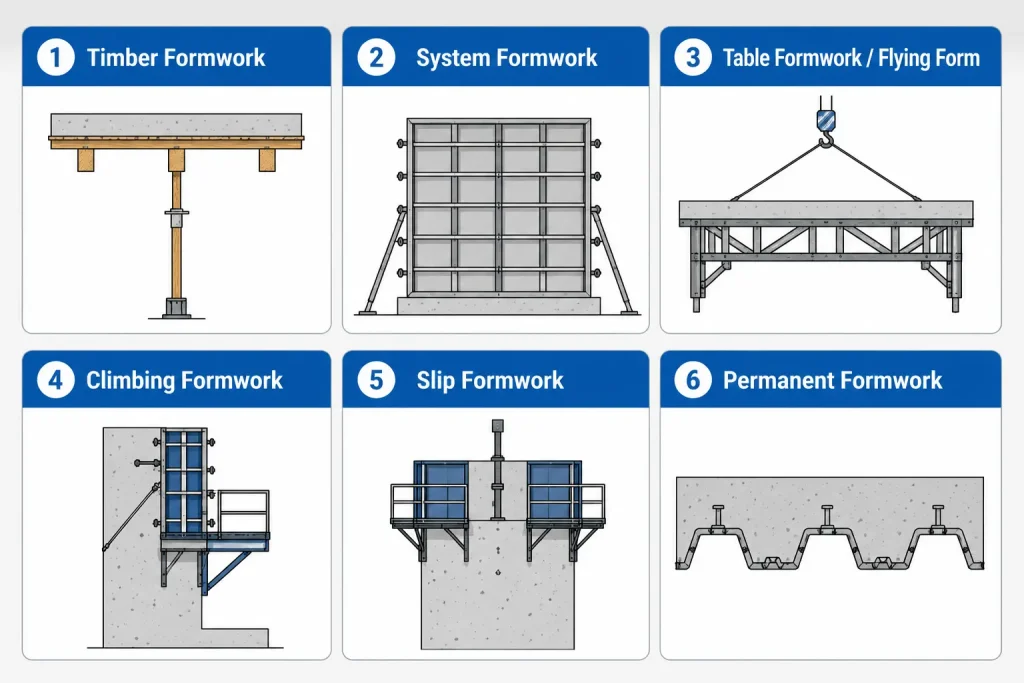
Timber Formwork
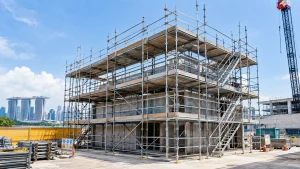
Timber formwork is the oldest and most flexible formwork system. It uses timber boards, plywood sheets, and timber framing members, props, joists, and ledgers, to construct a custom mould for the concrete element being cast. Every element is cut and assembled on site to the required dimensions, making timber formwork adaptable to any structural shape, however complex or irregular.
How it works:
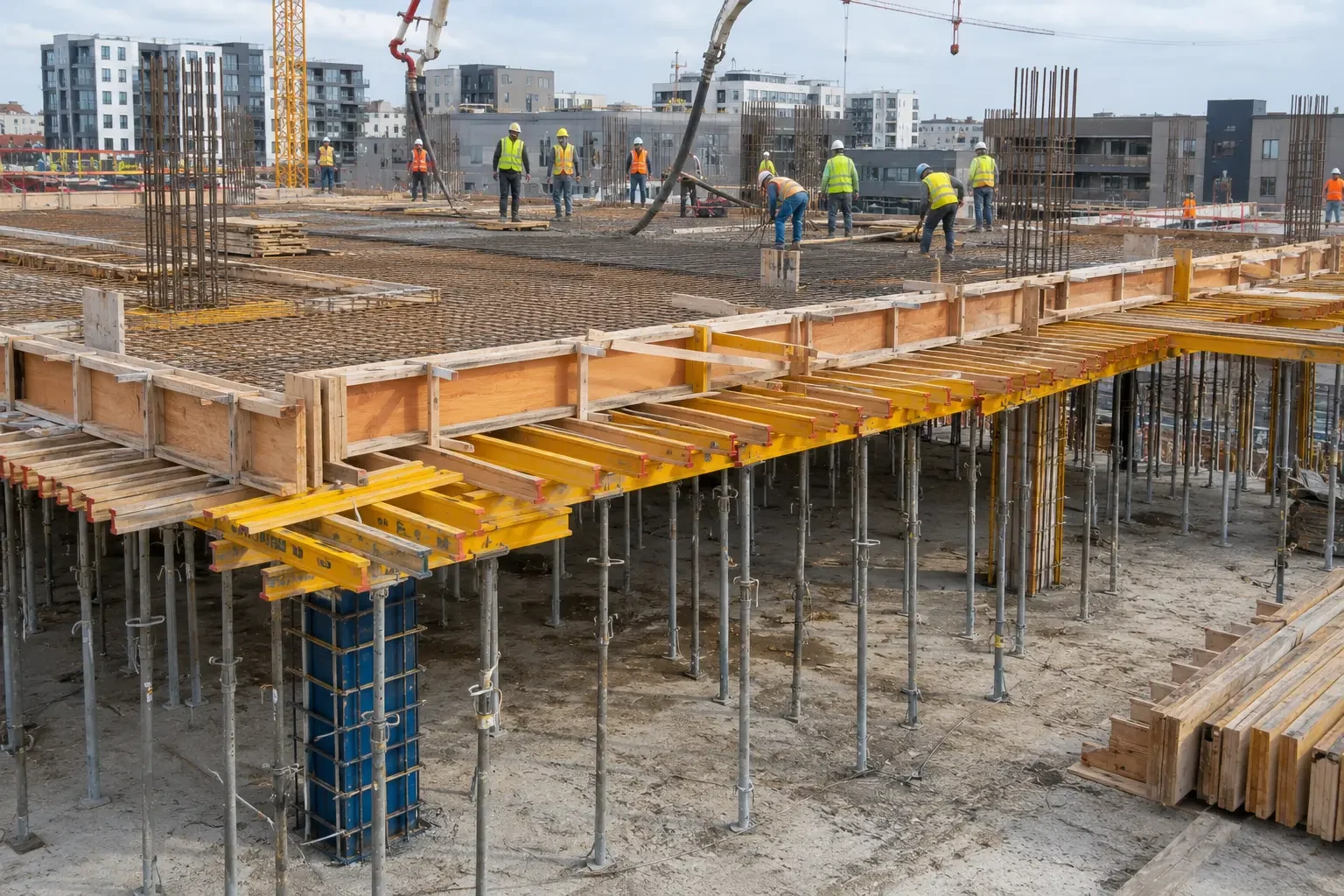
Structural plywood, typically 18 mm or 21 mm thick, forms the contact face with the concrete. The plywood is supported by a grid of timber joists running in one direction, spanning between ledgers running in the other direction, which in turn are supported by adjustable steel or timber props resting on the slab below or on the ground. The entire assembly must be designed to carry the hydrostatic pressure of the fresh concrete without deformation.
Advantages:
Timber formwork requires no specialist equipment and no proprietary components, any competent carpenter can work with it using standard hand and power tools. It can be adapted to any structural geometry and is particularly suited to projects with complex or non-repetitive structural elements, heritage restoration, and situations where proprietary system components cannot reach the required form.
Limitations:
Timber formwork is labour-intensive to fabricate and erect, and it generates significant quantities of waste timber. The number of reuses is limited, plywood typically achieves four to six good reuses before the surface quality deteriorates and the sheet must be replaced. On projects with many repetitive pours, the cumulative labour cost of timber formwork significantly exceeds that of proprietary systems. Dimensional consistency between pours can be difficult to maintain without careful carpentry.
Best suited for:
Complex or irregular structural geometry, low-volume pours, bespoke architectural concrete, projects in locations where proprietary system components are not readily available, heritage and restoration work.
System Formwork (Proprietary Panel Formwork)
System formwork, also called modular formwork or engineered formwork, uses standardised, pre-engineered panels of defined dimensions that clip, bolt, or pin together to form the mould. The panels are typically made from aluminium or steel frames faced with plywood or steel sheet, designed to be reused hundreds or even thousands of times.
How it works:
Panels of standard widths (typically 300 mm, 450 mm, 600 mm, and 900 mm) are assembled in combinations to form the required structural dimensions. Fillers and corner pieces accommodate non-standard dimensions. The panels are held together by wedge-action panel ties or through-bolts that also control the wall thickness. Adjustable steel props support horizontal formwork panels (soffit formwork) for slab pours.
The high reuse rate of system formwork, typically 200 to 500 reuses for aluminium panels, means the capital cost of the panels is amortised over a large number of pours, making it significantly more cost-effective than timber on repetitive projects.
Advantages:
System formwork is faster to erect and strike than timber because panels clip together quickly without cutting or nailing. The surface quality is consistent across reuses, the engineered panel face produces a uniform, smooth concrete surface. Labour requirements are lower than timber for equivalent volumes of concrete.
Limitations:
System formwork requires investment in a proprietary panel set, either purchased or hired, and is most cost-effective on projects where the structural geometry is sufficiently repetitive to use standard panel combinations. Non-standard dimensions require fillers that add complexity to the assembly. The panels must be lifted by crane or other mechanical means for larger elements, manual handling of individual panels is feasible for wall formwork but not for large slab soffit systems.
Best suited for:
Repetitive residential and commercial concrete construction, walls, columns, and slabs with standard dimensions, projects where speed of cycling and surface quality are priorities.
Table Formwork (Flying Form / Flying Table)
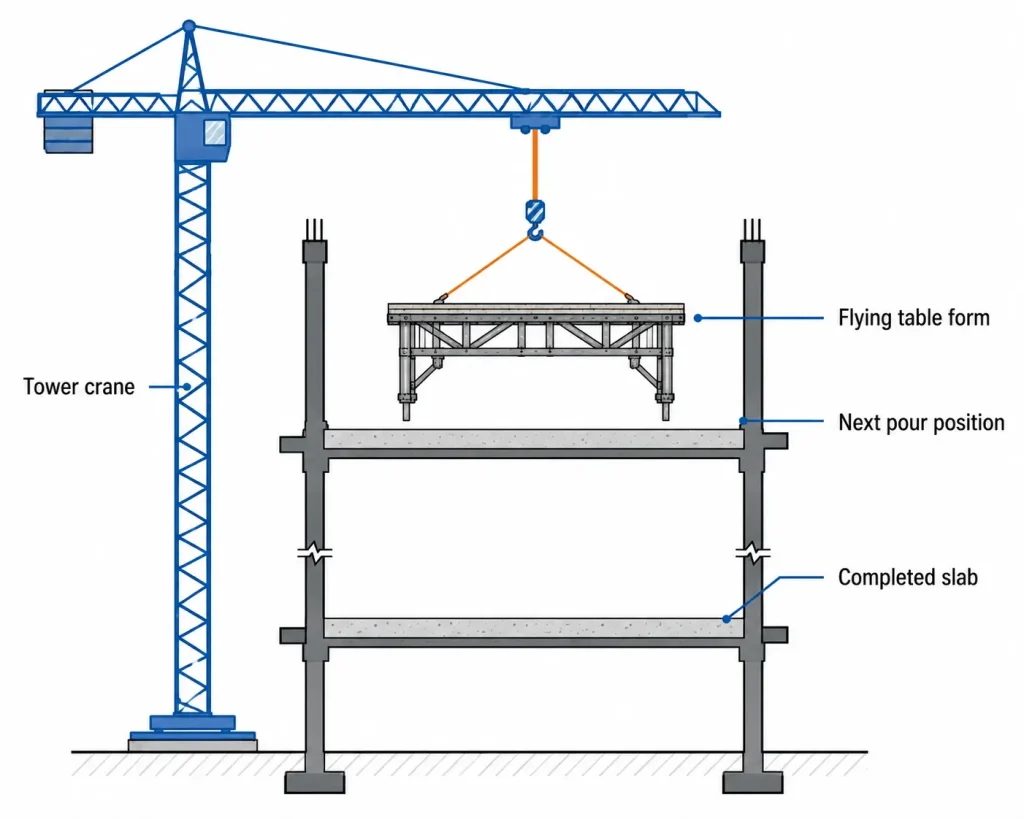
Table formwork, also called flying form or flying table, is a large pre-assembled slab soffit formwork unit that is designed to be moved as a single unit from one floor to the next using a crane, without being dismantled. The table consists of a steel or aluminium frame supporting a plywood soffit deck, typically spanning the full bay width between columns or walls.
How it works:
A table form is assembled once for the first pour. After the slab has gained sufficient strength and the table is struck, the entire unit is rolled or wheeled to the slab edge, lifted by crane, and flown to the floor above, ready to be rolled into position for the next pour. The assembly and dismantling that would normally occur at each floor level is eliminated, and the only crane time required is the fly operation itself.
Advantages:
Table formwork dramatically reduces the labour required per floor cycle. The flying operation, crane pick and set down, takes a fraction of the time required to strip, transport, and re-erect equivalent timber or system formwork. On a repetitive building with a regular column grid and consistent floor heights, table formwork can achieve floor-to-floor cycle times that would be unachievable with other systems.
Limitations:
Table formwork is only cost-effective on repetitive, regular structures, it cannot accommodate complex slab geometries, and it requires a consistent column or wall grid to support the table edges. The crane time required for flying operations must be carefully scheduled to avoid conflicts with other crane activities on site. The crane must have sufficient capacity to lift the table at the operating radius required, table form loads can be significant, and this must be confirmed from the crane load chart.
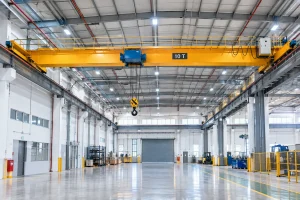
The interaction between table formwork and crane operations is one of the clearest examples of how formwork selection affects equipment planning. Understanding how crane components and rated capacities interact during lifting operations is directly relevant to planning a table formwork programme.
Best suited for:
Repetitive flat-slab construction, residential towers, commercial buildings with regular column grids, projects where maximising the floor-to-floor cycle speed is the primary objective.
Also read : Types of Pile Foundation: How They Work and How to Choose
Climbing Formwork
Climbing formwork, also called jump form or self-climbing form, is used for the construction of tall vertical concrete elements: core walls, shear walls, lift shafts, and bridge pylons. Rather than being stripped and re-erected from scratch at each level, climbing formwork is attached to the previously cast concrete and raised, either by crane or by self-climbing hydraulic jacks, to the next casting position.
How it works:
The formwork is suspended from climbing brackets that grip the previously cast concrete through anchor points cast into the wall. After each pour, the formwork is released, raised by the specified lift height (typically 3 to 4.5 metres, representing one floor or half-floor cycle), and re-secured to the new anchor points. The working platform, access walkways, and safety screens travel with the formwork, providing continuous fall protection and access at height without the need for separate scaffolding.
Types of climbing formwork:
Crane-climbed formwork relies on the tower crane to lift the formwork assembly to the next position. This creates a dependency between the formwork cycle and the crane programme, the crane must be available for the climbing operation, which can create scheduling conflicts on busy sites.
Self-climbing formwork uses hydraulic jacks mounted on the climbing brackets to raise the formwork without crane assistance. This eliminates the crane dependency and allows the wall to climb independently of other crane activities on site, a significant programme advantage on tall buildings where crane utilisation is a critical path activity.
Advantages:
Climbing formwork provides safe, integrated working platforms at height without the need for separate scaffolding. On tall concrete cores, it typically achieves faster cycle times than any other system because it is always in position, the crew remains on the same equipment throughout, and no time is lost to erection or dismantling.
Limitations:
Climbing formwork is expensive to procure or hire, and its design must be specific to the structure being built. It is not economical for short walls or structures of limited height. Self-climbing systems in particular require specialist design and are typically supplied and operated by specialist contractors.
Best suited for:
Tall concrete cores, shear walls, lift shafts, bridge pylons, chimneys, and any tall vertical concrete element where speed and safety at height are priorities.
Slip Formwork
Slip formwork is a continuous, moving formwork system used for structures of constant cross-section, silos, tanks, bridge piers, and tall building cores. The formwork moves upward continuously at a slow rate, typically 100 to 300 mm per hour, while concrete is continuously poured and the previously cast concrete hardens progressively below the formwork face.
How it works:
The formwork panels, working platform, and yoke assembly are raised by hydraulic jacks that grip vertical steel jack rods cast into the concrete. As the system rises, fresh concrete is continuously placed at the top, while hardened concrete emerges from the bottom of the formwork already self-supporting. The continuous nature of slip forming eliminates construction joints between pours, a structural and waterproofing advantage for liquid-retaining structures.
Advantages:
Slip formwork is the fastest method for constructing tall structures of constant cross-section. A slip forming operation on a large silo or building core can advance several metres per day. The absence of construction joints improves structural integrity and watertightness.
Limitations:
Slip forming requires round-the-clock operation, once started, it cannot be stopped without risk of the formwork seizing in the hardening concrete. This requires three shifts of workers and continuous concrete supply, which must be planned and resourced before the operation begins. Any interruption to the concrete supply or the jacking system can have serious consequences. Slip formwork is not adaptable to changes in cross-section or to complex geometries.
Best suited for:
Silos, storage tanks, bridge piers of constant cross-section, tall building cores, chimneys, and other tall structures where continuous, joint-free construction is a structural requirement.
Permanent Formwork
Permanent formwork, also called stay-in-place formwork, remains in place after the concrete has cured and becomes an integral part of the finished structure. The most common example is profiled steel deck (metal deck) used as permanent soffit formwork for composite floor slabs in steel-framed buildings.
How it works:
Profiled steel decking is laid across the steel beams, providing immediate working surface for the construction team and acting as the soffit formwork for the concrete slab above. Shear studs welded to the steel beams connect the slab to the beam, allowing them to act compositely. After the concrete cures, the decking remains in place as the soffit, typically receiving a spray plaster or suspended ceiling finish in the completed building.
Advantages:
Permanent formwork eliminates the cost and programme time of striking and removing soffit formwork. The steel deck provides an immediate, safe working surface for the placing team. On steel-framed buildings, it is the standard composite floor system.
Limitations:
Permanent formwork cannot be reused. Its cost must be accepted as a one-time element of the floor slab cost. The deck profile affects the effective structural depth of the composite slab and must be selected to suit the design span and load requirements.
Best suited for:
Composite floor slabs in steel-framed buildings, any application where the soffit formwork serves a permanent function in the finished structure.
Key Factors in Formwork Selection
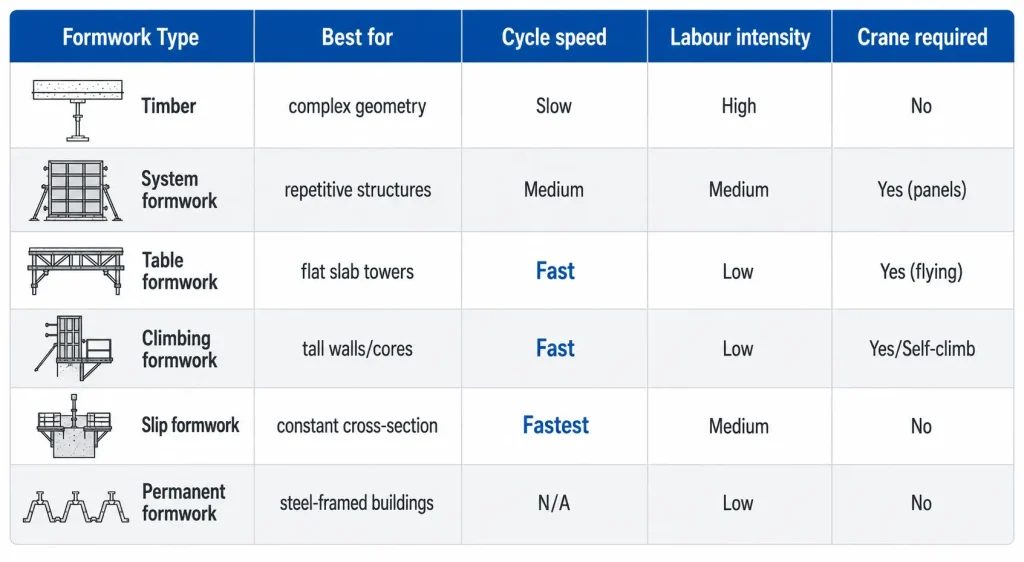
Selecting the right formwork system requires evaluating several project-specific factors:
Structural geometry: Regular, repetitive structures favour system formwork, table forms, or climbing systems. Complex or non-repetitive structures favour timber formwork.
Programme: Where cycle time is the primary driver, table formwork and climbing formwork offer the fastest cycling. Timber formwork is the slowest for equivalent volumes.
Labour availability: System and table formwork require less skilled labour than timber formwork for equivalent volumes. In markets where skilled carpenters are scarce or expensive, system formwork offers a labour-cost advantage even on moderately repetitive projects.
Crane availability and capacity: Table formwork and crane-climbed systems require significant crane time. Where crane utilisation is already a critical path constraint, self-climbing systems eliminate the dependency and free crane time for other activities.
Surface finish requirements: All systems can produce good concrete surfaces if correctly specified and maintained. Timber is most flexible for special architectural finishes. Steel-faced system formwork produces the most consistent surface quality across multiple reuses.
Cost: Timber has low upfront cost but high labour cost per pour. System formwork has higher upfront cost but lower labour cost per pour and is cost-effective from approximately five to ten reuses onward. Table and climbing systems have the highest upfront cost but the lowest labour cost per pour and are cost-effective only on tall, repetitive buildings.
The relationship between formwork selection and equipment requirements, particularly crane utilisation, material handling, and elevated access, is directly relevant to construction site planning. These interactions are covered in practical guides to construction site planning and equipment coordination.
For technical reference on formwork design standards, concrete pressure calculations, and international best practice for temporary works in concrete construction, engineering resources on concrete formwork design and construction methods provide comprehensive background on how formwork systems are engineered and specified.
Also read : Best Materials to Build a House: A Practical Guide
Choose the Right Formwork and Equip the Site to Support It
Formwork selection is a structural, logistical, and economic decision that shapes every phase of concrete construction, from the first column pour to the final slab. The right system, correctly specified and supported by the right equipment on site, allows the structure to be built safely, efficiently, and to the required quality standard.
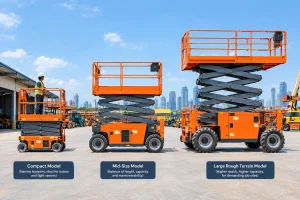
Every formwork system requires equipment to support it, cranes for flying tables and climbing systems, forklifts and telehandlers for moving panel sets, elevated access platforms for work at slab and wall edges, and generators for temporary power. Getting the equipment mix right alongside the formwork selection is what turns a sound formwork choice into a productive, well-run site.
RR Machinery offers a comprehensive range of construction equipment for sale and rental, including boom lifts, scissor lifts, mobile scaffolding, forklifts, and power generators, all maintained to operational standard and supported by experienced technicians. Explore our full range of construction and site equipment solutions or contact our team for practical advice and a clear quotation tailored to your project requirements.