When ground conditions near the surface cannot adequately support the loads from a proposed structure, pile foundations transfer those loads to deeper, more competent soil or rock layers. Piling is one of the most widely used deep foundation techniques in modern construction, used across residential, commercial, industrial, infrastructure, and marine projects worldwide.
Understanding the different types of pile foundations, how each one works, what ground conditions it is suited to, and what construction process it requires, is essential knowledge for structural engineers, geotechnical consultants, project managers, and contractors involved in any project where soil conditions present challenges for conventional shallow foundations.
The choice of pile type affects not only the structural performance of the foundation system but also the construction methodology, the equipment required on site, the noise and vibration impact on adjacent properties and structures, and the overall cost and programme of the project. Getting the pile selection right at the design stage prevents the costly variations, programme overruns, and structural problems that arise when the wrong piling system is deployed in unsuitable ground conditions.
This guide covers all the main types of pile foundations in widespread use, grouped by their mechanism of load transfer, installation method, and material. For each type, we explain how it works, what conditions it suits, and what the construction implications are.
How Pile Foundations Work
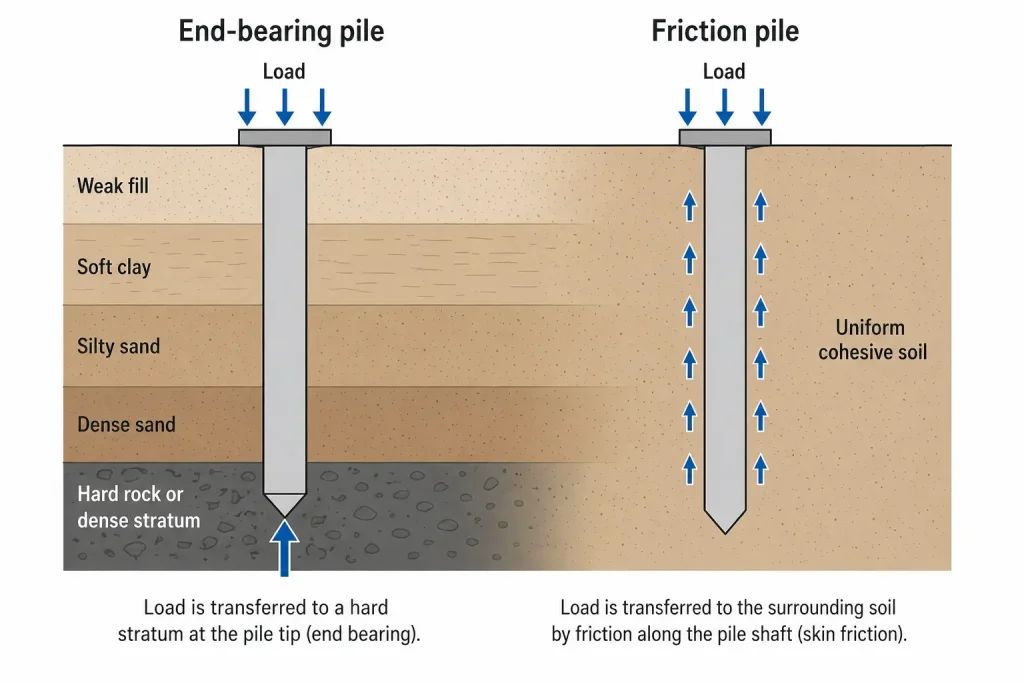
Before comparing individual pile types, it is important to understand the two fundamental mechanisms by which piles transfer load from the structure above to the ground below.
End-bearing piles transfer load primarily through the tip of the pile, which bears against a hard layer, typically rock, dense gravel, or a firm stratum, at depth. The pile acts essentially as a column, passing the load through weak upper soils to the competent bearing layer below. End-bearing piles are used where a suitable bearing stratum exists at a knowable and consistent depth.
Friction piles (also called skin friction piles or floating piles) transfer load primarily through friction between the surface of the pile and the surrounding soil. The pile does not need to reach a hard bearing stratum, instead, the accumulated skin friction over the length of the pile is sufficient to carry the design load. Friction piles are used in deep clay deposits and other cohesive soils where a suitable bearing stratum is either very deep or absent entirely.
Many piles in practice rely on a combination of both mechanisms, some end bearing at the tip and some skin friction along the shaft, with the relative contribution of each depending on the pile geometry, the installation method, and the soil profile.
Understanding how load transfer works is fundamental to selecting the right pile type and interpreting the results of pile load tests. This is directly analogous to understanding how load distribution works in above-ground lifting and access operations, whether specifying the right crane configuration for a specific lifting task or selecting the right pile for a specific soil condition, matching the load path to the capacity of the system is the essential engineering decision.
Also read : Best Materials to Build a House: A Practical Guide
Types of Pile Foundation by Material
Concrete Piles
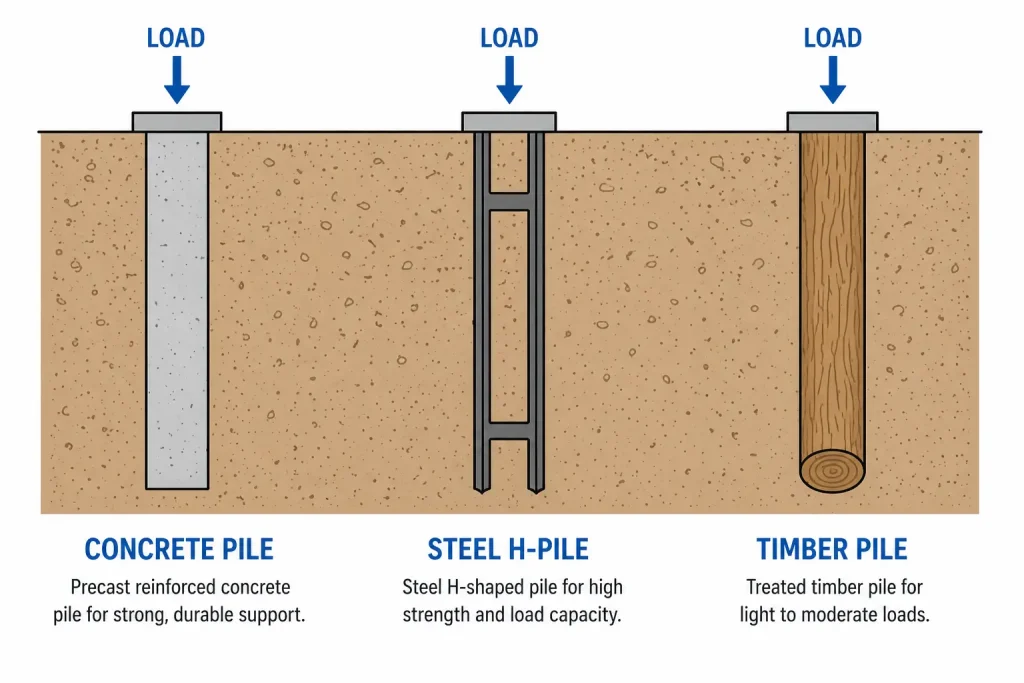
Concrete is the most widely used piling material globally. Concrete piles are available in two main forms: precast and cast-in-situ (bored).
Precast concrete piles are manufactured in a factory or casting yard, transported to site, and driven or jacked into the ground. They are available in square, circular, and octagonal cross-sections, and in pre-tensioned and post-tensioned configurations that improve their resistance to the tensile stresses that develop during driving. Precast piles are highly consistent in quality, because they are manufactured under controlled conditions, their strength and dimensions are reliable. They are commonly used in marine and waterfront construction, in bridge foundations, and in building foundations where driven piles are appropriate.
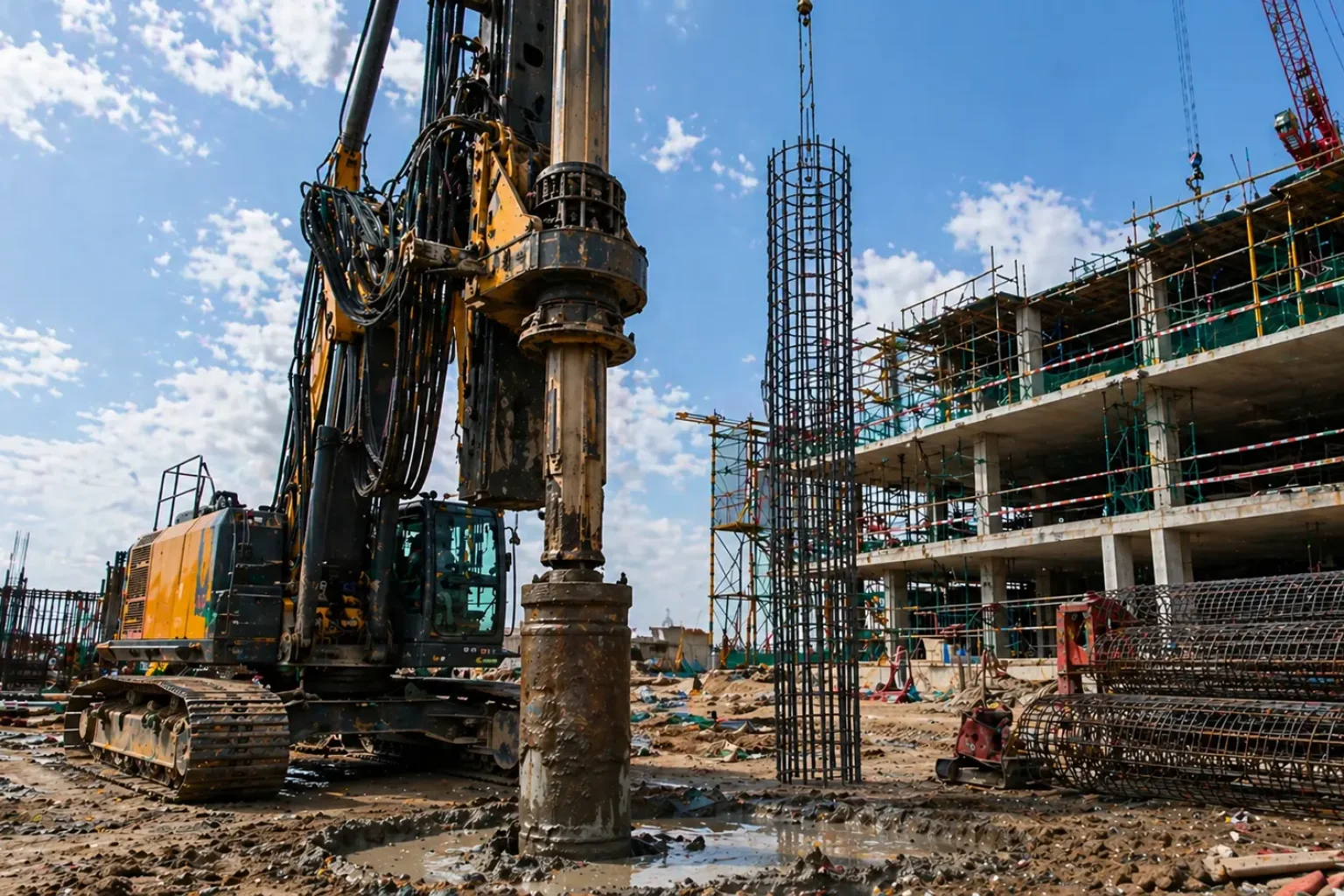
Cast-in-situ concrete piles (bored piles) are formed by drilling or boring a hole in the ground, inserting a reinforcement cage, and filling the hole with concrete. Bored piles can be constructed to large diameters (up to 2 metres or more) and deep lengths, making them capable of carrying very high loads. They produce no driving vibration, a significant advantage in urban environments adjacent to existing structures. The quality of cast-in-situ piles depends heavily on the workmanship during installation, proper cleaning of the borehole, correct reinforcement placement, and continuous tremie concreting are all critical to producing a sound pile.
Best suited for: Multi-storey building foundations, bridge piers, marine structures, any project where high load capacity and long service life are required.
Steel Piles
Steel piles are available in several profiles, H-piles (wide-flange sections), pipe piles (hollow circular sections), and sheet piles (interlocking sections used for earth retention rather than vertical load transfer). For vertical load-bearing applications, H-piles and pipe piles are most common.
Steel H-piles are driven through hard or dense soils that would damage or break a concrete pile during installation. Their relatively small cross-sectional area allows them to penetrate dense sands, gravels, and soft rock layers that resist concrete pile installation. They are commonly used in rock-bearing applications where the pile tip must be driven to refusal on bedrock.
Steel pipe piles can be driven open-ended (allowing soil to enter the pipe) or closed-ended (with a flat plate welded to the tip). Open-ended pipe piles can penetrate dense soils more readily; after driving, the interior may be cleaned out and filled with concrete to increase load capacity and corrosion resistance.
Best suited for: Rock-bearing applications, dense granular soils, projects requiring high penetration resistance, marine and offshore structures.
Limitations: Steel piles are vulnerable to corrosion, particularly in marine and aggressive soil environments. Adequate corrosion protection, through coating, cathodic protection, or increased wall thickness, must be specified for the expected design life.
Timber Piles
Timber piles are the oldest form of pile foundation, used in construction for thousands of years. Driven timber piles made from straight-grained hardwood or softwood species remain in use in certain applications, particularly in marine structures, jetties, and temporary works, where their low cost, easy availability, and adequate structural performance make them a practical choice.
Modern timber piles are typically treated with preservative compounds to resist biological degradation. Their load capacity is lower than concrete or steel piles of comparable dimensions, which limits their application to relatively light structures.
Best suited for: Marine and waterfront structures, jetties, light residential buildings on soft ground, temporary works and falsework.
Limitations: Lower load capacity than concrete or steel. Susceptible to biological degradation above the water table where alternate wetting and drying occurs. Not suitable for heavy structures.
Types of Pile Foundation by Installation Method
Driven Piles
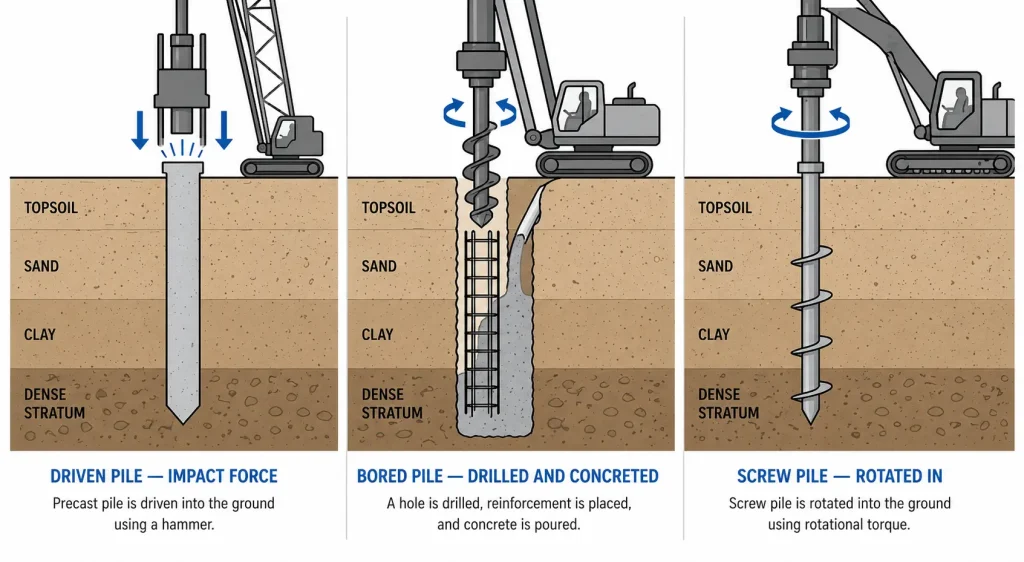
Driven piles are installed by applying repeated impact force to the top of the pile, using a drop hammer, diesel hammer, hydraulic hammer, or vibratory hammer, driving it progressively into the ground. The driving resistance increases as the pile penetrates to denser or stiffer soil layers, and driving continues until the pile reaches its design set (a specified penetration per blow that indicates sufficient bearing capacity has been achieved).
Driven piling is fast and productive on suitable sites. The installation process also densifies the surrounding soil (particularly in granular soils) through displacement, which can increase the load capacity of adjacent piles and improve the overall ground conditions.
Key advantages:
- Fast installation rates
- Suitable for a wide range of pile sizes and materials
- Installation provides direct evidence of ground resistance through blow count monitoring
- Displacement effect improves surrounding soil
Key limitations:
- Generates significant noise and vibration, problematic in urban environments adjacent to existing structures or vibration-sensitive equipment
- Hard driving can damage pile heads and tips
- Not suitable for all soil conditions, cobbles, boulders, and very dense layers can deflect or damage driven piles
Also read : Equipment to Clear Land: Every Machine You Need
Bored Piles (Drilled Shafts)
Bored piles are installed by drilling or boring a circular hole in the ground using rotary drilling equipment, then placing the reinforcement cage and filling with concrete. The borehole may be supported during drilling by a temporary steel casing, by a permanent casing, or by a drilling fluid (bentonite slurry or polymer fluid) that provides hydraulic pressure to prevent the borehole walls from collapsing.
Bored piling produces no driven vibration, making it the preferred method in urban areas, near existing structures, and on any site where vibration-sensitive conditions exist. Large-diameter bored piles, often called “barrettes” in certain configurations, can carry extremely high loads, making them the standard choice for high-rise building foundations in many parts of the world.
The drilling rigs used for bored piling range from compact track-mounted units for small-diameter piles to large crane-hung Kelly drilling rigs for large-diameter deep piles. The logistics of operating heavy drilling equipment, positioning, ground preparation, and access, requires the same careful planning that applies to all heavy machinery operations on construction sites.
Key advantages:
- No vibration during installation
- Can achieve very large diameters and depths
- Suitable for use near existing structures
- Minimal noise compared to driven piling
Key limitations:
- Slower than driven piling for equivalent numbers of piles
- Quality highly dependent on workmanship
- Disposal of arisings (excavated spoil) must be managed
- Ground conditions may require support fluid management
Screw Piles (Helical Piles)
Screw piles, also called helical piles or helical anchors, consist of a steel shaft with one or more helical plates (flights) welded along its length. The pile is installed by rotating it into the ground using a hydraulic motor mounted on an excavator, eliminating the need for either driving or boring.
The rotating action of the helical flights pulls the pile into the ground with minimal soil disturbance. Screw piles can be installed quickly, require no arisings removal, produce no vibration, and can be loaded immediately after installation without any concrete curing time. They are also removable, an advantage for temporary works applications.
Best suited for: Temporary structures, light to medium permanent buildings, sites with restricted access where larger piling rigs cannot operate, environmental restoration projects, areas where soil disturbance must be minimised.
Limitations: Load capacity is limited by the helix diameter, shaft size, and soil conditions. Not suitable for very high loads or for penetrating hard rock or dense obstructions.
Micropiles (Mini Piles)
Micropiles, also called mini piles or pin piles, are small-diameter (typically 75–300 mm) drilled piles that are used where access is restricted, loads are moderate, or existing structures must be underpinned. They are drilled and grouted rather than driven, producing no vibration. Their small diameter allows them to be installed inside existing buildings, in low-headroom situations, and in any location inaccessible to full-size piling rigs.
Micropiles are commonly used in underpinning existing foundations, strengthening ground beneath existing structures, and providing foundation support in heritage buildings where disruption to existing fabric must be minimised.
Best suited for: Underpinning, restricted access sites, low-headroom environments, heritage structures, seismic retrofit foundation strengthening.
Contiguous and Secant Bored Pile Walls
While individual bored piles are used for vertical load bearing, arrays of bored piles are also used to form earth retention walls for basement excavations, cut slopes, and below-ground structures.
Contiguous bored pile walls consist of bored piles installed in a row with a small gap between adjacent piles. They provide earth retention but are not fully watertight, groundwater can pass between the piles. They are used in relatively dry ground conditions where water ingress is manageable.
Secant bored pile walls consist of alternating “primary” and “secondary” piles where the secondary piles are bored to overlap with the adjacent primary piles, cutting into them and forming a continuous interlocked wall. Secant pile walls are watertight and are used in basement construction where groundwater exclusion is essential.
Key Factors in Pile Type Selection
Selecting the right pile type for a project involves evaluating several factors simultaneously:
- Ground conditions
The soil profile, its stratigraphy, strength, compressibility, and water table, is the primary determinant of pile type suitability. A geotechnical investigation (borehole drilling and in-situ testing) is essential before any piling specification can be made.
- Structural loads
The magnitude and nature of the loads to be transferred, axial compression, tension (uplift), and lateral loads, determine the required pile capacity and, consequently, the pile diameter, length, and number.
- Site constraints
Urban sites near existing structures require low-vibration, low-noise installation methods. Sites with restricted access or low headroom require compact piling equipment. Contaminated sites require careful management of arisings.
- Programme
Driven piling is generally faster than bored piling for equivalent pile numbers. Where programme is critical, the installation rate of different pile types, typically expressed as piles per shift, must be factored into the comparison.
- Cost
Pile cost depends on material, installation method, pile size, and quantity. Driven precast piles are generally cost-effective at moderate load levels. Large-diameter bored piles carry higher unit cost but can replace many smaller piles.
- Environmental impact
Noise, vibration, spoil disposal, and groundwater management are all environmental considerations that affect pile type selection, particularly in urban, sensitive, or regulated environments.
These selection principles apply across all foundation engineering decisions, and they mirror the structured approach that applies when selecting any heavy construction equipment, matching the capability of the chosen system to the specific demands of the site and the project, as covered in practical guides to heavy equipment selection for construction projects.
For technical reference on pile foundation design, installation standards, and geotechnical testing methods, engineering resources on deep foundation systems and pile engineering provide comprehensive background on how pile capacity is calculated and verified in practice.
Also read : Workplace Safety Tips for Construction and Industrial Sites
Get the Right Equipment and Support for Your Foundation Project
Understanding the types of pile foundations, from driven precast concrete piles to large-diameter bored piles, screw piles, and micropiles, gives project teams the foundation knowledge needed to engage meaningfully with geotechnical engineers, piling contractors, and equipment suppliers. The right pile type, correctly specified and installed, provides a foundation that will perform reliably for the life of the structure above it.
Foundation construction, piling, dewatering, temporary works, and substructure construction, requires a wide range of equipment operating in close coordination. Cranes for handling precast elements, excavators for bored pile arisings, generators for temporary power, and access platforms for working in deep excavations are all part of a complete foundation construction operation.
RR Machinery offers a comprehensive range of construction equipment for sale and rental, including boom lifts, scissor lifts, mobile scaffolding, forklifts, and power generators, all maintained to operational standard and supported by experienced technicians. Explore our full range of construction and site equipment solutions or contact our team for practical advice and a clear quotation tailored to your project requirements.