
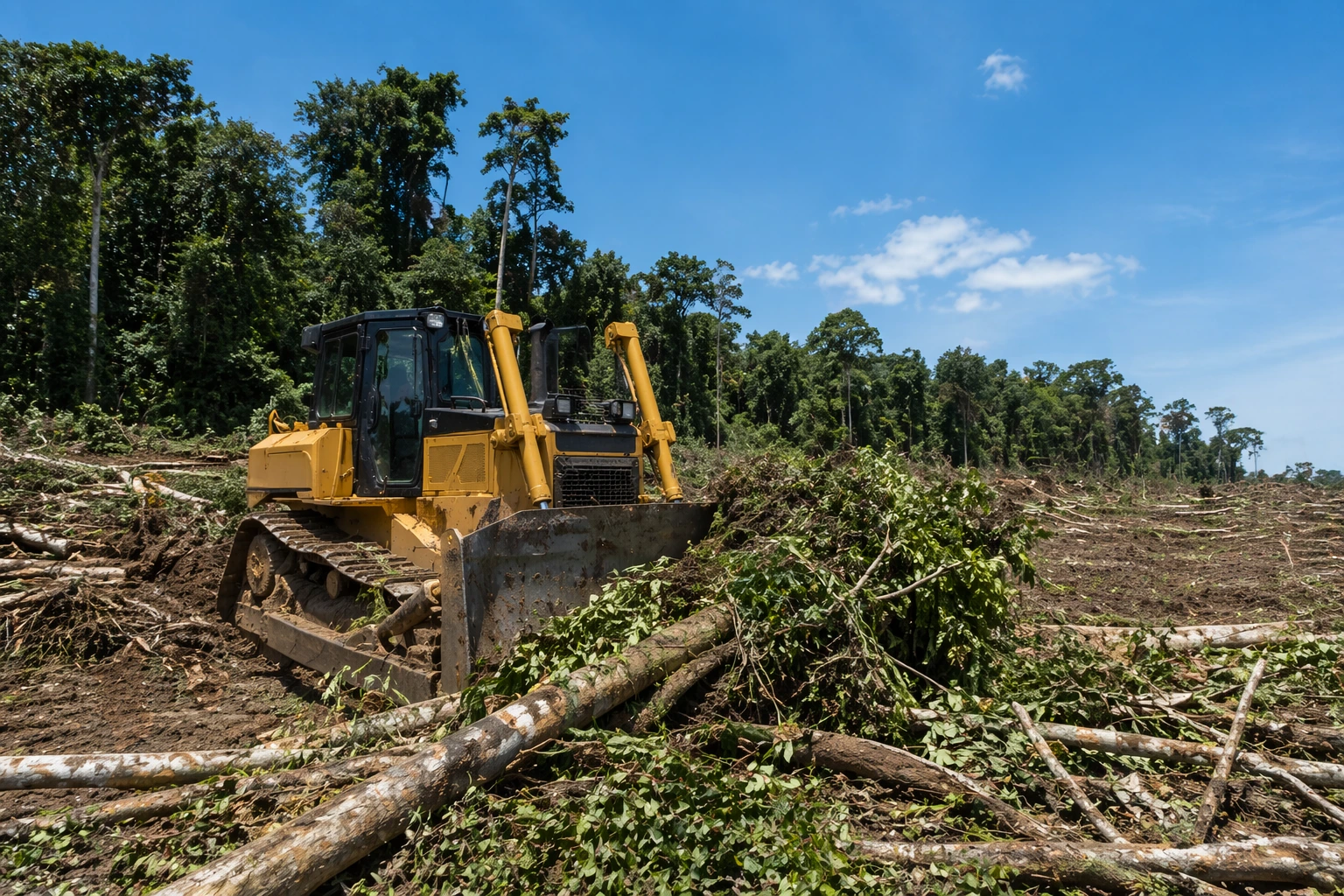
exLand clearing is one of the first and most critical phases of any construction, infrastructure, agricultural, or development project. Before foundations can be laid, roads can be built, or crops can be planted, the site must be cleared, vegetation removed, trees felled, stumps extracted, topsoil graded, and in many cases, existing structures or debris removed entirely. The equipment used to achieve this determines how quickly, safely, and cost-effectively the site can be prepared for what comes next.
The range of equipment available for land clearing is broad, and the right combination depends on the nature of the site, what is growing on it, how dense the vegetation is, what the soil conditions are, how large the area is, and what the cleared land needs to look like when the work is done. A site overgrown with light scrub requires different equipment from one covered in mature hardwood forest. A site that will become a building foundation requires a different standard of clearing from one being prepared for agricultural use.
This guide covers all the main types of equipment used to clear land, explaining what each machine does, how it works, and in which conditions it performs best, giving project managers, contractors, and site owners the information they need to plan a land clearing operation efficiently and safely.
Why Equipment Selection Matters in Land Clearing
Land clearing is not a single activity, it is a sequence of operations, each requiring different machines working in a coordinated order. Felling trees before the undergrowth is cleared creates access problems. Attempting to grade a site before stumps are removed damages grading equipment. Trying to compact ground before debris is removed produces an uneven, weak subgrade.
Understanding the sequence of land clearing operations and the equipment appropriate to each phase is as important as knowing what individual machines can do. The most common mistakes in land clearing operations are: using equipment that is too small for the site conditions, deploying machines in the wrong sequence, and underestimating the volume and weight of material that needs to be moved.
Every land clearing project also requires decisions about material disposition, whether cleared vegetation will be burned, chipped, mulched on site, or hauled off, and these decisions affect which ancillary equipment is needed alongside the primary clearing machines. Just as selecting the right type of lifting or access equipment for a construction phase prevents costly substitutions and delays, planning the complete equipment lineup for land clearing before work begins is essential for keeping the operation on schedule.
Also read : Types of Excavator Buckets and Their Uses Explained
Primary Land Clearing Equipment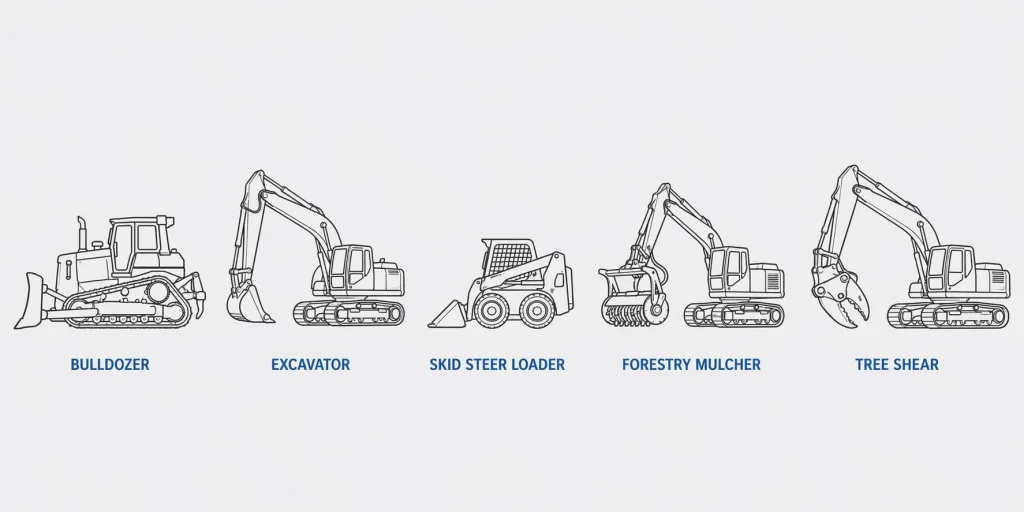
Bulldozer
The bulldozer is the foundational machine of land clearing. With its wide steel blade mounted at the front and powerful tracked undercarriage, a bulldozer pushes, uproots, and piles vegetation, trees, stumps, rocks, and debris. It can clear large areas of mixed vegetation efficiently, using its blade to fell trees by pushing against them at the base and its weight and ground pressure to uproot shallow root systems as it advances.
Bulldozers are available in a wide range of sizes, from compact machines suited to smaller sites to large crawler dozers with blades over 4 metres wide for major land clearing contracts. The choice of dozer size depends on the density of vegetation, the size of trees to be felled, and the ground conditions. Soft or waterlogged ground may require low ground pressure (LGP) track configurations that distribute the machine’s weight over a wider footprint.
Best for: Dense vegetation clearing, tree felling, stump pushing, large-scale debris piling, initial rough clearing on medium to large sites.
Limitations: Not suited for selective clearing where specific trees or vegetation must be preserved. Leaves a rough, uneven surface that requires follow-up grading. Can cause significant topsoil disturbance.
Excavator
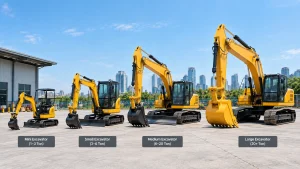
The excavator is one of the most versatile machines in land clearing. Fitted with a standard digging bucket, it can uproot stumps and clear roots from previously bulldozed areas. Fitted with a hydraulic thumb or grapple attachment, it can pick up, sort, and load felled trees and large debris. Fitted with a hydraulic breaker, it can break up rock, concrete, or hardpan that the bulldozer cannot penetrate.
The excavator’s boom-and-arm configuration gives it reach that a bulldozer does not have, it can work material from a distance, place debris in specific locations, and operate in tighter spaces than a large dozer. On sites where access is constrained or where selective clearing is required, an excavator is often the more practical primary machine.
Understanding the full range of excavator attachments and how each one is matched to specific ground conditions is directly relevant to land clearing operations, where the right bucket or attachment can make the difference between efficient clearing and slow, damaging work.
Best for: Stump removal, root clearing, loading felled material, breaking rock or hardpan, working in confined or restricted access areas, selective clearing.
Limitations: Slower at bulk vegetation clearing than a bulldozer. Requires a flat, stable working surface for safe operation.
Skid Steer Loader
A skid steer loader is a compact, highly manoeuvrable four-wheeled or tracked machine that accepts a wide range of front-mounted attachments. In land clearing, the most relevant attachments are the forestry mulcher (or brush cutter), the root rake, the grapple bucket, and the stump grinder attachment.
The skid steer’s compact footprint and tight turning radius make it invaluable on sites where a bulldozer or large excavator cannot operate effectively, around existing structures, in narrow corridors, along fence lines, and on sites with overhead obstacles. It is also the standard machine for clearing light to medium vegetation on smaller sites where a full-size bulldozer would be excessive.
Best for: Small to medium sites, clearing around obstacles, light to medium vegetation, mulching scrub and undergrowth, loading and sorting debris on cleared areas.
Limitations: Not powerful enough for large trees or dense mature forest. Limited reach compared to an excavator.
Forestry Mulcher (Forestry Cutter)
A forestry mulcher, also called a brush cutter, forestry head, or land clearing mulcher, is a hydraulic attachment most commonly fitted to a skid steer, track loader, or excavator. It uses a high-speed rotating drum fitted with carbide cutting teeth that shreds vegetation, small trees, and brush into chips or mulch that remain on the site as organic matter.
Forestry mulching has become an increasingly popular land clearing method because it eliminates the need for burning, chipping, hauling, or disposing of vegetation separately. The mulch produced is worked into the topsoil, reducing erosion risk and improving soil structure. It is particularly well-suited for sites where burning is prohibited, where hauling costs would be high, or where the cleared land will be used for agriculture or revegetation.
Best for: Sites where burning or hauling is impractical, erosion-sensitive sites, vegetation up to approximately 20–25 cm in diameter, agricultural land preparation, utility corridor clearing.
Limitations: Not effective on large-diameter trees. Leaves mulch on the surface that must be managed if the site is to be graded to a precise finish. Not appropriate where stumps and root systems must be fully removed.
Tree Shear
A tree shear is a hydraulic attachment, typically fitted to an excavator or skid steer, that grips and shears trees at the base rather than cutting them. It is fast and efficient for felling standing timber in a controlled manner, allowing the operator to direct the fall precisely without the hazards associated with chainsaw felling in mechanised clearing operations.
Tree shears are used where trees must be felled cleanly and quickly, particularly in timber harvesting operations alongside land clearing. They do not grind or mulch, they fell the tree intact, which then needs to be processed separately by a wood chipper, grapple saw, or hauled off site.
Best for: Controlled felling of trees in a specific direction, timber salvage operations, sites where logs will be processed or sold, working in areas where falling trees must be precisely directed.
Limitations: Does not process the felled tree, requires additional equipment for processing and disposal. Limited diameter capacity depending on model.
Secondary and Support Equipment
Stump Grinder
Once trees have been felled and the above-ground material removed, stumps remain as obstacles to grading, foundation work, and any use of the cleared land. A stump grinder uses a rotating cutting wheel fitted with tungsten carbide teeth to grind the stump down to below ground level, reducing it to wood chips that can be removed or incorporated into the soil.
Stump grinders are available as self-propelled walk-behind machines for small sites, ride-on machines for medium sites, and large tracked machines for high-volume stump grinding on major clearing contracts. The grinding depth required depends on what the cleared land will be used for, below-grade slabs and underground services require deeper grinding than surface-level agricultural use.
Best for: Removing stumps left after tree felling, preparing sites for foundations, roads, or other structures where residual root material cannot be left in place.
Chipper / Wood Chipper
A wood chipper processes felled trees, branches, and brush into woodchip that can be hauled away compactly or spread as mulch on site. It significantly reduces the volume of material that needs to be transported off site, a tree that would fill several truck loads when felled can be chipped and loaded into a single truck.
Chippers are towed behind a vehicle and fed by hand or by a crane/grapple. They are used wherever cleared material cannot be burned or mulched in place, and where transportation costs make volume reduction economically important.
Best for: Processing felled material for mulch or off-site disposal, reducing transport volume of cleared vegetation, sites where burning is prohibited.
Root Rake
A root rake is an excavator or dozer attachment consisting of heavy steel tines (similar to a comb) that rake through loose soil to separate roots, stumps, rocks, and debris from the topsoil. After a bulldozer has made an initial clearing pass and pushed vegetation into windrows, a root rake attachment on an excavator can clean the remaining surface, pulling root systems from the disturbed soil and piling them for removal.
Root raking is a critical step on sites where the cleared land will be used for agriculture, landscaping, or fine grading, the residual organic material left by a bulldozer clearing pass must be removed before the soil can be properly cultivated or compacted.
Also read : Construction Equipment Names: A Complete Reference Guide
Motor Grader
Once the primary clearing work is complete, vegetation removed, stumps ground, debris hauled, a motor grader is used to establish the final surface profile. The grader’s long adjustable blade can create precise gradients, drainage falls, and level surfaces across large areas far more accurately than a bulldozer.
Grading is the final step that transforms a rough-cleared site into a properly prepared platform for the next phase of the project, whether that is foundation excavation, road base construction, or agricultural cultivation. The quality of the grading work directly affects drainage performance, structural integrity of the finished works, and the efficiency of subsequent construction operations.
Best for: Final surface profiling, establishing drainage gradients, levelling large cleared areas, road formation.
Dump Truck and Articulated Hauler
All land clearing operations generate material that must be moved, either to an on-site disposal area, a stockpile, or off site entirely. Dump trucks and articulated haulers transport felled timber, stumps, roots, topsoil, and debris from the clearing area to the disposal point.
The haulage fleet must be sized to match the production rate of the primary clearing equipment, if the bulldozer and excavator can clear faster than trucks can haul, the operation backs up. If trucks are oversized for the clearing rate, capital and fuel are wasted. Balancing the clearing and haulage fleets is a fundamental part of land clearing project planning.
Planning the Right Equipment Combination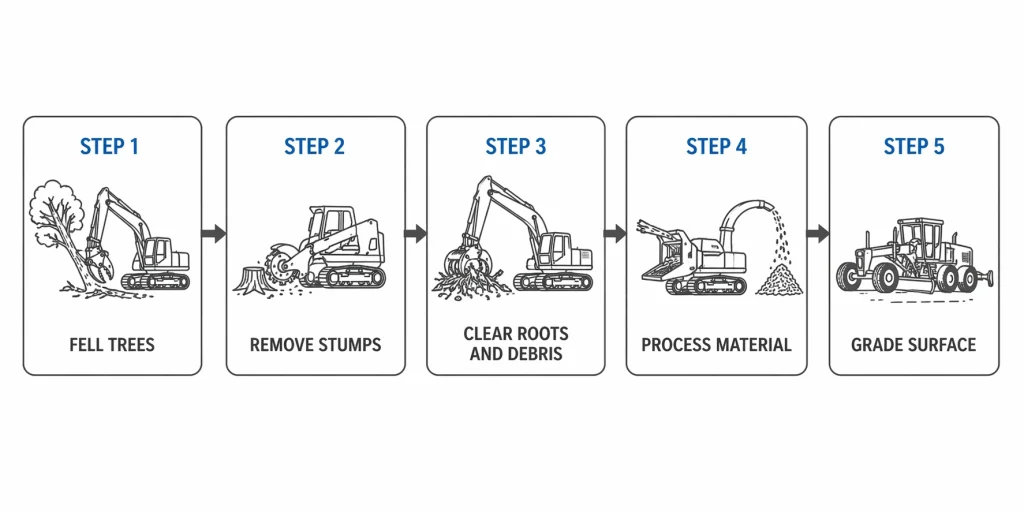
No land clearing project is identical, and the right equipment combination depends on a careful assessment of the specific site conditions, clearing objectives, material disposition plan, and programme.
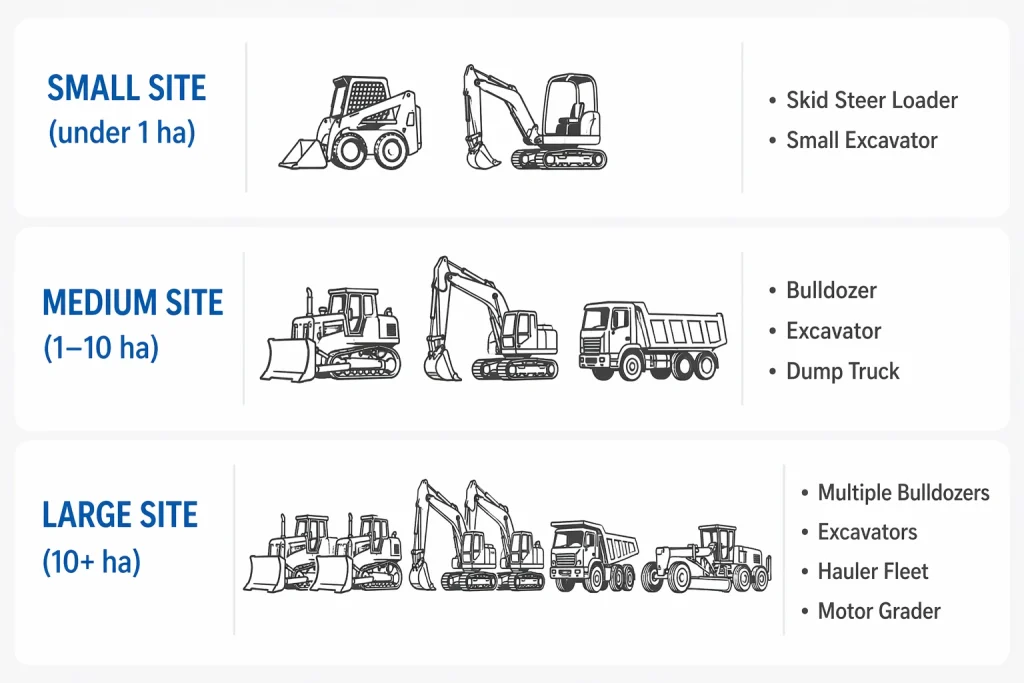
Site size is the first filter. Small sites (under 1 hectare) are typically handled by a skid steer with mulching or grapple attachments, perhaps supported by a small excavator. Medium sites (1–10 hectares) usually require a bulldozer as the primary machine supported by an excavator for stump removal and loading. Large sites require multiple dozers, excavators, and a coordinated haulage fleet.
Vegetation density and species determine what the primary clearing machine can handle. Light scrub and small trees can be mulched or pushed. Dense forest with large-diameter hardwood requires purpose-built forestry equipment and may require chainsaw crews for the largest trees before mechanical clearing can proceed.
Soil conditions affect machine selection and productivity. Soft, waterlogged ground requires LGP tracked machines. Rocky ground requires machines with adequate ground clearance and hydraulic breaking capability. Steeply sloping ground limits what equipment can safely operate.
Material disposition, burn, mulch, chip, haul, affects which processing and transport equipment is needed alongside primary clearing machines.
Programme and cost determine how many machines are deployed simultaneously and for how long. A larger, better-equipped operation is faster but more expensive per day. A smaller operation is cheaper per day but slower to complete, potentially increasing overall programme cost.
These planning considerations are parallel to those that apply when selecting material handling and site support equipment for construction operations, matching machine capacity to task volume, sequencing operations correctly, and ensuring support equipment does not become the bottleneck that limits the production rate of the primary machines.
For technical reference on land clearing methods, environmental considerations, and equipment classifications used in civil engineering and site preparation, resources on earthmoving and land clearing operations provide useful background on how clearing methodologies are classified and regulated across different jurisdictions.
Also read : How Does a Generator Work? Principles, Components, and Types Explained
Get the Right Equipment for Your Land Clearing Project
Land clearing is a complex, multi-phase operation that requires the right combination of primary clearing machines, processing equipment, and support fleet, deployed in the correct sequence and matched to the specific conditions of the site. Getting the equipment selection right at the planning stage prevents the costly delays, damage, and rework that occur when the wrong machines are brought to site.
Whether your project involves clearing a small plot for residential development, preparing a large site for industrial construction, or opening up land for agricultural use, the equipment you choose and the sequence in which you deploy it will determine how efficiently and safely the clearing is accomplished.
RR Machinery offers a comprehensive range of heavy machinery and site equipment for sale and rental, including equipment suited for construction, earthmoving, and site preparation operations. Explore our full range of heavy machinery solutions for construction and site preparation or contact our team for practical advice and a clear quotation tailored to your specific project requirements.


Great overview of why proper land clearing and excavation are so important before any construction project begins. I especially liked the emphasis on safety, site preparation, and proper grading because those early steps have a huge impact on the success of the entire project. The section on choosing the right contractor was also helpful for property owners who may not know what to look for. Thanks for sharing such a detailed and informative guide.