Not every lifting operation takes place on a smooth, stable, paved surface. Construction sites in their early phases have disturbed, uneven, and often waterlogged ground. Infrastructure projects, road construction, pipeline installation, bridge building, operate in terrain that no road-going crane can safely access. Offshore support bases, mining operations, and rural development projects require a crane that can travel where no truck-mounted machine would dare go.
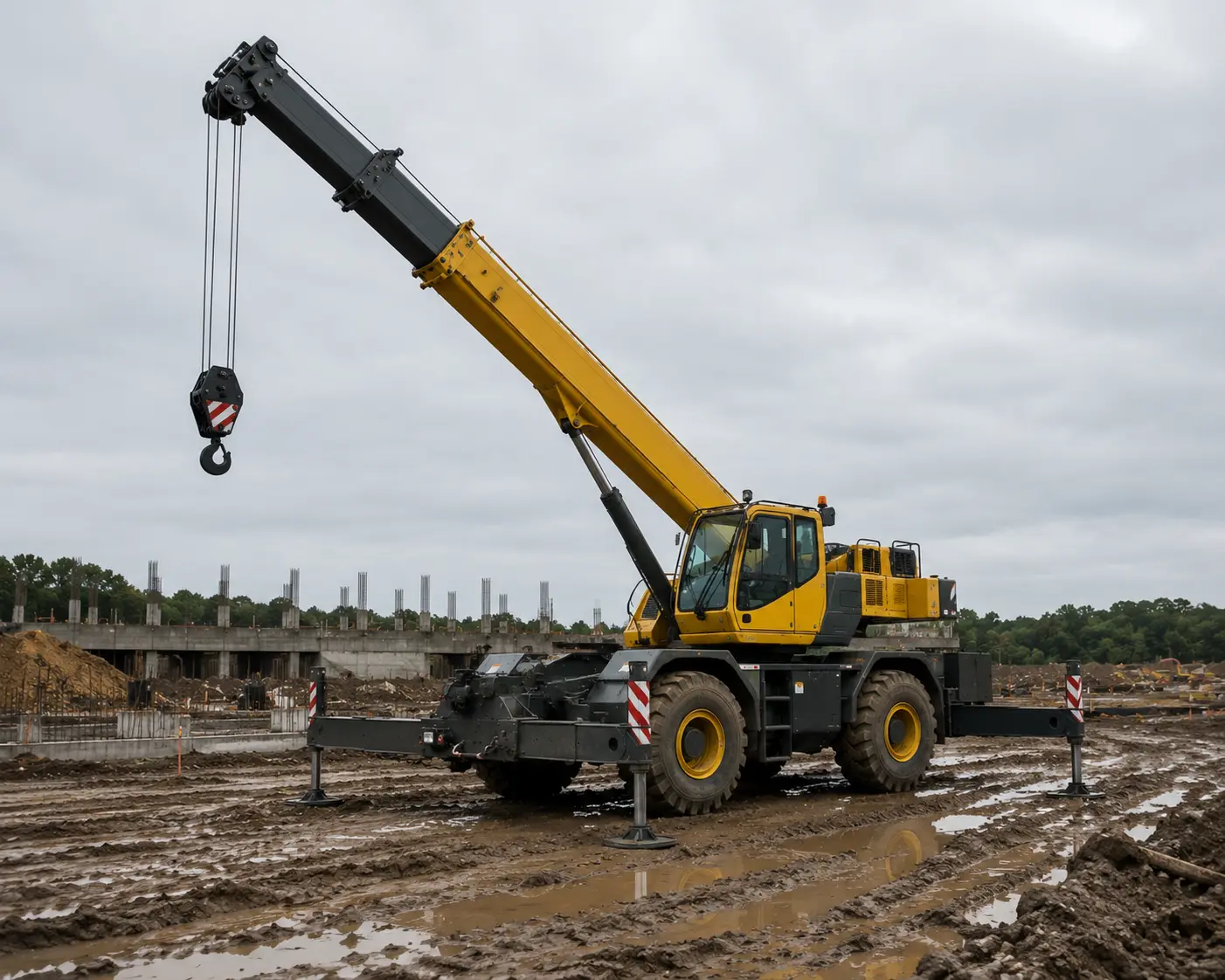
The rough terrain crane exists specifically for these conditions. It is a purpose-built mobile crane designed to lift, travel, and operate on ground surfaces that would be impossible or unsafe for conventional wheeled cranes, unpaved soil, gravel, sand, slopes, and soft or waterlogged ground. Its combination of a compact four-wheel-drive undercarriage, large-diameter tyres, and a telescopic boom mounted on a rotating superstructure makes it uniquely capable in environments where access, ground bearing capacity, and terrain variation are all challenging simultaneously.
Understanding the rough terrain crane, how it is built, how it handles difficult ground, what it can lift at what radius, and when it is the right tool for the job, is essential knowledge for project managers, site engineers, lifting supervisors, and equipment planners working on any project where site conditions fall outside the parameters of standard mobile crane operation.
What Is a Rough Terrain Crane?
A rough terrain crane is a type of mobile crane specifically engineered for operation on unpaved, uneven, or unstable ground. It is self-propelled, it drives under its own power without the need for a separate transport vehicle, and it is designed to travel across the same ground conditions in which it will lift.
This self-contained mobility on difficult terrain is what distinguishes the rough terrain crane from other mobile crane types. An all-terrain crane has greater road mobility and higher lifting capacity, but its multi-axle undercarriage is designed for highway travel and requires substantially better ground conditions at the lift site. A truck-mounted crane is fast on the road but limited on site once the pavement ends. The rough terrain crane sacrifices road speed and lift capacity in exchange for the ability to go where the work is, regardless of what the ground looks like.
The rough terrain crane is built around four key design principles:
Short wheelbase and compact footprint: A shorter distance between the front and rear axles gives the crane a tight turning radius and better manoeuvrability on confined sites.
Large-diameter, wide-section tyres: Wide tyres distribute the machine’s weight over a greater contact area, reducing ground pressure on soft ground and providing traction on loose or wet surfaces.
Four-wheel drive and four-wheel steering: All four wheels are driven, essential for traction on soft or sloped ground, and all four wheels steer, enabling crabbing (moving diagonally), tight turns, and improved manoeuvrability in confined spaces.
Single-operator cab: Unlike truck-mounted cranes where the drive cab and the crane operator’s cab are separate, the rough terrain crane has a single cab from which the operator both drives the machine and operates the crane. The cab rotates with the superstructure, giving the operator visibility over the working area at all times.
Also read : Parts of a Crane: Key Components and How They Work
Key Components of a Rough Terrain Crane
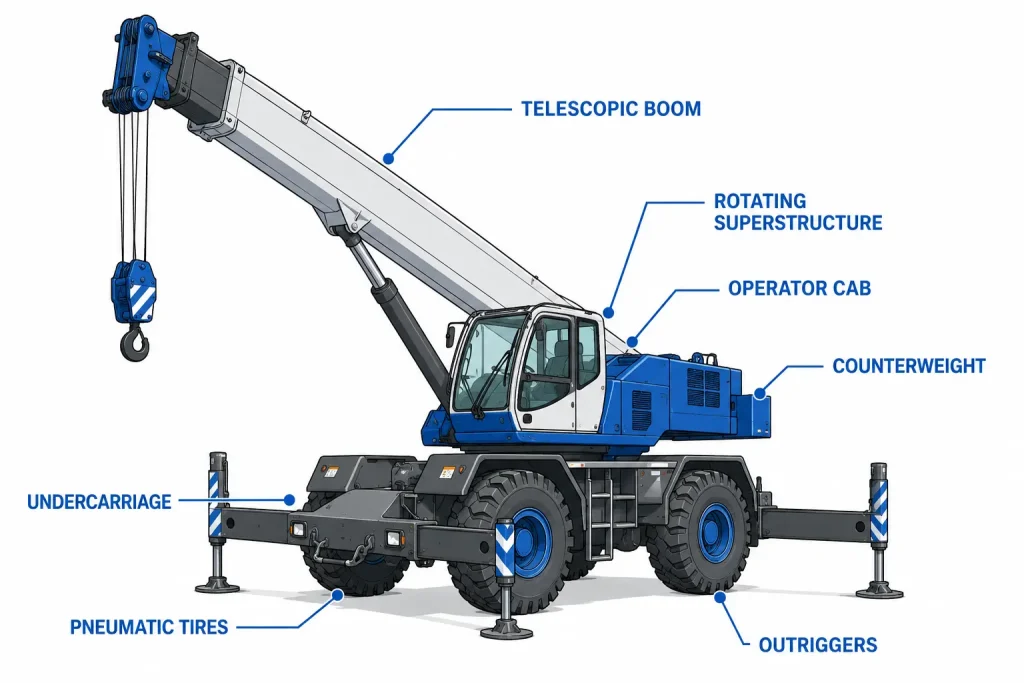
Undercarriage
The undercarriage of a rough terrain crane is its most distinctive feature. Four large-diameter pneumatic tyres, typically with knobby or multi-directional tread patterns, provide the ground contact, traction, and load distribution that allow the machine to operate on difficult ground.
The axles are typically both driven and steerable. In four-wheel-steering mode, all four wheels can be steered simultaneously, either in the same direction (for crabbing) or in opposite directions (for maximum turning). This steering flexibility is critical for manoeuvring in tight site conditions where a conventionally steered machine would be unable to turn without multiple reversals.
The ground clearance beneath the undercarriage is significantly greater than on road-going cranes, allowing the machine to pass over undulating terrain, deep tyre ruts, and minor obstacles without grounding the chassis.
Superstructure and Rotating Cab
The superstructure, the upper portion of the crane, rotates 360 degrees on a slewing ring mounted on the undercarriage. The operator’s cab is mounted on the superstructure and rotates with it, so the operator always faces the direction of the boom and the load. The superstructure also carries the counterweight, which is mounted at the rear to balance loads lifted at the front.
Telescopic Boom
The rough terrain crane uses a telescopic boom, a multi-section boom that extends outward in sections to achieve its rated lift height and reach. Most rough terrain crane booms are two to five sections, achieving working heights of 20 to 50 metres depending on the model.
Unlike lattice booms, which must be assembled from separate sections and are associated with crawler cranes and large all-terrain cranes, the telescopic boom is self-contained and deploys hydraulically without requiring ground-level assembly. This gives the rough terrain crane significant setup speed advantages on sites where time-to-lift is important.
Some models offer a jib or fly attachment, a shorter secondary boom that can be fitted to the tip of the main boom to extend reach at reduced capacity. The load chart changes significantly when a jib is fitted, and the relevant section of the chart must be consulted before any lift using a jib configuration.
Outriggers
Rough terrain cranes are fitted with outriggers, extendable support legs that deploy from the undercarriage and are lowered to the ground before lifting operations begin. The outriggers dramatically increase the machine’s stability footprint from the relatively narrow tyre track width to a much wider effective base, enabling the crane to lift loads that would be impossible, and dangerous, on tyres alone.
The outriggers on a rough terrain crane are designed to operate on the same ground conditions as the crane itself, they are typically equipped with large-area float pads that distribute the outrigger reaction force over a wider ground area, reducing the point load on soft or disturbed ground.
Load charts specify different rated capacities for different outrigger configurations, full extension, mid extension, and in some cases on-tyre (without outriggers deployed). Using a capacity figure from the full-extension chart when outriggers are only partially extended or not deployed is a serious and potentially fatal error.
Counterweight
The counterweight is a set of cast iron or steel blocks mounted on the rear of the superstructure, providing the rearward restoring moment that balances loads lifted at the front. On a rough terrain crane, the counterweight is typically permanently mounted, unlike larger all-terrain cranes where counterweight sections are transported separately and assembled on site.
The permanently mounted counterweight simplifies site setup but adds to the machine’s overall weight and its ground pressure demands, relevant on sites where ground bearing capacity is marginal.
Rough Terrain Crane Lifting Capacity and Load Charts
Understanding Rated Capacity
A rough terrain crane’s rated capacity, the maximum load it can lift safely, is not a single number. It varies with operating radius, boom length, boom angle, counterweight configuration, outrigger configuration, and the slewing zone over which the lift is conducted.
The load chart, a document specific to each crane make and model, specifies the permitted load for every combination of these variables. Before any lift, the load chart must be consulted for the exact configuration in which the crane will operate. Using the headline capacity figure without consulting the chart for the specific lift conditions is one of the most consistent causes of crane overloads.
For a detailed explanation of how to read and apply a crane load chart correctly, including the most common errors operators and supervisors make, a practical guide to reading crane load charts for safe lifting operations covers every element of the chart in operational terms.
Capacity vs Stability vs Structural Limits
Crane capacity at any given radius is governed by two separate limits, whichever is lower applies:
Structural capacity: The maximum load the boom and lifting components can carry without structural damage, regardless of stability.
Stability capacity: The maximum load that can be lifted without tipping the crane. For rough terrain cranes operating on outriggers, the stability limit is typically the governing constraint at longer radii, while the structural limit governs at short radii with the boom steeply elevated.
On a rough terrain crane, there is an additional variable that does not apply on the same scale to road-going cranes: the ground bearing capacity beneath the outrigger pads. Even if the crane load chart permits a given lift, if the ground beneath the outriggers cannot sustain the reaction force, the outrigger can sink or the ground can shear, causing the crane to tip. Ground assessment and outrigger pad specification are therefore critical elements of any rough terrain crane lift plan.
Also read : Construction Site Planning: How to Set Up and Manage a Site
Rough Terrain Crane vs Other Mobile Crane Types
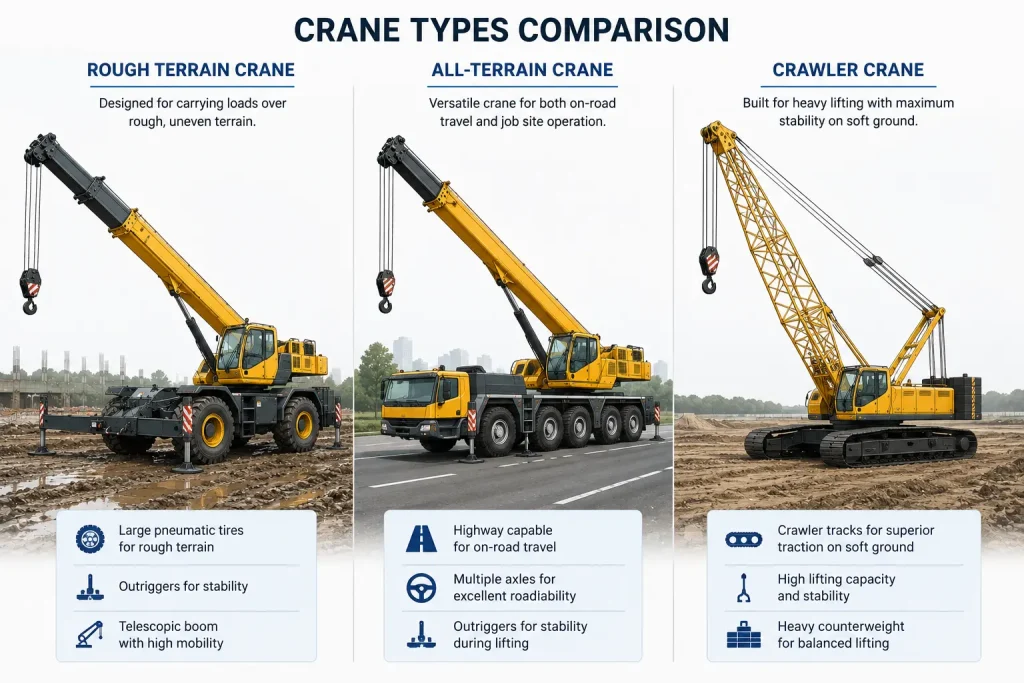
Rough Terrain Crane vs All-Terrain Crane
The all-terrain crane is the most capable mobile crane for demanding lifting tasks, it combines multi-axle road mobility with strong off-road capability. However, its multi-axle undercarriage is optimised for road travel, not for the extreme site conditions that a rough terrain crane can handle. On very soft, loose, or waterlogged ground where even four-wheel drive is insufficient, the narrow track width and high ground pressure of an all-terrain crane becomes limiting.
The rough terrain crane accepts lower road speed and lower maximum capacity in exchange for genuine rough terrain capability that an all-terrain crane cannot match on the worst ground conditions.
Rough Terrain Crane vs Crawler Crane
A crawler crane operates on rubber or steel tracks, giving it the lowest ground pressure of any crane type and exceptional stability for very heavy lifts. However, a crawler crane cannot self-propel on public roads and must be transported by low-loader between sites, a significant cost and logistics overhead. The rough terrain crane can drive itself to the lift location, within the constraints of its speed and road access limitations.
For heavy lifts where the crane will remain in one location for an extended period, a crawler crane may be more economical despite its transport cost. For projects requiring the crane to move frequently across a large site, as is typical in construction, pipeline, and infrastructure projects, the rough terrain crane’s self-propelled mobility is a decisive advantage.
Understanding the full range of crane types and their operational parameters for different lifting applications provides the context needed to make the right crane type selection for any project.
Rough Terrain Crane vs Truck-Mounted Crane
A truck-mounted crane is mounted on a road-going truck chassis, fast on highways, capable of self-deployment, and economic for sites accessible by paved road. On unpaved ground, however, the truck chassis provides limited traction, low ground clearance, and a high risk of becoming stuck on soft or disturbed soil. Where site access requires more than a firm gravel road, the truck-mounted crane reaches its operational limit.
When to Use a Rough Terrain Crane
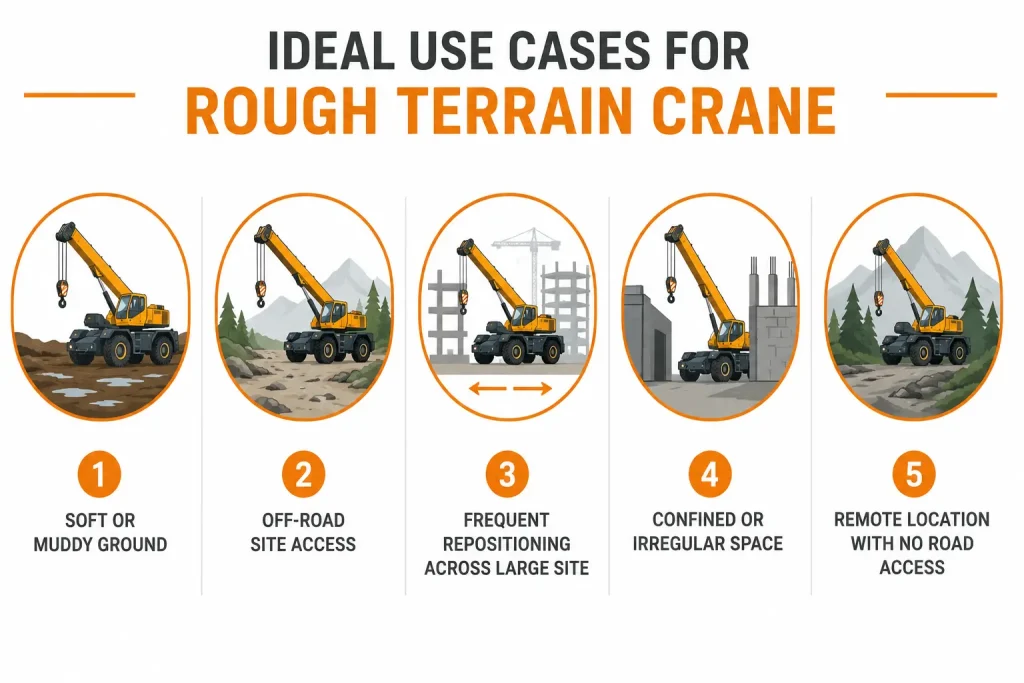
The rough terrain crane is the right choice when the lift location meets one or more of the following conditions:
Site ground conditions are soft, loose, or disturbed. Construction sites before the completion of permanent hardstanding, pipeline trenching operations, rural or agricultural sites, and post-rainfall conditions that leave ground waterlogged, all of these conditions favour the rough terrain crane’s wide-tyre, low-ground-pressure undercarriage.
Site access requires off-road travel. If the crane must travel across open ground, through rough terrain, across gradients that exceed what a road-going crane can safely navigate, or through conditions where a truck-mounted crane would become stuck, the rough terrain crane’s four-wheel-drive, high-clearance undercarriage is essential.
Lifting locations change frequently across a large site. A rough terrain crane can reposition itself quickly without the need for hard standing at every lift point. On a large civil engineering project where lifts are required at dozens of locations across a site, this self-mobility on unpaved ground significantly reduces the cost and time of repositioning compared to bringing in a truck crane for each individual lift.
The lift is in a confined or irregular environment. The rough terrain crane’s four-wheel steering and tight turning radius allow it to manoeuvre in spaces where a larger multi-axle crane cannot operate. On urban construction sites, behind-building maintenance access, and in industrial plant environments with restricted vehicle routes, this manoeuvrability advantage is significant.
The project is in a remote or infrastructure-poor location. Where road access is limited or non-existent, the rough terrain crane’s ability to travel cross-country, within its gradient and ground-pressure limits, allows it to reach lift locations that no road-dependent crane can access.
Safety Requirements for Rough Terrain Crane Operations
Pre-lift planning and ground assessment
Every rough terrain crane lift must begin with a thorough pre-lift plan that includes assessment of the ground conditions at the lift location and at the outrigger positions. Ground bearing capacity must be established, either from geotechnical data, from a competent assessment of soil type and condition, or conservatively from published bearing capacity values for the identified ground type.
Outrigger pad sizes must be selected to distribute the maximum outrigger reaction force over an area that the ground can sustain without failure. On soft or disturbed ground, crane mats, large timber or composite plates that spread the load further, may be required beneath the outrigger pads.
Load chart compliance
The load chart for the specific crane configuration must be consulted before every lift. The configuration includes boom length, boom angle, operating radius, counterweight arrangement, outrigger extension, and the slewing zone of the lift. Any change to these variables during the lift requires a new load chart check.
Operator competency
Rough terrain crane operators must be trained and certified for the specific crane type. The combination of driving the machine on difficult ground and operating the crane requires skills that go beyond standard mobile crane certification. On site, the operator must be supported by a qualified lift supervisor and, for blind lifts, a designated signaller.
The full scope of competency requirements and safety obligations for lifting operations involving all crane types is covered in practical guides to lifting equipment safety and pre-lift planning.
Slope and gradient limits
Every rough terrain crane has specified gradient limits, both for travelling and for lifting. Travelling on a gradient exceeding the rated limit risks the crane sliding or tipping. Lifting on a gradient, even within the travelling limit, can significantly reduce effective capacity because the counterweight’s restoring moment is reduced on a slope. The crane must be levelled using the outriggers before any lift is conducted, regardless of how slight the apparent gradient appears.
Also read : Types of Pile Foundation: How They Work and How to Choose
Get the Right Crane for Your Site and Your Lift
The rough terrain crane occupies a unique position in the mobile crane family, it is not the most capable lifter, nor the fastest road traveller, nor the cheapest option for a simple site lift. What it is, uniquely, is a crane that can go where the work is, across ground conditions that defeat every other wheeled crane type, and set up quickly to lift safely without the transport overhead of a crawler crane.
For project planners and lifting supervisors, the decision to deploy a rough terrain crane should be driven by a clear assessment of site conditions, lift requirements, and the operational constraints that make other crane types inadequate. When those conditions are present, the rough terrain crane is not a compromise, it is the correct and only practical choice.
RR Machinery offers a comprehensive range of construction and lifting equipment for sale and rental, including forklifts, boom lifts, scissor lifts, mobile scaffolding, and power generators, all maintained to operational standard and supported by experienced technicians. Explore our full range of heavy construction equipment solutions or contact our team for practical advice and a clear quotation tailored to your project and site requirements.