Every building is classified by how it is constructed, the structural system that carries its loads, the materials it is built from, and the construction methodology used to assemble it. Understanding building construction types is not only relevant to architects and structural engineers. It is essential knowledge for contractors, project managers, site supervisors, and equipment planners, because the construction type determines what equipment is needed on site, in what sequence, at what scale, and for how long.
A reinforced concrete frame building is constructed fundamentally differently from a structural steel building, a load-bearing masonry structure, or a prefabricated modular building. Each construction type requires a different combination of plant and equipment, a different workforce skill set, a different site logistics arrangement, and a different safety management approach. Getting this alignment right from the start, matching the construction methodology to the equipment, the crew, and the programme, is the difference between a project that runs efficiently and one that accumulates delays, cost overruns, and rework.
This guide covers the main types of building construction, organised by structural system and methodology, with a practical assessment of how each type is built, what equipment it requires, and what distinguishes it from alternative approaches.
Why Building Construction Type Matters Beyond Design
It is tempting to treat building construction type as purely a structural engineering matter, something resolved between the architect and the engineer before the contractor arrives on site. In practice, construction type has profound implications for every aspect of project delivery.
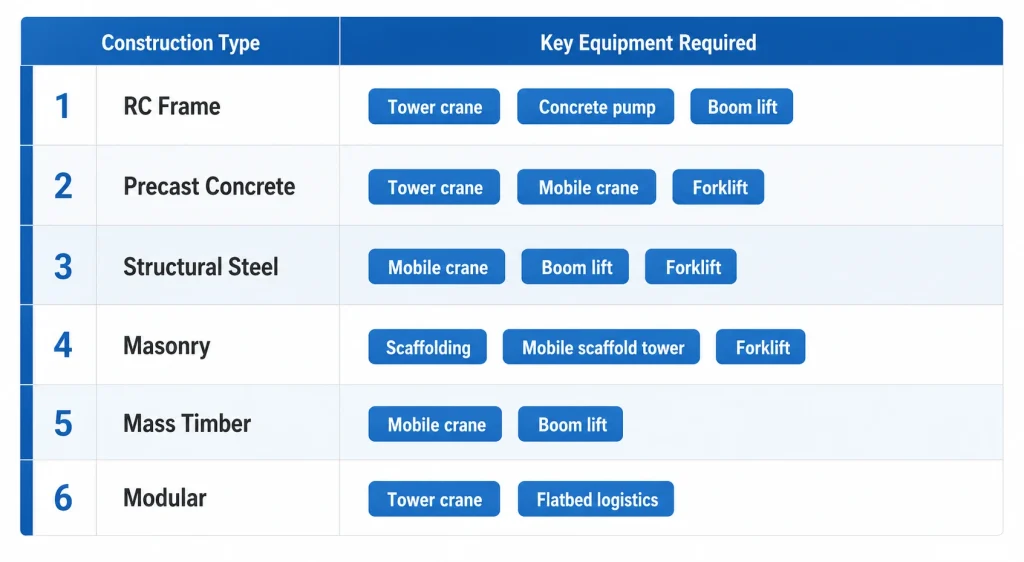
Equipment requirements are directly driven by construction type. A precast concrete building demands a tower crane capable of lifting panel weights at the required radius. A structural steel building requires a crane with sufficient hook height to service all floors. A masonry building requires scaffolding erected in stages as walls rise. A modular prefabricated building requires a crane and a large lay-down area for module staging.
Programme varies dramatically between construction types. Structural steel frames erect faster than in-situ concrete. Precast concrete eliminates curing time but requires precise sequencing of deliveries and crane picks. Modular construction compresses on-site time by shifting work to the factory, but requires careful coordination between manufacturing and site readiness.
Site logistics depend on the volumes and weights of material being delivered, stored, and lifted. A precast building may require multiple truck deliveries per day, each carrying panels that cannot wait in the yard because there is no room, they must be lifted directly from the truck. An in-situ concrete building requires continuous concrete delivery during pours, with pump placement and crane picks coordinated to avoid conflicts.
Safety management profiles differ by construction type. Structural steel erection involves high-risk lifting operations and working at height on open skeletal frames with limited fall protection from the structure itself. In-situ concrete construction involves formwork at height and the risks associated with wet concrete. Understanding the specific hazards of each construction type is as fundamental as understanding workplace safety management across different construction operations.
Also read : Best Materials to Build a House: A Practical Guide
Main Building Construction Types
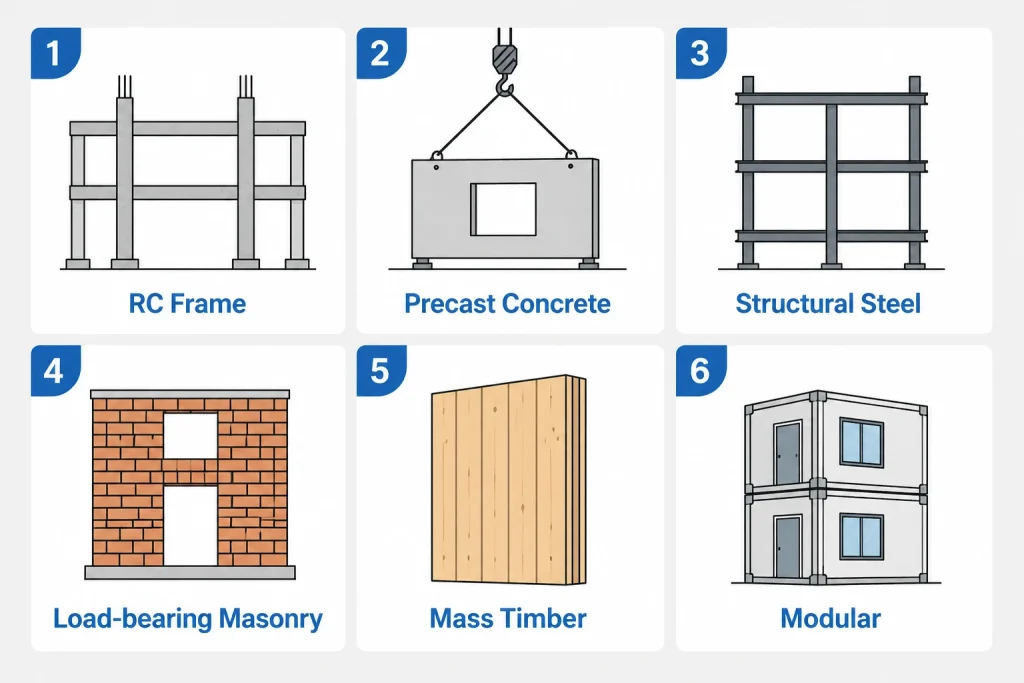
Reinforced Concrete Frame Construction
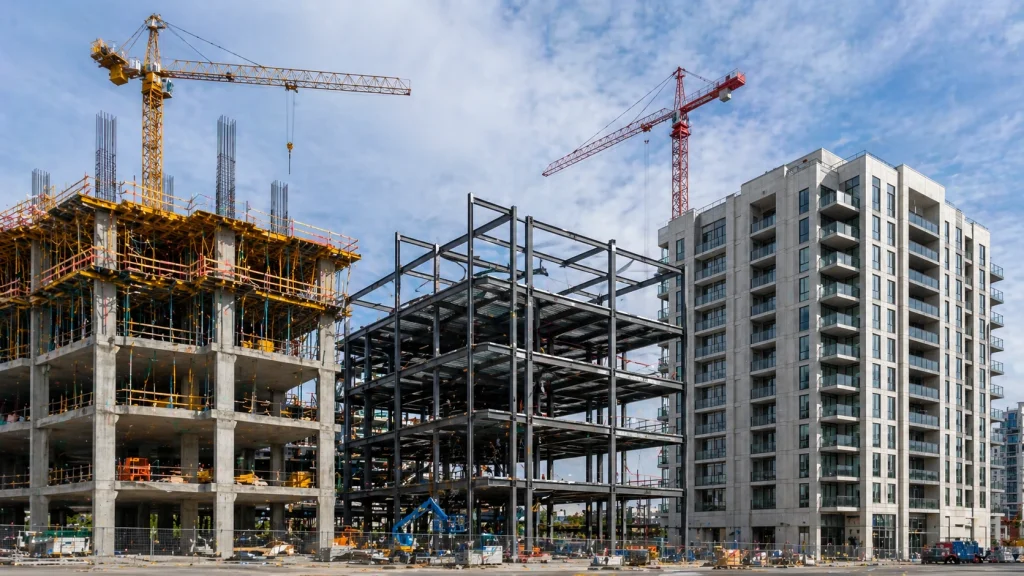
Reinforced concrete (RC) frame construction is the most common structural system for multi-storey buildings globally. The structural framework consists of concrete columns, beams, and floor slabs, all cast in situ using formwork and reinforcing steel. The RC frame carries all gravity and lateral loads and provides the primary structural stability of the building.
How it is built:
Construction proceeds floor by floor. On each level, the sequence is: erect formwork for columns and beams, place reinforcement cages, pour concrete, allow concrete to cure to the required strength, strike (remove) the formwork, and repeat for the next level. Slab formwork remains in place on multiple floors simultaneously, standard practice requires slab props to remain for several floors below the active pour to support the load of fresh concrete above.
The floor-by-floor cycle, typically one to two weeks per floor on a well-resourced site, means that RC frame construction is the slowest of the main structural systems in terms of the time to reach the structural topping-out stage. However, it requires the least specialist plant and is generally the most cost-effective system for standard multi-storey residential and commercial buildings.
Equipment requirements:
A tower crane is the primary lifting tool on RC frame construction sites, handling formwork panels, reinforcement cages, concrete skips (where pump access is limited), and materials. A concrete pump is used for all slab and wall pours. Mobile elevated work platforms, including scissor lifts and boom lifts, support formwork installation, fixing works, and access to areas the crane cannot service directly.
Best suited for: Mid to high-rise residential and commercial buildings, infrastructure structures (bridges, tunnels), buildings with complex geometry or high fire resistance requirements.
Precast Concrete Construction
Precast concrete construction uses factory-manufactured concrete elements, columns, beams, floor slabs, wall panels, staircases, and facade units, that are transported to site and assembled by crane. The connection between precast elements is made through cast-in connections, grouted joints, or post-tensioned tendons, creating a complete structural frame from prefabricated parts.
How it is built:
Site work begins with the substructure, typically an in-situ concrete foundation system. Once the foundations are ready, precast elements are delivered to site in the sequence in which they will be installed, lifted into position by the tower crane or mobile crane, and connected. The speed of erection depends entirely on the crane capacity and the delivery sequence, a well-organised precast operation can erect a floor per day on a standard residential building.
Because precast elements are manufactured in a controlled environment, quality is highly consistent. However, the tolerances required for precast connections are tighter than for in-situ work, and any dimensional errors in the structure must be resolved before the next element can be placed.
Equipment requirements:
Precast construction is crane-intensive above all else. The crane must be capable of lifting the heaviest element at the greatest radius on the site, a calculation that often drives the crane selection. Forklifts and telehandlers are used within the site storage and staging area to position elements for crane picks. Understanding the different types of cranes and their lifting capabilities is directly relevant to planning a precast construction operation.
Best suited for: Residential buildings, public housing developments, repetitive building types where the investment in precast tooling is amortised over many identical units, buildings where rapid structural erection is a programme priority.
Structural Steel Frame Construction
Structural steel frame construction uses rolled steel sections, columns, beams, and bracing, connected by bolting or welding to form the primary structural frame. Floor slabs are typically formed using composite construction, profiled steel decking (metal deck) that acts as permanent formwork for a concrete slab, with the concrete and steel acting compositely to carry floor loads.
How it is built:
Steel erection begins once the foundations are complete. Columns are set on base plates anchored to the foundations. Beams are connected to columns, and the steel frame rises section by section. Metal deck is laid on completed bays, concrete is poured and cured, and the process moves upward. Perimeter cladding and internal fit-out follow once the structural frame reaches full height.
Steel construction is significantly faster than RC frame construction for the structural phase. A steel frame for a medium-rise building can be erected in weeks rather than months. The absence of formwork and curing time is the primary driver of this speed advantage.
Equipment requirements:
Mobile cranes are commonly used for steel erection on lower-rise buildings where a tower crane is not economical. On taller buildings, a tower crane handles steel sections. For connection work at height, particularly for bolting and welding at each level, boom lifts are the standard access solution, providing the horizontal reach and elevation needed to access connection points on the steel frame perimeter. Forklifts handle steel sections within the site laydown area before they are craned into position.
Best suited for: Commercial and industrial buildings requiring long spans and open floor plans, warehouse and logistics facilities, sports and entertainment venues, high-rise office towers, buildings where construction speed is a primary commercial objective.
Load-Bearing Masonry Construction
Load-bearing masonry construction uses brick or block walls as the primary structural element, the walls carry both the self-weight of the structure and the loads from floors and roof above. Unlike framed construction where columns and beams carry the loads, in a load-bearing masonry building the walls themselves are the structure.
How it is built:
Walls are built course by course by bricklayers, with floor slabs cast or placed as construction rises. The building grows vertically from the ground upward, with no separate structural frame, the walls and slabs form an integrated monolithic structure. In modern construction, load-bearing masonry is typically limited to low-rise residential buildings (two to four storeys), where the required wall thicknesses are practical and the loads do not exceed what masonry can carry economically.
Equipment requirements:
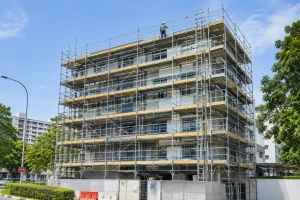
Masonry construction is scaffold-dependent. As walls rise, scaffolding must be erected and raised in stages to provide bricklayers with a safe working platform at every level. Mobile scaffolding towers are used for interior work. Fixed scaffold systems are erected on the perimeter for external wall construction. A concrete mixer or pump is used for mortar and any in-situ concrete elements. Forklift trucks deliver palletised block or brick to the scaffold platform level.
Best suited for: Low-rise residential housing, heritage building restoration, buildings in areas with limited access to precast or steel supply chains, construction in markets where masonry skills are readily available and cost-effective.
Structural Timber and Mass Timber Construction
Traditional timber frame construction uses dimensional timber, studs, posts, and beams, assembled on site to form a structural frame. Modern mass timber construction uses engineered timber products, cross-laminated timber (CLT), glued-laminated timber (glulam), and laminated veneer lumber (LVL), that are manufactured to precise dimensions in a factory and assembled on site in a manner similar to precast concrete construction.
How it is built:
Mass timber panels and elements are factory-produced and delivered to site ready for installation. They are lifted into position by crane, connected with specialist timber connectors, and the structure rises rapidly, a mass timber building can be erected at speeds comparable to precast concrete. The precision of factory production eliminates most on-site cutting and fitting, reducing waste and improving safety.
Equipment requirements:
Mass timber construction requires a crane for lifting panels and elements. Because mass timber panels are significantly lighter than equivalent concrete elements, smaller cranes can often be used, an advantage on confined urban sites where a large tower crane would be difficult to accommodate. Elevated access platforms are used for connection work at height.
Best suited for: Low to mid-rise residential, commercial, and institutional buildings; projects where low embodied carbon is a design priority; projects where rapid construction speed and reduced on-site labour are required.
Also read : Types of Pile Foundation: How They Work and How to Choose
Modular and Prefabricated Construction
Modular construction takes prefabrication to its logical conclusion, entire volumetric units (modules), complete with internal finishes, services, and fixtures, are manufactured in a factory and transported to site for assembly. Each module is a three-dimensional unit that may represent a room, an apartment, or a section of a larger space.
How it is built:
Modules are manufactured off site while the substructure (foundations and podium) is constructed on site. When the substructure is ready, modules are delivered by flatbed truck in the sequence in which they will be installed. Each module is lifted by crane onto the substructure, connected to adjacent modules, and tied into the building services infrastructure. The speed advantage over conventional construction can be dramatic, a multi-storey residential building that would take two years to build conventionally can be assembled on site in a matter of weeks using modular construction.
Equipment requirements:
Crane selection is critical in modular construction. Each module must be lifted from the delivery vehicle and placed with precision, the crane must have sufficient capacity for the heaviest module at the maximum required radius, and must be able to slew without obstruction to reach all installation positions. The delivery logistics, truck movements, staging area, crane pick sequence, must be planned to the hour to prevent the site from becoming a bottleneck. The parallel to heavy material handling in conventional construction is direct, the same principles of crane selection, rigging, and sequencing that apply to lifting and material handling operations across construction projects apply with equal rigour to modular installation.
Best suited for: Residential buildings, hotels, student accommodation, healthcare facilities, remote site accommodation camps, any project where construction speed, quality consistency, or reduced on-site labour is a priority.
Choosing the Right Construction Type
No single construction type is universally superior. The right choice for any project depends on:
- Structural requirements
Height, span, loads, seismic exposure, and fire resistance requirements all influence which structural system is feasible.
- Programme
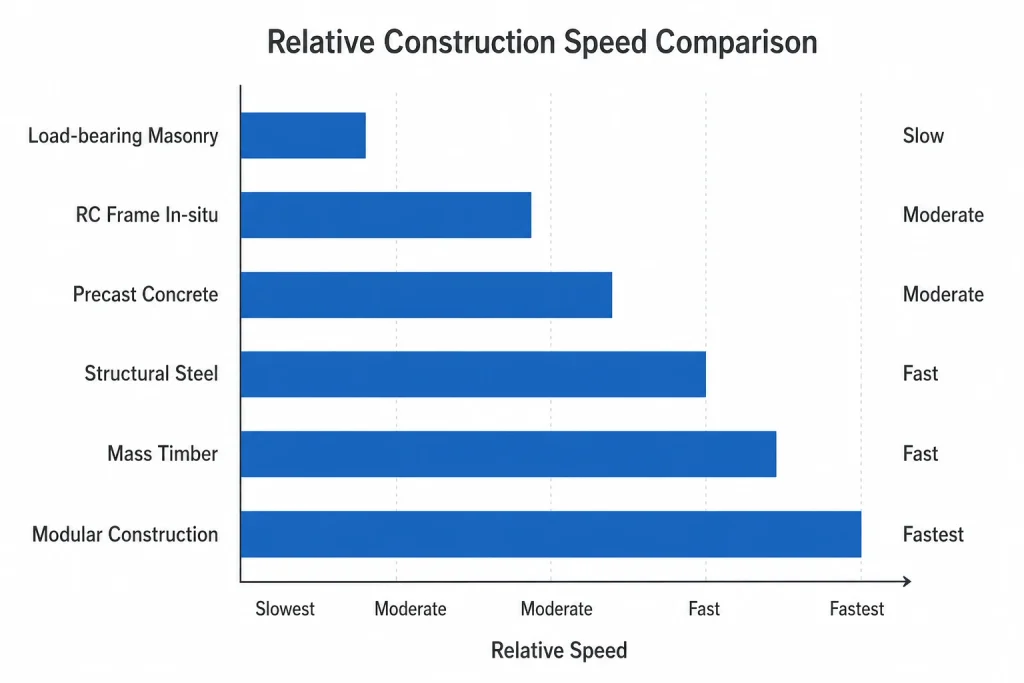
Where construction speed is the primary commercial driver, precast, steel, or modular construction offers significant advantages over in-situ concrete.
- Cost
In-situ RC construction is generally the most cost-effective for standard mid-rise buildings. Precast and steel carry premium costs that may be offset by programme savings. Modular construction has high factory costs that must be justified by volume or programme benefit.
- Site constraints
Confined urban sites, noise and vibration restrictions, and limited crane access all affect which construction type is practical.
- Supply chain
The local availability of precast manufacturers, steel fabricators, modular manufacturers, and skilled labour affects both cost and programme for each construction type.
- Sustainability
Embodied carbon, construction waste, and reusability at end of life are increasingly important criteria, favouring steel, mass timber, and modular approaches where these can be justified on other grounds.
For technical reference on building construction systems, structural classifications, and international construction methodology standards, resources on building construction methods and structural systems provide useful background on how construction types are classified and evaluated across different engineering and regulatory frameworks.
Also read : Parts of a Crane: Key Components and How They Work
Get the Right Equipment for Your Construction Project
Understanding building construction types, from in-situ RC frames and precast systems to structural steel, masonry, timber, and modular construction, gives project teams the foundation they need to plan equipment, logistics, and methodology from the earliest stages of a project. Every construction type places specific demands on the equipment deployed: the right crane, the right access platforms, the right material handling solution, and the right temporary power infrastructure.
RR Machinery offers a comprehensive range of construction equipment for sale and rental, including boom lifts, scissor lifts, mobile scaffolding, forklifts, and power generators, all maintained to operational standard and supported by experienced technicians. Explore our full range of construction and site equipment solutions or contact our team for practical advice and a clear quotation tailored to your project requirements.