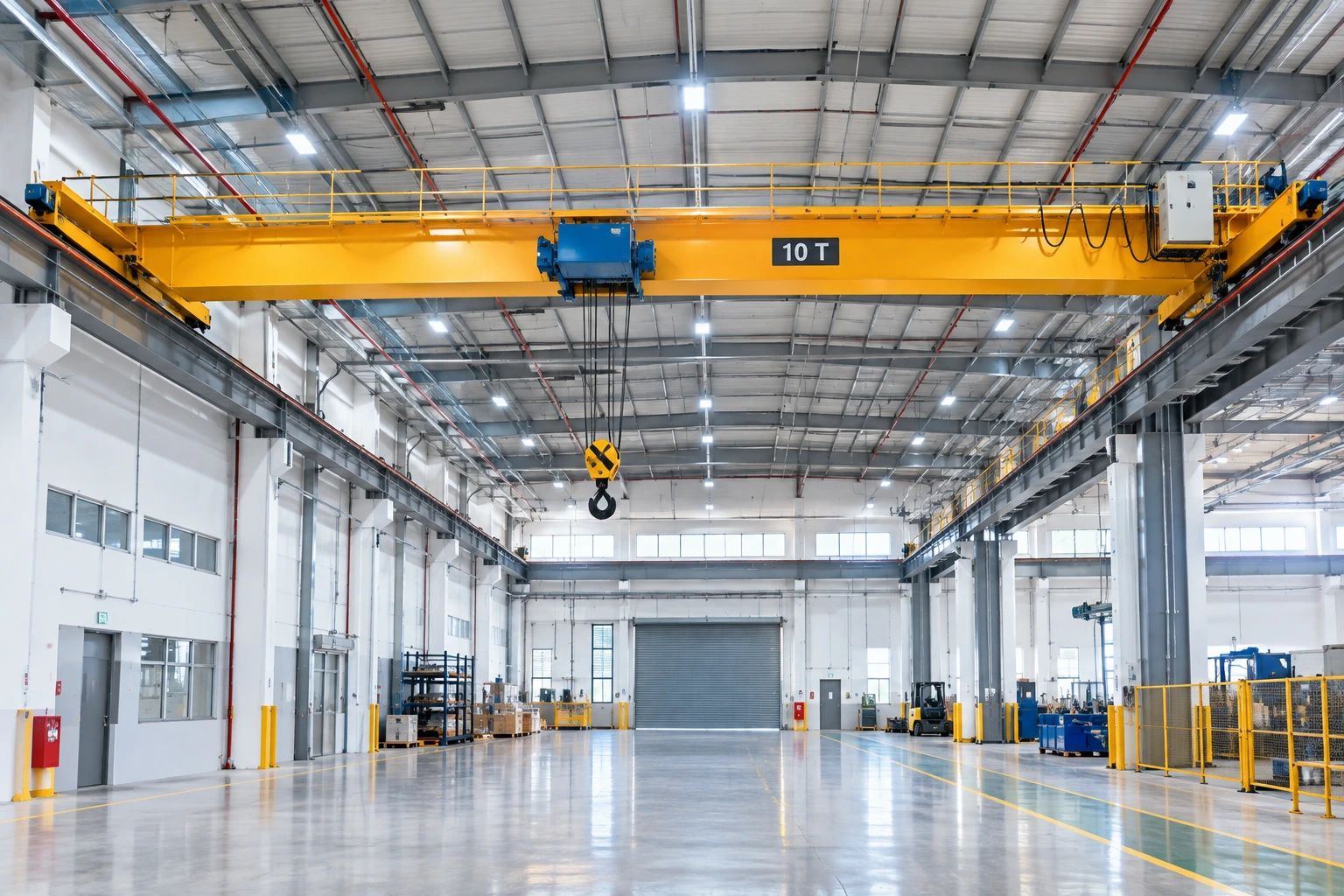
An overhead crane, sometimes called a bridge crane, operates continuously above the factory floor or warehouse it serves, lifting loads day after day with little visible sign of the wear accumulating in its hoist, wire rope, and bridge components. Unlike mobile equipment that gets a visual once-over between jobs almost by habit, an overhead crane’s elevated, fixed position means deterioration can go unnoticed for far longer unless a genuinely structured maintenance routine is in place.
This guide covers what a complete overhead crane maintenance programme actually involves, from daily pre-use checks through scheduled preventive maintenance, load testing, and the recordkeeping that ties it all together into a defensible, compliant maintenance history.
Why Overhead Crane Maintenance Matters
An overhead crane’s components operate under continuous cyclic load, raising, lowering, and traversing loads repeatedly throughout a working day, a pattern of use that causes fatigue and wear considerably faster than equipment used only intermittently. Because the crane operates above head height, a developing fault is also far less likely to be noticed incidentally by someone simply walking past it, unlike a ground-level machine where a leak, unusual noise, or visible damage might catch a passing worker’s attention.
This combination, continuous cyclic loading and reduced incidental visibility, is exactly why overhead crane maintenance needs to be a deliberate, scheduled programme rather than something addressed only when a problem becomes obvious. A fault in a hoist brake or a worn wire rope rarely announces itself clearly before failing, making structured inspection the primary way these issues are actually caught in time.
Daily and Pre-Use Inspection

Before an overhead crane is used at the start of a shift, a short but consistent set of checks catches the majority of issues that would otherwise develop into a bigger problem during actual lifting operations:
- Visually inspect the wire rope or chain for kinks, broken strands, corrosion, or visible wear along its accessible length
- Check hook condition, confirming the safety latch functions correctly and the hook shows no visible deformation or cracking
- Test upper and lower limit switches to confirm the hoist stops correctly at both extremes of travel
- Listen for unusual noise from the hoist motor, gearbox, or bridge and trolley wheels during a brief test movement
- Confirm all pendant or radio controls respond correctly and the emergency stop function operates as expected
- Check that warning devices, such as travel alarms or lights, are functioning correctly
Any fault identified during this check should stop the crane from being used until resolved, rather than proceeding on the assumption that a minor-seeming issue will not affect the task at hand.
Also read: Forklift Maintenance Tips for Safe and Efficient Operation
Scheduled Preventive Maintenance
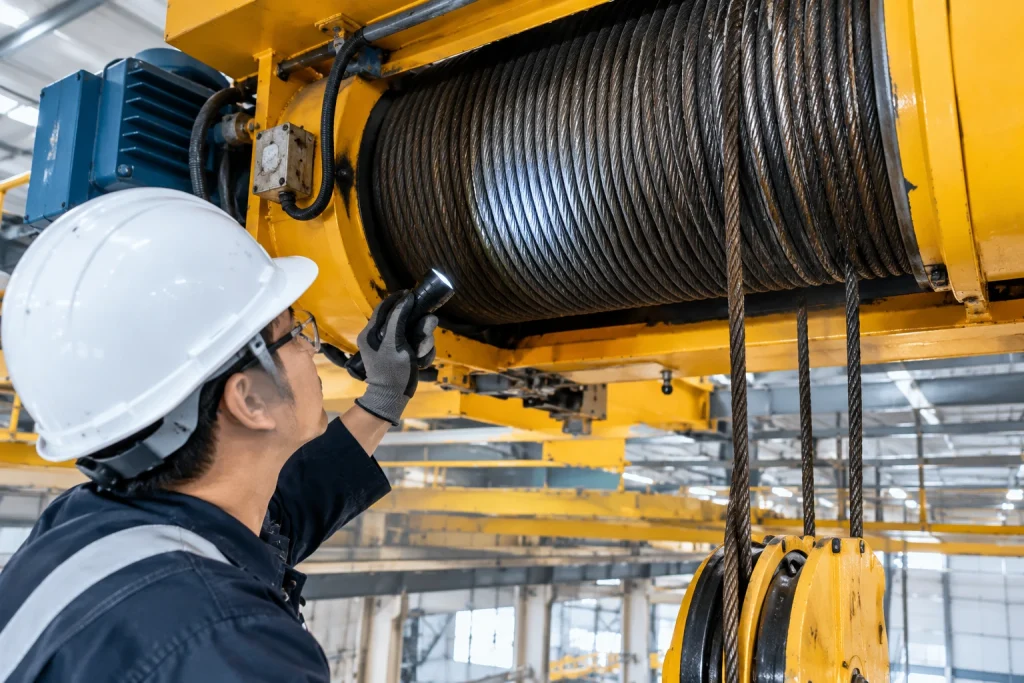
Beyond daily checks, a structured preventive maintenance schedule addresses components that develop wear more gradually and are not always practical to fully assess during a quick daily inspection.
Hoist and Wire Rope or Chain
The hoist mechanism, including its brake, gearbox, and motor, should be inspected on a scheduled basis for oil leaks, unusual wear, and correct brake holding force, since a hoist brake that has degraded gradually may still appear to function during a casual test while no longer holding its full rated load reliably. Wire rope or chain should be inspected along its full length, not just the visible sections, checking for internal wear at points that spend most of their time wound onto the drum and therefore see less obvious daily inspection.
Lubrication schedules for wire rope in particular matter more than many maintenance programmes account for, since a dry, under-lubricated rope wears considerably faster and is more prone to internal corrosion than one maintained according to the manufacturer’s specified lubrication interval.
Bridge and Trolley Wheels
The wheels that allow the crane’s bridge to travel along its runway, and the trolley to travel across the bridge, need periodic inspection for flat spots, cracking, and flange wear, since these components carry the crane’s full operating load continuously across every cycle. Runway rails themselves also deserve inspection, checking for misalignment, wear, or damage that could cause uneven wheel loading or binding as the crane travels.
Excessive wheel or rail wear often develops gradually and can initially seem like a minor operational inconvenience, a slightly rougher ride or an unusual sound during travel, before progressing to a more significant mechanical or safety issue if left unaddressed.
Electrical Systems and Controls
Electrical components, including motor controllers, wiring, and pendant or radio control systems, should be inspected for damaged insulation, loose connections, and correct operation of all safety interlocks. Given how much of an overhead crane’s safe operation depends on its control and limit switch systems functioning exactly as designed, electrical inspection deserves the same rigour as the crane’s mechanical components rather than being treated as a secondary concern.
Load Testing and Capacity Verification
Periodic load testing confirms that a crane’s rated capacity remains accurate and that its structural and mechanical systems perform correctly under actual load, rather than relying solely on visual inspection to confirm continued safe operation. Understanding how rated capacity is determined and how it should be verified against a specific crane’s load chart is covered below and in How to Read a Crane Load Chart: A Clear Guide, both directly relevant to overhead crane load verification even though they were written with mobile crane applications primarily in mind.
Also read: Crane Lifting Capacity Explained for Construction Projects
Load testing should follow a formal, documented procedure, typically involving lifting a test load at or slightly above rated capacity while confirming the crane operates correctly throughout the lift, rather than an informal check performed without proper load measurement or documentation.
Common Overhead Crane Problems and Their Causes
A handful of recurring issues account for a disproportionate share of overhead crane maintenance findings:
- Wire rope wear and corrosion, often accelerated by inadequate lubrication or operating in a corrosive or high-humidity environment without appropriate rope specification
- Hoist brake degradation, gradually reducing holding force in a way that may not be obvious without a proper brake test rather than casual observation
- Wheel and rail wear, developing from misalignment, overloading, or simply the cumulative effect of continuous operation over years of service
- Electrical control faults, frequently caused by vibration-loosened connections or environmental exposure to dust, moisture, or temperature extremes in an industrial setting
- Structural fatigue at connection points, a longer-term concern requiring periodic structural inspection beyond routine mechanical maintenance
Recognising these patterns helps a maintenance programme focus inspection effort where problems are statistically most likely to develop, rather than treating every component as equally likely to fail at any given time.
Maintenance Recordkeeping and Compliance
A complete maintenance history, documenting every inspection, repair, and load test performed on a crane, is essential both for genuinely tracking a machine’s condition over time and for demonstrating compliance during a regulatory inspection or in the event of an incident investigation. Records that show a consistent maintenance pattern, rather than gaps or irregular intervals, also tend to reveal developing problems earlier, since a component requiring more frequent attention than its scheduled interval suggests is often flagging a deeper issue worth investigating.
Singapore’s Ministry of Manpower publishes detailed Workplace Safety and Health guidance covering lifting equipment inspection, examination, and certification requirements that apply directly to overhead cranes operating in Singapore workplaces. The maintenance discipline required for overhead cranes shares much in common with other heavy equipment categories, covered from a comparable structured perspective below, useful reading for understanding how similar preventive maintenance principles apply across different equipment types.
Understanding the individual structural and mechanical components that make up a crane, useful background for interpreting what a maintenance inspection is actually checking, is covered below. Further general technical background on overhead crane design and classification is available through Wikipedia’s overview of overhead cranes.
Also read: The Parts of a Crane and Their Functions Explained
Building a Reliable Maintenance Programme
Overhead crane maintenance comes down to a consistent combination of daily pre-use checks, scheduled preventive maintenance covering the hoist, wire rope, wheels, and electrical systems, periodic load testing, and thorough recordkeeping that ties the whole programme together. None of these elements are complicated individually, but skipping or informally handling any one of them is where developing faults most often go unnoticed until they cause a genuine failure.
RR Machinery Pte Ltd supports Singapore’s construction and industrial sectors with reliable heavy machinery solutions and expert maintenance guidance across a wide range of lifting and material handling equipment. Browse our complete heavy machinery services or contact our team today for practical advice on maintaining your lifting equipment safely and reliably.