Not every working-at-height task requires a full scaffolding structure. Many maintenance, inspection, and installation tasks at height are short in duration, cover a limited area, require access at a single location rather than along an entire facade, or are performed by a single operator rather than multiple trades simultaneously. For these tasks, erecting a full tube-and-fitting scaffold, with its design requirements, erection sequence, inspection obligations, and dismantling process, is disproportionate to the scope of the work.
Mobile scaffolding exists to fill this gap. It provides a safe, stable, elevated working platform that can be erected by a small team without specialist scaffolding contractors, repositioned to each new work location without dismantling and rebuilding, and stored compactly when not in use. It is not a replacement for fixed scaffolding on large, long-duration, or multi-trade access requirements, but for the wide category of tasks where fixed scaffolding is more than the job needs, mobile scaffolding is the most practical, economical, and operationally efficient working-at-height solution available.
Understanding what mobile scaffolding is, how it is built, what types are available, when it is the right choice, and what safety requirements apply is essential knowledge for facilities managers, maintenance supervisors, site managers, and any professional responsible for working-at-height operations across construction, building maintenance, and industrial environments.
What Is Mobile Scaffolding?
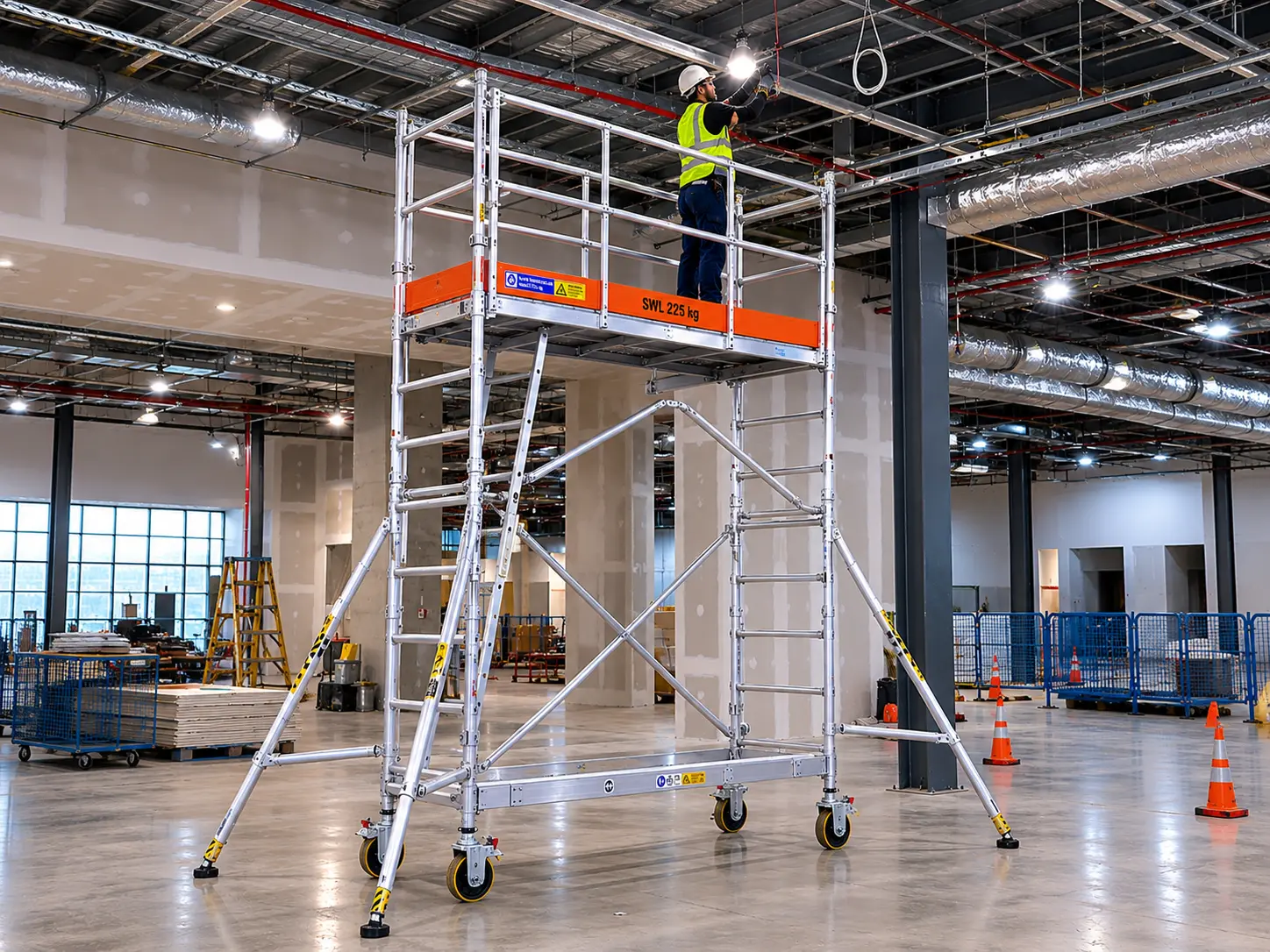
Mobile scaffolding, also called a mobile scaffold tower, rolling scaffold, or access tower, is a freestanding, wheeled scaffold structure that provides an elevated working platform at a fixed height for a temporary period, and can be moved on its wheels to a new position without being dismantled.
The defining characteristics that distinguish mobile scaffolding from fixed scaffolding are its wheels and its freestanding structure. The wheels, typically large-diameter castors fitted with locking mechanisms, allow the assembled tower to be rolled across a firm, level surface to each new work location. The freestanding structure means the tower is self-supporting without ties to a building or structure, relying on its own base dimensions and the relationship between its height and base width for stability.
These two characteristics, mobility and freestanding stability, define both the strengths and the limitations of mobile scaffolding. The mobility makes it exceptionally productive for tasks that require access at multiple locations in sequence. The freestanding stability requirement imposes a height-to-base ratio limit that determines the maximum safe working height for any given tower configuration.
Also read : Types of Excavators: A Complete Guide for Every Job
How Does Mobile Scaffolding Work?
A mobile scaffold tower is built from a system of prefabricated components, frames, braces, platforms, and base sections, that lock together without tools or with simple locking pins. The system approach is what makes mobile scaffolding practical for erection by non-specialist personnel: each component has a defined function and a defined connection method, and the assembly sequence is specified in the manufacturer’s erection guide for each tower configuration.
The tower is built up from the base, typically adjustable screw legs fitted into the castor bases, through successive frame sections to the working platform height. Diagonal braces are fitted between the frames at each lift to provide the lateral rigidity that prevents the tower from racking under horizontal load. The working platform, a trapdoor platform or a solid deck, is fitted at the working height, with guardrails and toe boards completing the edge protection on all open sides.
The height of the tower is adjusted by adding or removing frame sections. Most mobile scaffold systems offer a range of standard frame heights, typically 0.7 metres and 1.4 metres, that can be combined to achieve any required working height within the system’s rated range.
Before the tower is used, the castors must be locked, all four wheels engaged simultaneously, and the adjustable base legs must be set so the tower is level. A tower that is not level or whose castors are not all locked is not in a safe condition for use as a working platform, regardless of how solidly the structure appears.
Key Components of a Mobile Scaffold Tower
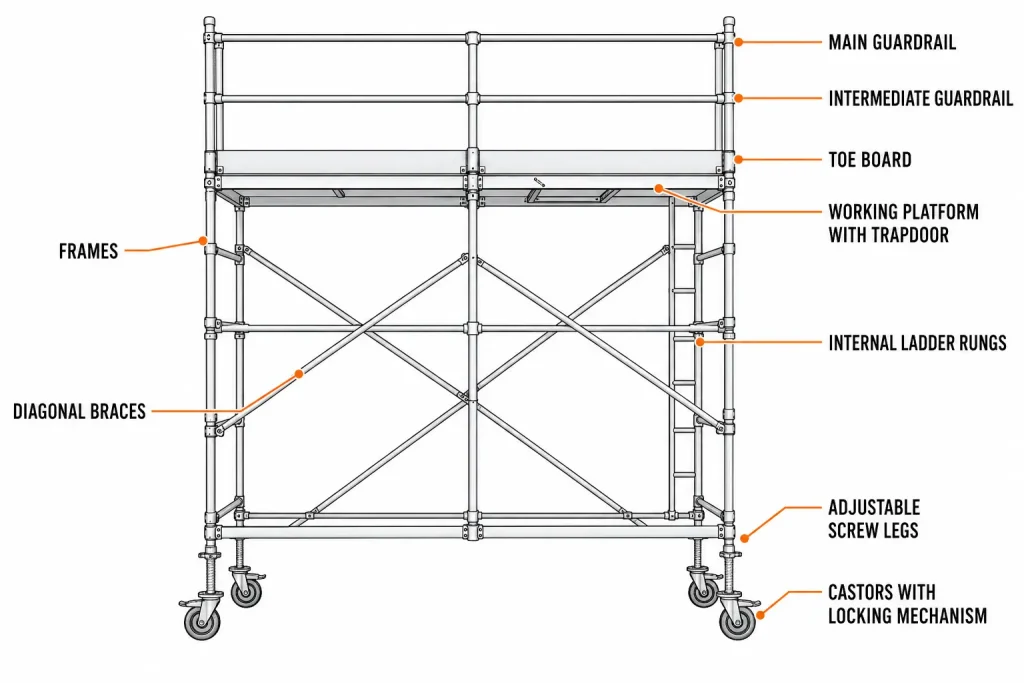
- Frames
The primary structural elements, typically of aluminium or steel tube construction. Frames are available in standard widths, most commonly 0.85 metres, 1.35 metres, and 1.85 metres internal width, and in standard heights. The frame width determines the internal platform width of the finished tower.
- Diagonal braces
Tubes or flat braces that connect the frames diagonally, providing the torsional and lateral rigidity of the tower. Braces must be fitted at every lift as specified in the erection guide, omitting braces to save time is one of the most common and dangerous errors in mobile scaffold assembly.
- Castors
Large-diameter wheels, typically 150 to 200 mm diameter, fitted to the base of the tower. Each castor has an individual locking mechanism, a foot-operated or hand-operated brake, that must be engaged before the tower is used. The castor diameter determines the size of surface irregularity the tower can be moved over safely.
- Adjustable base plates or screw legs
Fitted between the castors and the first frame section, allowing the tower to be levelled on slightly uneven surfaces. The adjustment range is typically 300 to 500 mm. Extending the screw legs beyond their rated travel reduces the tower’s stability and must not be done.
- Working platform
A decked platform fitted at the working height, with a trapdoor for vertical access via the internal ladder. Platforms are rated to a specific load capacity, typically 225 kg per platform for standard duty towers. Overloading the platform, by placing heavy materials or multiple operators on a platform rated for one, is a leading cause of mobile scaffold failures.
- Guardrails and toe boards
The edge protection system fitted to all open sides of the working platform. Main guardrail at approximately 950 mm, intermediate rail at approximately 470 mm, and toe board at platform level. These must be fitted before the platform is used, working on an unguarded mobile scaffold platform is not permitted under working-at-height regulations in any jurisdiction.
- Internal access ladder or stairway
The means of access to the working platform. On most mobile scaffold towers, access is via rungs built into the frame sections or via a separate ladder fitted inside the tower. Climbing the outside of the tower frame is not a safe or permitted method of access.
Types of Mobile Scaffolding
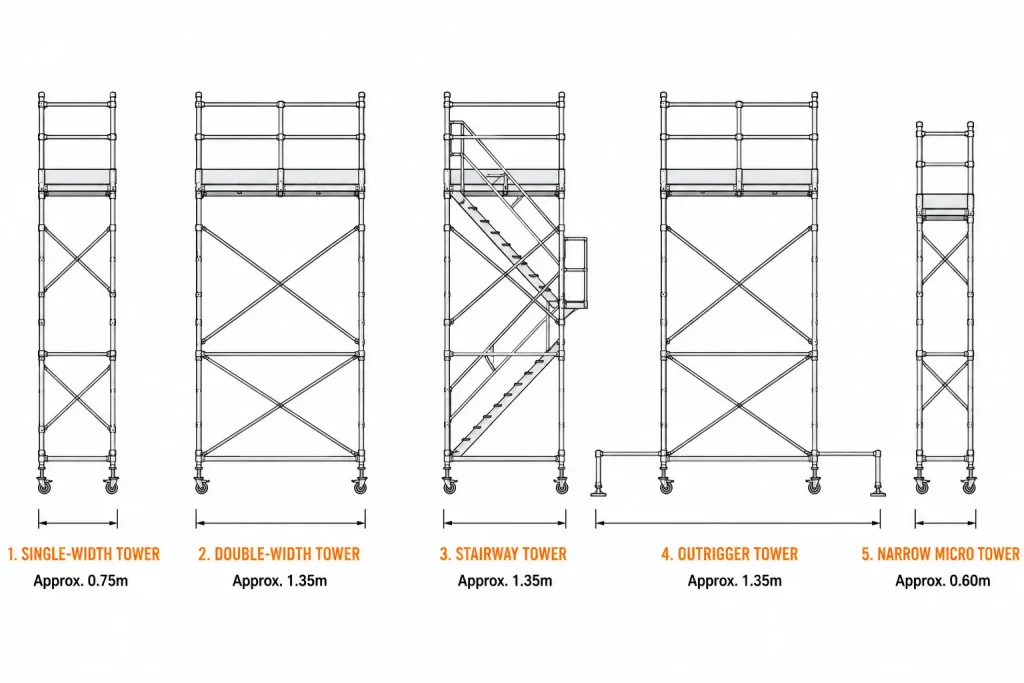
Mobile scaffold towers are available in several configurations, each suited to different working environments, height requirements, and access constraints.
Single-Width Tower
The single-width tower is the most compact mobile scaffold configuration. With an internal platform width of approximately 0.85 metres, it is suited to work in narrow spaces, corridors, stairwells, plant rooms, and locations where a wider tower cannot fit. The narrow platform width limits the working space available and restricts the number of operators and the quantity of materials that can be placed on the platform simultaneously.
Single-width towers are widely used in building maintenance, electrical and mechanical installation, ceiling work, and inspection tasks where the access constraint is horizontal space rather than working height. Their compact footprint allows them to be moved through standard doorways and positioned in locations that no other elevated work platform can access.
Double-Width Tower
The double-width tower provides a wider working platform, typically 1.35 or 1.85 metres internal width, giving the operator more space to work, more room for tools and materials, and the option of two operators working simultaneously on the same platform.
Double-width towers are better suited to tasks that require a wider working area, painting, plastering, installation of ceiling systems, mechanical and electrical work on broad structural elements, and to tasks where materials must be placed on the platform alongside the operator. The wider base also provides better stability at a given height compared to a single-width tower of the same frame height, allowing a greater working height within the same height-to-base ratio limit.
Stairway Tower
The stairway tower replaces the internal ladder access of a standard mobile scaffold with a built-in staircase running up the inside or outside of the tower structure. The staircase provides safer, easier access to the working platform, particularly for operators carrying tools or materials, and is required by some national working-at-height regulations for towers above a specified height.
Stairway towers are larger and heavier than ladder-access towers of equivalent height, and their footprint is greater due to the staircase structure. They are typically specified for longer-duration tasks where operators will ascend and descend the tower frequently throughout the working day, and for tasks where the work involves carrying heavy or awkward loads to the platform.
Cantilever or Outrigger Tower
The standard mobile scaffold tower’s stability depends on maintaining a defined ratio between the tower’s height and the dimension of its base. As working height increases, the base dimension must increase proportionally, or outriggers must be fitted to extend the effective base width beyond the tower’s frame width.
Outrigger tubes, horizontal extensions fitted to the base of the tower and braced back to the main frame, increase the effective base footprint without increasing the frame width. This allows a taller working height to be achieved within the stability ratio requirements without using a wider, heavier tower system.
Outriggers are typically required on towers above 2.5 times the minimum base dimension in height for indoor use, and above 2 times the minimum base dimension for outdoor use, though the specific ratios vary by system and by the applicable national standard. The manufacturer’s erection guide specifies the outrigger configuration required for each tower height.
Narrow or Micro Tower
At the compact end of the mobile scaffold range, narrow or micro towers are designed for very restricted access, spaces too tight even for a standard single-width tower. Some systems offer frame widths as narrow as 0.45 metres, allowing access through restricted openings and into plant spaces where no other access platform fits.
Narrow towers have correspondingly limited platform load capacity and working height capability. They are suited to light inspection, cleaning, and maintenance tasks in confined mechanical and electrical plant spaces, not to tasks requiring heavy materials or sustained physical effort at height.
Also read : Rough Terrain Crane: How It Works and When to Use It
Mobile Scaffolding vs Fixed Scaffolding
The choice between mobile scaffolding and fixed scaffolding is determined by the nature and duration of the work, the access geometry, and the number of users:
- Duration
Mobile scaffolding is suited to short-duration tasks, hours to a few days, at any single location. Fixed scaffolding becomes more economical when the work at a single location extends over weeks or months, because the cost of the scaffold is amortised over a longer period of use.
- Access extent
Mobile scaffolding is suited to point access, a single location or a series of separate locations reached by repositioning the tower. Fixed scaffolding is suited to continuous access along a facade, around a building perimeter, or across a large area where multiple trades need simultaneous access at multiple elevations.
- Number of users
A mobile scaffold tower typically accommodates one or two operators on the working platform. Fixed scaffolding can provide simultaneous access for many operators across its entire length and at multiple lift heights.
- Site conditions
Mobile scaffolding requires a firm, reasonably level surface to move and operate on. On rough, soft, or heavily sloped ground, mobile scaffolding cannot be used safely and fixed scaffolding, or an alternative working-at-height solution, is required. For tasks on ground conditions that prevent mobile scaffold use, the range of aerial work platforms and their suitability for different ground conditions is covered in detail in the guide to boom lifts, cherry pickers, and aerial work platform selection.
- Ties and building access
Fixed scaffolding requires ties to the building facade for stability at height, which means drilling or anchoring into the structure. Mobile scaffolding is freestanding and requires no building ties, making it the only practical option for access tasks in locations where drilling or anchoring to the structure is not permitted, listed buildings, finished interiors, temporary structures.
For a comprehensive understanding of when fixed scaffolding is the right choice and how it is correctly erected, the step-by-step guide to building scaffolding safely covers the full erection sequence, inspection requirements, and safety obligations that apply to fixed tube-and-fitting scaffold.
Safety Requirements for Mobile Scaffolding
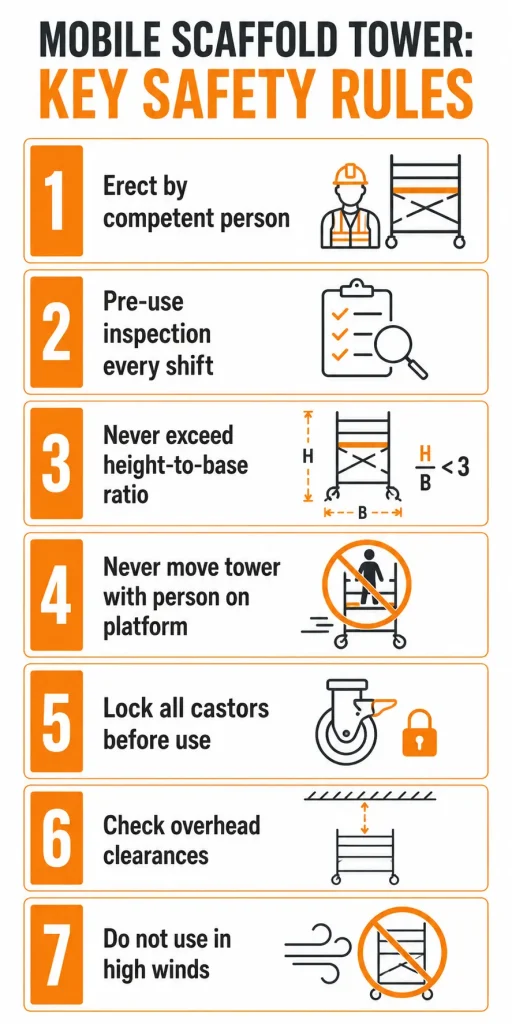
Mobile scaffolding carries the same fundamental working-at-height safety obligations as any other elevated work platform. The specific requirements that apply to mobile scaffold towers include:
- Erection by competent persons
The tower must be erected in accordance with the manufacturer’s erection guide by a person competent in mobile scaffold assembly. Competency does not necessarily require formal scaffolding certification, in most jurisdictions, the PASMA (Prefabricated Access Suppliers’ and Manufacturers’ Association) mobile scaffold operator training course is the recognised standard, but the erector must understand the assembly sequence, the stability requirements, and the correct use of all components.
- Pre-use inspection
Before each shift of use, the tower must be inspected by a competent person. The inspection must confirm that all braces are correctly fitted and locked, that all platform components are secure, that guardrails and toe boards are in place on all open sides, that castors are locked, and that the tower is level. Any defect must be rectified before the tower is used.
- Height-to-base ratio compliance
The tower’s working height must not exceed the maximum permitted by the height-to-base ratio for the configuration in use, with or without outriggers as required. Exceeding the ratio without outriggers is one of the most consistent causes of mobile scaffold overturn.
- No movement with persons on the platform
The tower must never be moved, pushed or pulled, while a person is on the working platform. All persons must descend to ground level before the tower is repositioned. Moving a tower with an occupant on the platform is a high-energy overturn risk and is prohibited under working-at-height regulations universally.
- Surface assessment
The surface on which the tower stands must be firm, level within the tolerance specified by the manufacturer, and capable of sustaining the tower’s loaded weight through the castor contact points. On surfaces of uncertain bearing capacity, the load through each castor must be assessed against the surface’s bearing limit. The principles of ground and surface assessment for elevated equipment are consistent across all categories of working-at-height plant, as set out in guidance on lifting equipment safety and surface bearing assessment for access equipment.
- Overhead hazard clearance
Before the tower is erected and used, overhead clearances must be checked, overhead power lines, structural beams, sprinkler heads, and other services that could be struck by the tower during erection, use, or movement. Contact with an overhead power line during tower movement is a recognised cause of fatal incidents involving mobile scaffold.
- Wind and weather
Mobile scaffold towers must not be used in wind speeds exceeding the manufacturer’s rated limit, typically Beaufort Force 6 (approximately 12.5 metres per second). Outdoors, the tower must be tied or secured against wind movement when not in use if it cannot be dismantled. An unsecured mobile scaffold left overnight or over a weekend in open outdoor conditions is a wind overturn risk.
When Mobile Scaffolding Is and Is Not the Right Choice
Mobile scaffolding is the right working-at-height solution when the work is short in duration, covers a limited area, requires access at multiple discrete locations, and the ground conditions are firm and level. It is productive, economical, and practical for building maintenance, interior fit-out, installation and inspection work, and any access requirement where the task moves rather than stays in one place.
It is not the right choice when the work extends across a full building facade or large continuous area requiring simultaneous access at multiple elevations, fixed scaffolding serves this requirement. It is not the right choice when the ground conditions are soft, uneven, or sloped beyond the tower’s operating tolerance, an aerial work platform, a rough terrain boom lift, or a cherry picker is more appropriate. And it is not the right choice when the working height required exceeds the maximum safe height achievable with the available base dimension, even with outriggers, at that point, a larger fixed scaffold or a boom lift provides the required height safely.
Understanding how mobile scaffolding fits within the broader family of working-at-height solutions, alongside boom lifts, cherry pickers, scissor lifts, and fixed scaffolding, is the foundation of correct access equipment selection on any project. The full range of aerial work platform types and their operational parameters are covered in the complete guide to what a cherry picker is and when to use one.
Also read : Types of Bridges: Structures, Uses, and How They Work
The Right Access Platform for Every Task
Mobile scaffolding is one of the most productive and cost-effective working-at-height solutions available, when it is used for the tasks it is designed for, on the surfaces it is designed for, within the height and load limits it is rated for. Its combination of rapid assembly, repositionable mobility, and freestanding stability makes it the default choice for a wide range of building maintenance, interior access, and construction finishing tasks that do not justify the overhead of fixed scaffolding or the cost of a powered access platform.
RR Machinery provides a comprehensive range of mobile scaffolding towers and access equipment for rental and sale, all maintained to full operational standard and available with guidance from experienced equipment specialists. Explore our full range of mobile scaffolding and access tower solutions, or contact our team for practical advice and a clear quotation matched to your working height, site conditions, and access requirements.