What Determines How Long a Generator Can Run
 Generator runtime is not a single specification that can be read off a datasheet without context. It is the product of several interacting factors, each of which must be understood and managed if the generator is to operate reliably for the duration required.
-
-
Fuel Tank Capacity and Fuel Consumption Rate
-
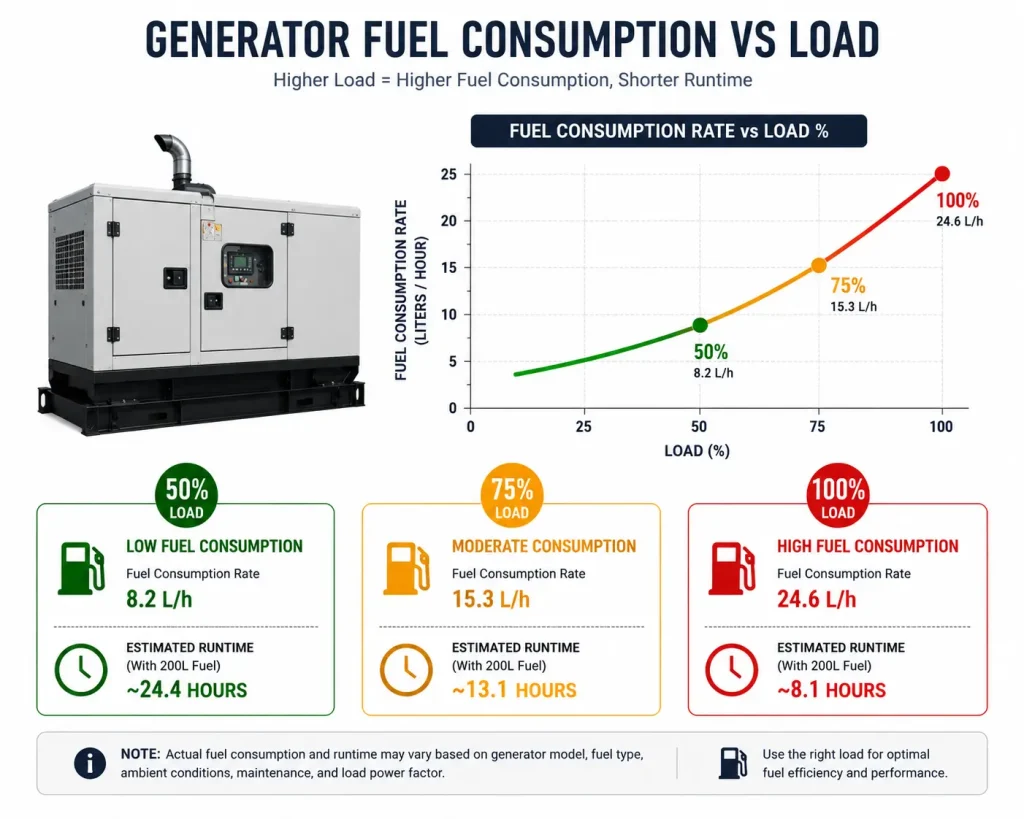
The most direct determinant of how long a generator can run without interruption is the relationship between its fuel tank capacity and its fuel consumption rate at the load being applied. A diesel generator with a 200-litre tank consuming ten litres per hour at 75 percent load will run for approximately twenty hours before the tank is exhausted. The same generator at full load might consume fourteen litres per hour, reducing that runtime to around fourteen hours. The same generator at 50 percent load might consume seven litres per hour, extending runtime to nearly twenty-eight hours.
This relationship between load and fuel consumption is the most practical variable a site manager or facilities operator can influence in the short term. Running a generator at a lower percentage of its rated capacity consistently extends the time between refuelling stops, reduces engine wear, and often improves overall fuel efficiency. Most generator manufacturers publish fuel consumption curves at 25, 50, 75, and 100 percent load, and these figures should be consulted when planning refuelling schedules for extended operations.
-
-
Generator Type and Design
-
Different generator types are built for different operating profiles, and this directly affects how long they can run continuously without requiring intervention. Industrial diesel generators, particularly those built for prime or continuous power applications, are designed with larger fuel tanks, more robust cooling systems, and engine specifications that allow sustained operation at rated load for extended periods. Many industrial models are rated for continuous operation at 80 percent of their prime power rating, meaning they can run indefinitely at that load level provided fuel supply, oil levels, and cooling are maintained.
Portable petrol generators, by contrast, are typically designed for intermittent use and have much smaller fuel tanks, lighter-duty engines, and cooling systems that are not intended for sustained high-load operation. Most portable generators should not be run continuously for more than eight to twelve hours without a rest period, and many have a recommended maximum continuous run time specified in the manufacturer’s manual that must be observed to avoid overheating and premature wear. The distinction between a portable standby generator and an industrial prime power diesel unit is significant, and selecting the wrong type for a sustained power application is one of the most common causes of generator failure in the field.
-
-
Engine Oil Level and Oil Change Intervals
-
Engine oil is consumed and degraded during generator operation, and its condition has a direct bearing on how long the generator can run safely. Most diesel generators consume a small amount of oil during normal operation, and on a machine running continuously for several days, the oil level can drop to a point where the engine’s lubrication system is no longer providing adequate protection to moving parts. Low oil pressure triggers an automatic shutdown on most modern generators, but operating close to that threshold for extended periods increases wear on bearings, cylinder walls, and other lubricated components.
Oil change intervals for continuously operating generators are typically specified in operating hours rather than calendar time. A generator rated for an oil change every 250 hours that has been running for 240 hours should not be assumed safe to run for another 100 hours simply because it appears to be functioning normally. Following the manufacturer’s oil change schedule is not discretionary maintenance. It is the primary mechanism by which the engine’s internal components are protected from the accelerated wear that continuous high-load operation produces.
-
-
Cooling System Condition
-
Diesel and petrol generators generate significant heat during operation, and the cooling system, whether air-cooled or liquid-cooled, is what keeps the engine temperature within the range at which it can operate reliably. Air-cooled generators are sensitive to ambient temperature and the cleanliness of their air intake and cooling fins. Operating in a hot environment, in an enclosed space with restricted airflow, or with blocked cooling fins will cause the engine temperature to rise above its safe operating range and trigger a thermal shutdown.
Liquid-cooled generators rely on a coolant circuit, radiator, and fan to maintain engine temperature. The coolant must be at the correct level and concentration, the radiator must be clean and free of obstructions, and the thermostat and water pump must be functioning correctly. A generator that has developed a slow coolant leak, a partially blocked radiator, or a failing water pump may appear to operate normally under light load but overheat during sustained high-load operation, which is precisely when reliable power supply is most critical. Checking the cooling system before any extended operating period is not optional. It is the inspection that prevents the most common category of generator thermal failure.
Also read: Power Generator for Sale and Rental
How Generator Fuel Type Affects Runtime
The fuel type a generator uses has a significant effect on its practical runtime, its refuelling logistics, and its suitability for continuous or extended operation. Understanding the characteristics of each fuel type allows project managers and facilities operators to select the right generator for the duration and operating profile of the application.-
-
Diesel Generators
-
Diesel generators are the most widely used option for construction sites, industrial facilities, data centres, and critical standby applications in Singapore and globally. Diesel fuel has a higher energy density than petrol, which means a diesel generator produces more power per litre of fuel consumed, resulting in longer runtime per tank and lower fuel costs over an extended operating period. Industrial diesel generators are built for sustained operation and are typically rated for continuous or prime power use, with many models capable of running for 24 hours or more per day provided fuel supply is maintained and scheduled maintenance is observed.
Diesel generators also benefit from the widespread availability of diesel fuel across construction sites, industrial facilities, and logistics operations in Singapore, which simplifies the refuelling logistics for extended deployments. The fuel is less volatile than petrol, making it safer to store in larger quantities on site. For any application requiring sustained power supply over days or weeks, a diesel generator is almost always the preferred choice on the basis of runtime capability, fuel economy, and durability under continuous load.
-
-
Petrol Generators
-
Petrol generators are lighter, more portable, and lower in initial cost than diesel equivalents, which makes them a practical choice for short-duration power needs where mobility matters more than sustained runtime. However, petrol generators are generally not suited to continuous heavy-duty operation. Their smaller engines, lighter construction, and more limited cooling capacity mean that extended high-load use accelerates wear and increases the risk of overheating compared to a diesel unit of comparable output.
Petrol’s higher volatility compared to diesel also introduces additional storage and handling considerations when fuel must be kept on site in quantity. For applications requiring more than eight to twelve hours of continuous operation, or where the generator is the primary rather than backup power source, a petrol generator is typically not the appropriate choice. Its role is best suited to emergency backup, short-term site power, or applications where portability and low setup cost are the primary criteria.
-
-
Natural Gas and LPG Generators
-
Natural gas and LPG generators offer a distinct advantage in terms of fuel supply continuity: when connected to a mains gas supply or a sufficiently large LPG tank, they can run for as long as gas is available without the interruption of manual refuelling. This makes them particularly attractive for standby and prime power applications in fixed installations where a reliable gas supply is available. The absence of a fuel tank that must be monitored and refuelled removes one of the most common causes of unplanned generator shutdown in extended operations.
The practical limitation of gas generators in Singapore’s construction and industrial context is the requirement for a connection to a gas supply infrastructure or a large LPG storage installation. On construction sites where the generator must be mobile and self-contained, diesel remains the more practical fuel type. For permanent or semi-permanent installations, particularly in data centres, healthcare facilities, and industrial plants with existing gas infrastructure, natural gas generators offer a compelling combination of continuous runtime and lower emissions compared to diesel.
Practical Runtime Limits for Continuous Generator Operation
Understanding the theoretical maximum runtime of a generator is useful, but understanding the practical runtime limits under real operating conditions is what determines how a generator deployment must be planned and managed on an active site or in a critical facility.-
-
Portable Generators
-
Most portable generators, whether diesel or petrol powered, are not designed for truly continuous operation and have a recommended maximum continuous run time that must be observed. For petrol portable generators, this is typically in the range of eight to twelve hours at full load, after which the engine should be allowed to cool before restarting. Running a portable generator beyond its recommended continuous run time without a cooling break risks overheating the engine, accelerating oil degradation, and in the worst case causing permanent damage to the engine’s internal components.
For construction sites or events where power is required for longer than a portable generator’s continuous run time allows, the practical solution is either to use an industrial generator rated for continuous operation, or to operate two portable units in rotation, running one while the other cools and is serviced. The logistics of this arrangement are manageable but require planning in advance, including the provision of transfer switching equipment to move the load between units without interruption to the powered equipment.
-
-
Industrial Diesel Generators
-
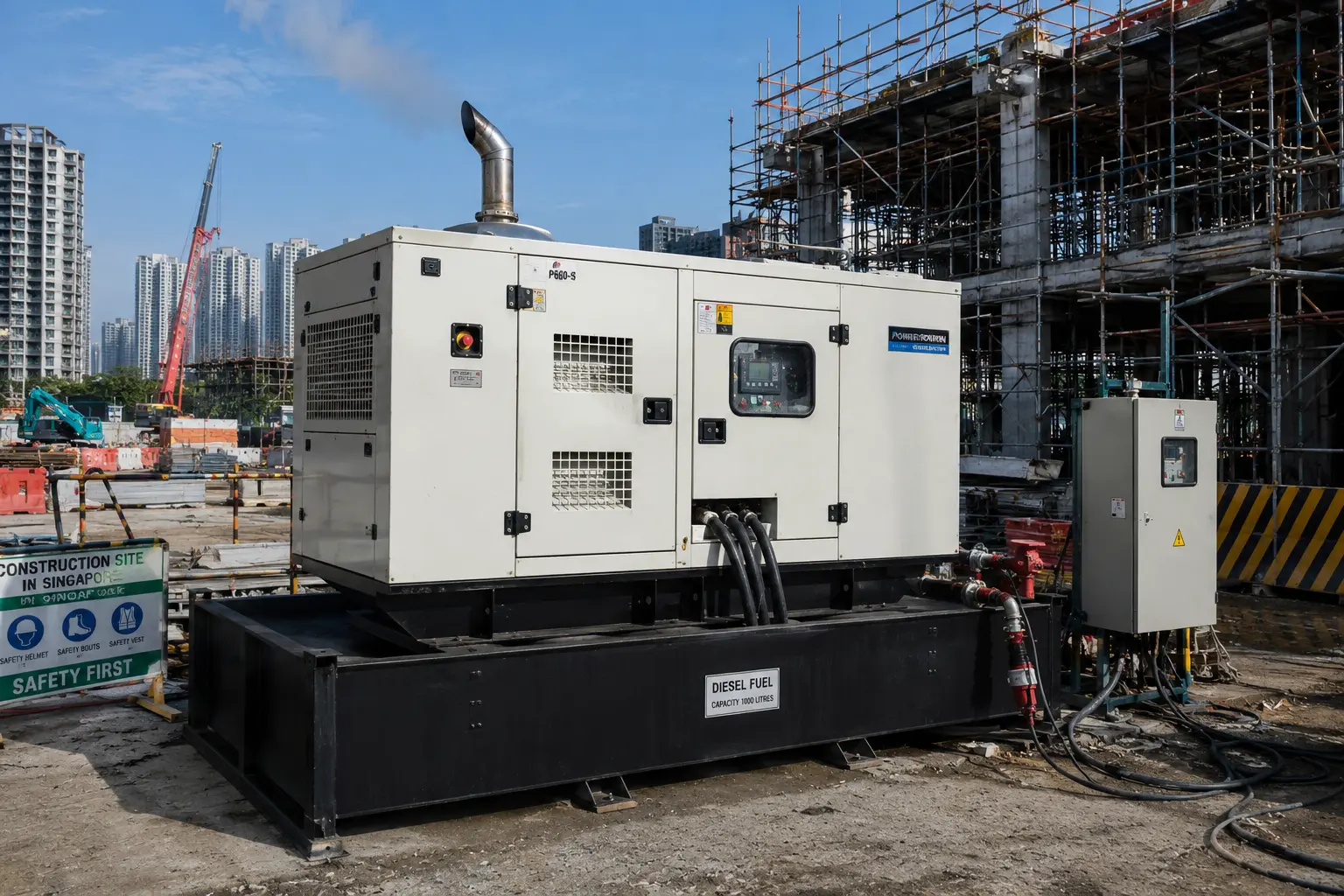
Industrial diesel generators built for prime power or continuous duty applications are designed to run indefinitely at or below their rated continuous load, provided fuel supply is maintained and scheduled maintenance is performed at the intervals specified by the manufacturer. Many industrial generators used in Singapore’s construction and industrial sectors are rated for continuous operation at 80 percent of their prime power rating, a load level that the engine and alternator can sustain without thermal or mechanical degradation over extended periods.
In practice, the limiting factor for continuous operation of an industrial diesel generator is not the engine’s mechanical capability but the maintenance schedule. Oil levels must be checked and topped up daily during continuous operation. Coolant levels must be verified at regular intervals. Air filters must be inspected and cleaned or replaced as required by the operating environment, which on a dusty construction site may mean more frequently than the standard service schedule specifies. Fuel quality must also be monitored on extended deployments, as diesel that has been stored in tanks exposed to temperature variation can develop microbial contamination and water ingress over time, both of which degrade engine performance and can cause fuel system damage.
-
-
Standby Generators
-
Standby generators are rated differently from prime power generators and are designed to operate for limited durations during power outages rather than as a continuous power source. A generator with a standby power rating is typically capable of sustaining that output for periods of up to 200 hours per year, with individual run durations of up to 500 hours before a major service is required. Running a standby-rated generator as a continuous prime power source without accounting for its duty cycle rating will shorten its service life and may void the manufacturer’s warranty.
For applications where continuous operation is anticipated, specifying a generator with a prime power rating rather than a standby rating is the correct approach from the outset. The distinction between standby and prime power ratings is not a marketing classification. It reflects genuine differences in the engine build standard, cooling system capacity, and service interval requirements of the two types of machine. Specifying the wrong duty cycle rating for a sustained power application is one of the most common specification errors made when renting or purchasing generators for construction and industrial projects.
How to Maximise Generator Runtime and Reliability
For any application where extended generator operation is planned, the steps taken before the generator starts running are as important as the maintenance performed during operation. A generator that is correctly selected, properly installed, and thoroughly checked before it is needed is far more likely to run reliably for the required duration than one that is mobilised at short notice without preparation.-
-
Load Management
-
Running a generator at an appropriate load level is one of the most effective ways to extend runtime, reduce fuel consumption, and protect the engine from premature wear. Operating a diesel generator consistently below 30 percent of its rated load leads to a condition known as wet stacking, where unburnt fuel and carbon deposits accumulate in the exhaust system and engine components, degrading performance over time. The recommended operating range for most diesel generators is between 50 and 80 percent of rated load, which balances fuel efficiency, engine protection, and the power headroom needed to handle transient load spikes without overloading the machine.
On construction sites and in industrial facilities where the electrical load varies throughout the day, a load monitoring system or generator management panel can provide real-time visibility of the load being applied and alert the operator when the generator is being run outside its optimal range. For larger installations with multiple generators, automatic load-sharing controls can distribute the electrical load evenly across units, keeping each machine in its optimal operating range while providing redundancy in the event that one unit requires service.
-
-
Pre-Operation Inspection
-
Before placing a generator in service for an extended run, a thorough pre-operation inspection is the single most important step in preventing unplanned shutdowns. The inspection should cover engine oil level and condition, coolant level and concentration, fuel level and fuel quality, battery condition and electrolyte level for electric start models, air filter condition, all belts and hoses for visible wear or deterioration, and a test of all safety shutdown devices including low oil pressure and high temperature cutouts.
For generators being returned to service after a period of storage or inactivity, the pre-operation inspection must be more thorough. Fuel that has been sitting in the tank for an extended period should be checked for contamination and, if in doubt, drained and replaced. Coolant antifreeze concentration should be verified. The battery should be load-tested, not just checked for voltage, because a battery that holds a surface charge may still fail to crank the engine under load. Running the generator under load for a period before relying on it for critical power supply allows any latent issues to surface in a controlled way rather than during an actual power emergency.
-
-
Scheduled Maintenance During Extended Operation
-
For generators running continuously over multiple days or weeks, scheduled maintenance during the operating period is not optional. Engine oil must be monitored daily and topped up as required, with a full oil change performed at the interval specified in the service manual for the number of operating hours accumulated. Air filter condition must be checked and the filter cleaned or replaced based on the operating environment, as construction site dust can block an air filter far more rapidly than the standard service interval assumes.
Fuel filters should be checked and replaced if flow restriction is detected, particularly on deployments where the quality of the fuel supply cannot be guaranteed. Coolant must be maintained at the correct level, and the radiator should be inspected for blockage caused by dust, debris, or insects, which can accumulate over extended outdoor operation and restrict airflow through the core. A generator that receives this level of attention during a continuous deployment will operate reliably across the full duration of the project. One that does not will eventually present a maintenance issue at the worst possible moment.
Also read: Generator Servicing and Equipment Maintenance
Generator Safety During Extended Operation
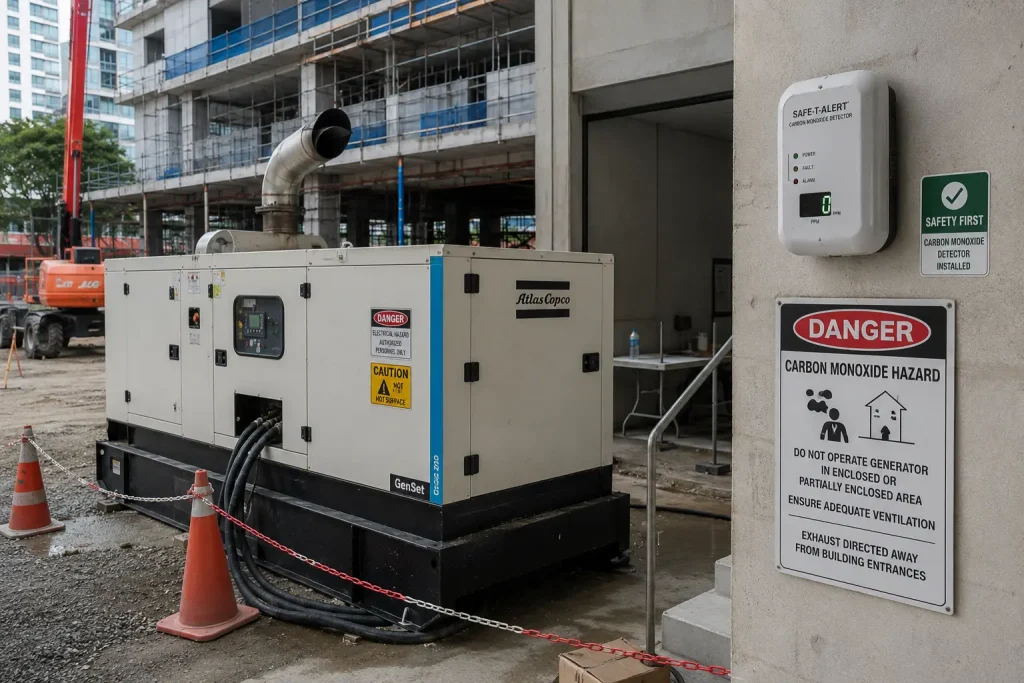 Running a generator for an extended period introduces safety considerations that do not arise during short-duration use. Carbon monoxide accumulation, fire risk from fuel handling, and electrical safety all require active management when a generator is in continuous service on a construction site or in a facility environment.
Carbon Monoxide and Ventilation
Diesel and petrol generators produce carbon monoxide as a combustion byproduct, and carbon monoxide is colourless and odourless, making it undetectable without appropriate monitoring equipment. The single most important safety rule for generator operation is that generators must never be operated in an enclosed space without adequate mechanical ventilation to exhaust combustion gases directly to the outside. Even a partially enclosed area such as a basement, a container, or a tent structure can accumulate dangerous carbon monoxide concentrations within minutes of a generator starting.
On construction sites in Singapore, generators deployed in or near enclosed spaces must be positioned with their exhaust directed away from occupied areas and air intakes, and carbon monoxide detectors should be installed in any space where personnel are working in the proximity of operating generators. The generator safety guidelines published by OSHA provide a comprehensive reference for the safe siting, ventilation, and monitoring requirements applicable to generator operations in construction and industrial environments.
Fuel Storage and Refuelling Safety
Extended generator operation requires fuel to be stored on site in quantities that introduce their own handling and safety considerations. Diesel fuel must be stored in approved containers or bunded fuel tanks positioned away from the generator itself, ignition sources, and site drainage points. Refuelling should always be performed with the generator shut down and the engine allowed to cool, particularly for petrol generators where the risk of fuel ignition from a hot exhaust component is more significant than with diesel.
Fuel spills must be cleaned up immediately and contaminated absorbent material disposed of in accordance with site environmental management procedures. On construction sites, fuel storage and handling is subject to specific requirements under Singapore’s environmental and fire safety regulations, and compliance with these requirements is the site manager’s responsibility. A fuel spill that reaches a drain or waterway creates environmental liability that is entirely avoidable with correct storage and refuelling discipline.
Reliable Generator Solutions for Every Project Duration
How long a generator can run comes down to the combination of machine specification, load management, fuel supply, and the quality of maintenance it receives throughout the operating period. A correctly specified diesel generator, running within its rated load range and serviced at the right intervals, will deliver reliable continuous power for as long as the project demands. One that is underspecified, overloaded, or poorly maintained will fall short of that expectation at the moment it matters most. RR Machinery provides power generators for sale and rental across Singapore, from compact portable units to heavy-duty industrial diesel generators built for continuous operation on construction sites, events, and critical standby applications. Explore our power generator range or contact our team for advice on generator selection and a quotation matched to your power requirements and project duration.