Scaffolding is one of the most fundamental elements of any construction, renovation, or maintenance project involving work at height. Yet despite how common it is on job sites across Singapore and the wider region, the term is often understood only at a surface level. Understanding what scaffolding is, how it works, what types exist, and which components make it safe is valuable knowledge for contractors, facility managers, project planners, and anyone responsible for work at height.
This guide covers everything you need to know about scaffolding in construction, from its basic definition and purpose to the different system types, core components, regulatory context in Singapore, and how to choose the right scaffolding solution for your specific project requirements.
What Is Scaffolding?
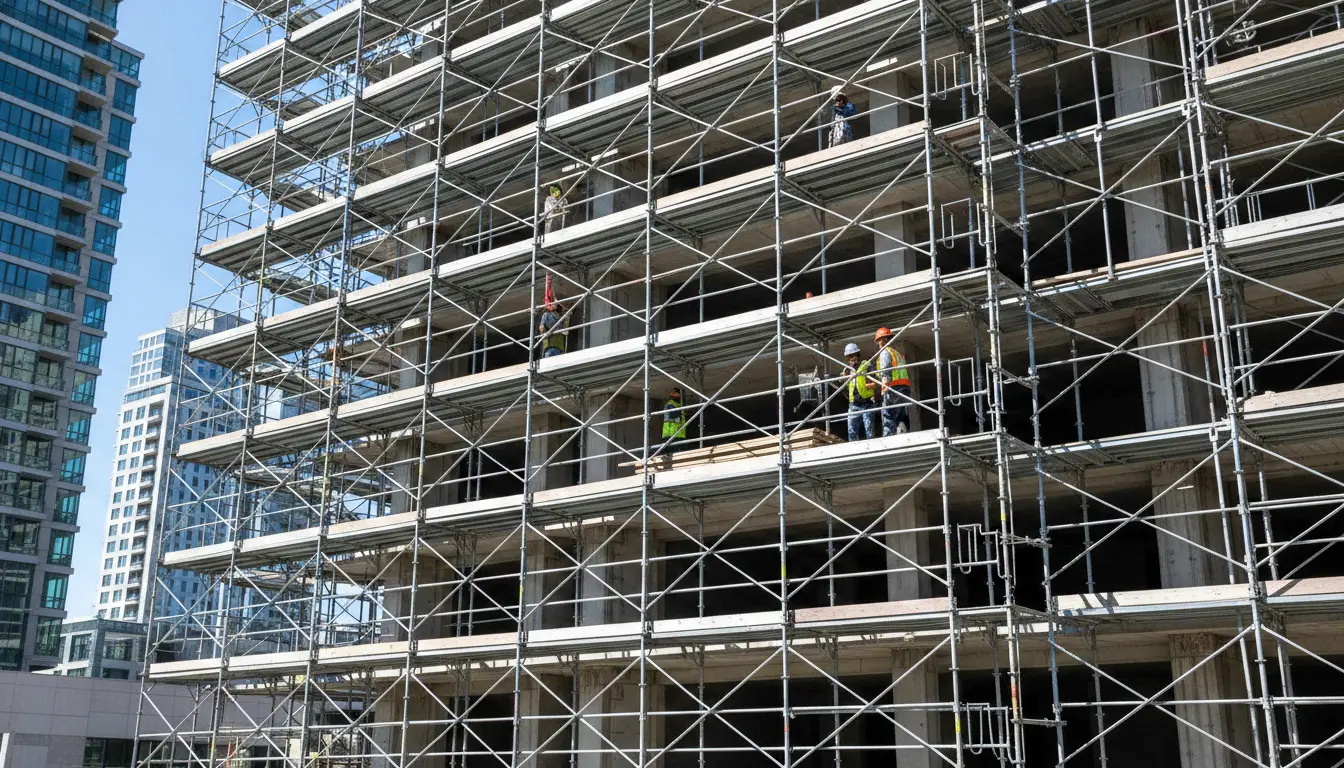
Scaffolding, in the context of construction and industrial work, refers to a temporary structure erected to provide workers with a safe, stable elevated platform from which they can perform tasks that cannot be safely reached from the ground. It supports both the workers and the materials they need, tools, equipment, finishing materials, while they carry out work at height.
The term comes from the Old French word escafaut, and the concept itself is ancient, historians have found evidence of scaffolding use in prehistoric cave painting sites and early Egyptian construction. In modern construction, however, scaffolding has evolved into a highly engineered system governed by strict safety standards, load calculations, and regulatory frameworks.
Scaffolding is not a permanent structure. It is assembled before a project begins, adjusted as work progresses, and dismantled once the work is complete. This temporary nature is what distinguishes it from fixed structural platforms, but it does not in any way reduce the engineering rigour required to make it safe and effective.
Also read : Forklift vs Pallet Jack: Differences, Uses, and How to Choose
Why Is Scaffolding Used in Construction?
The primary reason scaffolding is used is access, specifically, providing workers with a secure platform to carry out tasks at elevations that would otherwise be unsafe or impossible. But access is only one part of the picture.
Scaffolding serves multiple functions simultaneously on a construction site:
Worker safety
A properly erected scaffold provides a stable working surface with guardrails, toe boards, and load-rated planks that significantly reduce the risk of falls, one of the leading causes of workplace fatalities in construction globally.
Material support
Scaffolding allows construction materials such as bricks, tiles, cladding panels, and finishing components to be staged close to where they are needed, reducing handling time and physical strain on workers.
Structural access
For tasks like façade repair, painting, waterproofing, window installation, and external cladding, scaffolding provides the only practical means of maintaining consistent, repeatable access across large vertical or horizontal surface areas.
Multi-level work
On large construction sites, scaffolding systems can support multiple working levels simultaneously, allowing different trades, electrical, mechanical, structural, to work on different floors of a building at the same time.
Equipment support
Beyond carrying workers, scaffolding can also support temporary enclosures, weather protection sheeting, lighting, and other site equipment required to keep operations running.
Given these functions, it is clear why scaffolding remains a cornerstone of construction methodology even as powered access equipment such as boom lifts and scissor lifts has become more widely available. For many applications, particularly façade work, large-scale renovation, and multi-week access requirements, scaffolding remains the most practical and cost-effective solution.
Main Types of Scaffolding Used in Construction
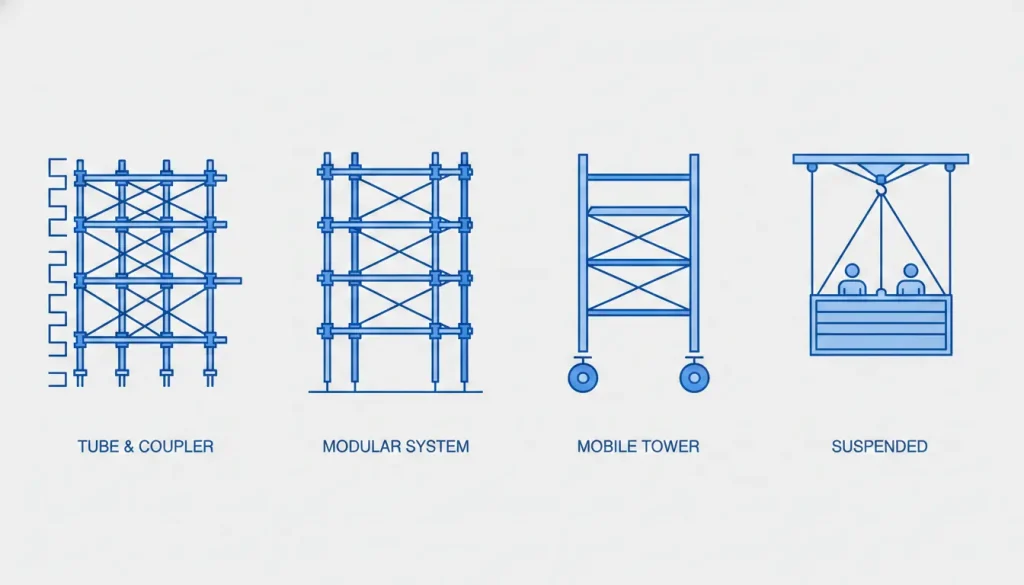
Scaffolding is not a single product. It is a category of temporary access systems, each designed for a different set of conditions, load requirements, and project durations. Understanding the main types helps project planners select the most appropriate system.
Tube and Coupler Scaffolding
Tube and coupler scaffolding is one of the oldest and most flexible systems still in widespread use. It consists of individual steel or aluminium tubes connected by mechanical couplers (also called clamps) to form a custom structure. Because every joint is independent, tube and coupler scaffolding can be configured to almost any geometry, including irregular building facades, curved surfaces, and areas with obstructions.
This flexibility makes it the preferred choice for complex or non-standard projects. However, it is also the most labour-intensive type to erect and dismantle, and it requires skilled scaffolders who understand load distribution and safe coupling practice.
System Scaffolding (Modular Scaffolding)
System scaffolding, also referred to as modular scaffolding, uses pre-engineered components with fixed connection points. Standards (vertical tubes), ledgers (horizontal tubes), and diagonal braces connect via rosette-style or cup-lock nodes at pre-set intervals. This standardisation makes erection faster, more consistent, and easier to inspect.
System scaffolding is widely used on large construction projects where speed of erection and repeatability are priorities. It is also generally regarded as safer for less experienced scaffolders, because the fixed geometry reduces the number of individual decisions that need to be made during assembly.
Popular system scaffolding types include Ringlock, Cuplock, and Kwikstage systems, each with slight differences in connector design and load rating.
Mobile Scaffolding (Tower Scaffolding)
Mobile scaffolding, sometimes called rolling scaffolding or scaffold towers, consists of a self-contained frame mounted on lockable castor wheels. It is assembled quickly, repositioned without dismantling, and ideal for indoor tasks or short-duration outdoor work where a fixed scaffold would be excessive.
Mobile scaffolding platforms typically reach heights ranging from 2 metres to 12 metres, making them suitable for a wide range of maintenance, electrical, painting, and installation tasks. Their compact footprint allows use in areas where larger scaffolding systems, or powered access equipment, cannot fit.
For businesses and contractors in Singapore looking for flexible elevated access without the commitment of a full scaffold installation, mobile scaffolding rental is an increasingly common choice, offering the practicality of a stable platform with the convenience of easy repositioning.
Suspended Scaffolding
Suspended scaffolding, as its name suggests, is hung from the structure above rather than built up from the ground. It is most commonly seen in the form of gondola systems on tall buildings, the same platforms used by window cleaners and façade inspection teams on high-rise towers.
Suspended scaffolding is used when ground-based access is not feasible, typically on very tall buildings or where the ground area below is inaccessible (active roads, water, existing structures). It requires careful load engineering and regular inspection of the suspension mechanism, which bears the entire weight of the platform and its occupants.
Cantilever Scaffolding
Cantilever scaffolding, also called needle scaffolding, is anchored to the building structure rather than the ground. Horizontal needles project from the building and support the working platform above or below the anchor point. This type is used when the ground cannot bear the load of a standard scaffold, or when access is needed to a specific section of a building above an obstruction.
Shoring Scaffolding
Shoring scaffolding, also known as falsework, does not serve as a working platform. Instead, it provides temporary structural support to a building or element under construction, such as a freshly poured concrete slab, a floor, or an arch. Shoring transmits the load of the structure above it to the ground or an adjacent structural element until the structure gains sufficient strength to be self-supporting.
Key Components of a Scaffold Structure
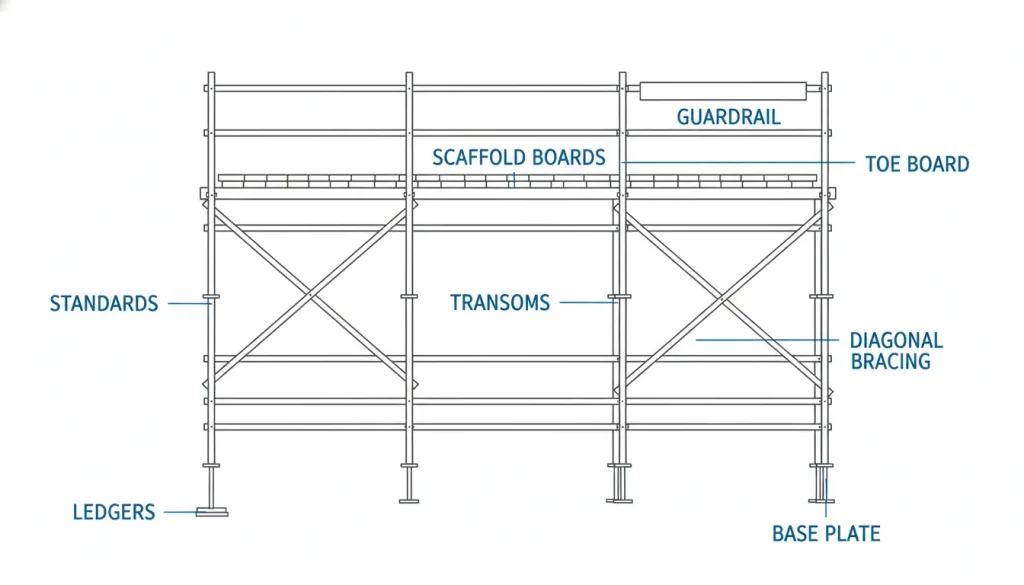
Regardless of the type of scaffolding system used, most scaffold structures share a common set of components. Understanding these components is important for anyone involved in specifying, erecting, or inspecting scaffolding on a construction site.
Standards
Standards are the vertical tubes or uprights that carry the full vertical load of the scaffold, the weight of the platform, workers, materials, and any dynamic loads from activity on the scaffold. They must be plumb (perfectly vertical) and rest on base plates or sole boards that distribute the load to the ground without sinking or shifting.
Ledgers
Ledgers are horizontal tubes that run parallel to the building face, connecting the standards at each lift height. They provide lateral stability to the scaffold and support the transoms and working platforms above.
Transoms
Transoms are horizontal tubes that run perpendicular to the building face, connecting the inner and outer rows of standards. They support the scaffold boards or planks that form the working platform surface.
Scaffold Boards or Planks
Scaffold boards form the working surface of the scaffold. They must be load-rated, free from defects, and laid without gaps that could trap a foot or allow tools to fall through. In Singapore, scaffold boards must comply with relevant safety standards for timber or metal decking.
Guardrails and Toe Boards
Guardrails are the uppermost horizontal rail on the scaffold’s open sides, positioned at a height that prevents workers from falling over the edge. Toe boards are vertical boards fixed along the edge of the platform at floor level, preventing tools, materials, or debris from rolling or sliding off the platform and falling onto people below.
Bracing
Diagonal bracing gives the scaffold its structural rigidity, preventing the framework from racking (leaning sideways) under lateral loads such as wind pressure or the movement of workers. Both face bracing (along the facade) and plan bracing (horizontally within the scaffold) are used in larger systems.
Base Plates and Sole Boards
Base plates are metal plates placed under the standards to distribute the load over a wider area. Sole boards are placed under the base plates when the ground is soft or uneven, spreading the load further to prevent the standard from sinking into the ground.
Ties and Anchors
Scaffolding must be anchored to the adjacent building structure at regular intervals to prevent the scaffold from falling away from the building face under wind loads or from being pushed into the building by loading. These tie points must be engineered to withstand the calculated forces and inspected regularly throughout the scaffold’s life.
Also read : Parts of a Crane: Key Components and How They Work
Scaffolding Safety and Regulatory Requirements in Singapore
In Singapore, scaffolding is governed by the Workplace Safety and Health (WSH) Act administered by the Ministry of Manpower (MOM). Any scaffold that exceeds a certain height threshold must be designed by a qualified person, erected by competent scaffolders, and inspected before use and at regular intervals thereafter.
Key regulatory requirements include:
Scaffold design
For scaffolds above a specified height (generally 4 metres and above), a Professional Engineer (PE) endorsement of the design may be required depending on the load and configuration.
Competent scaffolders
Only trained and competent scaffolders may erect, alter, or dismantle scaffolding. Scaffolders are required to hold relevant certifications from MOM-approved training providers.
Pre-use inspection
Every scaffold must be inspected by a competent person before workers use it, after any modification, and after any event (such as strong wind or impact) that may have affected its integrity.
Handover certificates
On completion of erection, a scaffold handover certificate signed by the erecting supervisor is typically required before the scaffold is handed to the user for work.
Fall protection
All working platforms must be provided with adequate guardrails, toe boards, and, where required, safety nets or other fall arrest systems beneath the platform.
These requirements reflect the serious risks associated with scaffold failure. Understanding the regulatory environment is essential for any construction firm or contractor operating in Singapore, both to protect workers and to avoid legal and financial liability.
For a broader understanding of how safety requirements apply across different types of heavy lifting and access equipment used in construction, the regulatory frameworks share many common principles around competency, inspection, and load management.
Scaffolding vs Powered Access Equipment
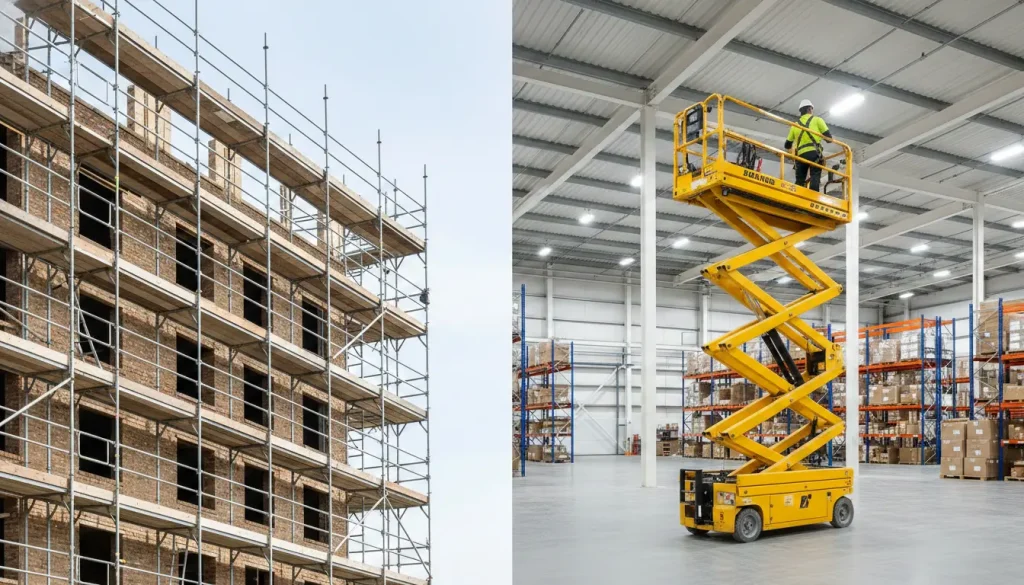
A common question among project planners is when to use scaffolding versus powered access equipment such as boom lifts, scissor lifts, or mobile elevated work platforms (MEWPs).
The answer depends on several factors:
Duration of access
For tasks requiring repeated access over days or weeks, scaffolding is generally more cost-effective than daily MEWP rental. For a one-off task lasting a few hours, a powered platform is usually more practical.
Surface area
For large façade work or multi-floor access, scaffolding provides simultaneous access across a wide area that no single MEWP can replicate.
Ground conditions
MEWPs require firm, level ground. In areas where the ground is soft, uneven, or occupied by structures or trenches, scaffolding may be the only viable option.
Indoor vs outdoor
In indoor environments with restricted ceiling heights, mobile scaffolding towers are often more practical than any powered platform. In outdoor environments with open ground, a boom lift offers faster setup and greater reach flexibility.
Cost profile
Scaffolding has higher upfront erection costs but low running costs once erected. MEWPs have lower setup costs but daily rental costs that accumulate over extended projects.
Many project managers use both, scaffolding for the primary access structure and powered platforms such as scissor lifts for supplementary or precise access tasks that the scaffold geometry doesn’t easily accommodate.
How to Choose the Right Scaffolding for Your Project
Selecting the right scaffolding system involves evaluating several project-specific factors:
Height and reach
How high does the working platform need to be? This determines whether a simple tower scaffold, a modular system, or a full tube-and-coupler structure is required.
Load requirements
How many workers will use the scaffold at once, and what materials will they need on the platform? Load calculations must account for all concurrent loads, not just the weight of one person.
Site geometry
Is the building facade straight or curved? Are there obstructions at ground level? The site geometry often determines whether a standard modular system or a more flexible tube-and-coupler approach is needed.
Duration
How long will the scaffold be needed? Longer projects benefit from system scaffolding that requires less maintenance. Short-duration tasks may be better served by mobile towers.
Indoor or outdoor
Indoor scaffolding must account for floor load limits and overhead clearances. Outdoor scaffolding must be designed to withstand wind loads and weather exposure.
Access requirements
Does the site require scaffolding that can be repositioned regularly, or is a fixed structure more appropriate?
Working with an experienced equipment supplier and, where required, a qualified scaffolding engineer ensures that these decisions are made correctly the first time, avoiding costly modifications, delays, or safety incidents during the project.
Scaffolding Maintenance and Inspection Best Practices
Once erected, scaffolding must be maintained and inspected throughout its service life. Key best practices include:
- Conducting pre-shift visual inspections before each working day
- Checking all ties, anchors, and base plates after high winds or heavy rain
- Replacing any damaged boards, guardrails, or structural members immediately
- Ensuring the scaffold is not loaded beyond its rated capacity
- Keeping access ladders and stairways clear and in good condition
- Never modifying the scaffold structure without involving a competent scaffolder
Scaffolding that is damaged, overloaded, or improperly modified becomes a serious hazard. Regular maintenance not only protects workers but also extends the usable life of the scaffolding equipment itself, reducing overall project costs.
Also read : Parts of a Crane: Key Components and How They Work
Get the Right Scaffolding Solution for Your Project
Understanding what scaffolding is in construction, and how to select, erect, and maintain it correctly, is fundamental to safe, efficient, and compliant work at height. Whether your project involves a short-duration indoor maintenance task or a months-long external façade renovation, the right scaffolding system makes a measurable difference to safety, productivity, and cost control.
RR Machinery offers a comprehensive range of mobile scaffolding systems available for both sale and rental across Singapore, with flexible daily, weekly, and monthly terms. Every unit is delivered ready to assemble, with optional on-site setup and safety guidance available from our experienced team.
Explore our full range of mobile scaffolding solutions to find the right configuration for your project, or contact our team for a practical recommendation and clear quotation tailored to your specific access requirements.