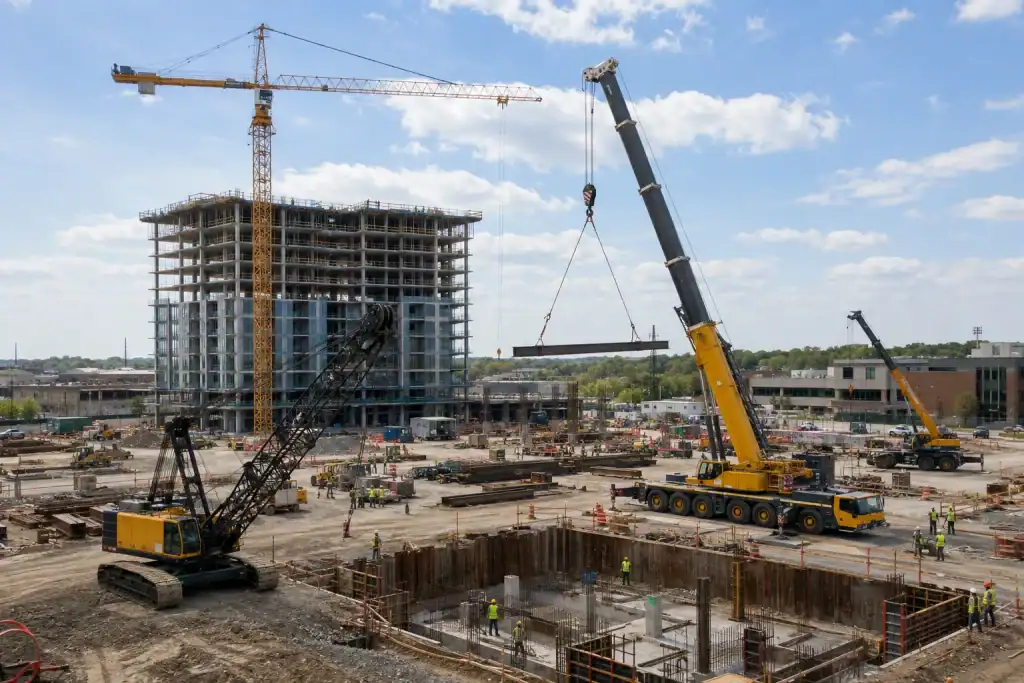
The crane is the machine that makes large-scale construction possible. Without cranes, there are no high-rise buildings, no long-span bridges, no offshore platforms, no large industrial facilities, and no infrastructure of the scale that modern economies depend on. The crane lifts what nothing else can lift, places it where nothing else can reach, and does so with a precision and control that no other category of lifting equipment approaches.
But “crane” is not a single machine, it is a family of machines, each built around a different structural principle, a different mobility configuration, and a different set of operational priorities. A tower crane anchored to a building core lifting structural steel at 200 metres, a mobile all-terrain crane driving itself to a rural infrastructure site, a crawler crane moving on tracks across soft ground at a refinery, these machines share the name “crane” and the function of lifting, but they differ in almost every other operational dimension.
For project managers, site engineers, lifting supervisors, and equipment planners, understanding the types of crane available, what each is built for, how it works, what its capacity and mobility limitations are, and when it is the right choice, is the foundation of effective lift planning on any project involving significant hoisting operations.
How a Crane Works
All cranes share a common functional principle: a structural arm, the boom or jib, extends from a support structure to position a load hook at the required location, and a hoisting mechanism lifts and lowers the load on wire rope or chain reeved through sheaves at the boom tip and at the hook block.
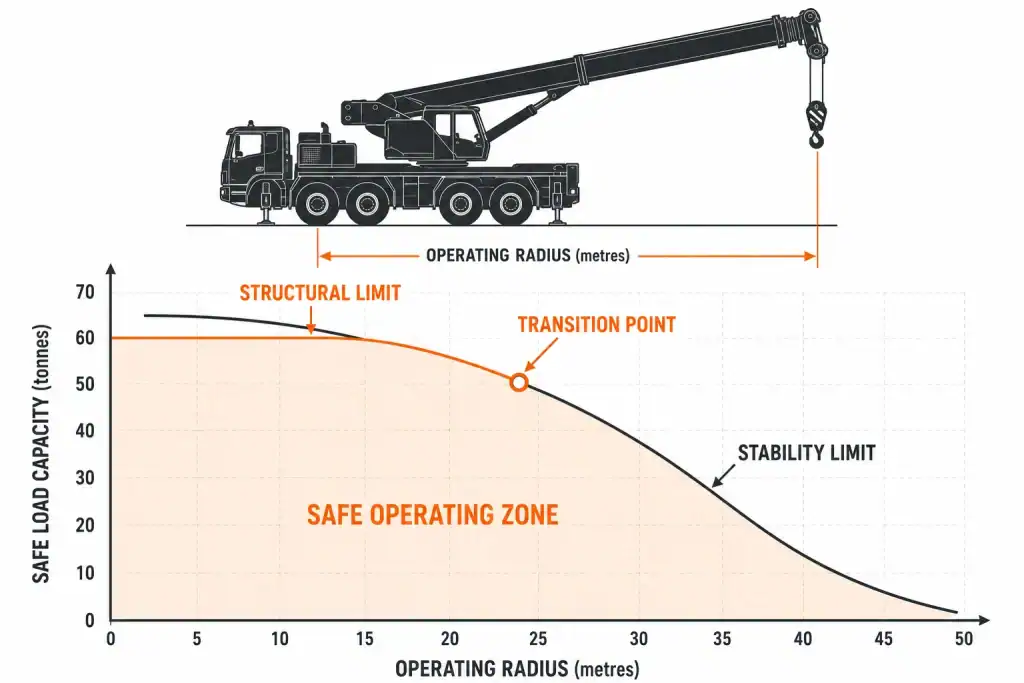
The load a crane can safely lift at any given configuration is determined by two limits, whichever is lower governs:
- Structural capacity
The maximum load the boom, jib, and lifting components can carry without structural failure, regardless of stability.
- Stability capacity
The maximum load that can be lifted without the crane tipping. For most crane types, the stability limit governs at longer radii, where the load is positioned far from the crane’s centre of gravity, while the structural limit governs at short radii with the boom steeply elevated.
The relationship between the crane’s configuration, boom length, boom angle, counterweight, outrigger spread, and the safe load it can lift at any radius is expressed in the crane’s load chart. Reading and applying the load chart correctly before every lift is the most critical single safety act in crane operation. The principles of load chart reading and application are covered in full in the practical guide to reading a crane load chart for safe lifting operations.
Also read : Bulldozer vs Excavator: Differences and When to Use Each
Types of Cranes
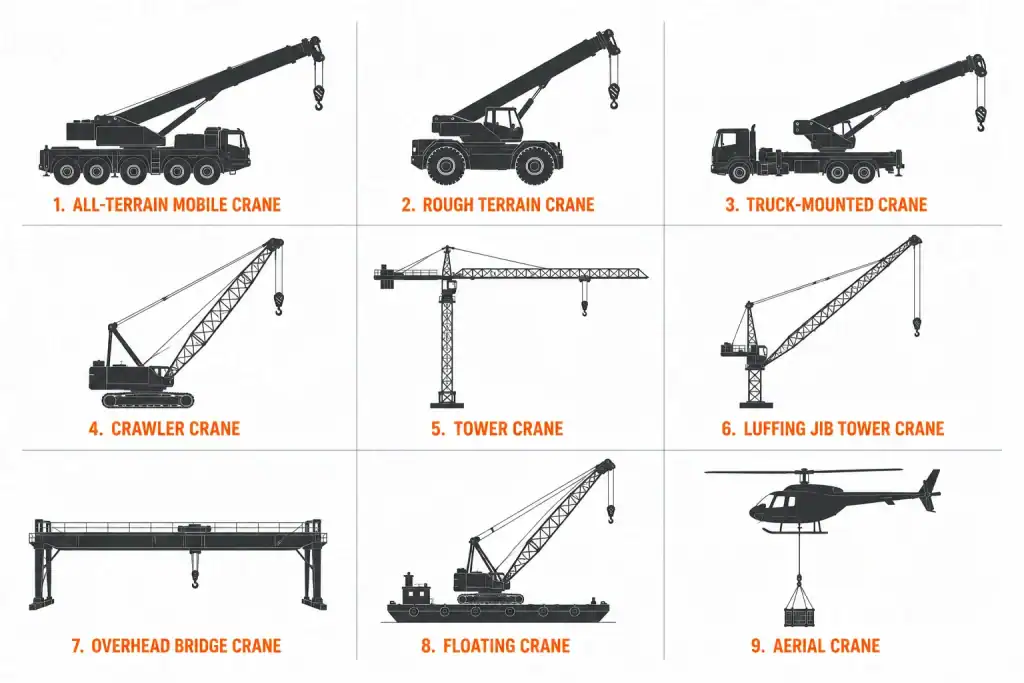
The crane family encompasses a wide range of machine types, each suited to a different scale of operation, site environment, mobility requirement, and lifting task. Understanding the full range is essential for correct crane type selection on any project.
Mobile Crane
The mobile crane is the most versatile and widely used crane type across construction, industrial maintenance, and infrastructure projects. It is self-propelled, it drives under its own power to the lift location, and is available in several undercarriage configurations that determine its road mobility and site capability.
Mobile cranes use telescopic booms, multi-section booms that extend hydraulically without requiring ground-level assembly, giving them significant setup speed advantages on sites where time-to-lift is a priority. Most mobile cranes are rated for 360-degree slewing, enabling them to position loads anywhere within their operating radius without repositioning the machine.
The mobile crane family includes several distinct undercarriage types, each with different mobility and ground capability characteristics, covered in detail in the sections below.
All-Terrain Crane
The all-terrain crane (AT crane) is the most capable of the mobile crane types. It combines multi-axle road mobility, capable of highway travel at speeds up to 80 kilometres per hour, with genuine off-road capability on the lift site. Multi-axle undercarriages with independent suspension and all-wheel drive allow the all-terrain crane to travel on public roads without a permit for smaller models, and to operate on site conditions that would defeat road-going cranes.
All-terrain cranes are available from approximately 40 tonnes capacity to over 1,200 tonnes on the largest multi-axle models. They are the default choice for major lifting tasks on construction sites, industrial projects, and infrastructure work where the lift is complex, the capacity requirement is significant, and road mobility between sites is required.
The all-terrain crane’s multi-axle configuration distributes its weight across multiple axles for road travel, but concentrates it on outriggers for lifting. Ground assessment beneath the outrigger pads is a critical element of every AT crane lift plan, the same principles of bearing capacity assessment that apply to all heavy plant operating on variable site conditions, as covered in guidance on lifting equipment safety and ground assessment for crane operations.
Rough Terrain Crane
The rough terrain crane is a purpose-built mobile crane designed for operation on unpaved, uneven, or soft ground, the conditions found on construction sites in their early phases, pipeline projects, rural infrastructure work, and any site where the ground surface falls outside the parameters of road-going plant. Its four-wheel-drive, four-wheel-steer undercarriage on large-diameter pneumatic tyres gives it genuine rough terrain capability that no all-terrain or truck-mounted crane can match on the most difficult ground conditions.
The rough terrain crane sacrifices road speed and maximum lift capacity in exchange for the ability to go where the work is, across ground conditions that defeat every other wheeled crane type. It is self-propelled and sets up quickly using telescopic outriggers, making it productive on sites where the crane must reposition frequently across difficult terrain.
For a comprehensive explanation of the rough terrain crane, its components, its load chart application, its ground requirements, and when it is the right choice compared to other mobile crane types, the complete guide to rough terrain cranes and their application on construction sites covers every operational dimension in detail.
Truck-Mounted Crane
The truck-mounted crane mounts a crane superstructure and telescopic boom on a road-going truck chassis. It is fast on public roads, travelling at highway speeds between locations, and can self-deploy at the work location, extending outriggers and beginning to lift without the transport logistics of a separate crane transport. Its limitation is site capability: the truck chassis provides limited traction off pavement, and the crane is restricted to firm, reasonably level ground for lifting operations.
Truck-mounted cranes are suited to applications where the work locations are accessible by paved road, where lift capacities are in the light to medium range, and where rapid deployment between multiple locations is a priority, utility infrastructure work, telecommunications tower erection, small bridge maintenance, and equipment installation in accessible industrial facilities.
Crawler Crane
The crawler crane operates on rubber or steel tracks rather than wheels, giving it the lowest ground pressure of any crane type and exceptional stability for heavy lifts. Tracks distribute the machine’s weight over a large contact area, allowing crawler cranes to operate on soft ground where wheeled cranes of equivalent capacity would be unable to work. The crawler crane’s tracked undercarriage also provides inherent longitudinal stability, the long track contact length resists forward tipping, enabling very large boom lengths and high lift capacities at long radii.
Crawler cranes are not road-mobile, they cannot travel on public roads and must be transported between sites on low-loaders or heavy haulage vehicles, often in multiple loads due to their size and weight. This transport overhead, the cost and logistics of dismantling, transporting, and reassembling a crawler crane at each new site, is the primary operational constraint of the type.
For projects where the crane will remain in one location for an extended period, large civil construction projects, petrochemical plant construction, offshore support base work, the crawler crane’s superior ground capability and lift capacity more than justify its transport cost. For projects requiring frequent moves between sites, the self-propelled mobility of a mobile crane is more economical despite its lower capacity.
Crawler cranes are used for the heaviest lifts in construction and industrial projects. Large crawler cranes with luffing jib attachments and superlift counterweight systems are capable of lift capacities exceeding 3,000 tonnes, the heaviest lifting capability available in any mobile crane format.
Tower Crane
The tower crane is the defining image of large-scale building construction. It is a fixed crane, anchored to the ground or attached to a building structure, that provides lifting coverage across the full footprint of a construction site throughout the building phase. Its tall mast and horizontal jib configuration allows it to lift materials to any floor of a high-rise building, to work across the full plan area of a large site, and to do so continuously without repositioning.
Tower cranes are available in two principal configurations:
- Hammerhead tower crane
The most common type, with a horizontal jib that rotates 360 degrees around the mast. A counterweight jib projects in the opposite direction from the main jib, balancing the load. The trolley, the load-carrying component, travels along the main jib to position the load at the required radius.
- Luffing jib tower crane
The jib on a luffing crane is inclined upward at a variable angle, it can be raised to near-vertical or lowered to a shallower angle, rather than remaining horizontal. This allows the luffing jib crane to work in confined airspace, near other cranes, or adjacent to buildings where a horizontal jib would clash with the structure. Luffing jib cranes are the standard specification for urban high-rise construction where multiple cranes must work in proximity and where airspace constraints prevent the use of horizontal jibs.
Tower cranes are erected using a climbing mechanism that raises the crane as the building rises, the crane climbs inside the building’s core or externally on the structure, keeping the hook height above the working floor as construction advances. At project completion, the crane is dismantled in reverse, typically using a smaller mobile crane to lift off the top sections.
Also read : Front End Loader: How It Works and When to Use One
Overhead Crane
The overhead crane, also called a bridge crane or gantry crane, operates on a horizontal beam (the bridge) that runs on elevated rails mounted on the walls or columns of a building or on a free-standing gantry structure. The hoisting mechanism travels along the bridge, and the bridge itself travels along the rails, giving the crane coverage of the full floor area beneath the rail span.
Overhead cranes are the standard lifting solution in manufacturing facilities, steel fabrication shops, maintenance workshops, ship repair yards, and any industrial facility where heavy loads must be moved regularly within a defined area. Their fixed installation within the facility provides continuous lifting coverage without the setup and repositioning overhead of mobile cranes.
Overhead crane capacities range from a few hundred kilograms on small workshop models to several hundred tonnes on heavy industrial versions, the largest overhead cranes in the world, used in nuclear vessel fabrication and large ship construction, exceed 1,000 tonnes capacity.
The distinction between workshop gantry cranes and full-span building-mounted overhead cranes is one of scale and installation, both operate on the same running-bridge principle. Portal gantry cranes, freestanding gantry structures on wheels or on fixed rail, provide the same coverage in outdoor environments, such as container yards, precast concrete storage areas, and railway maintenance depots.
Floating Crane
The floating crane mounts a crane on a barge or pontoon, allowing it to operate on water, in harbours, rivers, offshore locations, and any site where the lift must be conducted from the water surface. Floating cranes are used for bridge construction and maintenance, port infrastructure work, offshore module installation, salvage operations, and any lifting task where the structure being lifted or the location of the lift makes land-based crane access impractical or impossible.
The largest floating cranes in the world, purpose-built heavy lift vessels used in offshore oil and gas construction, are capable of lifting tens of thousands of tonnes in a single operation, installing complete offshore platform topsides in a single heavy lift. These specialist vessels are among the most expensive and technically complex pieces of lifting equipment in existence.
For construction projects involving bridge work, waterway infrastructure, or coastal development, the selection between a land-based crane operating from the riverbank and a floating crane positioned on the water depends on the geometry of the lift, the water depth and navigation constraints, and the availability of suitable land-based crane positions. The structural and foundation requirements of bridge construction, and the crane types used at each phase, are discussed in the context of bridge types and their construction methods and lifting requirements.
Aerial Crane (Helicopter Crane)
The aerial crane uses a heavy-lift helicopter as the lifting vehicle, suspending loads on a sling beneath the helicopter and flying them to locations inaccessible by any ground-based crane. Aerial cranes are used for placing communication tower components on remote hilltops, installing HVAC equipment on occupied building rooftops, erecting transmission line structures in mountainous terrain, and any application where ground access for a conventional crane is not feasible.
The aerial crane’s mobility is unmatched, it can reach any location accessible by air, but its lift capacity is limited by the helicopter’s useful lift capability, typically 5 to 12 tonnes for the largest civilian heavy-lift helicopters, and its operating cost is among the highest of any crane type. Aerial cranes are specified only when no ground-based alternative is feasible, or when the alternative, road construction, temporary structure erection, or long-duration ground crane mobilisation, is more expensive than the helicopter operation.
Choosing the Right Crane Type
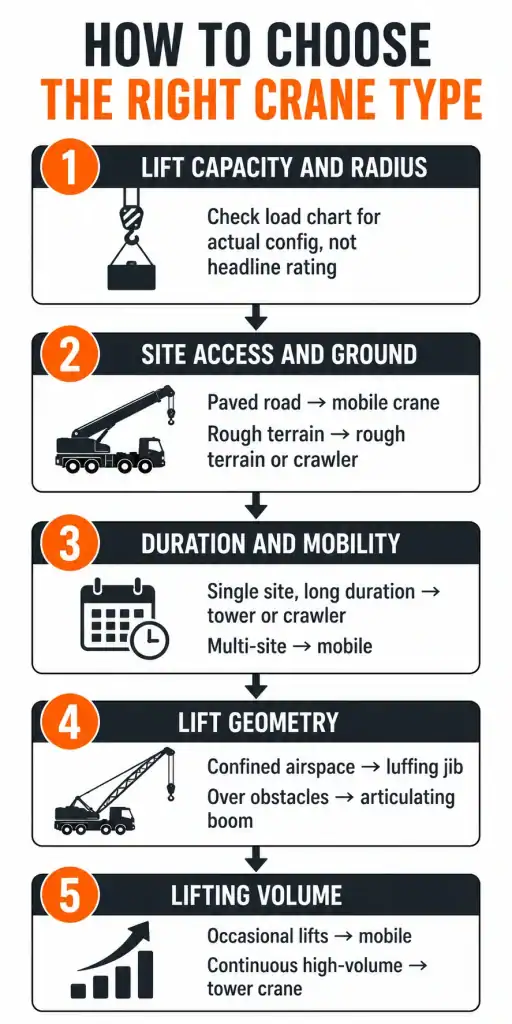
Selecting the correct crane for any lifting task requires matching the crane’s capability to the specific requirements of the lift:
- Lift capacity and radius
The load weight and the required operating radius, the horizontal distance from the crane’s centre to the load, determine the minimum crane capacity needed. Capacity must be confirmed from the load chart for the specific configuration, not from the crane’s headline rating.
- Site access and ground conditions
Can a road-going crane access the lift location, or do ground conditions require a crawler or rough terrain crane? Is the site accessible for crane transport vehicles, or does the crane’s self-propelled mobility determine the selection?
- Duration and mobility
Will the crane remain in one location for the project duration, favouring a tower crane or crawler, or must it move between multiple lift points across or between sites, favouring a mobile crane?
- Lift geometry and obstruction
Does the lift require working over or around existing structures, in confined airspace, or in locations where a standard horizontal jib would clash with adjacent buildings? Luffing jib and articulating boom configurations address these geometric constraints.
- Lifting programme volume
For a single or occasional lift, a mobile crane is almost always more economical than a fixed installation. For sustained high-volume lifting over the project duration, a tower crane’s continuous coverage and lower per-lift cost makes it more economical despite its higher mobilisation cost.
Understanding the full range of construction plant and how each type integrates into a coordinated site operation, including the interaction between cranes, excavators, loaders, and access equipment, is essential for effective project delivery. The selection and coordination of earthmoving plant alongside crane operations is one element of the broader construction site planning and heavy plant management framework that governs safe and productive site operations.
Safe Crane Operations
Every crane operation, regardless of crane type, requires a pre-lift plan, a competent and certified operator, a qualified lift supervisor, and a confirmed exclusion zone beneath and around the operating radius of the crane.
The pre-lift plan must specify the crane configuration, the load weight and dimensions, the lift radius at each stage of the operation, the ground bearing capacity at the crane and load positions, and the communication arrangements between the operator, the rigger, and any signaller involved in the lift. No crane lift should proceed without a completed and reviewed lift plan.
For complex lifts, tandem lifts using multiple cranes, lifts near existing structures or overhead services, lifts at the limits of the crane’s rated capacity, a formal engineered lift plan prepared by a competent lifting engineer is required. The standards and regulations governing crane safety, lift planning, and operator competency vary by jurisdiction but share the same fundamental requirements: competent people, correct equipment, thorough planning, and disciplined execution.
Also read : Heavy Equipment Safety: A Complete Site Guide
The Right Crane for Every Lift
No single crane type is the right choice for all applications. The tower crane’s continuous coverage is unmatched for high-rise building construction, but it cannot drive itself to a rural pipeline site. The crawler crane’s heavy lift capability is unmatched for petrochemical construction, but it cannot deploy without a transport fleet. The rough terrain crane goes where road-going cranes cannot, but its capacity ceiling is lower than an equivalent all-terrain model.
The correct crane is the one whose capacity, mobility, stability, and configuration most closely match the specific demands of the lift, confirmed by a load chart check for the actual operating configuration, not the headline rating.
RR Machinery provides a comprehensive range of construction and lifting equipment for sale and rental, including mobile cranes, rough terrain cranes, boom lifts, scissor lifts, and supporting plant, all maintained to full operational standard and supported by experienced lifting specialists. Explore our full range of crane and heavy lifting equipment solutions, or contact our team for practical advice on crane selection, lift planning, and a clear quotation matched to your project requirements and site conditions.